

An exchange-traded fund (ETF) is a pooled investment vehicle that holds a collection of underlying assets such as stocks, bonds, or commodities and trades publicly on global stock exchanges exactly like individual corporate shares. For long-horizon investors seeking low-friction diversification, understanding the precise structural mechanics of this asset class is the foundational first step to building a resilient, self-sustaining investment portfolio.
This comprehensive guide serves as the strategic root directory for our entire fund ecosystem, mapping the critical boundaries between structural fund wrappers, cost dynamics, and long-term passive ownership strategies.
Quick Takeaways
- An ETF is a legal wrapper designed to hold a basket of assets while offering continuous, intra-day trading liquidity on public securities markets.
- The legal vehicle itself is completely distinct from the underlying investment strategy; an ETF can house passive indexes, actively managed portfolios, or thematic assets.
- Long-term investment success depends on analyzing total cost of ownership across a decade rather than focusing solely on front-end marketing expense ratios.
- Diversification benefits must be weighed against localized tracking errors, asset size constraints, and specific regional regulatory guidelines.
What Is an ETF? The Fund Wrapper Explained
To grasp the true exchange-traded fund meaning, you must understand a fundamental industry truth: an ETF is not an investment strategy, but an institutional technology. It is a regulatory wrapper designed to pool capital from thousands of individuals to purchase a sprawling index or specific collection of securities. When you buy a single share of an ETF, you are acquiring a fractional interest in that collective, ring-fenced basket of underlying assets meaning those assets are legally separated from the fund manager's own finances and protected on your behalf.
The global investment industry frequently treats the terms "ETF" and "passive index fund" as completely interchangeable synonyms. This structural conflation is a costly mistake for long-horizon capital builders. The ETF is simply the structural container; what sits inside that container can range from a highly conservative, automated basket tracking the largest companies in the world to speculative, highly concentrated actively managed portfolios. As a long-term buy-and-hold investor, your primary operational goal is using this wrapper to capture broad market returns while systematically eliminating active human management risks.
Core Pillars of the ETF Landscape
The following structural sub-areas represent the complete architectural framework of our educational index. Each node defines a specific operational reality you must master to navigate long-term fund ownership successfully.
1. The Fund Mechanisms
The underlying engine of an exchange-traded vehicle relies on automated replication models designed to match the performance of a designated market sector without human bias. Understanding how a basic index fund pools assets is essential before evaluating live exchange trading, as the core principles of structural asset matching govern how efficiently a fund tracks reality. By shifting your approach toward systematic index investing, you effectively exit the dangerous game of single-stock speculation and anchor your capital to broad economic expansion.
2. Vehicle Structural Comparisons
Selecting the incorrect legal vehicle can expose your portfolio to drag from hidden structural fees, dividend inefficiencies, or structural liquidity cliffs. It is vital to separate the mechanics of an exchange-traded basket from a traditional, forward-priced mutual fund to preserve transaction efficiency over time. Evaluating the historical trade-offs of an ETF vs mutual fund highlights key operational boundaries regarding intra-day trading liquidity and capital gains distributions.
Furthermore, assessing a direct comparison of an ETF vs index fund reveals how different structural legal entities process identical index strategies. To complete this foundation, analyzing a traditional mutual fund vs index fund framework demonstrates why old institutional pooling methods are being rapidly replaced by high-efficiency, modern vehicles.
3. Core Income & Asset Varieties
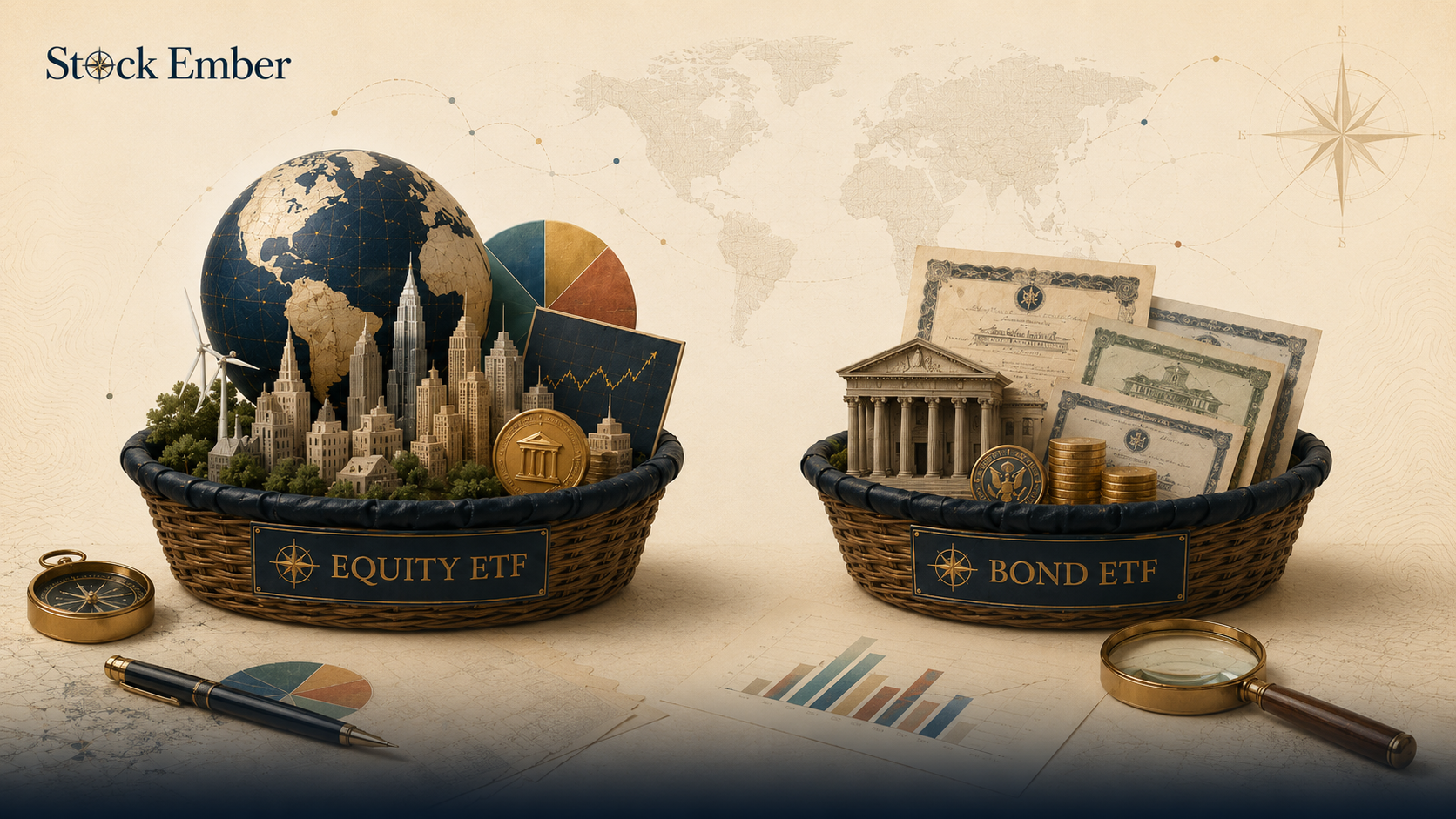
A properly allocated global portfolio requires structural balance across uncorrelated asset classes to survive multi-decade economic cycles. Integrating a dedicated bond ETF into your holding architecture provides a reliable, low-volatility fixed income buffer that offsets equity market drawdowns during structural contractions. For investors focused on building an independent stream of compounding liquidity, learning how to analyze a dividend ETF allows you to capture regular cash distributions without forced asset liquidation.
4. Technical Metrics & Selection Parameters
Evaluating the internal operational health of a fund wrapper requires looking past front-page marketing brochures and examining raw execution metrics. You must understand the role of Net Asset Value (NAV) in mutual fund structures to evaluate whether a vehicle's exchange trading price is drifting far from the actual value of its underlying holdings.
Measuring localized tracking error allows you to audit the fund manager’s structural precision and identify hidden performance leakage over time.
Additionally, checking total Assets Under Management (AUM) in ETF limits ensures you avoid thinly capitalized funds that suffer from wider buy-and-sell execution spreads on public exchanges. Finally, for international compliance safety, verify if a fund carries Undertakings for Collective Investment in Transferable Securities (UCITS) ETF classification, which confirms compliance with institutional diversification and structural investor protection standards under the EU's UCITS Directive (source: ESMA), applicable to investors outside the US framework.
The 10-Year Cost Reality of Fund Ownership
When evaluating fund costs, the financial media focuses almost entirely on the annual holding fee, known as the expense ratio. As a hypothetical example, a fund's 0.2% annual expense ratio looks trivial on paper. But compounded over a decade, the total drag on a $10,000 investment differs significantly across structures
| Fund Type | Annual Fee | 10-Year Cost (on $10,000) | Approx (Value Lost to Fees) |
|---|---|---|---|
| Passive ETF | 0.03–0.20% | ~$30–$200 | Minimal |
| Active Mutual Fund | 0.75–1.50% | ~$750–$1,500 | Significant |
| Thematic ETF | 0.40–0.95% | ~$400–$950 | Moderate |
Note: Illustrative estimates only. Assumes flat annual return of 7% pre-fee. Actual costs vary by provider and market conditions.
In practice, many long-term investors find that focusing solely on the stated expense ratio blinds them to additional structural friction: bid-ask spreads, portfolio rebalancing costs, and tracking error all of which compound silently over decades and can erode returns more than the headline fee suggests.
Navigating Your Long-Term ETF Journey
Successful long-term investing requires moving past simple asset definitions and building a systematic framework for long-horizon capital allocation. The journey of a patient investor transitions from understanding basic fund pooling logic to managing structural friction and optimizing localized tax structures.
As you advance through our educational index, you will learn to evaluate structural parameters objectively. Instead of chasing short-term market hype or thematic fund trends, a disciplined approach trains you to prioritize vehicle liquidity, low replication error, and institutional structural stability. This strategic patience can help your wealth-building engine remain structurally resilient during extended periods of global market volatility though no approach fully eliminates market risk.
Where to Start: A Roadmap for Beginners
If you are just beginning to build out your long-term capital framework, avoiding information overload is crucial. We suggest starting your path by exploring our foundational node on index investing to understand the core passive philosophy that anchors our media asset. From there, proceed directly to our comprehensive breakdown of an ETF vs mutual fund to master the core structural mechanics of public exchange trading.
Once those structural layout foundations are firmly locked into place, you can confidently advance to specialized topics, such as assessing global liquidity limits through AUM in ETF analysis or navigating cross-border regulatory protections.
The Bottom Line: What Is an ETF?
Exchange-traded funds offer one of the most accessible structural frameworks for building diversified, long-term wealth when deployed with strict cost discipline and a patient, buy-and-hold mindset. By shifting your focus away from speculative stock picking and systematically minimizing internal vehicle friction, you allow broad market compounding to do the heavy lifting for your portfolio across the next decade. When you are ready to transition from structural concepts to evaluating live investment options, exploring our curated ETF reviews is the natural next step to finding efficient, institutional-grade tools for your portfolio.