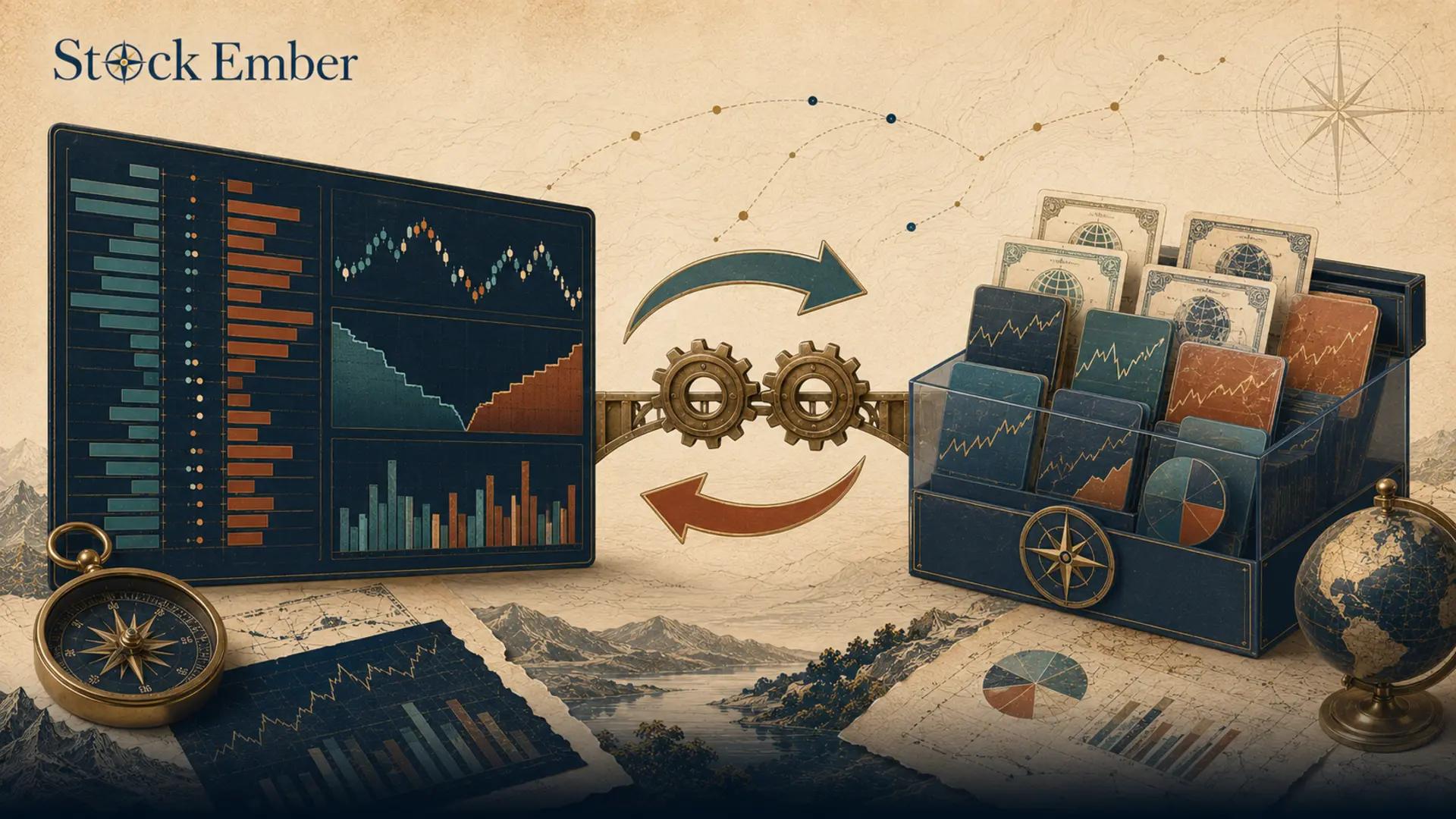
Index investing is a passive strategy that buys and holds a representative basket of assets matching a specific financial market benchmark. Instead of attempting to outperform the market through active stock picking, index investors accept broad market benchmark returns while significantly reducing annual management fees. Over long horizons, this low-cost approach minimizes fee drag and preserves portfolio compounding power.
Index investing is a passive strategy that tracks a market benchmark by holding a broad basket of securities rather than trying to pick individual winning stocks.
Instead of paying high fees to managers attempting to beat the market, index investors accept benchmark market returns at minimal cost. For long-term investors, this disciplined approach removes human bias, reduces trading expenses, and preserves compounding returns over decades. This guide explains how index tracking works, why costs matter over a 10-year horizon, and how to avoid common indexing pitfalls.
Quick Takeaways
01Index investing is a passive strategy designed to match the returns of a financial market benchmark rather than outperform it.
02Investors execute this strategy primarily using pooled funds, making what is index fund investing essentially the practical application of buying an entire market segment in a single asset.
03Lower management fees preserve significantly more compound growth over a 10-year holding period compared to active fund management.
04Market-capitalization weighting can create hidden concentration risk when a small group of large companies dominates benchmark value.
What Is Index Investing?
Index investing is an asset management approach aimed at replicating the price performance and dividend yield of a specific market benchmark.
Rather than paying fund managers to select individual equities, an index strategy buys all or a representative sample of the securities that make up a specific benchmark. When people ask what index fund investing is, they are looking at the practical way individuals implement this concept: purchasing shares of a mutual fund or exchange-traded fund (ETF) that automatically tracks an underlying index.
To understand the vehicle structure, it helps to learn what is an ETF, as exchange-traded funds are among the most flexible instruments used to build an indexed portfolio today.
In practice, many long-term investors find that switching from stock picking to indexing requires a major mental shift. Accepting market returns feels counterintuitive at first, but eliminating the daily stress of evaluating individual corporate earnings reports is often what allows investors to stay invested through volatile market cycles.
How Indexing Works: Market Weighting and Passive Tracking
Index investing operates by automatically mirroring the composition and rules of a target benchmark without discretionary trading.
Most broad equity indexes use market-capitalization weighting. In a market-cap-weighted index, larger companies make up a proportionally higher percentage of the fund's total value. As a company’s market value grows, its proportion in the index increases automatically.
Passive tracking relies on automated rules to adjust holdings:
Rebalancing: The fund buys or sells underlying shares periodically to match changes in the benchmark composition.
Low Turnover: Shares are traded only when the benchmark index changes its constituent companies, which minimizes transaction costs.
Tracking Error: This measures how closely a fund's performance matches its target benchmark. A well-managed index fund maintains a minimal tracking difference, with performance matching the index minus the fund's small annual operating fee.
Why Index Investing Beats Active Stock Picking Over 10 Years
Research consistently shows that the majority of actively managed funds fail to outperform their benchmark indexes over a 10-year period, primarily because of their higher underlying operating expenses.
Every fund charges an annual fee known as an expense ratio. Active funds require expensive research teams, analysts, and frequent portfolio trading, resulting in higher management fees. Index funds, by contrast, run on automated rules and carry minimal administrative costs.
When viewed through a 10-year total cost lens, seemingly small fee differences compound dramatically:
Fund Type
Annual Expense Ratio
Active Fund (illustrative)
0.75%
Index Fund (illustrative)
0.05%
Annual Fee Gap
0.70%
Holding a portfolio over 10 years with an extra 0.70% annual fee drag quietly consumes roughly 7% of your potential total accumulated wealth, depending on investment returns. That money goes directly to fund operations rather than remaining in your account to compound. Beyond low expense ratios, index funds generate fewer taxable events because they trade infrequently, keeping more capital working for you over long time horizons.
Concentration Risk and Market Volatility
Index funds experience the exact downswings of the broader market and can carry significant concentration risk during periods of mega-cap market dominance, when a small group of the largest companies by market value begins to drive the majority of index performance.
While indexing eliminates single-stock default risk through diversification, it does not protect against overall market volatility. When a broad index declines by 20%, an index fund tracking that benchmark will also decline by 20%.
Furthermore, market-cap-weighted indexes carry a structural concentration hazard. Because larger companies carry bigger weights, top holdings can begin to dominate a broad benchmark. During periods of strong mega-cap performance, market-cap-weighted indexes can become concentrated in a small number of companies, which may account for around 30% of the index, depending on the benchmark. If those companies or their sector suffer a downturn, your portfolio may experience higher volatility than expected from a "broadly diversified" fund.
Three Index Investing Mistakes to Avoid
Failing to stick to a long-term plan is the primary reason individual investors underperform the very benchmarks their index investing strategy is designed to track.
Attempting to Time the Market: Treating index funds like short-term trading assets destroys their core advantage. Buying and selling based on news headlines introduces trading costs and behavioral mistakes.
Over-Complicating the Portfolio: Holding 10 different specialized or sector-specific index funds often leads to unnecessary overlap and higher average fees.
Panic Selling During Downturns: Locking in paper losses (unrealized losses that exist on paper but have not yet been crystallized through selling) during a market decline prevents your portfolio from participating in the eventual recovery, undermining decades of compound growth.
Conclusion
Index investing offers a practical, low-cost path to long-term wealth accumulation by prioritizing broad market returns over active stock picking. By minimizing annual fee drag and maintaining strict discipline through market cycles, long-term investors preserve the full compounding power of their capital over a decade or more. When you are ready to evaluate specific funds that track these benchmarks, our ETF reviews provide a detailed look at fee structures, tracking accuracy, and underlying asset structures.
FAQ
5 questions
Is index investing safe for beginners?
Index investing is considered one of the safer approaches for stock market beginners because it provides instant diversification across hundreds of companies, reducing single-stock default risk. However, it is not risk-free. Your investment value will still fluctuate with overall market movements, meaning you can experience paper losses during broad economic downturns.
What is the main difference between an index fund and an ETF?
The primary difference lies in how they trade. Index mutual funds trade only once per day after market close at their net asset value (NAV). Index exchange-traded funds (ETFs) trade continuously throughout the trading day on stock exchanges like individual equities, offering real-time pricing and intraday trading flexibility. (50 words)
Can you lose money in an index fund?
Yes, you can lose money in an index fund because these funds mirror full market volatility. If the broader market benchmark falls, the value of your index fund drops by a corresponding amount. However, holding broad market index funds over long horizons historically allows portfolios to recover alongside long-term economic growth. (52 words)
How do index funds make money for investors?
Index funds generate returns for investors through capital appreciation and dividend distributions. As the underlying companies in the benchmark grow in value over time, the fund's share price increases. Additionally, cash dividends paid by constituent companies are collected by the fund and distributed to investors or automatically reinvested into more shares. (50 words)
What is the average long-term return of a broad market index fund?
The average return depends on the underlying market benchmark the fund tracks. Broad equity market benchmarks have historically delivered around 7% to 10% annualized returns before inflation over multi-decade holding periods, based on long-run historical return data published by NYU Stern School of Business and S&P Dow Jones Indices. However, past market performance never guarantees future returns, and short-term annual performance varies significantly.
Disclaimer
This guide was written with AI assistance and reviewed by the StockEmber editorial team for accuracy. StockEmber provides independent education, not personal financial advice. Some links may support our work at no additional cost to you.
The StockEmber Team is our in-house desk of independent research writers. We test brokerage platforms, read the fine print on fees and custody, and cover ETFs and long-horizon investing for people who plan to hold for decades — not days.