A UCITS ETF is an exchange-traded fund structured under European Union regulations, allowing cross-border distribution under a unified set of investor protection rules. It requires daily redemption liquidity, strict diversification limits, and third-party asset segregation to protect investor capital from fund management insolvency.
A UCITS ETF is an exchange-traded fund that complies with European Union regulatory standards, allowing fund managers to sell the product across multiple countries under a single set of investor protection rules.
When searching for funds to build a multi-decade portfolio, international investors often encounter ticker symbols carrying this designation. Understanding these rules helps you evaluate how your money is protected, how fund assets are held, and how European structures differ from US-domiciled options. This guide breaks down the core safety rules, tax considerations, and operational standards governing these products.
Quick Takeaways
01The framework establishes strict European regulatory standards for diversification, liquidity, and asset segregation.
02Third-party depositary banks keep fund holdings separate from the manager's balance sheet to protect investor capital from fund insolvency.
04For non-US investors, Irish-domiciled options offer tax advantages through reduced US dividend withholding rates.
05Regulatory compliance guarantees fund governance and operational rules, but it does not protect your portfolio from market price downturns.
What Is a UCITS ETF?
UCITS stands for Undertakings for Collective Investment in Transferable Securities, a European Union regulatory regime created in 1985 to standardize fund governance across borders. Before this framework existed, a fund manager had to register a product separately in every country where it was offered. The directive established a unified standard, allowing a fund registered in one EU member state to be distributed across all member countries—a concept known as regulatory passporting.
Today, this label extends far beyond Europe. Investors across Asia, Latin America, and the Middle East regularly use these funds to access global financial markets. When you buy ETFs carrying this designation, you are buying into a structure that meets defined standards for liquidity, financial disclosures, and asset custody.
How the Regulatory Framework Works: Liquidity and Protection
The core strength of the European fund framework lies in its structural safeguards designed to shield retail investors from operational failures.
First, rules require complete asset segregation through an independent custodian bank. The fund manager controls investment decisions, but a separate third-party depositary holds the fund's actual shares and cash. If the fund management company goes bankrupt, creditors cannot claim the underlying assets because those holdings remain safe at the independent custodian bank.
Second, the framework mandates frequent liquidity, meaning fund managers must offer daily redemption rights under normal market conditions. Investors can sell their shares back to the fund or on an exchange on any trading day.
Finally, managers must publish clear regulatory disclosures, including a detailed fund prospectus and a standardized Key Information Document (KID). These documents outline exact fund fees, investment objectives, and operational risks in plain language. The standards governing these products are maintained by European regulatory bodies, such as the European Securities and Markets Authority (ESMA).
Why These Rules Matter for Long-Term ETF Investors
For buy-and-hold investors compounding wealth over decades, European fund rules enforce disciplined portfolio construction behind the scenes.
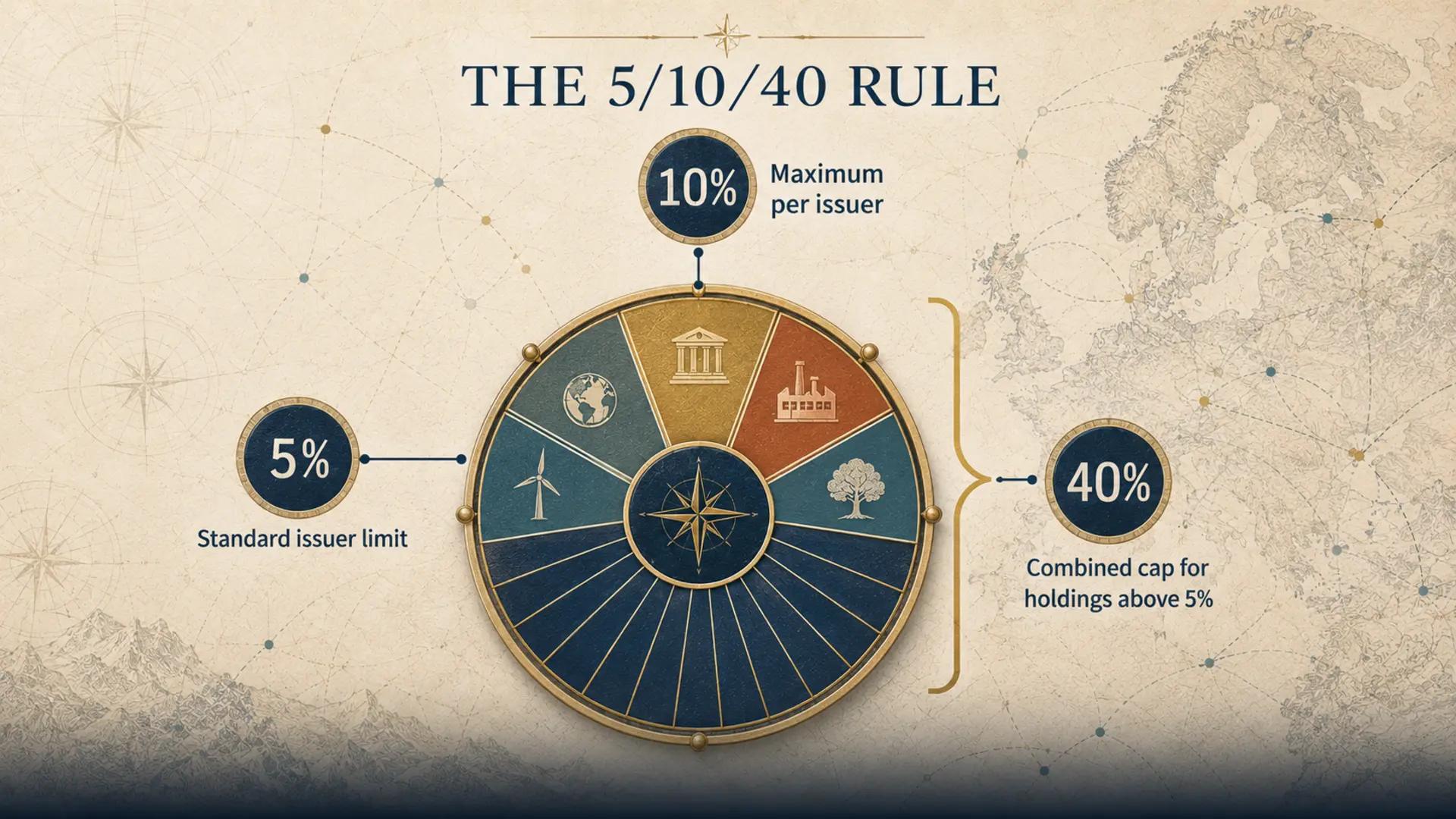
Diagram showing the European fund 5/10/40 portfolio diversification rule.
A core portfolio protection requirement is the 5/10/40 concentration rule. Under this mandate:
No single stock or issuer can make up more than 10% of the fund's total assets.
The total sum of all positions that individually exceed 5% of the fund cannot exceed 40% of the overall portfolio.
This rule prevents a fund manager from concentrating capital into a handful of individual companies, ensuring the fund maintains broad market coverage.
For synthetic funds that track indexes using derivatives rather than buying physical shares, regulations set a strict counterparty risk limit of 10%. The derivative provider must back the swap with collateral so that default exposure remains strictly capped.
UCITS vs US-Domiciled ETFs: Key Differences for Global Portfolios
International investors frequently compare European-domiciled UCITS products with US-domiciled options. While US funds often boast lower expense ratios and deep liquidity, European structures offer distinct tax advantages depending on your country of residence.
Feature
UCITS ETFs (European Domicile)
US-Domiciled ETFs
Primary Target Audience
European and Global Non-US Investors
US Tax Residents and US Domestic Investors
European Retail Access
Available via PRIIPs Key Information Document
Restricted for EU/UK retail investors without KID
US Dividend Withholding Tax
15% for Irish domicile via US-Ireland tax treaty
30% default rate for non-US residents without treaty
US Estate Tax Exposure
Protected (no US estate tax on non-US domiciles)
Exposed to US estate tax on US-situs holdings above the $60,000 exemption threshold set by the IRS for non-resident aliens
Under the US-Ireland Double Taxation Treaty, as administered by the US Internal Revenue Service (IRS), non-US investors holding an Irish-domiciled fund that owns US equities can reduce dividend withholding tax from the standard 30% rate to a treaty rate of 15%.
Over a 10-year holding period, saving 15% on dividend withholding taxes can add up to meaningful compound returns that easily offset a slightly higher expense ratio.
Common Misconceptions: What the Rules Do Not Protect Against
While European fund regulations guarantee structural oversight, it is important to understand what the framework does not cover.
First, regulatory approval does not eliminate market risk. If global stock prices fall by 30%, an index fund tracking those stocks will also fall by 30%. The framework protects against fraud, asset misallocation, and custodian failure—it does not insure your capital against market price drops.
Second, these rules do not eliminate tracking error or currency exposure. An ETF holding Japanese equities priced in yen will still fluctuate with foreign exchange movements when measured in your local currency. In addition, operational costs, index licensing fees, and rebalancing costs mean the fund will slightly lag its underlying index over time.
Conclusion
The UCITS framework offers international investors a strong, highly regulated environment with built-in asset segregation, strict diversification rules, and favorable tax treaties when domiciled in regions like Ireland. While it provides strong operational protections against custodian failure and excessive concentration, it remains an investment structure rather than a shield against market price movements. When you are ready to evaluate specific products, our ETF reviews provide clear breakdowns of cost, tracking error, and index construction. Investing always carries market risk, and past performance does not predict future results, so use these regulatory standards as a foundation for your own long-term research.
FAQ
5 questions
What does UCITS stand for in ETFs?
UCITS stands for Undertakings for Collective Investment in Transferable Securities. It is a European Union regulatory framework created to standardize retail fund rules, asset custody, and cross-border distribution across EU member states and global markets.
Does UCITS compliance guarantee my investment will not lose money?
No. UCITS compliance enforces strict operational rules, such as daily liquidity and asset segregation at an independent depositary bank. However, it does not protect your capital against stock market declines, foreign currency fluctuations, or broad economic downturns.
Can non-EU residents invest in UCITS ETFs?
Yes. Investors in Asia, Latin America, the Middle East, and the UK routinely purchase UCITS ETFs through international brokers. Many non-US investors choose Irish-domiciled UCITS funds to benefit from favorable tax treaties on US dividend distributions.
What is the main difference between physical and synthetic UCITS ETFs?
Physical UCITS ETFs purchase and hold the underlying shares directly. Synthetic UCITS ETFs use derivative swap contracts to match index performance. UCITS rules mandate that synthetic counterparty exposure cannot exceed 10% of the fund's total assets.
Why are US-domiciled ETFs restricted for European retail investors?
Under the EU's Packaged Retail and Insurance-based Investment Products (PRIIPs) regulations, fund managers must provide a Key Information Document (KID) before selling to retail investors. Because most US-domiciled ETFs do not issue a KID, European brokers generally restrict retail clients to purchasing UCITS-compliant alternatives.
Disclaimer
This guide was written with AI assistance and reviewed by the StockEmber editorial team for accuracy. StockEmber provides independent education, not personal financial advice. Some links may support our work at no additional cost to you.
The StockEmber Team is our in-house desk of independent research writers. We test brokerage platforms, read the fine print on fees and custody, and cover ETFs and long-horizon investing for people who plan to hold for decades — not days.