A global equity index fund is a passive investment vehicle that tracks a broad index of stocks across multiple countries in proportion to their market capitalization. It offers long-term investors instant global diversification, spreading capital across thousands of companies through a single trade.
this fund type is a single pooled investment that tracks a benchmark of publicly traded stocks across multiple countries. It gives long-term investors instant exposure to worldwide share markets through one transaction.
Trying to pick individual winning stocks across dozens of foreign exchanges can quickly become complex and costly. Holding a single fund that captures global market growth helps remove the guesswork from building an international portfolio. This guide covers how these index funds work, how major benchmarks differ, and key risks like market concentration to watch for over a ten-year horizon.
Quick Takeaways
01A broad global stock fund buys thousands of companies across multiple countries to match a worldwide benchmark.
02Not all global indices are the same; "world" benchmarks often focus only on developed markets, while "all-country" benchmarks include emerging economies.
03Over a ten-year holding period, subtle expenses like foreign exchange drag and tracking error matter just as much as stated fund fee ratios.
What Is a Global Equity Index Fund?
This type of index fund is a passive vehicle that holds stocks across global markets in proportion to their total market value. Instead of relying on a fund manager to pick winning companies, the fund uses passive management to track a global stock index. It automatically adjusts its holdings whenever companies grow, shrink, or rebalance within the index.
When you buy shares in ETFs or index mutual funds covering worldwide markets, your money is spread across thousands of individual businesses. You gain proportional ownership in companies across North America, Europe, Asia, and beyond. This approach eliminates the need to open multiple foreign brokerage accounts or manage local currencies yourself.
Index Methodology: MSCI World vs. MSCI ACWI vs. FTSE All-World
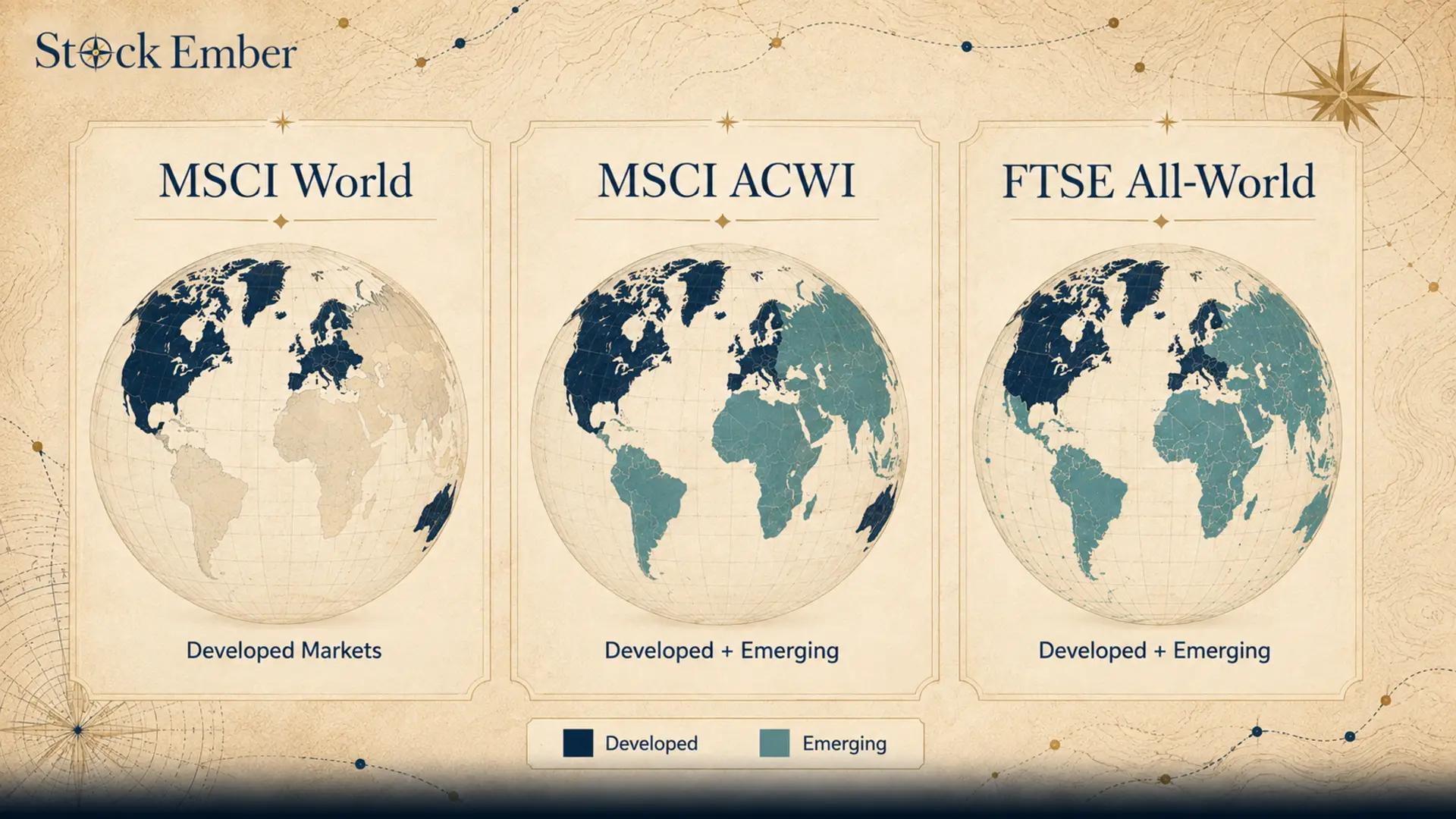
Global equity indices differ primarily by whether they include emerging market economies alongside developed nations. Investors often assume the term "global" implies complete coverage of every stock exchange on earth. However, index providers use distinct methodologies:
Diagram comparing regional stock coverage between developed and emerging market global indices.
MSCI World Index: Despite its broad name, this index tracks roughly 1,400+ large and mid-cap companies across 23 developed markets only. It contains zero exposure to fast-growing emerging markets like Brazil, India, or Taiwan.
MSCI All Country World Index (ACWI): This benchmark covers both developed markets and emerging markets, holding approximately 2,800+ stocks across 47 countries.
FTSE All-World Index: Similar to MSCI ACWI, this FTSE benchmark provides broad coverage by tracking around 4,000+ companies across developed and emerging economies.
Choosing between these benchmarks depends on whether you want your core allocation restricted to established industrial nations or expanded to include emerging economic growth.
The US Concentration Illusion & Currency Risk
Market-capitalization weighting concentrates a large portion of a worldwide stock fund into the largest stock market in the world, which is currently the United States. Most global index funds use market-cap weighting, meaning a company's representation in the fund is proportional to its total market valuation. Because American corporations have grown to dominate global stock market capitalization over recent decades, "world" funds are far less regionally balanced than many investors expect.
Currently, according to MSCI index data, US equities make up roughly 60% to 70% of major global equity index funds. While this gives you exposure to leading international technology and consumer leaders, it also means your portfolio's performance remains tightly bound to the US economy.
Holding foreign assets also introduces currency risk (the chance that exchange rate swings impact fund returns). If your local currency strengthens against the US Dollar or Euro, your international investment gains may shrink when converted back home—even if the underlying stock prices remain steady.
The 10-Year Total Cost Lens: OCF, Tracking Error, and Drag
The true cost of owning a broad global fund includes stated annual management fees alongside implicit costs like tracking error and dividend withholding tax drag. When evaluating costs, many investors focus solely on the ongoing charges figure (OCF) or expense ratio. However, looking at total cost of ownership over a ten-year holding period reveals how secondary drags eat into compounding returns.
Consider a hypothetical $100,000 investment held over ten years with an assumed 7% annual gross return:
Stated Fee Drag: An OCF of 0.15% per year reduces your nominal return to 6.85%, costing roughly $2,800 in total direct fees over a decade.
Tracking Error & Tax Drag: Unhedged foreign currency conversion costs and non-recoverable dividend withholding taxes can add an extra 0.10% to 0.20% in annual drag. Over ten years, an additional 0.15% hidden drag reduces your final portfolio value by approximately $3,100 more.
Small fractions of a percent seem minor in year one, but across a ten-year horizon, total fee drag can quietly remove thousands of dollars from your portfolio wealth.
Aligning Global Equities with ESG Filters
Investors can maintain broad international equity exposure while filtering out specific industries using screened environmental, social, and governance indices. If you prefer not to own shares in fossil fuels, weapons manufacturing, or tobacco companies, you do not have to abandon broad indexing. Many index providers offer screened versions of their primary global benchmarks.
By integrating socially responsible investing strategies into global equity index funds, managers exclude non-compliant companies while preserving broad geographic diversification. These funds tilt toward businesses with higher sustainability ratings, though they may carry slightly higher expense ratios or tracking differences compared to standard market-cap benchmarks.
3 Pitfalls to Avoid in Global Indexing
Common mistakes in global indexing stem from portfolio redundancies, geographic biases, and misunderstandings about fund coverage.
Stacking Regional Funds on Top: Buying an S&P 500 index fund alongside a worldwide index fund creates heavy US stock duplication, since the global fund is already 60%+ invested in American companies.
Home Bias Overload: Over-allocating to your local stock market out of familiarity can undermine the global risk-spreading benefits of your primary index fund.
Confusing Developed with Total-World: Purchasing an MSCI World fund believing it covers the entire globe leaves your portfolio with zero exposure to emerging markets.
Conclusion
A worldwide index product serves as an efficient, low-maintenance cornerstone for long-term equity growth. By capturing global stock market expansion across thousands of companies, a single index fund provides instant diversification and helps reduce individual stock risk. Understanding index differences, keeping a close eye on ten-year total costs, and managing US market concentration will help you build a durable buy-and-hold portfolio.
When you are ready to evaluate individual funds and select a provider, our ETF reviews are the place to start. Investing always puts your capital at risk and past performance does not guarantee future results, so use this guide as an educational foundation for your own research.
FAQ
4 questions
What is the difference between a global equity fund and an international fund?
A global equity fund holds stocks worldwide, including the investor's domestic market (such as the United States). An international fund specifically excludes domestic companies and invests exclusively in foreign markets.
Does a global equity index fund include emerging markets?
It depends on the benchmark. Developed-market indices like the MSCI World Index exclude emerging markets entirely, whereas all-country benchmarks like the MSCI ACWI and FTSE All-World include emerging market equities.
How much of a global equity index fund is invested in the US?
Because most worldwide index products use market-capitalization weighting, US equities—according to MSCI's index factsheets—typically make up roughly 60% to 70% of total fund holdings in market-cap-weighted global benchmarks.
What hidden costs affect a global equity index fund?
In addition to the annual ongoing charges figure (OCF), global index funds can experience tracking error, foreign exchange conversion fees, and unrecoverable dividend withholding tax drag across foreign jurisdictions.
Disclaimer
This guide was written with AI assistance and reviewed by the StockEmber editorial team for accuracy. StockEmber provides independent education, not personal financial advice. Some links may support our work at no additional cost to you.
The StockEmber Team is our in-house desk of independent research writers. We test brokerage platforms, read the fine print on fees and custody, and cover ETFs and long-horizon investing for people who plan to hold for decades — not days.