A UCITS ETF is a European Union-regulated exchange-traded fund designed with strict retail investor protections, including independent asset custody, regular dealing and redemption rights, and strict concentration limits. Non-U.S. investors frequently use Irish-domiciled UCITS ETFs to reduce U.S. dividend withholding taxes from 30% to 15% and avoid exposure to U.S. federal estate tax.
A UCITS ETF is an exchange-traded fund that complies with European Union regulatory standards designed to protect retail investors through strict diversification mandates, independent asset custody, and guaranteed daily liquidity.
For long-term investors outside the United States, understanding this structure is essential to building a low-cost, tax-efficient portfolio. Choosing the right fund domicile can save you tens of thousands of dollars in withholding and estate taxes over a decade of compounding. This guide breaks down how UCITS protections work, why fund location matters, and the key tax rules to keep in mind.
The sections below answer what is a UCITS ETF in practical terms: how the structure protects your capital, how it changes your tax bill, and where the traps are.
Quick Takeaways
01UCITS is a regulatory quality stamp, not an asset class, created by the EU to enforce strict investor safety standards across international borders.
02Your capital is ring-fenced at an independent depositary bank, keeping your assets separate from the fund manager's or broker's balance sheet.
03Irish-domiciled UCITS ETFs slash U.S. dividend withholding tax from 30% to 15% and protect non-U.S. residents from the 40% U.S. estate tax trap.
04Accumulating share classes automatically reinvest dividends inside the fund, driving seamless multi-year compounding without generating taxable distribution events in many jurisdictions.
What Is a UCITS ETF? Breaking Down the Name
UCITS stands for Undertakings for Collective Investment in Transferable Securities, a regulatory framework established by the European Union to create a standardized, cross-border quality benchmark for investment funds. Rather than describing a specific investment strategy, the UCITS label indicates that a fund complies with a common set of investor protection and operational standards.
When you buy a fund labeled UCITS, you are not buying a specific strategy or index. Instead, you are buying a fund that operates under a rigorous European legal framework. A UCITS ETF can track global equities, corporate bonds, or broad market indexes, while the UCITS designation governs how the fund is structured and managed rather than what it invests in.
Although created for European Union markets, the UCITS framework has become a global standard. Asset managers register these funds in tax-efficient European jurisdictions - most notably Ireland and Luxembourg - and distribute them to retail and institutional investors across Europe, Asia, Latin America, and the Middle East.
It is also important to distinguish UCITS funds from standard U.S.-domiciled funds. While a conventional U.S. fund operates under the rules of the Securities and Exchange Commission (SEC), a UCITS fund operates under European directives. For anyone learning what is an etf, understanding how the regulatory framework differs from the investment vehicle itself is an important early step.
The Core Investor Protections: How UCITS Ring-Fences Your Capital
UCITS regulations protect investor capital through legal asset segregation, strict diversification caps, mandatory daily redemptions, and standardized fee disclosures.
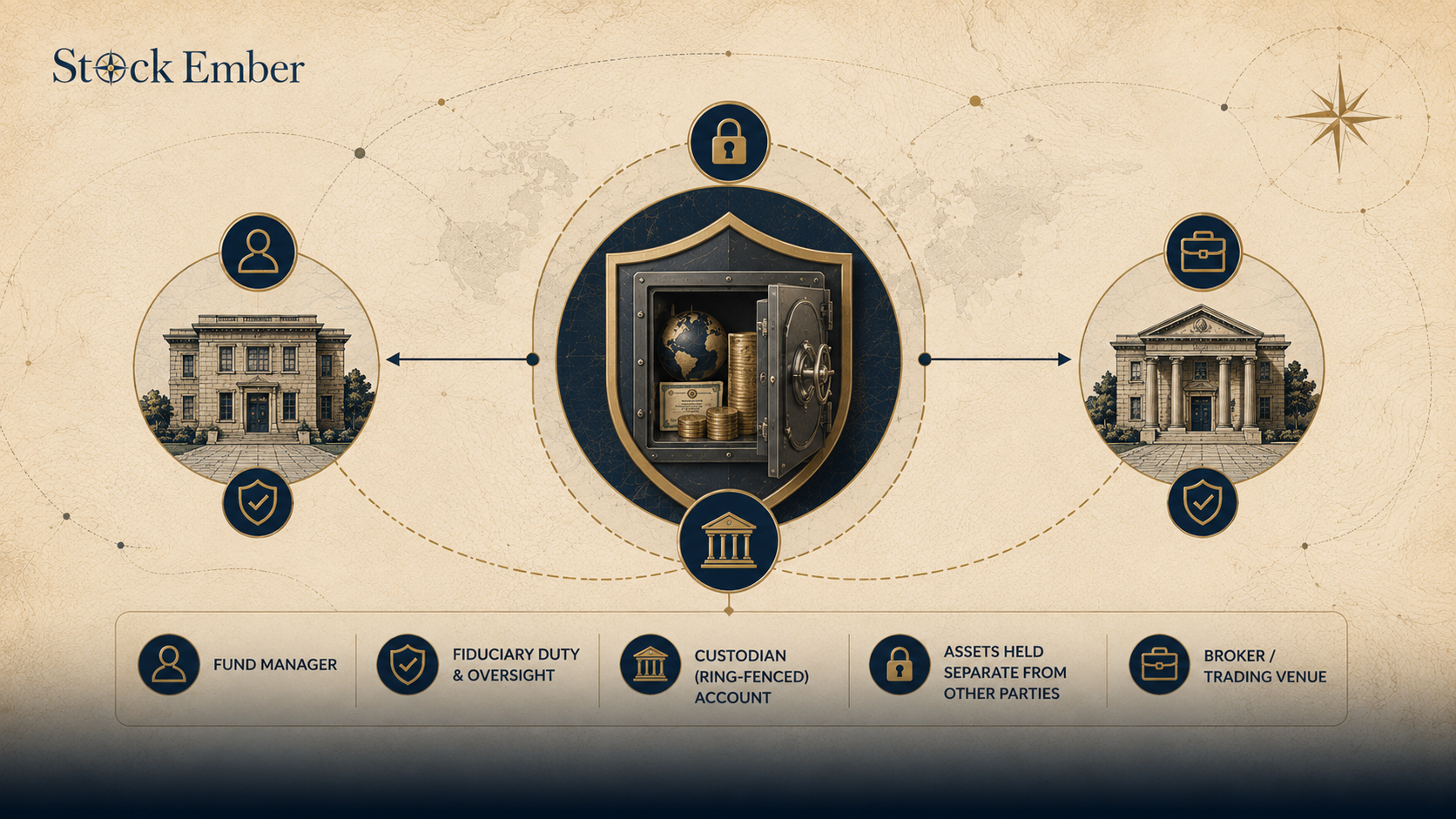
Diagram showing ring-fenced asset segregation under UCITS regulations
The legal backbone of UCITS rests on four mandatory guardrails:
Independent Asset Custody (Ring-Fencing): A UCITS ETF must appoint an independent depositary bank to hold all fund assets. The fund manager controls the investment strategy, but they never hold your money. If the ETF manager or your retail broker goes bankrupt, creditors cannot touch the fund’s underlying securities.
The 5/10/40 Diversification Rule: To reduce concentration risk, the UCITS diversification rules set out in Directive 2009/65/EC, Article 52 provide that a UCITS fund may not invest more than 10% of its assets in transferable securities issued by any single body, while the combined value of holdings exceeding 5% in individual issuers may not exceed 40% of the fund's total assets.
Regular Dealing and Redemption Rights: UCITS rules require funds to allow redemption at least twice a month, and in practice most UCITS ETFs deal daily and can also be bought or sold on exchange during trading hours, subject to available market liquidity.
Standardized Transparency (KID / KIID): Fund providers must publish a standardized Key Information Document outlining historical tracking performance, risk metrics, and the Total Expense Ratio (TER).
In practice, many long-term investors discover the structural impact of a fund domicile only after accumulating a substantial portfolio, making early regulatory choices far more consequential over a decade than minor expense ratio differences. Understanding what is a UCITS ETF begins with recognizing how these investor protections work together to reduce structural risk over the long term.
Tax Advantages: Why International Investors Choose Irish-Domiciled UCITS ETFs
International investors outside the United States frequently choose Irish-domiciled UCITS ETFs because the fund-level treaty rate can reduce U.S. dividend withholding tax, and because shares in an Irish-domiciled fund are generally not treated as U.S.-situs assets for U.S. federal estate tax purposes, though individual outcomes depend on your country of residence and personal tax circumstances.
If you live outside the U.S. and buy a U.S.-domiciled ETF (such as SPY or VOO) directly, U.S. tax authorities automatically withhold 30% of all dividend distributions at source. A bilateral tax treaty between the United States and your country of residence may lower that rate.
There is a second, less visible exposure. Holding more than $60,000 in direct U.S.-situs assets exposes foreign investors to U.S. federal estate tax rates of up to 40% upon death.
Irish-domiciled UCITS ETFs solve both problems simultaneously through structural tax efficiency:
Tax Feature
U.S.-Domiciled ETF (Held by Non-U.S. Resident)
Irish-Domiciled UCITS ETF
U.S. Dividend Withholding Tax
30% default rate (unless treaty reduced)
15% at fund level under the U.S.–Ireland income tax treaty
U.S. Estate Tax Exposure
Up to 40% on holdings above $60,000
Generally outside the scope of U.S. estate tax (fund shares are typically treated as non-U.S.-situs assets); confirm with a tax adviser in your jurisdiction
Dividend Reinvestment
Cash payout (taxable distribution event)
Accumulating (Acc) option reinvests automatically
The 10-Year Compounding Math
Consider a non-U.S. investor holding a $100,000 portfolio in a U.S. index fund yielding a 2% annual dividend.
For illustration only: assuming a constant 2% dividend yield on a $100,000 portfolio, no change in portfolio value, and no treaty relief in the investor's own country of residence, a 30% withholding rate would cost roughly $600 per year, or about $6,000 over ten years before accounting for lost compounding. Actual outcomes vary with market returns, yield changes, and the tax treaty between the United States and your country of residence.
By contrast, an Irish-domiciled UCITS ETF utilizes the U.S.–Ireland tax treaty to reduce dividend withholding to 15%, keeping an extra $300 per year compounding inside your portfolio. Over a decade, that small structural shift preserves thousands of dollars in investment capital.
Accumulating vs. Distributing Share Classes
UCITS ETFs offer two distinct structural methods for handling income:
Accumulating (Acc): The fund automatically reinvests dividends back into the underlying portfolio without paying out cash. This accelerates long-run compounding and avoids triggering taxable dividend events in jurisdictions that tax income distributions upon receipt.
Distributing (Dist): The fund pays periodic cash dividends directly into your brokerage account, ideal for investors seeking passive income streams.
Common Pitfalls: What to Watch Out for Before Buying
While UCITS ETFs offer robust structural and tax benefits, investors must navigate specific tax traps, vehicle limitations, and foreign exchange costs before investing.
1. The U.S. Citizen / Green Card Tax Trap
If you are a U.S. citizen or green card holder living abroad, UCITS ETFs are generally unsuitable. The Internal Revenue Service (IRS) classifies most foreign-domiciled funds as Passive Foreign Investment Companies (PFICs), meaning that holding a UCITS fund as a U.S. tax resident can trigger punitive tax rates and complex annual reporting requirements (Form 8621). U.S. taxpayers should consult a qualified cross-border tax adviser before investing in any non-U.S. fund.
2. Confusing ETFs with ETCs and ETNs
Not all exchange-traded products traded in Europe are UCITS funds. Exchange Traded Commodities (ETCs) and Exchange Traded Notes (ETNs) are structured as debt instruments, not funds, which changes the protections you receive:
Feature
UCITS ETF
ETC
ETN
Legal structure
Investment fund
Debt instrument (often asset-backed)
Unsecured debt instrument
Independent asset custody
Yes
Varies by issuer
No
5/10/40 diversification rule
Yes
No
No
Issuer credit risk
No direct exposure
Partial, depending on collateral
Full exposure to issuer default
Typical use case
Broad equity and bond indexes
Single commodities (e.g., gold, oil)
Niche, leveraged, or synthetic strategies
3. Currency Conversion Drag
UCITS ETFs often trade in multiple currencies on different exchanges. Pay close attention to three distinct currency metrics:
Base Currency: The currency in which the fund manages its portfolio (e.g., USD).
Trading Currency: The currency you use to buy shares on your local exchange (e.g., EUR or GBP).
Underlying Asset Currency: The denomination of the actual holdings inside the fund.
Trading a USD-base fund in your local currency avoids manual exchange steps, but ensures your broker does not charge hidden FX conversion spreads on the execution.
4. Risks You Still Carry
UCITS status is a regulatory standard, not a shield against loss. A UCITS ETF can still fall in value with the market, may trade at a premium or discount to net asset value, can deviate from its index (tracking error), may be thinly traded on some exchanges, and if it is a synthetic (swap-based) fund it carries counterparty exposure to the swap provider. Currency movements between the fund's base currency and your own can add or subtract from returns independently of index performance. Ultimately, understanding what is a UCITS ETF means recognizing both the protections the framework provides and the investment risks that remain.
Conclusion
For investors asking what is a UCITS ETF, the simplest answer is that it is a European-regulated fund wrapper that provides international investors with a highly regulated, tax-efficient framework for building wealth over a 10-year horizon. By enforcing strict asset segregation, mandatory daily liquidity, and fund-level tax optimization, the UCITS framework removes structural headwinds so your money can compound unimpeded.
When you align strict regulatory protections with a disciplined strategy like index investing, you eliminate avoidable fees and tax leakage from your wealth-building plan. When you are ready to evaluate specific funds and compare low-cost trading platforms, our comprehensive ETF reviews provide the detailed breakdowns you need to make an informed choice, and where a commercial relationship exists, we disclose it on the review page itself.
Information Current (July 2026): Tax rates, treaty rates, and regulatory thresholds cited in this guide are current as of July 2026 and are subject to change. Verify the latest figures with the relevant tax authority before making any investment decision.
FAQ
5 questions
What does UCITS stand for in simple terms?
UCITS stands for Undertakings for Collective Investment in Transferable Securities. In simple terms, it is a legal regulatory framework created by the European Union to ensure investment funds meet strict diversification, asset custody, and liquidity standards for retail investors worldwide.
Why can't non-U.S. investors or European residents buy U.S.-domiciled ETFs directly?
European Union and UK regulatory rules under the Packaged Retail and Insurance-based Investment Products (PRIIPs) Regulation require fund providers to supply a standardized Key Information Document (KID), which standard U.S.-domiciled ETFs do not issue. Furthermore, non-U.S. residents buying U.S.-domiciled ETFs directly risk facing up to 40% U.S. federal estate tax on holdings exceeding $60,000.
What is the difference between an accumulating and distributing UCITS ETF?
An accumulating UCITS ETF automatically reinvests cash dividends back into the fund's underlying assets, driving continuous long-term compound growth. A distributing UCITS ETF pays out cash dividends directly to your brokerage account on a quarterly or annual schedule.
Are UCITS ETFs safer than regular ETFs?
UCITS ETFs provide greater structural safety through mandatory independent asset segregation, preventing fund manager insolvency from affecting investor capital. However, UCITS regulatory status does not protect investors from broad stock market downturns or price volatility.
How do I know if an ETF is UCITS compliant?
UCITS compliance is clearly stated in the ETF's official name, prospectus, and Key Information Document (KID). Most UCITS ETFs are domiciled in Ireland or Luxembourg and feature "UCITS" directly within their ticker title or fund name on European and international exchanges.
Disclaimer
This guide was written with AI assistance and reviewed by the StockEmber editorial team for accuracy. StockEmber provides independent education, not personal financial advice. Some links may support our work at no additional cost to you.
The StockEmber Team is our in-house desk of independent research writers. We test brokerage platforms, read the fine print on fees and custody, and cover ETFs and long-horizon investing for people who plan to hold for decades — not days.