An index fund is a passive investment vehicle that holds a basket of stocks or bonds designed to match the performance of a specific financial market benchmark, such as the S&P 500. By following rules-based tracking rather than relying on active stock picking, index funds offer broad market diversification and minimal annual management fees.
An index fund is a pooled investment vehicle designed to track the performance of a specific financial market benchmark, such as the S&P 500, by automatically holding all or a representative sample of its underlying assets.
Picking individual stocks requires constant research and often leads to underperformance over time. Index funds remove the guesswork by letting you buy a piece of the entire market in a single transaction. This guide explains how an index fund works, why low management fees compound into higher long-term returns, and how to evaluate passive funds for your portfolio.
Quick Takeaways
01An index fund automatically tracks a rules-based market benchmark rather than relying on active stock pickers.
02Index funds exist as either index mutual funds or exchange-traded funds (ETFs).
03Broad-market diversification eliminates single-company default risk across your investment portfolio.
04Ultra-low management costs preserve significantly more compound growth over a 10-year holding period.
05Index funds carry full market risk and will decline in value during broad economic downturns.
What Is an Index Fund and How Does It Work?
An index fund works by using a rules-based, passive strategy to purchase the exact shares or a representative sample that make up a target market index.
When you ask what an index fund is in practice, it helps to distinguish the fund from the index it follows. An index (like the S&P 500 or the Nasdaq-100) is simply a mathematical list of securities used to measure a section of the market. An index fund is the actual investment product that buys shares in those companies to match the index's return as closely as possible.
Because the manager of an index fund does not analyze individual corporate earnings or try to predict market movements, the fund operates on autopilot. If a stock is added to the benchmark index, the fund buys it; if a stock is removed, the fund sells it.
Most index funds weigh their holdings by market capitalization. This means larger companies make up a bigger percentage of the fund's total assets. When companies inside the fund pay cash dividends, the fund manager collects those payments and either distributes them to you as cash or automatically reinvests them into additional fund shares.
In practice, long-term investors who switch from picking individual stocks to holding a broad index fund often experience immediate psychological relief, removing daily price monitoring that consistently prevents emotional, panic-driven trading decisions during market volatility.
Index Funds, Mutual Funds, and ETFs: Clearing the Confusion
The phrase "index fund" describes an investment strategy, whereas "mutual fund" and "exchange-traded fund" (ETF) describe the legal structures used to deliver that strategy.
Understanding this distinction resolves much of the confusion surrounding passive investing. You can buy an index strategy in two different wrapper types:
Index Mutual Funds: Priced once per day after market close. Orders are executed directly through the fund provider or broker at the net asset value (NAV).
Index ETFs: Traded continuously on public stock exchanges throughout the trading day at live market prices.
Costs the price of a single share (or fractional share)
Tax Efficiency
Moderate (may pass on capital gains distributions)
High (in-kind creation/redemption reduces tax drag)
Automatic Investing
Easy to set up automated recurring cash amounts
Depends on broker support for fractional shares
Why Index Funds Drive Long-Term Wealth
Index funds generate wealth over long horizons because they capture the continuous compound growth of whole economic sectors while charging almost nothing to do so.
When you purchase a single broad-market index fund, you instantly gain exposure to hundreds or thousands of individual corporations. This broad diversification eliminates single-stock risk. If one company in the index suffers financial distress or goes bankrupt, its decline is offset by the growth of hundreds of healthier competitors.
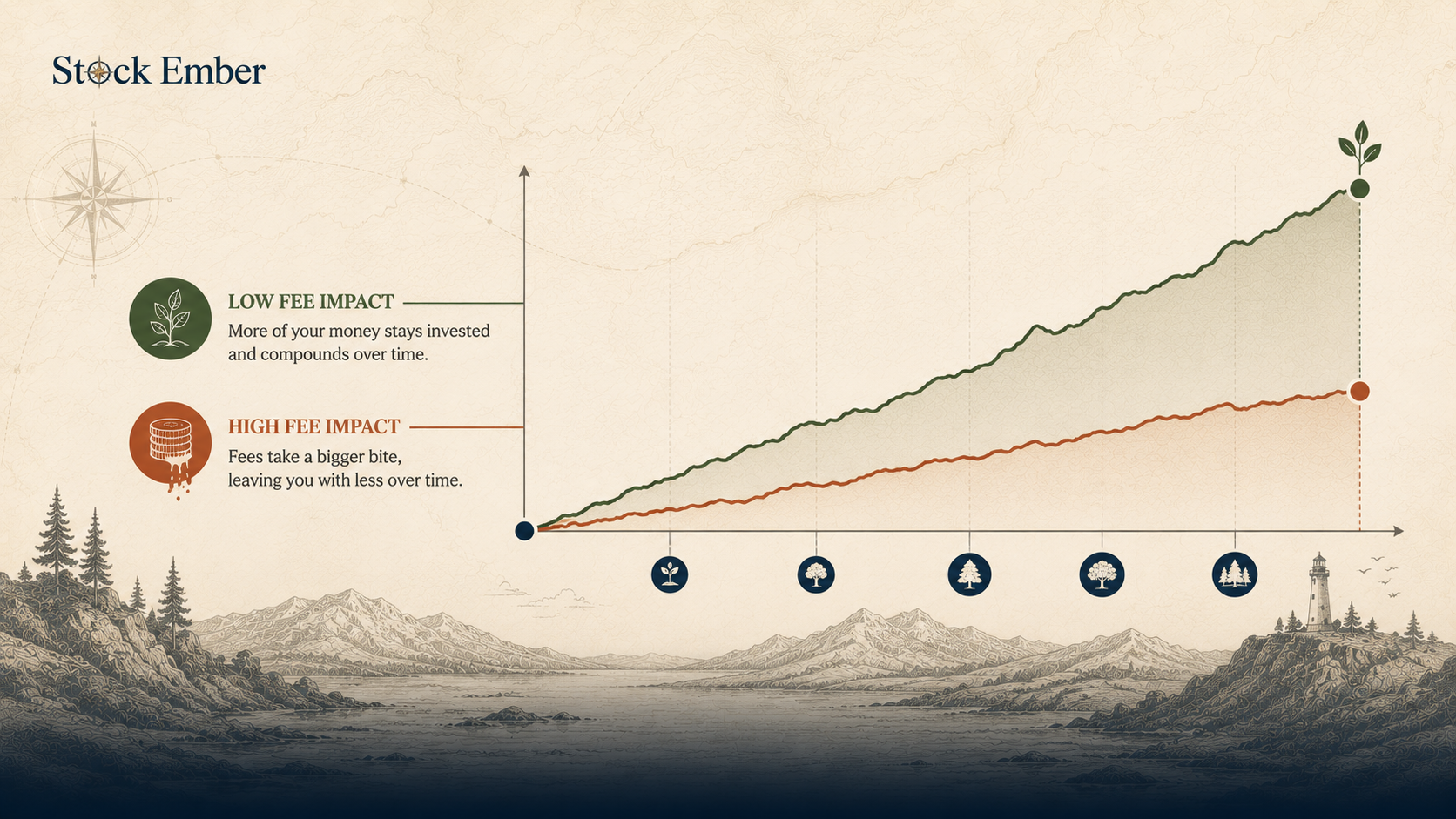
Diagram comparing 10-year compound returns between low-cost index funds and high-cost active funds
Furthermore, passive tracking removes human management errors. Historically, active fund managers who attempt to beat the market regularly fail over extended periods. According to the S&P Indices Versus Active (SPIVA) U.S. Scorecard (Year-End 2024), approximately 85% to 90% of actively managed U.S. large-cap equity funds underperformed their benchmark over a 15-year period. By opting to track the market rather than beat it, you align your capital with the winning side of long-term historical average, though past patterns do not guarantee future outcomes.
The 10-Year Cost Advantage: Fee Drag Math
Management fees expressed as annual expense ratios act as a permanent drag on portfolio growth, compounding against your terminal wealth every single year.
Because index funds require no team of analysts or active trading desks, their administrative overhead is minimal. These savings are passed directly to you through low expense ratios.
Consider an illustrative $10,000 investment held over a 10-year period, assuming a hypothetical 7% average annual market return:
Low-Cost Index Fund (0.05% Expense Ratio): Your net annual return is 6.95%. After 10 years, your $10,000 investment grows to approximately $19,580, costing you roughly $90 in total management fees over the decade.
Actively Managed Fund (0.80% Expense Ratio): Your net annual return falls to 6.20%. Based on typical active equity fund fees, after 10 years, your portfolio grows to approximately $18,250.
The seemingly minor 0.75% difference in management fees silently erodes over $1,330 of your wealth. Over 20 or 30 years, that fee gap can easily consume tens of thousands of dollars in compound returns.
What Index Funds Cannot Do: Inherent Market Risks
An index fund cannot protect your portfolio from overall market downturns because it is designed to mirror its benchmark in both bull and bear markets.
Passive management is a double-edged sword. When the broader market rises, your index fund rises with it. However, if an economic crisis causes the S&P 500 to drop 30%, an S&P 500 index fund will also drop 30%. The fund manager will not move assets into cash or sell off declining holdings to limit your losses.
Investors also frequently ask if you can lose all your money in an index fund. While asset prices fluctuate daily, losing 100% of your capital in a broad-market index fund would require every company within that index to go bankrupt simultaneously, an event that would signal a complete collapse of the global financial system.
Lastly, investors should watch for tracking errors. Tracking error is the minor discrepancy between the performance of the underlying index and the net performance of the fund itself, usually caused by management expenses, cash drag, and execution costs.
Common Index Fund Mistakes to Avoid
Failing to review underlying holdings and reacting emotionally to short-term market drops are two primary errors that destroy passive investment returns.
Creating Unintended Portfolio Overlap: Buying multiple index funds does not automatically increase your diversification. For example, owning an S&P 500 index fund alongside a US Large-Cap Growth index fund often results in holding double exposure to the exact same mega-cap technology stocks.
Attempting to Time the Market: Index funds are built for buy-and-hold strategies. Trying to trade passive funds short-term based on news headlines frequently leads to selling low during panics and buying high during market peaks.
Ignoring Asset Class Balance: Equities provide long-term growth, but they carry volatility. Depending on your time horizon, holding only equity index funds without considering fixed income or cash reserves can expose you to more market fluctuations than your risk tolerance can comfortably handle.
Conclusion
Index funds offer long-term investors a straightforward, low-cost way to capture broad economic growth without the stress or expense of stock picking. By minimizing management fees and holding diversified baskets of quality assets, you keep more of your compound returns working for your future over decades. Success with passive investing requires choosing broad benchmarks, avoiding unnecessary overlap, and committing to a disciplined buy-and-hold approach. When you are ready to evaluate specific funds to build your portfolio, our ETF reviews are the ideal next step.
FAQ
5 questions
Do index funds pay dividends to investors?
Yes, index funds pay dividends. When the underlying companies inside an index fund distribute dividends to shareholders, the fund manager collects those cash payments and passes them along to investors, typically on a quarterly schedule. Alternatively, long-term investors can set up an automatic dividend reinvestment plan (DRIP) to buy additional shares of the fund.
Can you lose all your money in an index fund?
While asset prices fluctuate daily and index funds carry market risk, losing 100% of your capital in a broad-market index fund is exceptionally improbable. For a broad index fund to go to zero, every underlying company within that benchmark would need to go bankrupt simultaneously, which would represent a complete collapse of the global financial system.
What is the main difference between an index fund and an ETF?
An index fund refers to a passive investment strategy, whereas an exchange-traded fund (ETF) describes a legal fund structure. Index funds can exist as either mutual funds or ETFs. Index ETFs trade continuously on public stock exchanges throughout the trading day, while index mutual funds execute trades only once daily at market close.
Are index funds safe for beginner investors?
Index funds are widely regarded as one of the most reliable building blocks for beginner long-term investors. By holding hundreds or thousands of individual assets in a single purchase, index funds eliminate single-stock default risk. However, they carry full systemic market risk, meaning their portfolio value will decline during broader economic recessions.
How do index funds generate financial returns over time?
Index funds generate returns through two primary mechanisms: capital appreciation and dividend distributions. Capital appreciation occurs when the market valuation of the underlying companies in the benchmark grows over long horizons. Dividends are cash payments distributed by profitable companies inside the index, which can be taken as cash income or reinvested to compound growth.
Disclaimer
This guide was written with AI assistance and reviewed by the StockEmber editorial team for accuracy. StockEmber provides independent education, not personal financial advice. Some links may support our work at no additional cost to you.
The StockEmber Team is our in-house desk of independent research writers. We test brokerage platforms, read the fine print on fees and custody, and cover ETFs and long-horizon investing for people who plan to hold for decades — not days.