A mutual fund is an investment vehicle that pools money from multiple investors to purchase a diversified portfolio of stocks, bonds, or other securities. Shares are priced and traded once daily after market close at Net Asset Value (NAV), offering built-in diversification and automated reinvestment for long-term holders.
A mutual fund is an investment vehicle that pools money from thousands of individual investors to buy a diversified portfolio of stocks, bonds, or other securities managed by a financial professional.
For long-term investors, mutual funds offer a simple way to build a diversified portfolio without picking individual stocks. Instead of buying dozens of separate assets, you buy shares of a single fund. Here is how mutual funds work, how daily pricing affects your capital, and what you need to know about fees over a ten-year holding horizon.
Quick Takeaways
01A mutual fund pools money from multiple investors to purchase a single, diversified collection of stocks, bonds, or other assets.
02Mutual funds execute trades only once per day after market close at Net Asset Value (NAV), making them suited for disciplined long-term holders rather than intraday traders.
03Annual management fees and expense ratios compound significantly over time, making fee evaluation critical for a 10-year investment horizon.
04Mutual funds allow for seamless automated investing and dollar-cost averaging, but taxable accounts may incur unexpected capital gains distribution taxes.
What Is a Mutual Fund?
A mutual fund is a company that pools money from many investors and invests that capital in securities like stocks, bonds, and short-term debt. When you buy a share of a mutual fund, you are buying proportional ownership of the fund's underlying asset collection. If the fund owns shares of 500 individual companies, your single mutual fund share gives you indirect exposure to every company in that basket, consistent with the definition provided in the SEC's mutual fund overview.
Mutual funds generally fall into two management styles: active and passive. Actively managed funds rely on professional portfolio managers who select individual securities attempting to outperform a target benchmark. Passive funds often called index funds simply aim to mirror the performance of a specific index, such as the S&P 500. Regardless of whether a fund is actively or passively managed, the core benefit remains the same, collective purchasing power and built-in diversification.
How Mutual Funds Work: NAV and Daily Trading
Mutual funds trade once per business day at the fund’s Net Asset Value (NAV), which is calculated after the financial markets close. Unlike individual stocks that fluctuate in price every second during market hours, mutual fund shares are priced strictly at the end of the trading day. The NAV represents the total market value of the fund's assets minus its liabilities, divided by the total number of outstanding shares.
When you place an order to buy or sell a mutual fund at 11:00 AM, your order sits in queue until the market closes (typically 4:00 PM Eastern Time). The transaction then executes at the newly calculated NAV for that day. This structure removes intraday market volatility and impulse trading from your routine. Furthermore, mutual funds excel at automated compounding: cash dividends and interest earned by the underlying holdings can be automatically reinvested into buying additional fractional shares without manual intervention.
Why Mutual Funds Matter for Long-Term Investors
Mutual funds matter for long-term investors because they provide immediate portfolio diversification and hands-off investment management in a single transaction. Building a well-balanced portfolio of 100 individual stocks from scratch requires significant capital, time, and ongoing research. A single purchase of a diversified mutual fund spreads your money across hundreds of holdings immediately, protecting your capital from the failure of any single company.
Mutual funds also simplify systematic accumulation. Most fund providers allow you to set up automated monthly investments commonly known as dollar-cost averaging where set dollar amounts buy fund shares regularly regardless of unit price.
In practice, automated mutual fund contributions remove emotional friction from investing. Setting up automatic bank transfers into a broadly diversified fund keeps long-term compounding intact during market dips, preventing market noise from interrupting your strategy.
The 10-Year Cost Impact: Expense Ratios and Fee Drag
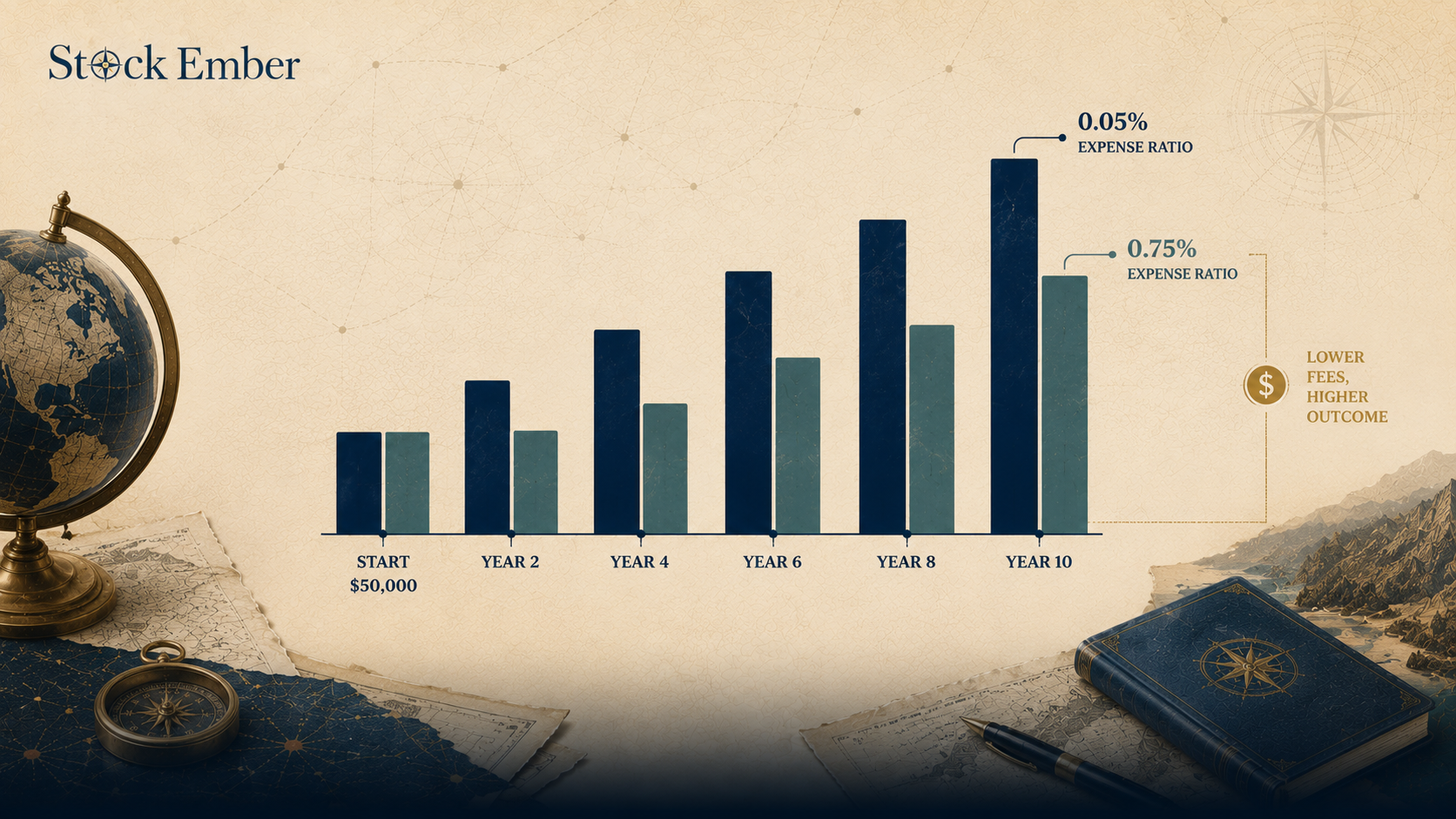
The total cost of owning a mutual fund is captured primarily by its expense ratio, as outlined by Investor.gov, an annual percentage fee deducted directly from fund assets to cover management and administrative expenses. While an annual expense ratio of 0.75% for an actively managed fund or 0.05% for an index fund may sound small on paper, fees compound against your wealth over time just as investment returns compound for you.
Consider an initial investment of $50,000 held over ten years with an assumed gross annual return of 7%.
Based on a compound interest calculation assuming a fixed 7% gross annual return, your investment grows to approximately $97,800 over 10 years, with total fees consuming only around $480 of your potential returns. (Figures are illustrative estimates; actual returns will vary.)
Based on a compound interest calculation assuming a fixed 7% gross annual return, that same portfolio grows to approximately $91,300 over the same 10 years. Under the same assumptions, the 0.70% difference in annual fee drag results in more than $6,500 less ending wealth over a single decade. These figures are illustrative estimates based on fixed assumptions; actual results will vary.
In addition to expense ratios, watch for sales commissions known as "loads." Front-end loads take a percentage of your capital before it is invested, while back-end loads charge a fee when you sell your shares. Furthermore, 12b-1 fees are operational marketing fees tucked into some funds that directly reduce your long-term yield without offering any investment benefit.
Chart illustrating the 10-year compounding fee drag between low-cost and high-cost mutual funds.
Mutual Funds vs. ETFs: Key Structural Differences
Mutual funds and ETFs (exchange-traded funds) both offer diversified baskets of securities, but they differ fundamentally in how they trade, their cost structures, and their tax treatment. While mutual funds trade only once a day at closing NAV through the fund company, what is an etf is structured to trade continuously throughout market hours on public stock exchanges just like individual equities.
For a deeper head-to-head breakdown of these two structures, explore our full guide on ETF vs mutual fund.
Another crucial distinction is tax efficiency. Actively managed mutual funds frequently buy and sell internal holdings, and when those sales generate capital gains, the fund is legally required to distribute the taxable gains to shareholders at year-end, meaning you could owe taxes even if you never sold a single share.
In contrast, ETFs utilize an in-kind creation/redemption process that shields long-term holders from most internal capital gains distributions.
Three Mutual Fund Pitfalls to Watch Out For
The three primary pitfalls of mutual funds are capital gains tax drag in taxable accounts, excessive load charges, and hidden "closet indexers."
Tax drag from portfolio turnover: Active portfolio managers who frequently turn over holdings create taxable events that are passed straight to you, eating away at taxable account returns.
High sales loads and 12b-1 fees: Commissions charged when buying or selling shares subtract directly from your starting principal, making it harder for your money to compound efficiently.
Closet indexers: Some actively managed funds charge high management fees while taking portfolio positions that virtually mirror low-cost index benchmarks. You pay premium active prices for index-level performance.
Conclusion
Mutual funds remain a foundational vehicle for long-term wealth building, offering instant diversification and simplified dollar-cost averaging. However, minimizing expense ratios and watching out for sales loads are critical steps toward keeping more of your market returns compounding over decades. When you are ready to evaluate exchange-traded options to compare against these funds, our ETF reviews provide an ideal next step for your research.
FAQ
5 questions
How do you make money from a mutual fund?
Investors generate returns from mutual funds through three primary channels: dividend distributions paid by underlying stocks, interest payments from bonds, and capital gains when the fund manager sells appreciated assets. Additionally, as the market value of the fund's underlying portfolio grows, the Net Asset Value (NAV) per share increases, allowing you to sell your shares for a profit.
Can you lose all your money in a mutual fund?
While it is theoretically possible to lose your entire principal if every single underlying company in the fund goes bankrupt simultaneously, built-in asset diversification makes total loss extremely unlikely. However, mutual funds remain subject to broader market risks, meaning the value of your investment will fluctuate and can decline during market downturns.
Are mutual funds safe for long-term beginners?
Mutual funds are generally considered beginner-friendly because they offer instant diversification across hundreds of assets through a single transaction, removing the risk of single-stock selection. However, safety depends entirely on the underlying assets. Equity mutual funds carry market risk, while money market or government bond funds focus on capital preservation.
What hidden fees should you watch for in mutual funds?
Beyond the annual expense ratio, mutual funds can charge sales commissions known as front-end or back-end loads, which deduct a percentage of your investment upon purchase or sale. Additionally, some funds include 12b-1 marketing fees embedded in operational expenses, and active trading within the fund can generate unexpected taxable capital gains distributions.
How are mutual funds taxed in a taxable brokerage account?
In taxable accounts, mutual fund holders are subject to taxes on dividend distributions, interest, and capital gains generated when internal portfolio holdings are sold at a profit. Even if you do not sell your mutual fund shares, the fund must distribute net realized capital gains to shareholders annually, which triggers a taxable income event.
Disclaimer
This guide was written with AI assistance and reviewed by the StockEmber editorial team for accuracy. StockEmber provides independent education, not personal financial advice. Some links may support our work at no additional cost to you.
The StockEmber Team is our in-house desk of independent research writers. We test brokerage platforms, read the fine print on fees and custody, and cover ETFs and long-horizon investing for people who plan to hold for decades — not days.