An exchange-traded fund (ETF) trades continuously on a stock exchange throughout market hours at market prices, while a mutual fund prices once daily after market close at its Net Asset Value (NAV). ETFs generally offer superior tax efficiency in taxable accounts due to in-kind share redemptions, whereas mutual funds simplify automated dollar-cost averaging.
An exchange-traded fund (ETF) trades continuously on a stock exchange throughout the trading day at market prices, whereas a mutual fund prices once daily after market close at its Net Asset Value (NAV).
Choosing between these two vehicles comes down to understanding how they execute trades, manage internal taxes, and fit your personal investing habits. Both can hold identical portfolios, but their underlying operational mechanics create meaningful differences in cost and flexibility over time. This ETF vs. mutual fund guide breaks down trading flexibility, tax efficiency, and long-term costs so you can select the right structure for your portfolio.
Quick Takeaways
01ETFs trade on exchanges throughout market hours like stocks, while mutual funds execute orders once per day after market close.
02ETFs are generally more tax-efficient in taxable accounts due to an in-kind creation and redemption process that limits capital gains distributions.
03Mutual funds offer seamless automated investing for fractional share purchases, whereas ETF automation depends heavily on your specific brokerage platform.
04Both vehicles serve as structural wrappers; the underlying assets inside the fund drive your investment returns, not the wrapper itself.
05Understanding the ETF vs. mutual fund distinction starts with how each vehicle executes trades.
What Is the Difference Between an ETF and a Mutual Fund?
The ETF vs. mutual fund cost comparison looks beyond listed expense ratios. The primary difference between an ETF and a mutual fund lies in their legal structure and how investors buy and sell shares of the fund.
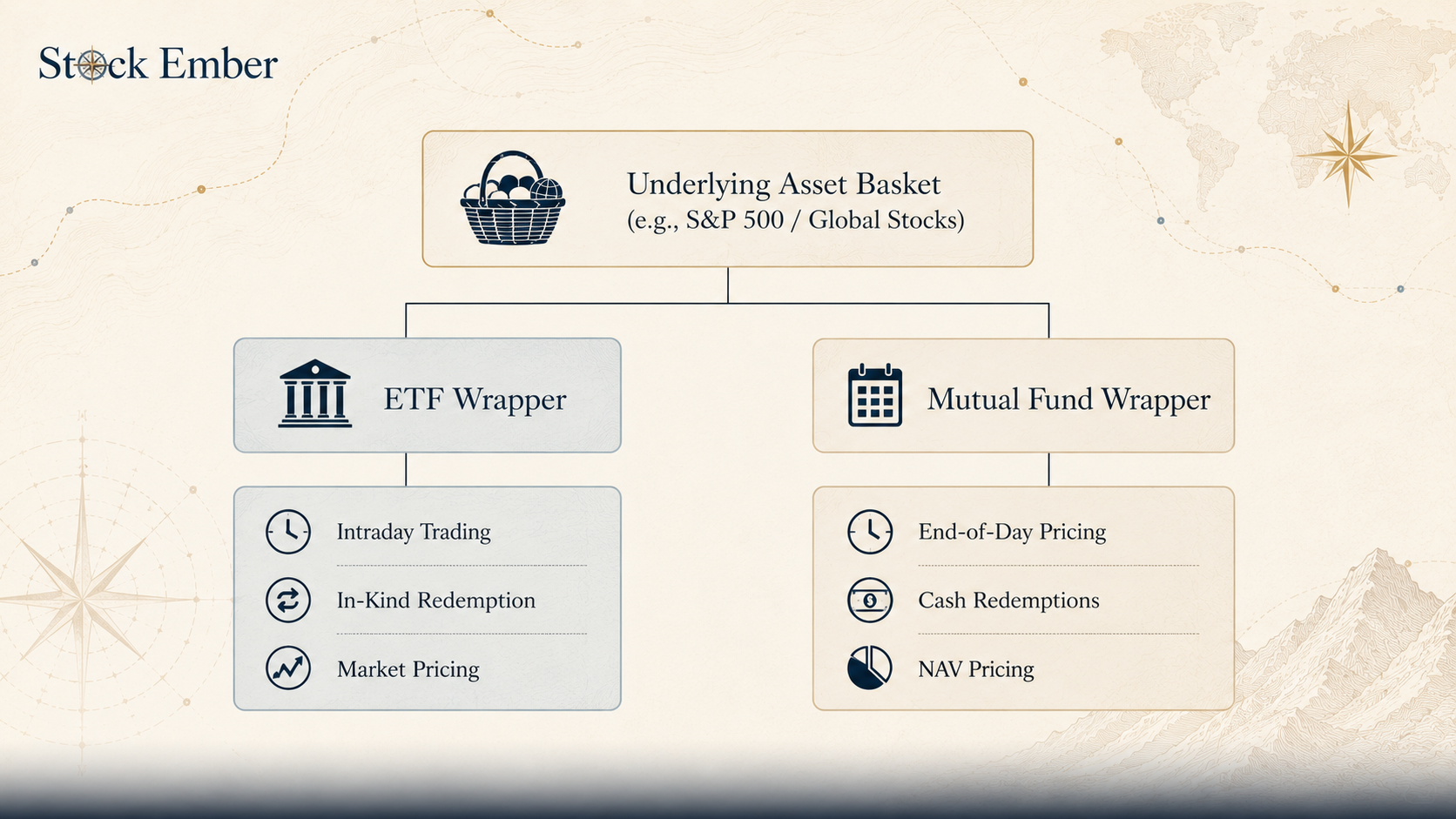
It is helpful to think of both vehicles as financial "wrappers." A wrapper is simply the legal basket that holds an underlying collection of assets, such as stocks, bonds, or commodities. When comparing an ETF vs mutual fund, investors often assume the funds hold completely different types of investments. In reality, a mutual fund and an ETF can hold the exact same basket of underlying stocks, such as the 500 largest companies in the United States while operating under entirely different trading rules.
Diagram showing how ETFs and mutual funds can hold the same underlying asset basket while differing in trading, pricing, and tax mechanics.
Investors frequently confuse the fund wrapper with its management strategy. Understanding what is an ETF starts with recognizing that an ETF can be managed passively to track an index or actively managed by a stock-picker. The same is true for mutual funds.
If you are choosing between index-tracking versions of these vehicles, the core operational distinction comes down to trading mechanics, tax efficiency, and fee structures rather than performance targets. To explore how passive strategies apply across these vehicles, see our guide on ETF vs. index fund.
The core ETF vs. mutual fund trading difference is simple: continuous vs. once-daily pricing.
ETFs provide continuous intraday trading liquidity, while mutual funds execute all buy and sell orders at a single calculated end-of-day price.
Because ETFs trade on public stock exchanges, their prices fluctuate constantly during market hours based on supply and demand. You can buy or sell ETF shares at 10:00 AM, 1:30 PM, or right before the closing bell using advanced order types like limit orders, stop-loss orders, or market orders. However, this flexibility introduces a minor transaction layer: the bid-ask spread. The bid-ask spread represents the difference between the highest price a buyer is willing to pay and the lowest price a seller is willing to accept.
Diagram comparing ETF intraday market pricing versus mutual fund end-of-day net asset value (NAV) execution.
Mutual funds bypass stock exchanges entirely. When you place an order to buy or sell a mutual fund, your order sits in a queue until the market closes. The fund manager then calculates the total value of all underlying assets minus liabilities, divided by the number of outstanding shares, to determine the Net Asset Value (NAV).
Every investor buying or selling the mutual fund on that day receives the exact same NAV price, regardless of whether they submitted their order at 9:00 AM or 3:55 PM.
For long-horizon buy-and-hold investors, intraday trading control is rarely a necessity. However, guaranteed NAV execution means mutual fund investors never have to worry about bid-ask spreads or temporary market dislocations during volatile trading hours.
The ETF vs. mutual fund cost gap is most visible over 10 years.
ETFs typically deliver superior tax efficiency and lower holding costs over a 10-year horizon due to their unique in-kind share redemption mechanism.
The total cost of holding a fund goes well beyond its listed management expense ratio. To evaluate the true financial impact, you must look at total cost through a 10-year lens. Consider a hypothetical $100,000 portfolio invested over a decade:
Expense Ratio Drag: Based on a hypothetical illustration only, actual expense ratios vary by fund and share class. A broad-market index ETF might carry an expense ratio of 0.03%, while a similar index mutual fund might charge 0.18%. Over 10 years, assuming a 7% average annual return, that 0.15% fee differential compounds quietly, costing you nearly $3,000 in lost growth and extra management fees.
Capital Gains Drag: Mutual funds generate internal tax friction when the manager sells underlying holdings to meet shareholder redemptions or rebalance the portfolio. If the fund sells appreciated stocks, it must pass those capital gains distributions along to all current shareholders at year-end. You can incur a taxable capital gains bill even if you did not sell a single share of the mutual fund yourself. For U.S. investors, see IRS Publication 550 for detailed guidance on capital gains distributions.
Investment Vehicle
Expense Ratio
Estimated 10-Year Fee Cost
Internal Tax Friction
Index ETF
0.03%
~$570
Low (In-Kind)
Mutual Fund
0.18%
~$3,400
Moderate-to-High
ETFs largely avoid internal capital gains distributions through a process called "in-kind" creation and redemption. Institutional market makers handle large redemptions by swapping ETF shares directly for the underlying basket of stocks, according to the SEC's Exchange-Traded Funds guidance, rather than forcing the fund manager to sell assets for cash. This mechanism keeps taxable events isolated to the moment you personally sell your ETF shares.
In practice, many long-term investors in taxable accounts only realize the tax drag of mutual funds after receiving an unexpected year-end capital gains distribution statement during a down market year.
DCA and Automation: Matching Structure to Investor Habits
Mutual funds excel at automated, dollar-cost averaging setups, whereas ETFs offer maximum flexibility for manual trading and limit orders.
Dollar-cost averaging (DCA) the habit of investing a fixed dollar amount on a regular schedule is one of the most effective ways to build wealth over time. Mutual funds were built for this behavior. Because mutual funds trade in fractional dollar amounts rather than fixed share counts, you can set up an automatic bank transfer for $250 every month. The mutual fund platform automatically purchases $250 worth of the fund, down to the fourth decimal point, leaving zero uninvested cash sitting in your account.
Historically, ETFs made automated dollar-cost averaging harder because investors had to buy whole shares manually during market hours. If an ETF traded at $180 per share and you had $250 to invest, you could only buy one share, leaving $70 uninvested.
Today, many modern brokerages offer automated fractional-share ETF investing, narrowing this gap significantly. However, if your brokerage does not support automated fractional ETF trading, a mutual fund remains the most seamless "set-it-and-forget-it" vehicle for regular monthly contributions.
Many ETF vs. mutual fund mistakes stem from confusing the wrapper with the strategy.
Long-term investors often make costly errors by confusing fund management style with fund structure or ignoring hidden transactional friction.
Assuming ETFs Are Always Cheaper: While index ETFs generally have lower expense ratios than active mutual funds, institutional-class index mutual funds can match or beat retail ETF expense ratios. Always compare the specific expense ratios of the exact funds you are evaluating.
Over-Trading Intraday Access: The ability to trade ETFs continuously during market hours can encourage bad behavioral habits. Long-term wealth accumulation requires patience; checking real-time ETF prices throughout the day often leads to impulse selling during market drawdowns.
Trading ETFs During Volatile Market Openings: Placing market orders for ETFs in the first 15 minutes of the trading day can expose you to wider bid-ask spreads as underlying market prices settle. If you trade ETFs, using limit orders during stable midday hours protects you from poor execution pricing.
Conclusion
The ETF vs. mutual fund decision ultimately comes down to your account type and investing behavior.
Choosing between an ETF vs. mutual fund in a taxable account often favors the ETF for its tax efficiency.
Neither investment wrapper is universally superior; your choice depends on whether you value intraday trading control or hands-off automated investing. If you are investing in a taxable brokerage account, an ETF's internal tax efficiency usually makes it the stronger long-term choice. Conversely, if you prioritize automated monthly cash transfers inside a tax-sheltered account where capital gains distributions are not taxed, an index mutual fund offers equal utility. When you are ready to evaluate specific investment products and platforms, exploring detailed ETF reviews is a natural next step for building your long-term portfolio.
FAQ
5 questions
Is it better to invest in an ETF or a mutual fund for long-term growth?
Neither structure inherently delivers higher returns because both can hold the exact same underlying assets (such as the S&P 500). However, an ETF may yield slightly higher net growth in taxable accounts over a 10-year period due to lower management expense ratios and reduced capital gains tax drag resulting from in-kind share redemptions.
Why would an investor choose a mutual fund over an ETF?
An investor might choose a mutual fund for its seamless, automated dollar-cost averaging features. Mutual funds allow you to set up automatic bank transfers that directly purchase fractional shares down to the cent without dealing with bid-ask spreads, manual trade execution, or uninvested cash drag.
Do ETFs generate fewer capital gains taxes than mutual funds?
Yes, ETFs are generally more tax-efficient in taxable brokerage accounts. Thanks to their unique "in-kind" creation and redemption mechanism, ETF managers rarely need to sell underlying stocks to meet shareholder redemptions, minimizing unexpected year-end capital gains distributions compared to mutual funds.
Can I set up automatic monthly investments into an ETF?
Yes, but it depends on your brokerage platform. While traditional mutual funds naturally support automated recurring dollar-based investments, ETF automation requires a broker that offers automated fractional-share purchases during trading hours.
Can you convert a mutual fund into an ETF without paying taxes?
Certain fund providers allow non-taxable conversions from specific mutual fund share classes to their ETF equivalents if both share classes exist within the same fund framework. However, selling a mutual fund to buy a different ETF in a taxable account triggers a taxable capital gains event.
Disclaimer
This guide was written with AI assistance and reviewed by the StockEmber editorial team for accuracy. StockEmber provides independent education, not personal financial advice. Some links may support our work at no additional cost to you.
The StockEmber Team is our in-house desk of independent research writers. We test brokerage platforms, read the fine print on fees and custody, and cover ETFs and long-horizon investing for people who plan to hold for decades — not days.