A dividend ETF is a pooled investment security that holds a basket of dividend-paying equities and periodically distributes accumulated cash income to fund shareholders. Rather than selecting individual dividend stocks, investors use dividend ETFs to gain diversified exposure to cash-flowing companies through a single stock exchange transaction.
A dividend exchange-traded fund (ETF) is a pooled investment vehicle that holds a basket of dividend-paying equities and periodically distributes the accumulated cash income directly to its shareholders.
Many investors turn to dividend ETFs seeking regular cash flow without the concentration risk of choosing individual stocks. However, focusing exclusively on current yield without understanding payout mechanics, underlying company health, and tax friction can erode long-term capital compounding. This guide breaks down how dividend ETFs operate, compares high-yield versus dividend-growth strategies, and evaluates their total return impact over a 10-year horizon.
Quick Takeaways
01A dividend ETF pools investor capital to buy dividend-paying stocks and passes accumulated dividend income to shareholders on a regular schedule.
02Fund share prices (NAV) drop automatically on the ex-dividend date by the exact distribution amount paid out per share.
03High-yield dividend strategies focus on immediate cash flow, whereas dividend-growth strategies prioritize payout safety and capital appreciation.
04Long-term wealth accumulation depends on total return (price appreciation plus reinvested distributions), not current dividend yield alone.
What Is a Dividend ETF?
A dividend ETF is an exchange-traded fund designed to track an index of publicly traded companies that pay regular cash dividends to shareholders. When you purchase shares of a dividend ETF, you gain fractional ownership across dozens or hundreds of cash-flowing companies through a single transaction on a stock exchange, operating under the same trading rules as any standard what is an ETF holding.
Instead of requiring you to evaluate individual balance sheets, corporate debt loads, and payout ratios, the ETF manager relies on a rule-based index system. This index screens companies based on strict eligibility criteria, such as consecutive years of dividend increases, minimum dividend yield thresholds, or maximum payout ratio caps.
By pooling capital across diverse equities, dividend ETFs eliminate the default risk associated with a single company cutting its payout. If one underlying firm slashes its dividend due to financial stress, the impact on the ETF’s total income distribution remains limited to that company's percentage weight within the broader portfolio.
How Dividend ETFs Work: Distributions and NAV Mechanics
Dividend ETFs operate by collecting cash dividend payments from their underlying portfolio companies and redistributing those funds to ETF shareholders on a monthly or quarterly schedule. The fund manager holds incoming corporate payouts in a short-term cash account until the fund's scheduled distribution date, at which point the accumulated cash is distributed pro-rata to all registered ETF shareholders.
In practice, many long-term investors mentally treat income distributions as "free cash," overlooking the fact that the fund's Net Asset Value adjusts downward by the exact distribution amount on the ex-dividend date.
To understand why dividend payouts are not free money, you must look at how distributions affect fund pricing. On the ex-dividend date, the ETF's Net Asset Value (NAV) drops by the exact amount of the per-share cash payout. Similar to what is NAV in mutual fundpricing mechanics, an ETF trading at $100 per share that distributes a $1.00 dividend will open at $99 per share on its ex-dividend date, assuming zero market movement.
Investors have two primary options for handling dividend distributions:
Cash Distribution: Receiving payouts as uninvested cash in a brokerage account for immediate spending.
Dividend Reinvestment Plan (DRIP): Automatically using cash distributions to purchase additional fractional shares of the ETF, compounding share accumulation over time.
High Dividend ETFs vs. Dividend Growth ETFs
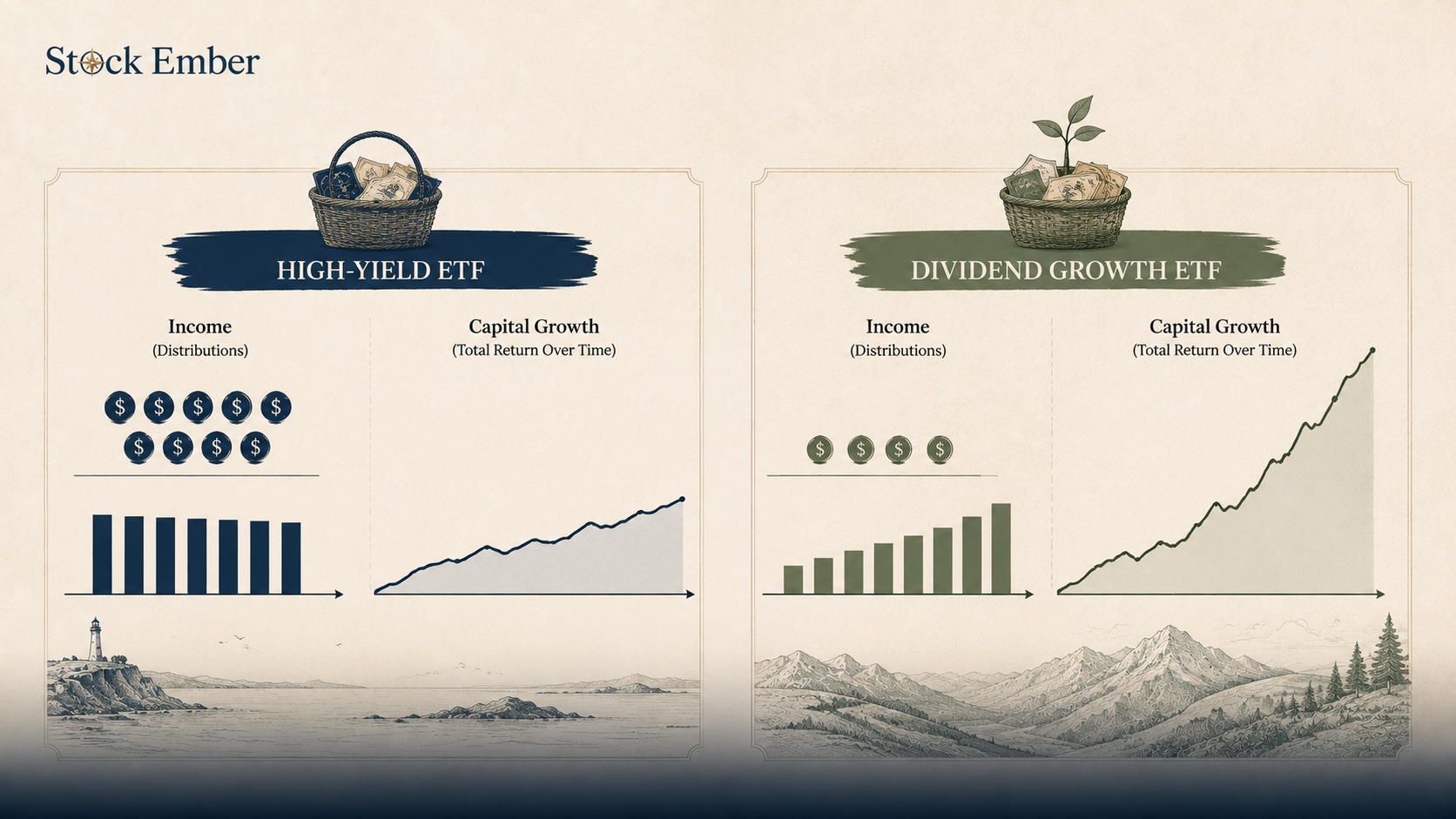
High dividend ETFs focus on maximizing immediate yield by selecting stocks with above-average payout rates, whereas dividend growth ETFs prioritize companies with a proven track record of consistently increasing their payouts over time.
Choosing between these two approaches depends on whether your priority is current cash flow or long-term wealth accumulation:
Feature
High Dividend ETF
Dividend Growth ETF
Primary Goal
Maximize immediate income yield
Long-term capital growth + rising payout
Typical Yield
Above market average (typically around 3%–6%)
Moderate (typically around 1.5%–3%)
Sector Focus
Utilities, Real Estate (REITs), Energy, Financials
Higher vulnerability to payout cuts during downturns
Stronger balance sheets and conservative payout ratios
Note: Typical yield ranges are based on Morningstar dividend ETF research and representative ETF prospectuses. Actual yields vary by fund, sector allocation, market conditions, and prevailing interest rates.
A high dividend etf strategy appeals to retirees or income-focused accounts that require cash today. However, companies offering abnormally high yields often reinvest less capital into research and expansion, leading to slower share price appreciation over time. Conversely, dividend growth funds target mature, profitable enterprises, frequently referred to as Dividend Aristocrats that balance steady distributions with ongoing business expansion.
Comparison diagram showing high yield dividend ETF vs dividend growth ETF long term returns
The 10-Year Cost Lens: Yield Traps, Tax Drag, and Fee Spreads
Evaluating a dividend ETF over a 10-year horizon requires looking beyond headline yield to account for the compounding effects of management expense ratios, annual tax drag, and dividend sustainability.
3 structural cost factors quietly dictate your actual total return over a decade:
1. Yield Traps and Dividend Safety
A high current yield is sometimes the mathematical result of a collapsing stock price rather than corporate financial strength. If a company's share price drops by 50% due to declining revenue while its historical dividend payout remains unchanged, its yield temporarily doubles. If the underlying index contains distressed companies that eventually cut their dividends, the fund experiences both capital loss and reduced income distributions.
2. Tax Drag in Taxable Brokerage Accounts
In taxable accounts, dividend payouts trigger annual tax liabilities in the year they are received, regardless of whether you cash them out or reinvest them via DRIP. Qualified dividends are taxed at lower long-term capital gains rates (0%, 15%, or 20% depending on taxable income, per IRS Publication 550), but non-qualified dividends such as those from Real Estate Investment Trusts (REITs) are taxed at higher ordinary income rates. Over 10 years, paying annual taxes on distributions reduces the capital left to compound compared to holding broad-market growth funds that generate fewer taxable events.
3. Expense Ratio Spreads Over 10 Years
Specialized rules-based dividend ETFs often carry higher expense ratios than standard broad-market index funds. Consider the compound effect of fee differences on a $100,000 portfolio over 10 years, assuming a 7% annual gross return:
Broad-Market Index ETF (0.03% Expense Ratio): Fund fees total approximately $500 over 10 years, leaving an ending portfolio value of ~$196,000. (illustrative; calculated at 7% gross annual return, fees deducted annually, distributions reinvested).
Specialized Dividend ETF (0.35% Expense Ratio): Fund fees total approximately $5,700 over 10 years, leaving an ending portfolio value of ~$190,500. (illustrative; calculated at 7% gross annual return, fees deducted annually, distributions reinvested).
That modest 0.32% management fee difference quietly removes over $5,500 from your final wealth over a decade.
Common Pitfalls for Long-Term Dividend Investors
Long-term income investors frequently undermine their portfolio compounding by falling for yield traps, ignoring sector overconcentration, and treating dividend distributions as free capital gains.
Mental Accounting Bias: Treating dividend cash as "free income" while ignoring that the fund's underlying share price drops on the ex-dividend date.
Sector Overconcentration: Over-allocating to high-yield sectors like utilities or real estate, leaving the portfolio vulnerable to interest rate spikes.
Chasing Yield Over Total Return: Selecting a fund with a 6% yield that experiences zero price growth, while passing up a fund with a 2% yield that doubles its capital base over 10 years.
Conclusion
Dividend ETFs offer an accessible, diversified mechanism for collecting equity income, but long-term financial success depends on prioritizing total return and low friction rather than yield alone. Balancing immediate distribution needs with dividend growth, tax efficiency, and low management fees ensures your capital continues to compound effectively over a multi-year horizon. When you are ready to analyze specific fund structures and fee schedules, our ETF reviews provide detailed breakdowns to help you select the right vehicle for your portfolio.
FAQ
5 questions
How does a dividend ETF pay you?
A dividend ETF collects cash distributions from its portfolio companies, pools the cash, and pays it out to fund shareholders on a monthly or quarterly schedule. Investors can receive payouts as uninvested cash in their brokerage account or automatically reinvest them via a Dividend Reinvestment Plan (DRIP).
Does a dividend ETF drop in price when it pays dividends?
Yes. On the ex-dividend date, an ETF's Net Asset Value (NAV) drops by the exact amount of the per-share cash distribution, reflecting the cash leaving the fund's assets.
What is the difference between a high dividend ETF and a dividend growth ETF?
High dividend ETFs focus on maximizing current income by selecting stocks with high yield payout rates, often in mature or low-growth sectors. Dividend growth ETFs focus on companies with a history of consistently increasing their dividend payouts annually, prioritizing payout safety and long-term capital appreciation over immediate yield.
Are dividend ETFs better than holding individual dividend stocks?
Dividend ETFs offer instant diversification across dozens or hundreds of cash-flowing companies, eliminating single-stock default risk and severe dividend cut impacts. While individual stocks allow precise portfolio selection, ETFs significantly reduce operational management and single-stock concentration risk for long-term investors.
Are dividends from ETFs taxable?
Yes. In taxable brokerage accounts, ETF dividend payouts trigger annual tax liabilities in the year they are received, even if automatically reinvested via DRIP. Depending on the holding period and underlying asset class, payouts are taxed at qualified capital gains rates or ordinary income rates.
Disclaimer
This guide was written with AI assistance and reviewed by the StockEmber editorial team for accuracy. StockEmber provides independent education, not personal financial advice. Some links may support our work at no additional cost to you.
The StockEmber Team is our in-house desk of independent research writers. We test brokerage platforms, read the fine print on fees and custody, and cover ETFs and long-horizon investing for people who plan to hold for decades — not days.