A bond ETF is an exchange-traded fund that holds a diversified portfolio of fixed-income securities and trades continuously on a public stock exchange. Unlike individual bonds, these funds maintain a perpetual target duration by constantly rolling over their underlying debt holdings.
A bond ETF is an exchange-traded fund that buys a diversified basket of fixed-income securities, allowing you to buy and sell debt instruments on the open stock market like a standard stock. By tracking a specific index of bonds, these funds provide regular investors with institutional-grade access to government, corporate, and municipal debt markets without requiring deep capital pools.
If you have ever tried to navigate the traditional bond market, you know it can feel opaque, illiquid, and heavily weighted toward massive institutions. Many long-term investors want the steady income or portfolio stability that fixed-income assets provide, but they don't want the logistical headache of managing dozens of individual maturity dates. This guide breaks down exactly how a bond ETF bridges that gap, how it differs fundamentally from holding individual debt, and how to spot the hidden costs that can erode your returns over time.
Quick Takeaways
01A bond ETF wraps thousands of individual debt securities into a single fund that trades continuously throughout the stock market day.
02Unlike individual bonds, a standard bond ETF does not have a fixed maturity date; it rolls its capital perpetually to maintain a target portfolio duration.
03Interest paid by the underlying bonds is collected by the fund and distributed to shareholders as regular, predictable monthly or quarterly cash payouts.
04While bond ETFs reduce transaction friction and default risk through diversification, their principal values remain highly sensitive to central bank interest rate fluctuations.
How a Bond ETF Works
The Fund Wrapper Mechanics
What is a bond ETF, exactly? At its core, a bond ETF functions as a collective investment wrapper. The fund management company pools capital from thousands of retail investors and uses those funds to replicate a specific fixed-income index. For instance, the fund might track an index composed entirely of long-term government debt or high-quality corporate loans.
Underlying Assets and Cash Flow
When you purchase a share of a fixed income ETF, you do not own the underlying debt directly. Instead, you own a fractional slice of the total fund portfolio. As the thousands of individual bonds held inside the fund pay out their scheduled interest (known as coupon payments), the fund manager aggregates these incoming cash flows.
The Payout Structure
Instead of passing those complex, scattered coupon schedules directly to you, the ETF normalizes the payout structure. The fund distributes this accumulated interest to its shareholders on a clean, predictable timeline, most commonly via monthly cash distributions. This structural efficiency is one of the primary reasons buy-and-hold investors use these vehicles to generate consistent portfolio cash flow.
The Core Difference: Individual Bonds vs. Bond ETFs
The Perpetual Maturity Trap
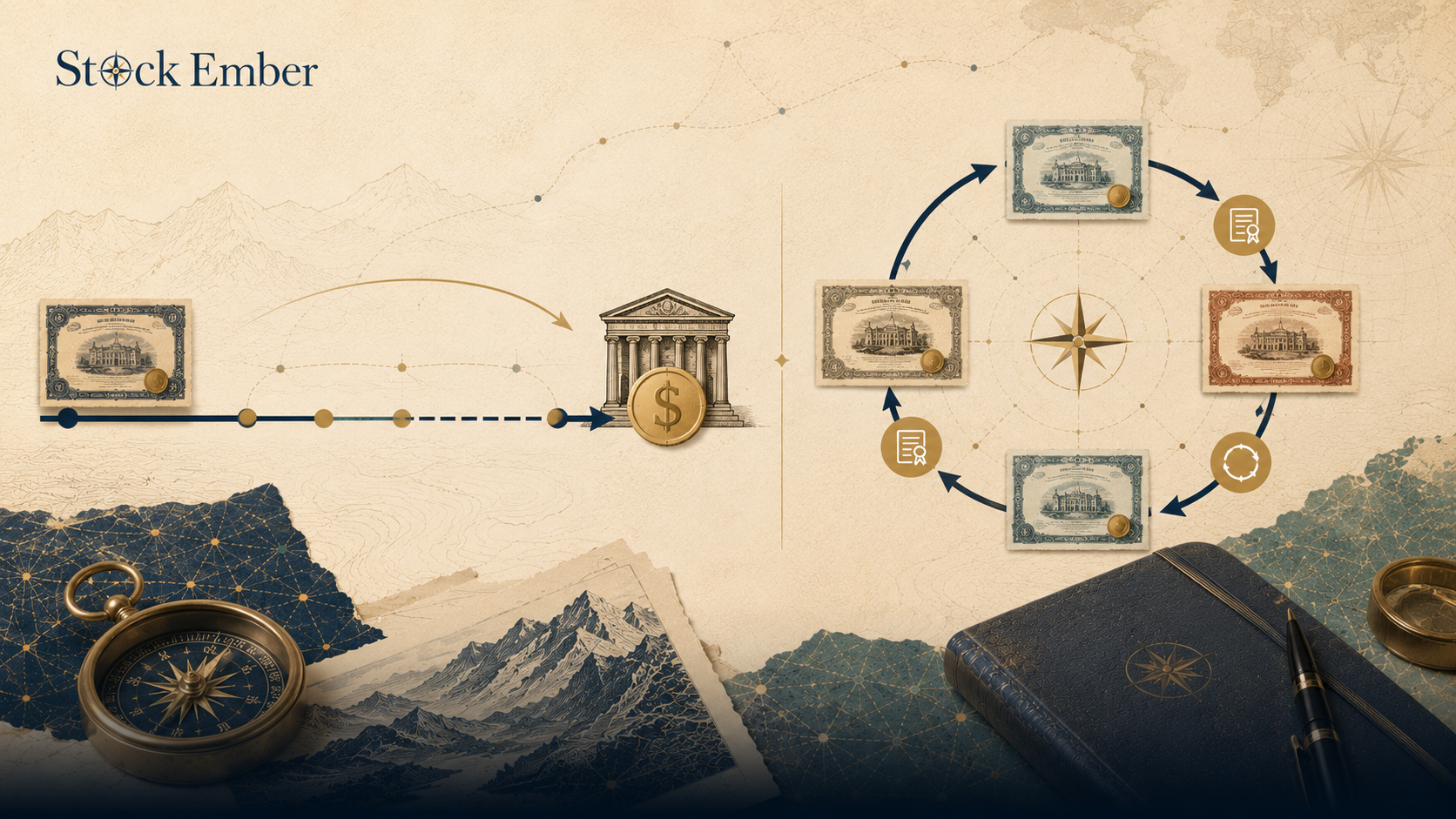
The single most critical concept a long-term investor must understand before allocating capital to this asset class is the "maturity trap." Traditional individual bonds are fundamentally different from bond funds because individual bonds have an expiration date. When you buy a single 10-year government bond at issuance, you receive regular interest payments for a decade, and at the end of those ten years, the issuer returns your initial face value principal in full.
The Portfolio Rolling Process
A standard bond ETF does not work this way. It is designed to be a perpetual investment vehicle.
Diagram illustrating individual bonds maturing versus a bond ETF rolling its holdings indefinitely.
To maintain a steady risk profile, a bond ETF targets a fixed average maturity range (such as 5-to-7 years). To keep that target stable, the fund manager must constantly sell off bonds that are getting too close to expiration and use that money to purchase newly issued, longer-term bonds. This process is called portfolio rolling.
Indefinite Principal Volatility
Because the fund is a spinning wheel of debt that never actually reaches a final maturity date, your principal investment is never automatically paid back at par by an issuer. Instead, the value of your ETF shares will fluctuate indefinitely on the open market based on current macroeconomic environments.
The Categories: Corporate, Government, and High Yield
Government Bond ETFs
These funds hold debt issued by sovereign nations. Because they are backed by the taxing power of governments, they are generally considered to carry the lowest credit risk among major bond categories, though no bond issuer is entirely immune to default. However, because they are structurally safe, they offer lower interest yields.
Corporate Bond ETFs
A corporate bond ETF shifts your focus toward private companies. When major corporations need to fund operations, they issue debt. These funds offer higher yields than government debt to compensate you for the reality that companies can, occasionally, go bankrupt.
High Yield Bond ETFs
If you are hunting for maximized income streams, a high yield bond ETF tracks debt issued by companies with lower credit ratings (often referred to as "junk bonds"). While the monthly dividend potential is significantly higher than alternative funds, the underlying businesses carry a much greater risk of failing to fulfill their loan obligations. If you are balancing this approach against an equities-driven income strategy, it helps to understand how this differs from a traditional what is a dividend ETF approach.
Why Bond ETFs Matter for a Long-Term Portfolio
Diversification and Liquidity Benefits
Buying individual bonds requires substantial capital to spread risk across different industries and issuers. A single share of a broad market bond ETF, however, immediately exposes your money to thousands of distinct underlying loans in one transaction.
These funds also solve the liquidity problem. The traditional over-the-counter bond market can take days to execute a trade at a fair price, whereas an ETF sits on a major stock exchange, letting you buy or sell your position instantly during standard market hours.
The Strategic Portfolio Ballast
For generations, the cornerstone of balanced investing has been the strategic trade-off between bonds vs stocks. While equities provide long-term growth potential, they are volatile. Bonds traditionally provide the ballast, a smoothing mechanism that cushions your portfolio when the stock market experiences sudden downward corrections.
The Hidden Cost: Watching Your Fees Over 10 Years
The Compounding Management Drag
Because bonds inherently offer lower total return potential than historical equity markets, minimizing operational drag is paramount. When evaluating a fund, you must look directly at its annual management fee, known as the expense ratio. A fund fee of 0.40% a year might sound entirely harmless when viewed in isolation. However, you must view every investment expense through a decade-long lens to see its true impact.
10-Year Illustrative Math
Consider an illustrative example: If you allocate $10,000 to a bond portfolio yielding a steady 4% annually, a 0.40% annual fee means you are giving up a full tenth of your total interest income to the fund manager every single year. Over a 10-year holding horizon, that quiet annual deduction compounds against your returns. On a $10,000 investment, a 0.40% fee would reduce your ending balance by roughly $560 compared with a fee-free equivalent, money that could have otherwise remained in your account to compound. Respect the structural drag of fees; over a decade, they are never minor.
Common Pitfalls for Long-Term Holders
Interest Rate Sensitivity
Bond prices and market interest rates move in opposite directions. This is known as interest rate risk. When a central bank raises interest rates, older bonds holding lower fixed yields become less attractive, causing their market value to fall. Because a bond ETF holds these older bonds permanently without a single maturity finish line, your fund's share price will drop during rising interest rate cycles.
Inflation Risk
Fixed-income assets return a fixed amount of cash. If inflation climbs rapidly, the purchasing power of those monthly distributions degrades, leaving you with lower real-world returns.
Credit/Default Crises
During severe economic downturns, corporate default rates rise. This can cause corporate and high-yield funds to experience sharp capital declines at the exact moment you expected them to remain stable.
Conclusion
Understanding what is an ETF provides the foundation, but understanding what is a bond ETF and how bond ETFs fit into a long-term portfolio is what helps you make more informed investment decisions. A bond ETF strips away much of the operational complexity of the bond market, offering a liquid and diversified way to gain fixed-income exposure without managing individual bonds.
However, convenience does not eliminate risk. Unlike individual bonds, most bond ETFs never mature, meaning their share prices continue to fluctuate with changes in interest rates, inflation, and credit conditions. Before investing, pay close attention to the fund's underlying holdings, duration, credit quality, and expense ratio, as each can meaningfully affect your long-term returns.
When used thoughtfully, a bond ETF can serve as a reliable stabilizer within a diversified portfolio, helping reduce overall portfolio volatility while providing a consistent stream of income over the long term.
FAQ
5 questions
Do bond ETFs pay back your principal?
No. Unlike individual bonds that return their face value at a specific maturity date, a standard bond ETF operates indefinitely. Because the fund continuously rolls over its holdings to maintain a target duration, your principal value will fluctuate on the open market based on changing interest rate environments.
How often do bond ETFs distribute interest payments?
Most bond ETFs distribute the interest collected from their underlying fixed-income securities on a monthly basis, though some distribute quarterly. This provides a more predictable and streamlined cash flow stream compared to managing individual bond coupon schedules.
Why do bond ETFs lose value when central bank interest rates rise?
Bond prices and interest rates share an inverse relationship. When interest rates rise, older bonds with lower yields become less attractive to the market, causing their value to drop. Because a bond ETF holds a basket of these older fixed-income assets, its net asset value declines.
Are bond ETFs safer investments than stock ETFs?
Generally, bond ETFs experience significantly less price volatility than equity ETFs and serve as excellent portfolio stabilizers. However, they are not risk-free; they remain exposed to interest rate fluctuations, inflation risk, and credit default risks within lower-tier corporate debt.
What is the difference between a government and a corporate bond ETF?
Government bond ETFs hold sovereign debt backed by national taxing power, generally offering the highest credit quality within the bond universe in exchange for lower interest yields. Corporate bond ETFs hold debt issued by private companies, which introduces credit default risk but compensates the investor with higher monthly payouts.
Disclaimer
This guide was written with AI assistance and reviewed by the StockEmber editorial team for accuracy. StockEmber provides independent education, not personal financial advice. Some links may support our work at no additional cost to you.
The StockEmber Team is our in-house desk of independent research writers. We test brokerage platforms, read the fine print on fees and custody, and cover ETFs and long-horizon investing for people who plan to hold for decades — not days.