Bonds are debt instruments where an investor lends capital to a government or corporation in exchange for periodic interest payouts and principal return at maturity. The main types of bonds include sovereign government debt, investment-grade and high-yield corporate issues, and zero-coupon or inflation-protected structures. Each bond category carries varying levels of credit risk, duration sensitivity, and yield potential within a long-term portfolio.
In finance, bonds are debt contracts where an investor lends money to a borrower, such as a government or corporation, in exchange for periodic interest payments and the return of principal at maturity.
Choosing fixed income assets can feel confusing when facing an array of government, corporate, and inflation-indexed debt. For a buy-and-hold investor, matching debt instruments to long-term goals requires understanding how borrowers, credit ratings, and interest rate sensitivity interact.
This guide breaks down the core bond categories, their payoff structures, and how they function inside a portfolio.
Quick Takeaways
01Sovereign debt provides core liquidity, though long-term issues remain exposed to inflation and interest rate risk.
02Corporate bonds offer higher income potential than government debt, balanced by credit rating tiers and default risk.
03Bond prices move inversely to interest rates, making duration a key metric for measuring portfolio volatility.
04Structuring maturities across different timeframes helps buy-and-hold investors manage cash flow without market timing.
Sovereign and Government Debt
When constructing a resilient multi-asset allocation, national government debt often forms the baseline anchor for capital preservation.
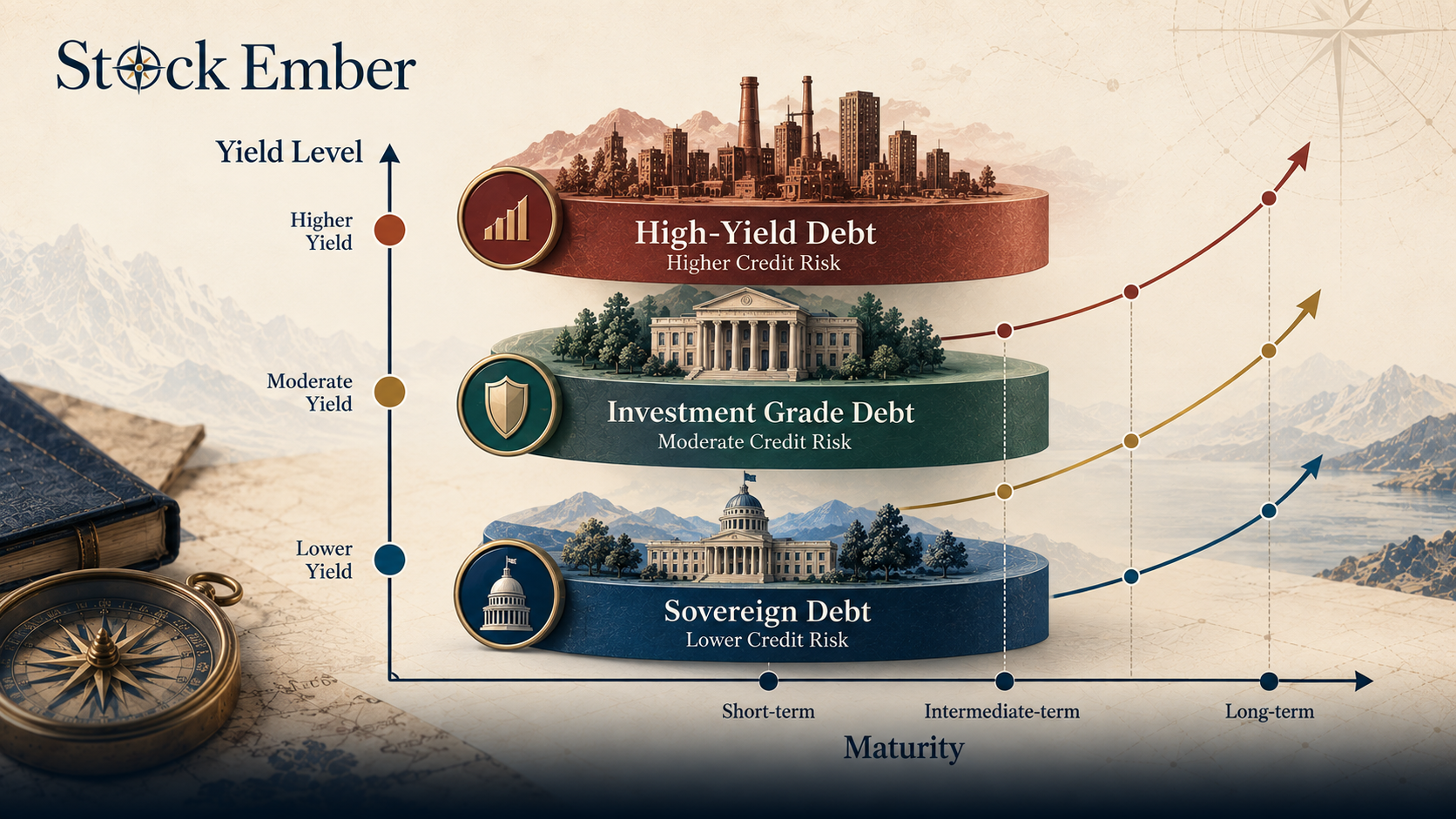
Governments issue sovereign debt to finance public infrastructure, civic programs, and budget deficits. Because national governments hold taxing authority and central bank backing, these securities carry lower default risk than private sector issues.
However, lower credit risk does not make government bonds risk-free. Holding sovereign debt exposes investors to purchasing power erosion from inflation and market price swings driven by shifting central bank interest rates.
Sovereign debt options vary depending on issuer jurisdiction and structural features:
US Treasuries: Issued by the US Department of the Treasury, these debt instruments set global interest rate benchmarks and offer high secondary market liquidity.
UK Sovereign Debt: In British financial markets, national debt obligations issued by HM Treasury are officially known as UK Gilts, functioning as the core sterling fixed-income benchmark.
Inflation-Indexed Securities: To protect purchasing power over multi-year holding periods, governments issue specialized instruments like Treasury Inflation-Protected Securities (TIPS), whose principal value adjusts upward with inflation metrics.
Corporate Debt and the Credit Quality Spectrum
While sovereign debt finances public expenditure, corporate debt allows private companies to raise capital for business expansion, capital expenditure, or refinancing without diluting equity shares. Corporations issue debt across a broad spectrum of financial strength, making credit evaluation essential.
Independent rating agencies evaluate an issuing company's balance sheet, debt coverage, and cash flow stability to assign credit ratings. These ratings split corporate debt into two primary categories:
Investment-Grade Issues: Debt issued by financially sound, low-default-risk companies receives an investment-grade rating of at least BBB- or Baa3. Allocating to investment-grade bonds gives portfolio managers steady interest payouts with low to moderate default risk.
High-Yield Issues: Companies with weaker balance sheets or higher debt loads must pay higher interest rates to compensate investors for default risk. These lower-rated securities, commonly referred to as junk bonds, experience higher price volatility and behave more like equities during economic downturns.
Structural and Payoff Variations
Beyond borrower identity and credit quality, debt contracts differ in how interest is calculated, how principal is repaid, and whether early redemption clauses exist.
Zero-Coupon Structure: Standard bonds pay interest payments every six months. In contrast, zero-coupon bonds pay no regular interest. Instead, they sell at a deep discount to face value and mature at full face value, compounding return entirely through price appreciation over time.
Callable Provisions: Borrowers sometimes embed rights into debt agreements that allow early debt retirement before the stated maturity date. Holding callable bonds introduces reinvestment risk, as issuers typically exercise early payoff clauses when interest rates drop.
Floating-Rate Debt: Unlike fixed-rate issues, floating-rate debt adjusts interest payouts periodically based on benchmark interest rate shifts, reducing price sensitivity during rising interest rate cycles.
Diagram comparing credit risk and yields across different types of bonds
Core Mechanics: Rates, Yields, and Sensitivity
Understanding how bonds work requires reviewing the interplay between price, interest rates, and investor return metrics. When asking what are bonds in finance, the answer lies in evaluating three central variables that govern fixed income valuation:
Stated Interest Rate: The coupon rate represents the fixed annual interest percentage promised by the issuer based on the bond's original face value.
Total Annualized Return: Because market prices fluctuate after issuance, the coupon rate alone does not show total return. Investors rely on the yield to maturity (YTM), which calculates the total expected annualized return if the bond is held until its final redemption date.
Interest Rate Sensitivity: Bond prices and market interest rates move in opposite directions. When market rates rise, existing bond prices fall. To measure this price sensitivity to rate changes, investors calculate bond duration, expressed in years. A portfolio with a longer duration experiences larger price swings when central bank interest rates shift.
Trading Dynamics and Laddering Strategies
Fixed income securities trade primarily in over-the-counter (OTC) secondary markets rather than centralized exchanges. Institutional trading volume heavily influences bond market liquidity, affecting bid-ask spreads for individual corporate issues compared to widely traded government debt according to guidance from regulatory authorities like the US Securities and Exchange Commission.
To reduce interest rate uncertainty without relying on market timing, long-horizon investors frequently implement structured maturity schedules:
Maturity Staggering: Building a bond ladder involves buying individual bonds or targeted funds that mature at equal intervals over several years. As each bond matures, the returning principal is reinvested at prevailing market rates.
Index Implementation: Rather than managing individual certificates, buy-and-hold investors often gain diversified exposure using low-cost index funds. This systematic approach aligns naturally with passive investing, lowering administrative friction and maintaining consistent target duration.
How These Bond Types Work Together in a Portfolio
Combining different fixed income assets allows long-term investors to tune portfolio volatility and income streams to match specific timelines. Sovereign debt provides core stability and liquidity, while investment-grade corporate bonds boost yield. High-yield issues and inflation-protected securities play specialized roles for specific economic environments.
Bond Category
Issuer Type
Primary Risk Factor
Portfolio Role
Sovereign Debt (Treasuries / Gilts)
National Governments
Interest Rate & Inflation
Capital preservation & core liquidity
Investment-Grade Corporate Debt
Financially Strong Corporations
Credit & Default Risk
Balanced income generation
High-Yield (Junk) Debt
Lower-Rated Corporations
High Default Risk
Capital growth & yield enhancement
Inflation-Indexed (TIPS)
Governments
Real Yield Volatility
Purchasing power protection
Conclusion
Every major bond category fulfills a distinct role inside a multi-asset investment strategy. Sovereign debt offers base stability, corporate issues provide enhanced income, and specialized structures hedge against inflation or interest rate shifts. Balancing credit risk, duration, and liquidity ensures that fixed income holdings support your broader wealth accumulation goals.
When you are ready to implement these concepts through diversified index funds, our ETF reviews are the place to start.
Investing always involves risk of loss, and past interest rate trends do not guarantee future performance. Treat this education as a foundation for personal research rather than personalized financial advice.
FAQ
5 questions
What are the main types of bonds in finance?
The primary types of bonds include sovereign government debt (such as US Treasuries or UK Gilts), corporate bonds, municipal bonds, and specialized structures like zero-coupon or inflation-protected securities. Each category is defined by who issues the debt, the underlying credit quality, and how interest and principal payments are distributed over time.
How do government bonds differ from corporate bonds?
Government bonds are issued by national governments to fund public spending and generally carry minimal default risk, though they remain subject to inflation and interest rate risk. Corporate bonds are issued by private companies to finance business operations; they offer higher yield potential to compensate investors for added business credit and default risk.
What is the difference between investment-grade and junk bonds?
Investment-grade bonds are issued by financially stable corporations with low estimated default risk, making them suitable for reliable income generation. Junk bonds or high-yield bonds are issued by companies with lower credit ratings, offering higher interest payouts in exchange for substantially greater default and price volatility risk.
How do zero-coupon bonds generate return without coupon payments?
Zero-coupon bonds do not pay regular periodic interest payments. Instead, issuers sell zero-coupon debt at a substantial discount to its original face value. The investor receives the full face value upon maturity, earning a total annualized return entirely through gradual price appreciation rather than ongoing income payouts.
How do TIPS protect fixed-income investors against inflation?
Treasury Inflation-Protected Securities (TIPS) safeguard purchasing power by indexing their principal value to official inflation rates. As inflation rises, the underlying principal increases, leading to higher periodic coupon payouts. Upon maturity, investors receive either the adjusted higher principal or the original face value, whichever is greater.
Disclaimer
This guide was written with AI assistance and reviewed by the StockEmber editorial team for accuracy. StockEmber provides independent education, not personal financial advice. Some links may support our work at no additional cost to you.
The StockEmber Team is our in-house desk of independent research writers. We test brokerage platforms, read the fine print on fees and custody, and cover ETFs and long-horizon investing for people who plan to hold for decades — not days.