Bond yield to maturity (YTM) is the total annualized rate of return expected on a bond if held until its maturity date. It accounts for periodic coupon interest payments, the difference between the purchase price and face value, and the remaining time until principal repayment.
Bond yield to maturity (YTM) is the total estimated annual return earned on a bond if held until its maturity date, accounting for interest payments and price changes.
When evaluating fixed-income investments, comparing coupon rates alone can be misleading if a bond trades above or below its original face value. YTM solves this by combining annual interest income with capital gains or losses over time. This guide explains how yield to maturity functions, why it serves as an essential benchmark for fixed-income investors, and how fund fees reduce net bond returns over ten years.
Quick Takeaways
01Yield to maturity (YTM) represents the comprehensive total annualized rate of return earned on a bond held until its final maturity date.
02Unlike simple coupon rates, YTM accounts for periodic interest payments, purchase price discounts or premiums, and the time remaining until principal repayment.
03YTM calculation relies on the key assumption that all received coupon payments are reinvested at the exact same yield rate over the bond's lifespan.
04Ongoing fund expense ratios and portfolio turnover in bond ETFs reduce realized net yields over multi-year holding periods.
What Is Yield to Maturity on a Bond?
Yield to maturity on a bond is the annualized internal rate of return an investor receives by holding the security until its maturity date and collecting all scheduled payments.
To understand fixed income, you must separate three common return metrics: coupon rate, current yield, and yield to maturity.
Coupon Rate: The fixed annual interest percentage set by the issuer when the bond is issued, calculated against its par (face) value.
Current Yield: The annual coupon payment divided by the current market price of the bond.
Yield to Maturity: The total rate of return that factors in coupon payments, the purchase price relative to face value, and the time remaining until repayment.
When asking what is yield to maturity on a bond, investors are seeking the most complete measurement of fixed-income return potential. If you buy a bond at par value ($1,000) with a 5% coupon, your YTM equals 5%.
However, if market interest rates rise and the bond price drops to $950, what is the yield to maturity of a bond purchased at that discount? In that scenario, your yield rises above 5% because you collect both the 5% coupon income and a $50 capital gain when the bond matures at $1,000. Evaluating the total yield to maturity of a bond allows you to compare different fixed-income opportunities on an equal footing.
How Bond Yield to Maturity Works
Bond yield to maturity works by balancing a bond's purchase price, periodic coupon payments, and final principal payback over time.
Bond prices and yields move in opposite directions. When market interest rates rise, existing bond prices fall, which increases their YTM. When market interest rates fall, bond prices rise, which lowers their YTM.
This inverse relationship creates three primary pricing scenarios across different types of bonds:
Discount Bonds: When a bond's market price is lower than its face value, its YTM is higher than its coupon rate.
Premium Bonds: When a bond's market price is higher than its face value, its YTM is lower than its coupon rate.
Par Bonds: When a bond trades exactly at its face value, its YTM equals its coupon rate.
For example, if you purchase a 10-year bond with a $1,000 face value and a 4% coupon for $900, your annual coupon remains $40. But because you paid $100 less than face value, your calculated YTM rises to 5.31%, capturing both annual income and capital appreciation at maturity.
Why It Matters for Long-Term Investors
Yield to maturity matters for long-term investors because it provides an objective baseline to compare expected returns across various fixed-income maturities and risk profiles.
When building a balanced portfolio, selecting fixed-income holdings requires looking past short-term price fluctuations. Relying strictly on coupon rates can lead to poor decisions, such as preferring a high-coupon bond trading at an extreme premium over a lower-coupon bond trading at a steep discount.
Many long-term investors find that relying on YTM as a standard yardstick removes guesswork when comparing corporate bonds against government treasuries with different maturity dates.
Furthermore, tracking YTM helps buy-and-hold investors project expected cash flows and align bond maturities with future financial milestones, ensuring that income schedules match long-term capital preservation goals.
The 10-Year Fee Impact: Calculating Net Yield Drag on Bond ETFs
Calculating net yield drag in bond index ETFs shows how ongoing management fees and trading friction reduce gross YTM over a ten-year holding period.
Many retail investors access fixed income through bond index funds rather than holding individual bonds to maturity. While individual bonds have a defined maturity date and stated cash flows if held to repayment, bond ETFs continuously buy and sell bonds to maintain a target duration, exposing investors to ongoing management fees.
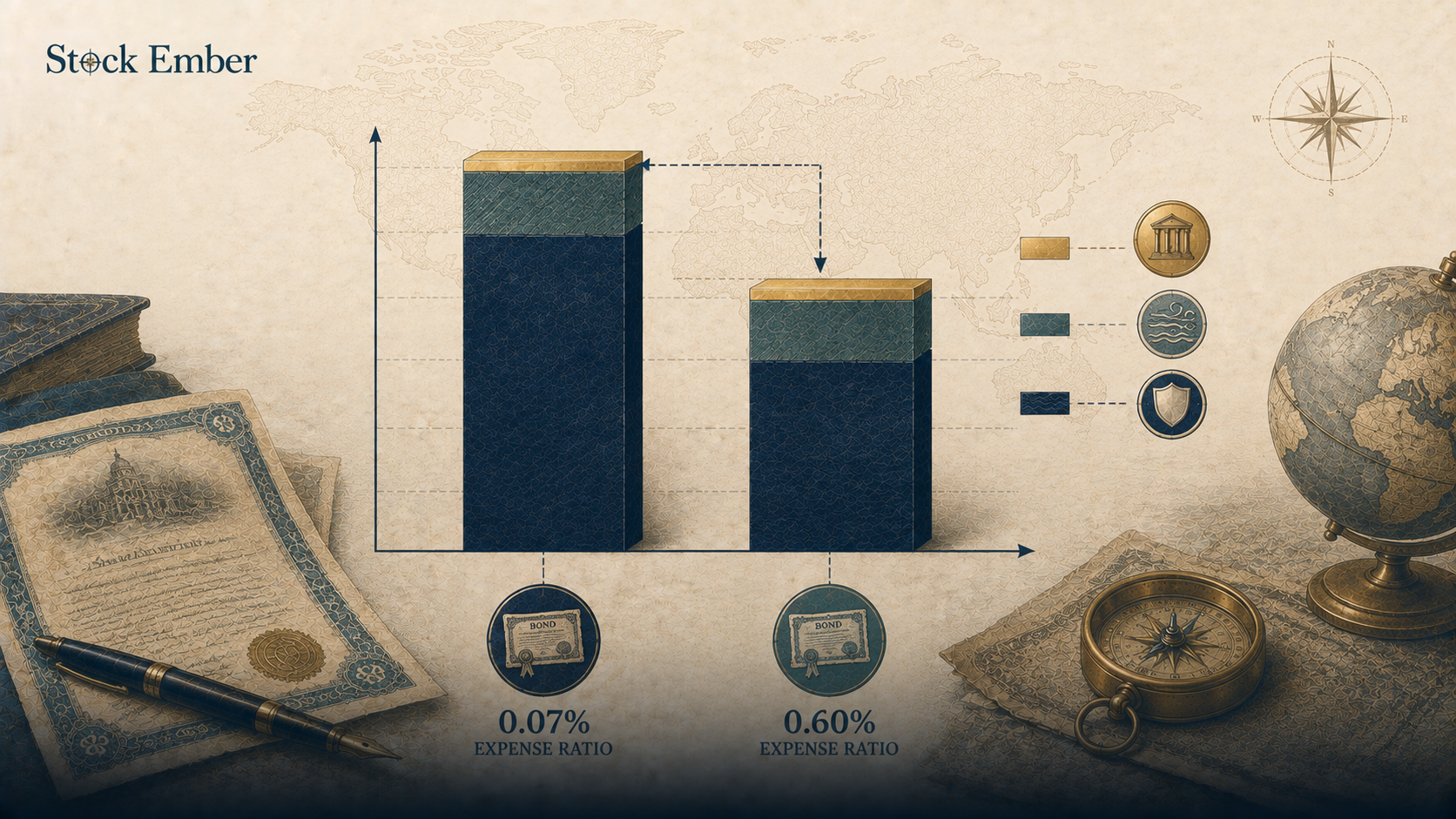
Consider an illustrative $100,000 investment held in a bond ETF over 10 years with a gross portfolio YTM of 4.5% before expenses:
Low-Cost Bond ETF (0.07% Expense Ratio): Deducting a 0.07% fee leaves a net annual yield of 4.43%. Over 10 years, your $100,000 investment grows to approximately $154,300.
Active Bond ETF (0.60% Expense Ratio): Deducting a 0.60% fee leaves a net annual yield of 3.90%. Over 10 years, the investment grows to approximately $146,600.
These figures are hypothetical illustrations based on constant assumed rates and are not a guarantee of future performance; actual bond ETF returns will vary with market conditions.
Over a decade, a 0.53% difference in annual fund fees removes over $7,600 in net earnings. For fixed-income investors seeking income stability, minimizing fee drag is critical to preserving long-term yield compounding.
Chart showing 10-year yield drag from expense ratios in bond ETFs
Managing Pitfalls: Reinvestment Risk, Inflation, and Zero-Coupon Dynamics
Managing YTM pitfalls requires recognizing the reinvestment rate assumption, accounting for inflation drag, and understanding how zero-coupon structures eliminate reinvestment risk.
While yield to maturity is a powerful calculation, relying on it blindly introduces three specific limitations:
The Reinvestment Rate Flaw: YTM math assumes that every periodic coupon payment is reinvested at the exact same YTM rate until maturity. In reality, interest rates constantly fluctuate, making it difficult to achieve that exact compounding rate over long horizons.
Inflation Risk: YTM represents a nominal return rate. If a bond offers a 4% YTM while annual inflation runs at 3.5%, your real purchasing power growth is only 0.5% per year before taxes.
Credit and Default Risk: YTM calculations assume the issuer pays all interest and principal on schedule. If a corporate issuer defaults, realized returns will fall far short of the starting YTM.
To eliminate coupon reinvestment risk entirely, investors can hold a zero coupon bond. Because zero-coupon bonds pay no periodic interest and sell at a deep discount, their YTM depends solely on the price difference at maturity, eliminating the need to reinvest intermediate cash flows.
Conclusion
Bond yield to maturity provides a reliable, standardized metric for evaluating total expected fixed-income returns across varying bond prices and maturities.
By combining annual coupon income with purchase price adjustments and time horizons, YTM gives long-term investors a clear framework for evaluating fixed-income performance. Keeping fund management fees low ensures that more of a bond's gross yield reaches your portfolio. As you construct your fixed-income allocation, balancing YTM expectations with credit quality and inflation protection remains essential for steady compounding.
When you are ready to explore low-cost fixed-income index funds, our ETF reviews offer comprehensive data to help you compare fund structures. Investing in bonds involves risk of loss, including credit default and interest rate volatility, so use this guide as educational context for your allocation decisions.
FAQ
5 questions
What is bond yield to maturity in simple terms?
Bond yield to maturity (YTM) is the total estimated return you receive annually if you buy a bond today and hold it until the issuer repays the principal. It includes both coupon interest payments and any gain or loss from buying the bond at a discount or premium.
What is the difference between coupon rate and yield to maturity?
A bond's coupon rate is the fixed interest percentage paid annually based on its face value. Yield to maturity measures total annualized return, incorporating the current market purchase price, coupon income, and time remaining until maturity.
Is yield to maturity a guaranteed return on a bond?
Yield to maturity is not an absolute guarantee. It assumes that the bond issuer does not default and that all periodic coupon payments are reinvested at the exact same YTM rate over time, which rarely occurs in fluctuating interest rate environments.
How do bond price changes affect yield to maturity?
Bond prices and yields move in opposite directions. If a bond's market price drops below face value (trading at a discount), its yield to maturity rises above its coupon rate. If the price rises above face value (trading at a premium), its YTM falls below the coupon rate.
How does reinvestment risk impact yield to maturity?
Reinvestment risk occurs when coupon payments are received and must be reinvested at prevailing market interest rates that are lower than the original YTM. Holding zero-coupon bonds eliminates reinvestment risk because no intermediate coupon payments are made.
Disclaimer
This guide was written with AI assistance and reviewed by the StockEmber editorial team for accuracy. StockEmber provides independent education, not personal financial advice. Some links may support our work at no additional cost to you.
The StockEmber Team is our in-house desk of independent research writers. We test brokerage platforms, read the fine print on fees and custody, and cover ETFs and long-horizon investing for people who plan to hold for decades — not days.