Bond market liquidity measures how easily fixed-income securities can be bought or sold in large quantities without causing significant price drops. Because most individual bonds trade over-the-counter rather than on central exchanges, liquidity varies widely across Treasuries, corporate debt, and municipal bonds.
Bond market liquidity is the ease with which fixed-income securities can be bought or sold in large quantities without causing significant changes in their market prices.
While major stocks trade continuously on central exchanges with transparent order books, most individual bonds trade over-the-counter across decentralized dealer networks. This structural difference creates varying liquidity levels across government, corporate, and municipal debt. This guide explains how secondary market liquidity works, evaluates 10-year trading friction, and shows how broad index ETFs help investors manage liquidity risks.
Quick Takeaways
01Bond market liquidity measures how quickly you can convert fixed-income assets into cash without taking a price haircut.
02Most individual bonds trade over-the-counter through private dealer inventories rather than central public exchanges.
03US Treasuries offer high liquidity, whereas corporate and municipal bonds frequently face wider bid-ask spreads.
04Broad bond index ETFs provide an extra layer of secondary market liquidity for individual investors.
What Is Bond Market Liquidity?
Bond market liquidity refers to how easily a fixed-income security can be converted into cash at a fair market price.
When you trade shares of a large public company, thousands of buyers and sellers meet on centralized exchanges like the Nasdaq or New York Stock Exchange. In contrast, the bond market operates predominantly as a decentralized over-the-counter (OTC) network. Buyers and sellers trade directly with financial institutions acting as market makers, who hold inventories of debt securities.
Official guidelines from FINRA highlight that bond liquidity depends heavily on dealer inventory and market-making capacity. Because a single company may issue dozens of different bond issues with distinct maturity dates and coupon rates, trading volume is split across thousands of individual securities. This fragmentation means many corporate and municipal bonds trade only a few times a week, creating trading friction for individual investors.
How Bond Market Liquidity Works: OTC Markets vs. Index ETFs
How bond liquidity functions depends on whether you trade individual debt issues in over-the-counter markets or hold exchange-traded fund shares.
In the OTC market, liquidity varies across different types of bonds:
Sovereign Debt (Treasuries): US Treasury bills and benchmark notes represent the most liquid fixed-income assets in the world, with continuous institutional trading and narrow bid-ask spreads.
Investment-Grade Corporate Bonds: Large corporate issues trade regularly, but secondary market activity drops off sharply for smaller corporate offerings.
Municipal and High-Yield Bonds: Frequently experience low trading volume, requiring investors to accept wider bid-ask spreads when buying or selling.
To solve this fragmentation, exchange-traded bond funds (ETFs) create a secondary trading layer. When you buy or sell a bond ETF, you trade shares on a stock exchange with other investors. Authorized participants (institutional market makers) create or redeem fund shares in the primary market only when necessary, shielding everyday investors from the illiquidity of individual underlying bonds.
The 10-Year Portfolio Lens: Trading Spreads, Market Shocks, and Holding Costs
Evaluating fixed-income liquidity over a 10-year horizon reveals how bid-ask spread costs and market shocks reduce net portfolio compounding.
The bid-ask spread represents the gap between the highest price a buyer is willing to pay and the lowest price a seller is willing to accept. When trading individual bonds, market makers charge this spread to compensate for the risk of holding illiquid inventory.
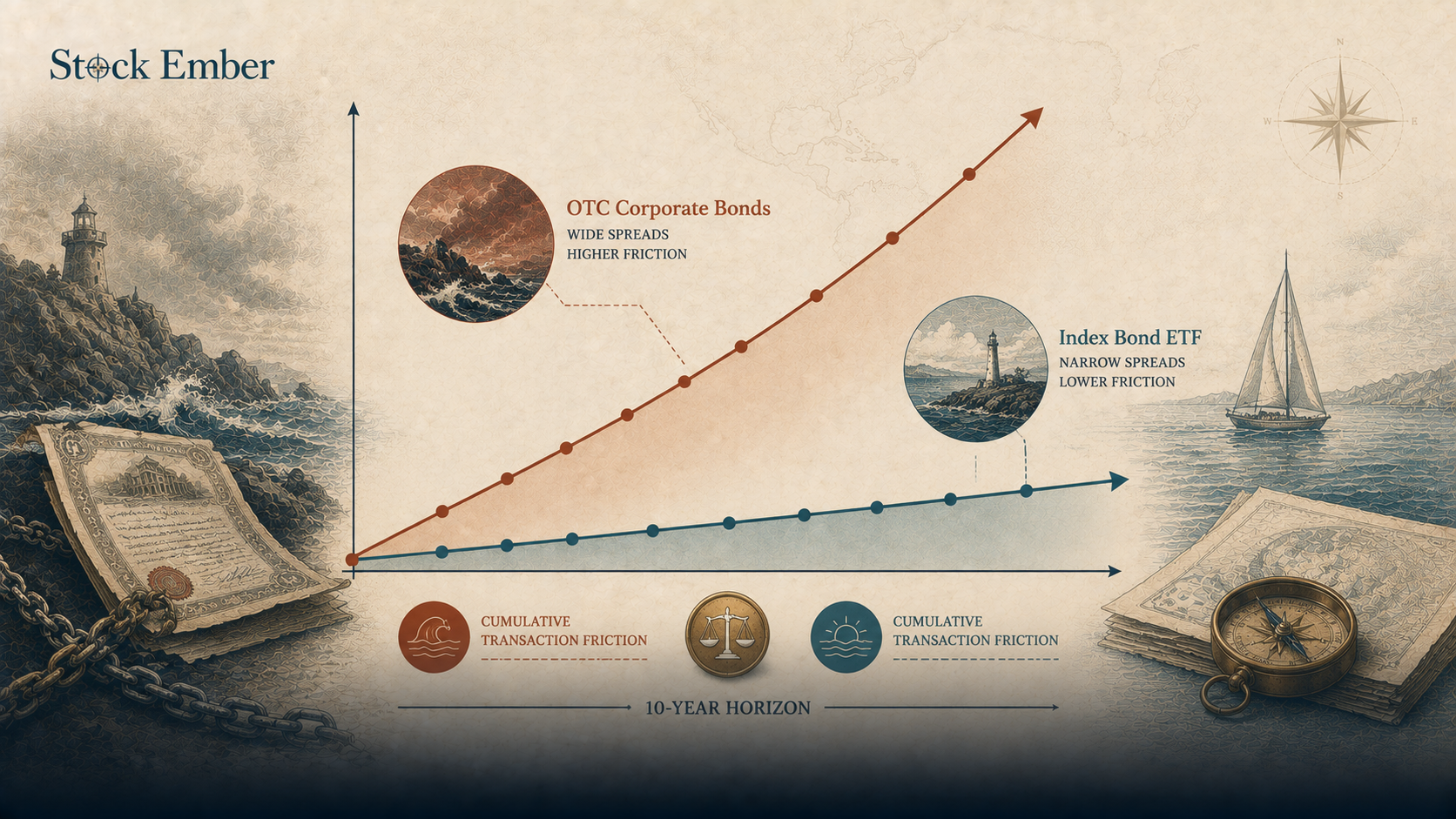
Consider a $50,000 corporate bond portfolio rebalanced periodically over a 10-year period:
Individual Corporate Bonds: Trading costs vary by bond and market conditions. Federal Reserve data shows that investment-grade corporate bond transaction costs were about 0.30% before rising sharply during the March 2020 market stress.
Broad Bond Index ETF: Tight ETF trading spreads (often 0.01% to 0.02%) keep total 10-year trading friction under $100 for the same portfolio size.
During the severe market stress of March 2020, liquidity in the corporate bond market deteriorated sharply as some dealers reduced their capacity to absorb bond sales. Bond ETFs continued to trade on exchanges during this period, although their bid-ask spreads and market prices could also come under pressure as liquidity in the underlying bond market deteriorated.
Chart showing 10-year trading cost comparison between individual OTC bonds and bond index ETFs.
Common Pitfalls: Confusing Yield with Liquidity and Panic Selling
The most frequent mistake fixed-income investors make is confusing a high coupon or yield with actual market liquidity.
A high yield to maturity often reflects both credit risk and a liquidity premium, extra yield required by the market to compensate for holding debt that is difficult to sell quickly. Buying an illiquid bond simply because it offers an attractive yield can leave you trapped if you need to access cash before maturity.
Another pitfall is panic selling during market drawdowns when bond funds trade at temporary discounts to their net asset value (NAV). During market shocks, the ETF price may drop slightly below the estimated value of its underlying bonds due to OTC illiquidity. Investors who sell during these temporary gaps lock in unnecessary price concessions.
In practice, many long-term investors find that holding core fixed income in broad index ETFs eliminates the hassle of sourcing individual bond quotes from dealers during routine portfolio rebalancing.
Conclusion
Understanding bond market liquidity allows you to structure a fixed-income allocation that balances predictable yield against trading accessibility. By recognizing how over-the-counter trading differs from stock exchanges, you can avoid unnecessary transaction costs and keep holding friction low over ten-year periods. When you are ready to evaluate broad fixed-income funds for your asset allocation, our ETF reviews provide a clear breakdown of low-cost options. All fixed-income investing involves market risks, including interest rate volatility and liquidity shifts during economic stress, so treat this guide as educational material rather than individual financial advice
FAQ
5 questions
Why is the bond market less liquid than the stock market?
Stocks trade on centralized exchanges with continuous public buy and sell orders, whereas individual bonds trade across decentralized over-the-counter (OTC) dealer networks. Because thousands of distinct bond issues exist with varying maturity dates and coupon rates, trading volume is fragmented.
What is the difference between individual bond liquidity and bond ETF liquidity?
Individual bonds rely on dealer inventory in the OTC market. Exchange-traded bond funds (ETFs) trade on stock exchanges, offering a secondary layer of liquidity that allows retail investors to buy and sell fund shares instantly without executing underlying bond trades directly.
What happens to bond market liquidity during economic crises?
During market stress, dealer financial institutions often reduce their balance sheet risk, widening bid-ask spreads and making lower-rated corporate and municipal debt harder to sell at fair market prices.
How does the bid-ask spread affect long-term bond returns?
The bid-ask spread represents the transaction cost charged by market makers. Wide spreads increase the cost of buying or selling individual bonds, acting as a drag on net investment returns over time.
Which fixed-income securities offer the highest liquidity?
Sovereign debt, particularly short-term US Treasury bills and benchmark notes, offers the highest liquidity in global fixed-income markets due to constant trading volume and tight bid-ask spreads.
Disclaimer
This guide was written with AI assistance and reviewed by the StockEmber editorial team for accuracy. StockEmber provides independent education, not personal financial advice. Some links may support our work at no additional cost to you.
The StockEmber Team is our in-house desk of independent research writers. We test brokerage platforms, read the fine print on fees and custody, and cover ETFs and long-horizon investing for people who plan to hold for decades — not days.