An investment grade bond is a debt security issued by a corporation or government that credit rating agencies evaluate as having a low risk of default. They offer regular coupon income and relative capital stability compared to high-yield or junk debt.
An investment grade bond is a debt security issued by a corporation or government that credit rating agencies evaluate as having a low risk of default.
Understanding credit quality is essential when adding fixed income to your portfolio. While higher-rated debt offers greater capital preservation, it yields less than speculative securities. This guide answers what is an investment grade bond, breaks down its ratings scales, contrasts them with junk bond ratings, and explains how to evaluate credit risk over a 10-year holding horizon.
Quick Takeaways
01Investment grade bonds represent debt securities rated BBB-/Baa3 or higher by major credit rating agencies.
02They carry significantly lower default risk than high-yield securities, offering regular coupon income and relative capital stability.
03Triple-B rated bonds form the lowest investment grade tier and remain vulnerable to economic downgrades.
04Over a 10-year period, interest rate swings and inflation drag can impact real fixed-income returns even when default risk is low.
What Is an Investment Grade Bond?
To answer this question, you must examine how independent credit agencies measure a borrower's ability to repay debt.
When a company or government agency issues bonds to raise capital, independent rating organizations, primarily Standard & Poor’s (S&P), Moody’s, and Fitch assess the issuer's financial strength. They assign a letter grade reflecting the likelihood that the borrower will make all interest and principal payments on time.
Bonds receiving high rating marks are classified as investment grade. Institutional investors, pension funds, and conservative individuals hold these debt instruments to anchor portfolios, preserve capital, and generate predictable yield. When structuring a fixed-income allocation, understanding how different types of bondsperform across various credit environments helps balance risk against return objectives.
Investment Grade Bond Ratings vs. Junk Bond Ratings
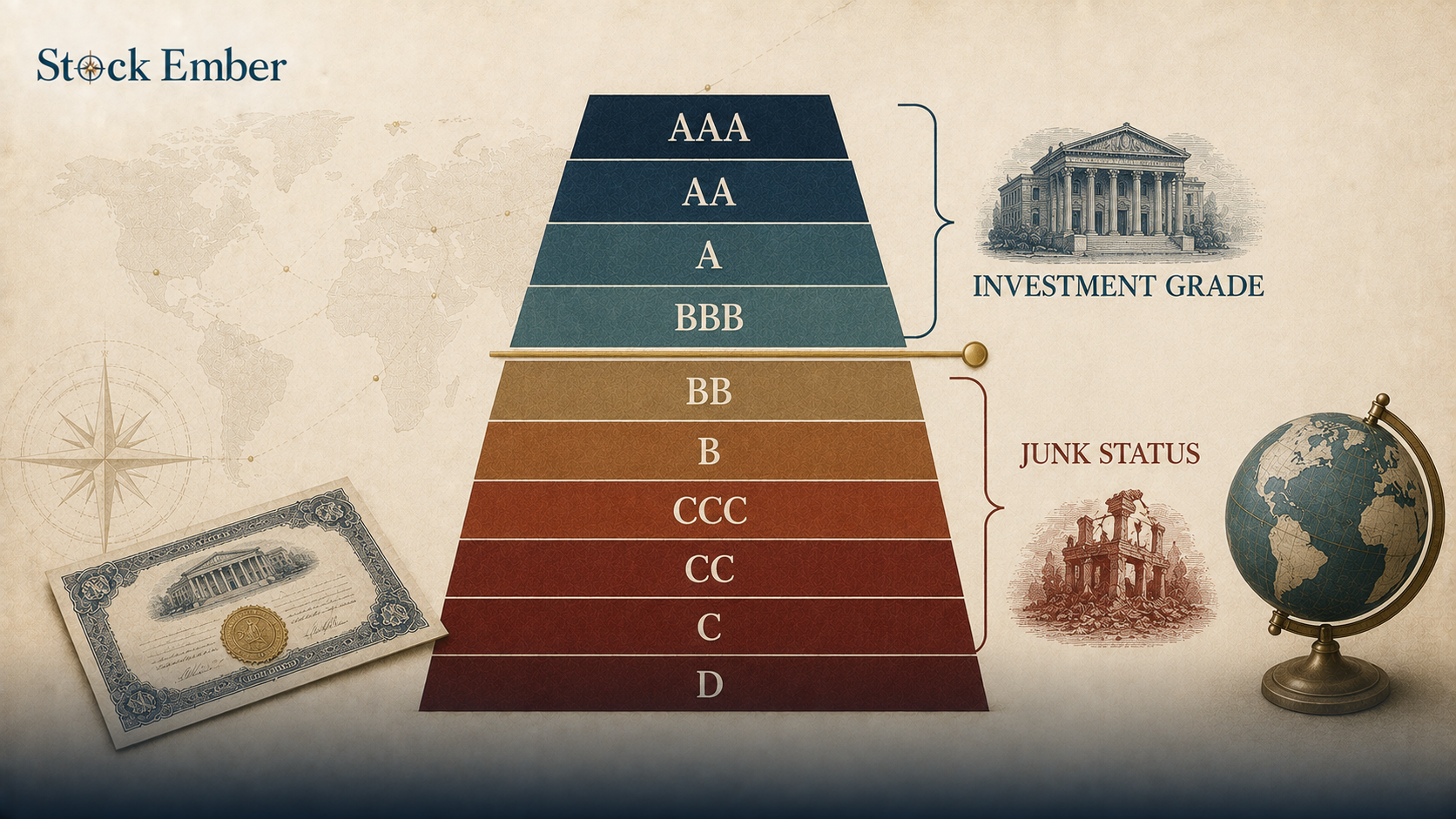
The bond market divides debt into two primary categories separated by a strict rating threshold: investment grade and high-yield (or junk) debt.
Credit rating agencies use standardized scales to categorize corporate and government debt. The top tiers represent prime borrowers with exceptionally strong financial cushions, while lower tiers reflect increasing levels of credit risk.
Credit Tier
S&P / Fitch Rating
Moody's Rating
Default Risk Profile
Highest Quality (Prime)
AAA
Aaa
Minimal default risk; strongest balance sheets
High Quality
AA+, AA, AA-
Aa1, Aa2, Aa3
Very low default risk; strong repayment capacity
Upper Medium
A+, A, A-
A1, A2, A3
Low default risk; susceptible to economic shifts
Lower Medium (Lowest IG)
BBB+, BBB, BBB-
Baa1, Baa2, Baa3
Moderate default risk; lowest investment grade status
Understanding this ratings threshold requires watching the exact boundary line. A rating of BBB- (from S&P or Fitch) or Baa3 (from Moody's) marks the final step of investment grade status.
If an agency downgrades a company from BBB- to BB+, the debt receives a junk bond rating. Because many institutional funds are legally restricted from holding high-yield debt, crossing into junk bond ratings often triggers forced selling, causing the bond's market price to drop sharply. To compensate for this elevated risk, issuers with junk bond ratings must offer higher bond coupon rates to attract buyers.
Scale comparing investment grade bond ratings against junk bond ratings.
The 10-Year Portfolio Lens: Credit Risk, Inflation, and Fees
Evaluating fixed-income performance over a 10-year period reveals how holding fees, inflation, and credit downgrades impact long-term capital.
Official guidance from Investor.gov notes that while high-grade bonds reduce default exposure, they remain subject to market price swings caused by changing interest rates.
Consider a $50,000 investment held over a 10-year horizon across two corporate bond fund structures:
High-Fee Active Bond Fund: An actively managed corporate bond fund charging a 0.55% annual expense ratio with a 4.5% gross annual return would grow a $50,000 investment to approximately $73,700 over 10 years, compared with about $77,600 before fees. The difference is roughly $4,000.
Low-Cost Index Bond ETF: A broad market bond index fund charging a 0.06% expense ratio with the same 4.5% gross annual return would grow the investment to approximately $77,200 over 10 years, about $445 less than the no-fee scenario.
Today, BBB-rated corporate bonds account for about 44% of the Bloomberg U.S. Corporate Bond Index, based on Vanguard data as of June 30, 2026. During economic downturns, a wave of downgrades can push weaker BBB issuers into below-investment-grade territory, potentially putting downward pressure on bond prices.
Common Pitfalls: The BBB Trap and Inflation Erosion
Investors frequently make three major mistakes when allocating money to high-grade bond funds.
First, many confuse low default risk with complete price stability. Even AAA-rated bonds drop in market value when central banks raise interest rates. If you need to sell a long-term bond before maturity during a high-rate environment, you may experience a capital loss regardless of the issuer's credit rating.
Second, investors often ignore inflation erosion. A corporate bond paying a fixed 4% coupon yield delivers negative real growth if inflation averages 4.5% over your holding period.
Third, portfolio managers sometimes take on hidden credit risk by reaching for yield within the lowest investment grade band without monitoring corporate debt levels.
In practice, many conservative investors use broad-market IG bond index ETFs rather than holding individual corporate issues to eliminate single-company downgrade risk.
Conclusion
Investment grade bonds provide reliable income and capital stability, making them a useful tool for balancing equity market volatility. By understanding credit rating scales and avoiding heavy concentration in borderline BBB debt, you can build a resilient fixed-income allocation. When you are ready to evaluate low-cost fixed-income funds for your portfolio, our ETF reviews offer a clear breakdown of broad-market index options. Investing involves risk including potential loss of principal, so treat this guide as educational material rather than individual financial advice.
FAQ
5 questions
What is an investment grade bond?
An investment grade bond is a debt instrument issued by a corporate or government entity that receives a rating of BBB-/Baa3 or higher from major rating agencies. This rating indicates that the borrower carries a low risk of defaulting on interest and principal payments.
What is the threshold between investment grade and junk bond ratings?
The cutoff line sits between BBB- (Baa3 on Moody's scale) and BB+ (Ba1 on Moody's scale). Ratings at or above BBB- represent investment grade debt, while ratings at or below BB+ receive a speculative or junk bond rating.
What are the main investment grade bond ratings scales?
Major credit agencies like S&P, Moody's, and Fitch grade debt using letter scales. AAA/Aaa represents prime high-quality debt, AA/Aa represents high quality, A/A represents upper-medium quality, and BBB/Baa represents lower-medium quality.
What happens when an investment grade bond drops to a junk bond rating?
When a bond rating drops below BBB-, the debt becomes a "fallen angel" with a junk bond rating. Many institutional funds are required by policy to sell non-investment grade debt, often causing temporary price drops for the affected bond.
Are investment grade bonds safe from capital loss?
While investment grade bonds carry low default risk, they are not risk-free. Their market values drop when benchmark interest rates rise, and fixed coupon payments can lose buying power during periods of high inflation.
Disclaimer
This guide was written with AI assistance and reviewed by the StockEmber editorial team for accuracy. StockEmber provides independent education, not personal financial advice. Some links may support our work at no additional cost to you.
The StockEmber Team is our in-house desk of independent research writers. We test brokerage platforms, read the fine print on fees and custody, and cover ETFs and long-horizon investing for people who plan to hold for decades — not days.