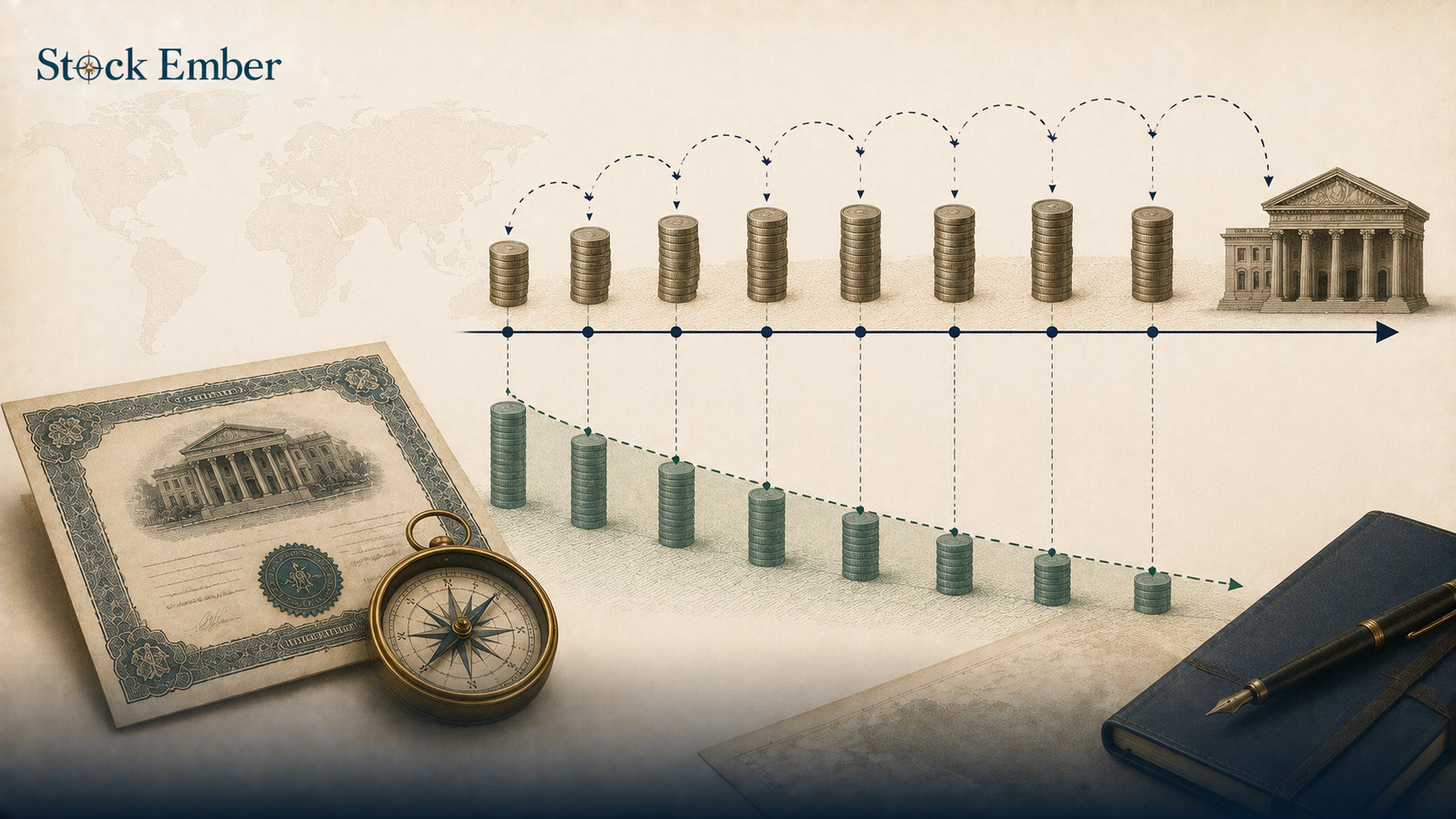
A bond coupon rate is the fixed annual interest rate paid by a bond issuer relative to the bond's original face (par) value, expressed as a percentage. It determines the predictable annual cash flow an investor receives throughout the bond's lifespan.
A bond coupon rate is the fixed annual interest payment an issuer promises to pay a bondholder, expressed as an exact percentage of the bond's par value.
Seeing a bond offering a fixed 5% or 6% payout sounds simple enough, but fixed income mechanics can quickly confuse new investors when market prices shift. Understanding how coupon distributions work helps you evaluate real portfolio cash flow. This guide explains what a bond coupon rate is, how to calculate payouts, and how inflation affects fixed interest over a 10-year horizon.
Quick Takeaways
01The coupon rate is the fixed annual interest percentage paid on a bond's original face value.
02A bond's coupon rate stays fixed throughout its lifecycle, while its market yield moves as bond prices fluctuate.
03Fixed coupon distributions lose real purchasing power if annual inflation rates rise above the coupon rate.
04Long-term investors must evaluate total return after accounting for management fees and price changes, not coupon yield alone.
What Is a Bond Coupon Rate?
To answer what is a bond coupon rate, you must look at the contractual agreement between a borrower and a lender.
When a company or government agency issues a bond, it sets a fixed face value, usually $1,000 known as par value. The issuer promises to pay the bondholder a specific percentage of that par value every year until the bond matures. Asking what is the coupon rate of a bond simply means identifying this fixed interest percentage.
The term originated in the era of physical paper bonds. Investors literally clipped physical paper coupons from the bond certificate and turned them in to receive their regular interest payments. Today, payments are electronic, but the underlying mechanism remains identical.
Whether you are asking what is the coupon rate of a bond or what is a coupon rate for a bond, the core definition is the same. Official guidelines from the US Securities and Exchange Commission explain that a bond's nominal coupon remains fixed from issuance to maturity, providing predictable income regardless of broader market fluctuations.
How to Calculate the Coupon Rate of a Bond
Learning how to calculate the coupon rate of a bond requires only two variables: the total annual interest payment and the bond's par value.
The Coupon Rate Formula
To determine the exact coupon rate of a bond, divide the total annual interest dollar amount by the face value and multiply by 100:
For example, if a bond with a $1,000 par value pays $50 in interest each year (often split into two $25 semiannual payments):
Coupon Rate = ($50 / $1,000) * 100 = 5.0%
Coupon Rate vs. Current Yield vs. Yield to Maturity
A common point of confusion is mixing up the fixed coupon rate with fluctuating market yields. While the coupon percentage never changes, the market price of a bond moves up and down daily based on prevailing interest rates.
Metric
What It Measures
Changes Over Time?
Coupon Rate
Annual interest paid as a percentage of original par value ($1,000)
Fixed permanently
Current Yield
Annual interest paid divided by the current market price
Moves daily with market price
Yield to Maturity (YTM)
Total expected return if held until maturity, including price gains or losses
Moves daily with market price
If interest rates rise in the broader economy, newly issued bonds offer higher coupons. To compete, existing bonds with lower coupons must drop in market price, trading at a discount. Conversely, if interest rates fall, existing higher-coupon bonds trade at a premium.
The 10-Year Portfolio Lens: Inflation, Fees, and Market Price Movements
Evaluating fixed-income payouts over a 10-year horizon highlights how inflation and fund management expenses alter the real value of fixed coupon distributions.
When allocating capital across different types of bonds, relying solely on nominal interest figures can create a false sense of security.
Consider a $20,000 investment in a corporate bond fund paying a fixed 4.5% annual coupon:
Nominal Annual Cash Flow: $900 per year ($9,000 over 10 years).
Annual Fund Expenses: A 0.45% expense ratio takes $90 annually in management costs.
Inflation Drag: If annual inflation averages 3.0%, the purchasing power of that fixed $900 payout declines every single year.
After 10 years, the nominal cash received remains unchanged, but its real buying power is reduced by nearly a quarter.
Additionally, individual bond prices can experience temporary swings before maturity. For investors trading fixed-income funds on secondary exchanges, bond market liquidity dictates how easily you can buy or sell shares near their actual net asset value without suffering price slippage.
Chart showing how inflation reduces the buying power of fixed bond coupon payments over time.
Common Pitfalls: The High Coupon Trap and Rate Volatility
The most frequent mistake beginner investors make is selecting bonds based on high coupon rates alone.
A company offering a 9% or 10% coupon rate usually does so because credit rating agencies view its business as higher risk. If the firm faces financial distress, it may default on its debt obligations, wiping out both coupon payments and principal capital.
Another pitfall is assuming that a fixed coupon rate protects you against interest rate swings. If benchmark interest rates double, the market value of your lower-yielding bond will fall. While you still receive the promised coupon if you hold to maturity, selling early forces you to realize a market loss.
In practice, many buy-and-hold investors prefer low-cost broad bond index ETFs over individual bonds because the fund automatically reinvests distributions and balances interest rate exposure across thousands of issues.
Conclusion
A bond coupon rate provides a clear, contractual measure of fixed annual interest income relative to par value. By separating fixed coupon distributions from fluctuating market yields, you can better manage interest rate risks and protect your buying power against inflation over ten-year periods. When you are ready to evaluate low-cost fixed-income index funds for your long-term asset allocation, our ETF reviews offer a clear breakdown of broad-market options. Fixed-income investments carry market risk including inflation and interest rate sensitivity, so treat this guide as educational context rather than individual financial advice.
FAQ
5 questions
What is the coupon rate of a bond?
The coupon rate of a bond is the fixed annual interest payment an issuer promises to pay relative to the bond's original par (face) value, expressed as a percentage. For example, a $1,000 bond paying $50 per year has a 5% coupon rate.
What is the difference between a bond's coupon rate and its current yield?
A bond's coupon rate remains permanently fixed based on its original par value. Its current yield moves up and down daily because it calculates annual interest relative to the bond's fluctuating market price.
Why do bond prices fall when market interest rates rise?
When prevailing market interest rates rise, new bonds offer higher coupon payouts. To compete for buyers, older existing bonds with lower fixed coupon rates must drop in market price to trade at a discount.
How does inflation affect fixed bond coupon payments?
While the nominal dollar payment from a fixed coupon rate remains constant, rising inflation reduces the purchasing power of those cash distributions over time.
Does a higher bond coupon rate indicate a safer investment?
No. Issuers offering unusually high coupon rates typically carry lower credit ratings and higher default risk, requiring higher yields to compensate investors for elevated risk.
Disclaimer
This guide was written with AI assistance and reviewed by the StockEmber editorial team for accuracy. StockEmber provides independent education, not personal financial advice. Some links may support our work at no additional cost to you.
The StockEmber Team is our in-house desk of independent research writers. We test brokerage platforms, read the fine print on fees and custody, and cover ETFs and long-horizon investing for people who plan to hold for decades — not days.