Treasury Inflation-Protected Securities (TIPS) are U.S. government bonds designed to protect investor purchasing power by adjusting their principal value according to changes in the Consumer Price Index (CPI-U). When inflation rises, the principal scales upward, causing semi-annual coupon payments to increase proportionally.
Treasury Inflation-Protected Securities (TIPS) are U.S. government bonds designed to protect investors from inflation by adjusting their principal value based on changes in the Consumer Price Index.
When inflation rises, traditional fixed-income investments lose purchasing power over time. Incorporating inflation-indexed bonds helps preserve real wealth during periods of rising prices. This guide explains how TIPS work, how coupon payments adjust over time, and how to evaluate their role in a multi-year portfolio.
Quick Takeaways
01Treasury Inflation-Protected Securities adjust principal values upward with inflation and downward with deflation based on the Consumer Price Index.
02Semi-annual interest payments fluctuate because the fixed coupon rate applies to the inflation-adjusted principal rather than the original par value.
03At maturity, investors receive either the inflation-adjusted principal or the original par value, whichever is higher.
04Secondary market prices fluctuate based on shifts in real interest rates (the nominal rate minus expected inflation) rather than nominal interest rates.
What Are Treasury Inflation-Protected Securities?
Treasury Inflation-Protected Securities, commonly known as TIPS, are debt obligations issued by the U.S. government specifically designed to shield investor purchasing power from inflation.
Unlike standard fixed-income instruments, the principal value of a TIPS bond increases with inflation and decreases with deflation.When evaluating different types of bonds for a portfolio, understanding how inflation protection alters cash flows is essential. While traditional Treasury bonds pay a fixed interest rate on a static principal amount, TIPS adjust their underlying value continuously using official economic benchmarks.
Understanding what TIPS are starts with recognizing their backing. Because these bonds are backed by the full faith and credit of the U.S. government, credit default risk is negligible. According to investor education materials from the U.S. Securities and Exchange Commission, government-backed securities carry minimal default risk, though secondary market price fluctuations remain a factor for investors selling before maturity.
For long-term investors, TIPS offer a direct mechanism to maintain purchasing power across multi-year holding periods.
How TIPS Work: CPI Indexation and Coupon Mechanics
The mechanics of TIPS rely on adjustments linked to the Consumer Price Index for All Urban Consumers (CPI-U), published monthly by the U.S. Bureau of Labor Statistics.
When you buy a TIPS bond, it comes with a fixed coupon rate determined at auction. However, the interest payment you receive every six months is not fixed in dollar terms. Instead, the U.S. Treasury applies the fixed coupon rate to the inflation-adjusted principal.
The calculation follows two basic steps:
Adjusted Principal = Original Par Value * (Current CPI / Base CPI)
For example, suppose you purchase a 10-year TIPS bond with a $1,000 par value and a fixed coupon rate of 2%. If inflation rises by 3% in your first year, the principal value increases to $1,030. Your annual interest payment is calculated using the updated principal, raising your 2% coupon payment from $20 to $20.60 per year.
TIPS also feature a built-in deflation floor. If the economy experiences cumulative deflation over the bond's lifespan, the principal value drops below $1,000. However, at maturity, the U.S. Treasury guarantees you will receive either the higher inflation-adjusted principal or the original $1,000 par value.
TIPS vs. Nominal Treasuries: Understanding the Breakeven Rate
Choosing between TIPS and nominal U.S. Treasuries depends on market expectations of future inflation, represented by the breakeven inflation rate.
Nominal Treasuries offer a fixed yield that accounts for both expected inflation and a real rate of return. TIPS, by contrast, yield a real return directly. The difference in yield between a nominal Treasury and a TIPS bond of the same maturity reveals the market's expected inflation rate.
If a 10-year nominal Treasury yields 4.0% and a 10-year TIPS yields 1.5%, the breakeven inflation rate is 2.5%.
If actual annual CPI inflation averages more than 2.5% over the next decade, holding TIPS delivers a higher total return than nominal Treasuries. Conversely, if average inflation stays below 2.5%, the traditional nominal Treasury generates better overall income. Evaluating this rate helps buy-and-hold investors avoid paying too much for inflation protection when market expectations are already elevated.
Key Portfolio Risks: Real Rates, Duration, and Phantom Tax
While TIPS eliminate inflation risk, they introduce distinct risks that long-term investors must manage carefully.
The primary driver of TIPS market prices is the movement of real interest rates. If real interest rates rise, the market price of existing TIPS falls, even during periods when inflation is elevated. Investors managing bond duration must realize that long-term TIPS carry substantial price volatility if traded on the secondary market prior to maturity.
Another key issue is tax treatment in taxable accounts, known as "phantom income." The Internal Revenue Service (IRS) treats the annual upward adjustment of your principal as taxable income in the year it occurs. You will not actually receive that cash adjustment until the bond matures or is sold.
In practice, many long-term investors find that holding TIPS inside taxable brokerage accounts creates unnecessary cash-flow drag due to annual tax liabilities on unpaid principal adjustments.
Individual TIPS vs. TIPS ETFs: Fixed Maturity vs. Continuous Duration
Investors can hold TIPS either as individual bonds purchased directly or through exchange-traded funds (ETFs). Each approach changes how duration and cash flows behave.
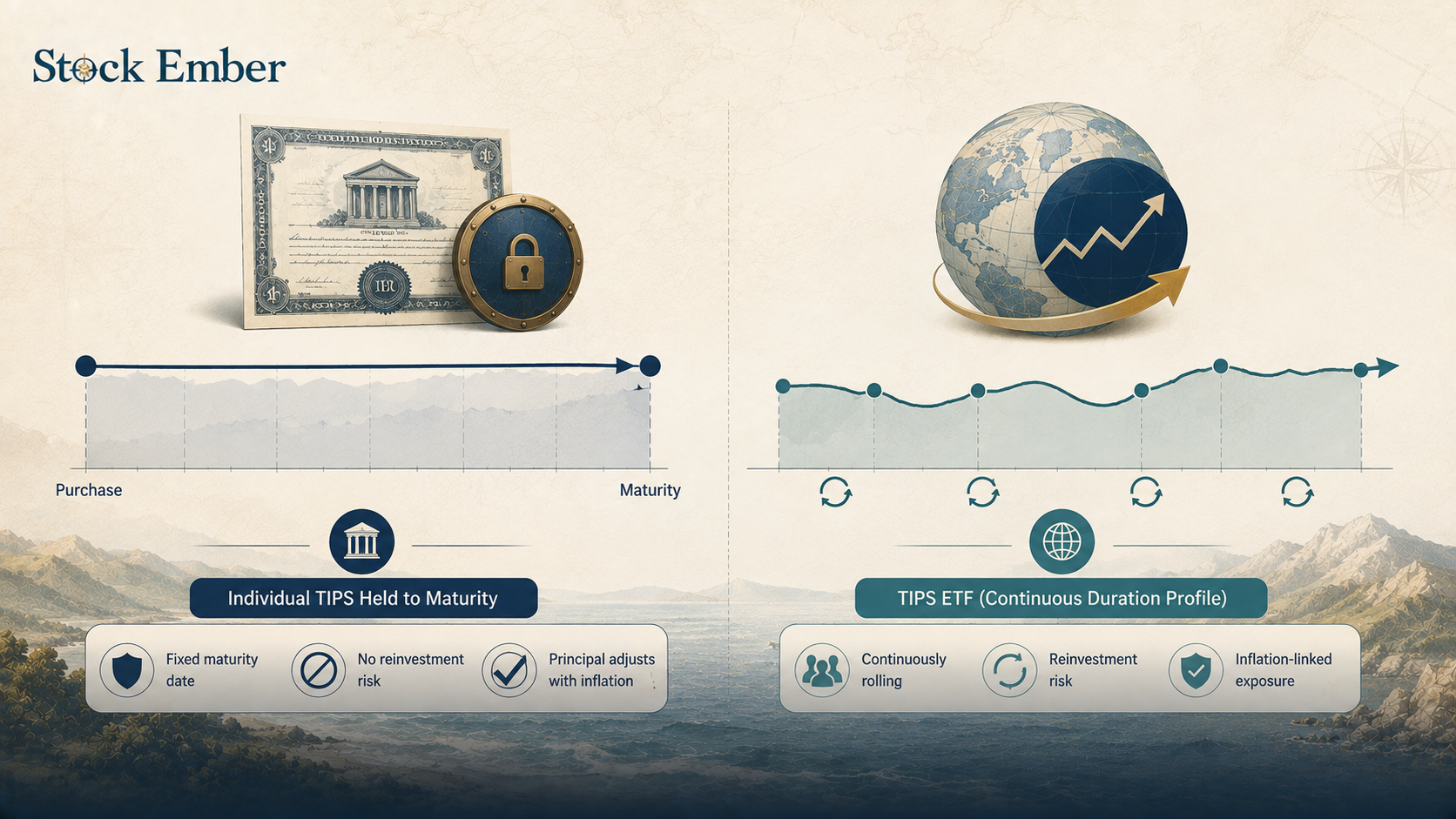
Holding individual TIPS bonds allows you to lock in a specific real yield if held to maturity. Because individual bonds pay out their full adjusted principal at a defined date, secondary market price fluctuations during the bond's lifespan become irrelevant to buy-and-hold investors who keep the security until it matures.
In contrast, TIPS ETFs hold a basket of inflation-protected bonds and continually roll maturing bonds into new issues to maintain a target maturity range. Because a TIPS ETF has no fixed maturity date, its share price moves constantly with shifts in real interest rates. During periods of sharp interest rate increases, a TIPS fund can suffer noticeable capital losses, offsetting the benefit of short-term CPI adjustments.
The Hidden 10-Year Opportunity Cost of Low Real Yields
Allocating capital to low real yield assets creates a silent 10-year opportunity cost that can slow long-term portfolio growth.
When real yields on TIPS are near zero or negative, the security preserves existing purchasing power but provides little real capital expansion. Locking significant capital into low real yields over a full market cycle deprives your portfolio of higher compounding opportunities.
Consider a hypothetical comparison over a 10-year period. Suppose an investor places $10,000 into TIPS yielding a real return of 0.5% after inflation. After 10 years, that investment grows to approximately $10,511 in real purchasing power.
If that same $10,000 were allocated to a diversified broad equity index earning a hypothetical real return of 5.5% after inflation, the real value expands to roughly $17,081 over the decade. While TIPS offer stability, over-allocating to them during low real yield regimes can cost an investor over $6,500 in lost real growth per $10,000 invested.
How to Allocate TIPS in a Long-Term Portfolio
Integrating TIPS into a portfolio requires matching asset duration with future expenditure goals and using tax-efficient accounts.
To get the most value from inflation protection, keep these practical practices in mind:
Use Tax-Advantaged Accounts: Hold individual TIPS or TIPS funds inside traditional IRAs, Roth IRAs, or 401(k) plans. This shields annual principal adjustments from phantom income tax drag.
Align Maturity with Investment Horizon: Match the maturity date of individual TIPS bonds with future cash needs, such as retirement expenses or funding education.
Maintain Balance with Equities: Treat TIPS as a fixed-income stabilization component rather than a primary growth driver, keeping the core portfolio focused on long-term compound growth.
Conclusion
TIPS provide a structured way to preserve purchasing power against rising living costs by adjusting principal values directly to CPI figures. While individual TIPS guarantee inflation-adjusted par values at maturity, price volatility from real interest rate shifts and annual phantom income tax drag require careful asset placement. Balancing TIPS allocations against long-term compounding assets keeps portfolios protected without sacrificing growth.
When evaluating fixed-income options and broader portfolio structures, reviewing our ETF reviews offers a natural next step. Investing carries market risk and past performance does not guarantee future results, making clear personal research essential before adjusting your allocations.
FAQ
5 questions
How Do Treasury Inflation-Protected Securities Work?
TIPS adjust their underlying principal value based on monthly Consumer Price Index (CPI-U) data published by the U.S. Bureau of Labor Statistics. When CPI increases, the principal scales upward; during deflation, it scales downward. Semi-annual interest payments are calculated by multiplying a fixed coupon rate by the inflation-adjusted principal.
What is the main risk of holding TIPS?
The primary market risk for TIPS is sensitivity to changes in real interest rates. If real interest rates rise, secondary market prices for TIPS fall, which can lead to capital losses if sold prior to maturity. Additionally, principal adjustments create annual phantom income tax liabilities in taxable accounts.
What is phantom income on TIPS?
Phantom income refers to federal income taxes owed on the annual inflation adjustment applied to a TIPS bond's principal. The IRS taxes this upward principal adjustment in the calendar year it occurs, even though the investor does not receive the cash adjustment until the bond matures or is sold.
What is the difference between individual TIPS and TIPS ETFs?
Individual TIPS carry a fixed maturity date that guarantees payout of either the inflation-adjusted principal or original par value at maturity, whichever is higher. TIPS ETFs hold a portfolio of inflation-indexed bonds without a fixed maturity date, exposing investors continuously to secondary market price shifts driven by real interest rates.
What is the breakeven inflation rate?
The breakeven inflation rate is the yield difference between a standard nominal Treasury bond and a TIPS bond of equal maturity. If actual CPI inflation exceeds this breakeven rate over the holding period, individual TIPS generate a higher total return than equivalent nominal Treasuries.
Disclaimer
This guide was written with AI assistance and reviewed by the StockEmber editorial team for accuracy. StockEmber provides independent education, not personal financial advice. Some links may support our work at no additional cost to you.
The StockEmber Team is our in-house desk of independent research writers. We test brokerage platforms, read the fine print on fees and custody, and cover ETFs and long-horizon investing for people who plan to hold for decades — not days.