UK gilts are sovereign bonds issued by HM Treasury via the Debt Management Office to finance public expenditure. They pay fixed or inflation-linked interest payments over a specified term and return the full nominal principal when the bond reaches maturity.
Gilts are sovereign debt securities issued by the British government to raise capital for public spending. When you buy a gilt, you are lending money to HM Treasury in exchange for regular interest payments and full principal repayment at maturity.
Investors often look to gilts when they want predictable income and capital stability inside a broader portfolio. While these instruments carry near-zero default credit risk, secondary market prices still move when market interest rates shift. This guide explains how gilts work, how conventional and index-linked options differ, and how to evaluate their 10-year holding costs.
Quick Takeaways
01UK gilts are sovereign bonds issued by HM Treasury through the UK Debt Management Office to fund government expenditure.
02Conventional gilts pay a fixed semi-annual interest payment, whereas index-linked gilts adjust coupon payments and principal for inflation.
03Sovereign backing provides strong credit safety, but secondary gilt prices fluctuate whenever prevailing interest rates change.
04Individual gilts generally generate coupon income that may be subject to Income Tax, while gains on the disposal of gilts are exempt from Capital Gains Tax for UK individual investors.
What Are UK Gilts?
UK gilts short for "gilt-edged securities" are sovereign bonds issued by HM Treasury through the UK Debt Management Office to fund government budgets and public infrastructure.
Historically, paper gilt certificates featured gilded edges to signify the high creditworthiness of the British Crown. Today, gilts exist as digital instruments, but the name remains standard across financial markets.
Every gilt operates on three core terms:
Par Value (Face Value): The nominal value of the gilt, typically set at £100 per unit. This is the exact amount the government promises to repay when the bond reaches its maturity date.
Coupon Rate: The annual fixed interest rate paid on the par value. For example, a 4% coupon gilt pays £4 every year for each £100 unit held, split into two equal semi-annual payments of £2.
Maturity Date: The specific future date on which the government redeems the bond and pays back the full £100 principal to the holder.
Because gilts are backed by the taxing power of HM Treasury, default risk is extremely low. However, holding a gilt to maturity is very different from selling it early on the secondary market.
Conventional vs. Index-Linked Gilts
The UK government issues two main types of sovereign bonds: conventional gilts and index-linked gilts.
Conventional gilts are the standard form of sovereign debt. They pay a fixed cash coupon twice a year and return the £100 nominal principal at maturity. Because the cash payments are fixed from the day of issuance, inflation slowly reduces the real purchasing power of those future payments.
Index-linked gilts address purchasing power risk directly. With an index-linked gilt, both the semi-annual coupon payment and the final principal repayment adjust in line with the UK Retail Prices Index (RPI). From February 2030, the UK Statistics Authority plans to bring CPIH methods and data sources into the calculation of RPI. If inflation rises over a ten-year holding period, the nominal value of your interest payments and final principal increases accordingly.
In practice, many long-term investors allocate to conventional gilts when seeking fixed nominal income, while choosing index-linked gilts when hedging against multi-year inflationary spikes.
Feature
Conventional Gilts
Index-Linked Gilts
Coupon Payment
Fixed cash amount paid semi-annually
Adjusts upward or downward with inflation
Principal Repayment
Fixed £100 per unit at maturity
Adjusted for cumulative inflation at maturity
Primary Risk
Purchasing power loss during inflation
Underperformance if inflation stays low
Primary Use
Predictable nominal income
Protection against rising living costs
The Mechanics: How Yields, Prices, and Interest Rates Interact
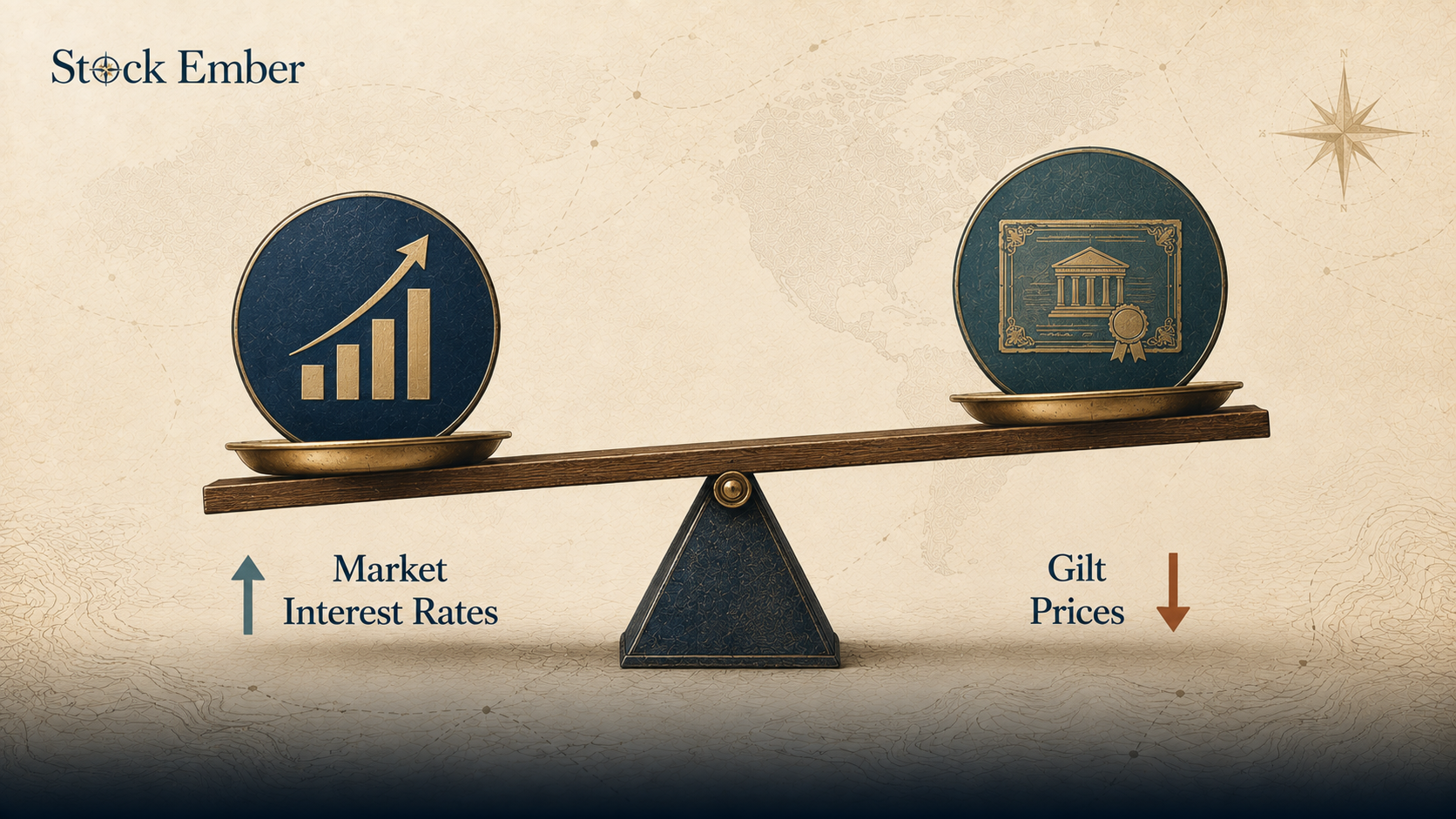
Gilt market prices and prevailing interest rates move in opposite directions.
When central banks raise benchmark interest rates, newly issued bonds offer higher yield payouts to attract buyers. As a result, existing gilts with lower coupon rates become less attractive, causing their market prices on the secondary market to fall. Conversely, when central bank interest rates drop, existing gilts with higher fixed coupons rise in market price.
To evaluate a gilt on the open market, investors look beyond the nominal coupon rate to the yield to maturity, the total annual return expected if you buy the gilt at its current market price and hold it until maturity.
Yield to Maturity = (Annual Coupon + ((Par Value − Market Price) / Years to Maturity)) / Market Price
For instance, if a gilt with a £100 par value and a 3% coupon trades at a discounted market price of £90 with five years remaining, your yield to maturity accounts for both the £3 annual coupon and the £10 capital gain when the bond matures at £100.
Diagram showing how gilt prices fall when interest rates rise.
The 10-Year Portfolio Lens: Role and Holding Costs
Within a broad portfolio framework, gilts serve as a stabilizing counterweight to equities, offering fixed cash flows and capital preservation.
When exploring different types of bonds, investors must decide whether to hold individual gilts directly or invest through a gilt exchange-traded fund (ETF). Over a 10-year horizon, holding costs make a meaningful difference to net returns.
Direct Gilt Ownership vs. Gilt ETFs:
If you purchase individual gilts directly through a brokerage platform, you pay an upfront transaction fee, but you avoid ongoing fund management charges. Furthermore, if you hold the gilt to maturity, you receive the full £100 par value regardless of intermediate market fluctuations.
If you hold a gilt ETF, the fund manager continuously buys and sells gilts to maintain a target duration (for example, 7–10 years). This means the ETF never matures, exposing your capital to ongoing price shifts. Additionally, the ETF charges an annual expense ratio.
Consider an illustrative 10-year holding period:
Direct Holding: A £50,000 direct purchase in a 10-year gilt incurs a single upfront broker commission (for example, £10). Annual ongoing fund fees are zero.
Gilt ETF: A £50,000 investment in a gilt ETF with an ongoing charge of 0.15% per year, plus a 0.10% annual platform custody fee, incurs a total recurring cost of 0.25% per year.
Over ten years, a 0.25% annual fee drag on a £50,000 balance removes roughly £1,250 in direct fee payments and compounding growth. For buy-and-hold investors who want a fixed return at a known date, direct ownership avoids continuous management friction.
Common Mistakes: Low Default Risk vs. Price Volatility
The most common error beginner investors make is confusing low default credit risk with complete price stability.
While HM Treasury backing means the government is virtually certain to pay interest and principal on time, a gilt's secondary market price can experience sharp price drops before maturity. If central bank interest rates rise rapidly, a long-duration gilt can lose significant market value. If you sell that gilt on the open market before its maturity date, you will realize a capital loss.
It is also helpful to compare gilts against corporate investment grade bonds. Corporate bonds are issued by public companies with strong credit ratings. While corporate bonds offer higher coupon yields to compensate for corporate default risk, gilts carry lower default risk but remain subject to market interest rate swings.
Long-term investors often match the maturity date of their gilts to the exact year they need cash, removing intermediate price volatility from their financial plan.
Conclusion
Gilts provide sovereign-backed stability, predictable income, and capital return at maturity for long-horizon investors. By understanding the distinction between conventional and index-linked structures, watching secondary market price sensitivity, and keeping holding costs low, you can build a resilient fixed income foundation. When you are ready to evaluate broader bond fund structures, our ETF reviews provide a clear breakdown of low-cost options. Investing in sovereign bonds carries market and inflation risks, so treat this guide as educational context rather than personal financial advice.
FAQ
5 questions
Are UK gilts tax-free for individual investors?
Individual investors in the UK do not pay Capital Gains Tax on profits made when selling or redeeming gilts. However, the interest coupon payments received from gilts are subject to UK Income Tax according to your personal tax bracket, unless the gilts are held within a tax-wrapped account like an ISA or SIPP.
What happens when a UK gilt reaches its maturity date?
When a gilt matures, HM Treasury redeems the security and returns the full par value (typically £100 per unit) directly to the registered owner or holding broker. After this final principal repayment and the ultimate coupon payment are made, the gilt expires and ceases to trade on the secondary market.
How do UK gilts differ from corporate bonds?
The primary difference lies in credit risk. UK gilts are issued by HM Treasury and backed by the British government, making sovereign default extremely unlikely. Corporate bonds are issued by private companies, offering higher interest rates to compensate for the higher credit and default risk associated with commercial businesses.
Can international non-UK investors buy UK gilts?
Yes, international investors can buy UK gilts through global brokerage platforms that offer access to the London Stock Exchange or UK sovereign bond markets. However, foreign investors must account for currency exchange risk, as coupon payments and principal repayments are denominated strictly in British pounds sterling.
Why do gilt market prices fall when interest rates rise?
Gilt prices and interest rates move in opposite directions. When central banks raise benchmark rates, newly issued bonds offer higher interest returns. Consequently, older existing gilts with lower fixed coupon rates become less attractive to investors on the secondary market, driving their market resale price down until their yields match market rates.
Disclaimer
This guide was written with AI assistance and reviewed by the StockEmber editorial team for accuracy. StockEmber provides independent education, not personal financial advice. Some links may support our work at no additional cost to you.
The StockEmber Team is our in-house desk of independent research writers. We test brokerage platforms, read the fine print on fees and custody, and cover ETFs and long-horizon investing for people who plan to hold for decades — not days.