A zero-coupon bond is a fixed-income security sold at a discount to its face value that pays no periodic coupon interest. The investor's total return comes entirely from the bond's market price appreciating to its full face value at maturity.
A zero-coupon bond is a fixed-income security that pays no periodic interest payments and trades at a deep discount to its face value, maturing at its full par value.
When planning for fixed financial goals decades away, traditional dividend or interest payments can create unexpected reinvestment headaches. Understanding how a zero-coupon bond operates helps long-term investors lock in a specific future payout while avoiding ongoing market reinvestment decisions. This guide breaks down pricing mechanics, phantom tax traps, and portfolio strategy.
Quick Takeaways
01A bond does not pay annual interest return comes entirely from buying at a discount and redeeming at face value.
02Holding the bond to maturity eliminates reinvestment rate risk, locking in a predictable return.
03Taxable accounts face annual taxes on accrued "phantom interest" before receiving any cash payout.
04Prices for these securities fluctuate more sharply with interest rate changes than standard coupon bonds before maturity.
What Is a Zero-Coupon Bond?
A zero-coupon bond is a fixed-income asset designed to grow from a discounted purchase price to its full face value at maturity without paying interim interest. When asking what is a zero coupon bond, the simplest answer is an investment stripped of periodic coupon checks. Traditional bonds distribute interest semiannually or annually to holders. In contrast, these securities keep that value locked within the asset until the contract reaches its end date.
These securities represent a distinct category among broader types of bonds available to individual portfolio builders. While corporate borrowers and local governments issue zero-coupon debt, the most common variety comes from the federal government. Known as Treasury STRIPS (Separate Trading of Registered Interest and Principal of Securities), these securities split traditional Treasury bonds into standalone principal and coupon components. If you buy the principal component, you hold a zero-coupon security backed by government credit.
How Zero-Coupon Bonds Work: Pricing & Discount Mechanics
Zero-coupon bonds generate investment returns through capital growth between your purchase price and the final par value. Because the bond issuer provides no cash payments during the holding period, the bond sells below its face value, typically $1,000 to offer a market return. Over time, the market value of the instrument increases, reaching full par value as the maturity date arrives.
This discount is calculated based on current market interest rates and the time remaining until maturity.
Zero-Coupon Bond Price = Par Value / (1 + Yield to Maturity)^Years to Maturity
For example, suppose you purchase a 10-year bond with a face value of $1,000 when prevailing yields are 5%.
You pay $613.91 upfront. Over ten years, the bond undergoes compound accretion, gradually increasing in value on paper. At the end of ten years, the issuer pays you the full $1,000 face value. The $386.09 difference represents your total investment return, translating to an effective 5% annualized yield without receiving a single physical payment along the way.
Why Zero-Coupon Bonds Matter for Long-Term Investors
These securities provide long-term portfolio builders with precise cash flow predictability for fixed future liabilities. If you know you need $50,000 for college tuition or a mortgage payoff in fifteen years, traditional coupon-bearing bonds introduce reinvestment rate risk. When traditional bonds pay semiannual interest, you must reinvest those cash payments at prevailing market rates, which might be lower than your original purchase yield.
These securities eliminate reinvestment rate risk because there are no cash distributions to reinvest. Your compound rate of return is mathematically locked at the moment of purchase, provided you hold the security until maturity.
Feature
Zero-Coupon Bond
Traditional Coupon Bond
Cash Flow
No periodic payments
Regular coupon payments
Reinvestment Risk
None
Yes
Cash-Flow Predictability
High if held to maturity
Lower due to reinvestment
Interest Rate Sensitivity
High
Generally lower
Best For
Known future cash needs
Investors seeking periodic income
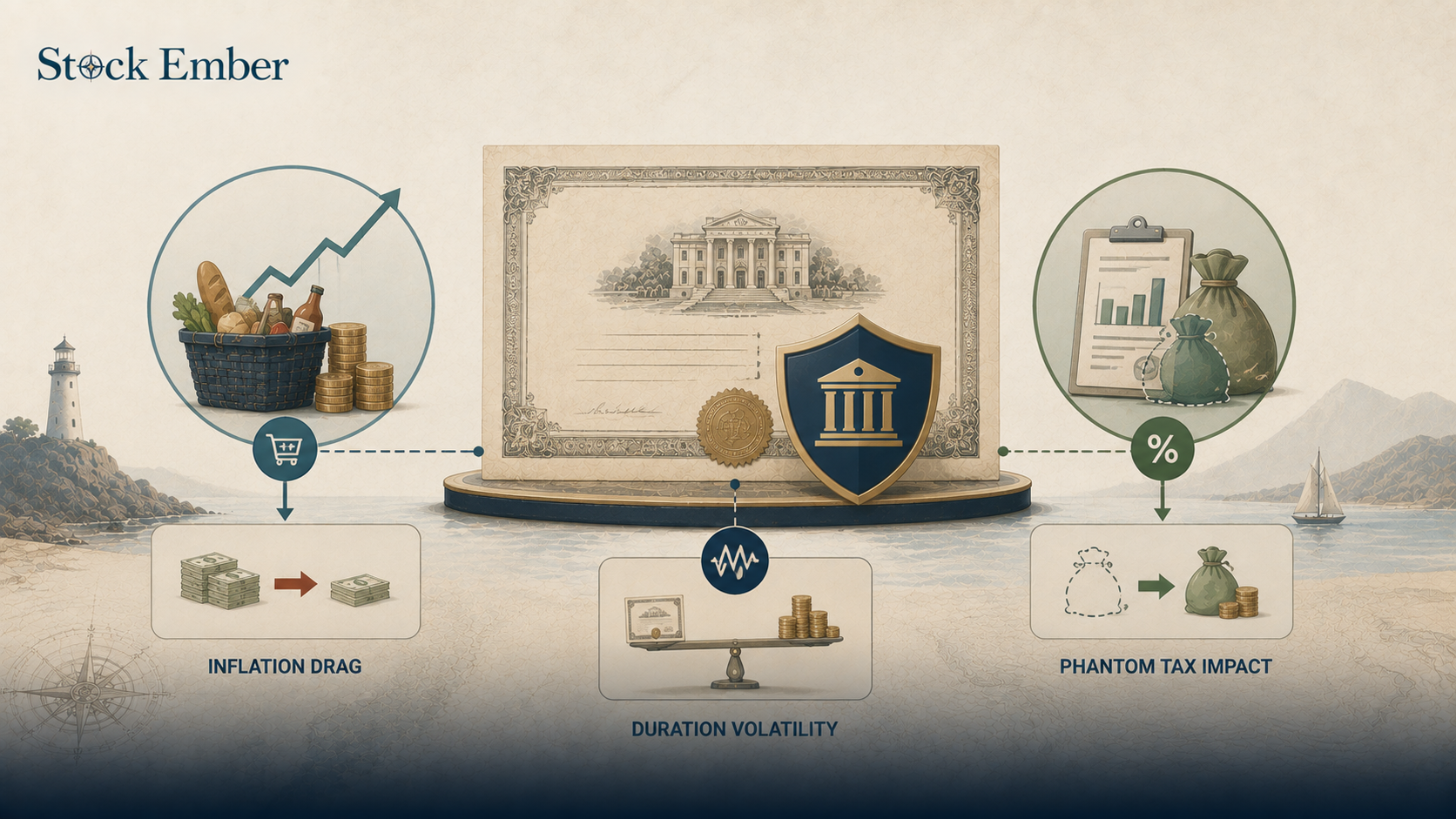
However, this structural certainty comes with heightened price sensitivity to interest rate movements before maturity. The bond has a duration equal to its time to maturity. Because no cash returns to the investor early, market prices swing more aggressively than standard bonds when interest rates change. A 1% rise in benchmark interest rates causes a drop in a 20-year zero-coupon bond's market value, though this paper loss disappears if you hold the bond until maturity.
The Hidden Cost: Phantom Taxes & Multi-Year Tax Drag
The most surprising feature for new investors is the tax treatment applied to these securities held in taxable brokerage accounts. According to rules set by the U.S. Internal Revenue Service (IRS), the annual increase in a bond's accreted value is classified as Original Issue Discount (OID). The IRS generally taxes this annual growth as ordinary income each year, even though you collect zero cash.
This phenomenon, commonly called "phantom tax," creates a continuous cash drag over a 10-year holding period.
In practice, many long-term investors find that paying annual income taxes on cash they have not yet received requires pulling funds out of pocket, unexpectedly reducing overall portfolio liquidity.
Consider the 10-year bond purchased for $613.91. In year one, the bond's value grows by roughly $30.70 on paper. If you sit in a 24% tax bracket, you owe $7.37 in taxes for year one despite receiving no cash flow. Over a decade, these annual tax payments accumulate to tens or hundreds of dollars paid out of pocket before receiving your principal.
To avoid this tax drag, experienced investors place these securities inside tax-shielded accounts like Individual Retirement Accounts (IRAs) or 401(k) plans. Within a tax-deferred account, annual accretion accumulates tax-free until withdrawal, preserving compound growth.
Common Pitfalls & Key Risks to Watch
While these securities offer predictable maturity values, they carry three distinct risks that require careful evaluation.
First, credit default risk poses a hazard when dealing with corporate zero-coupon debt. If the issuing corporation suffers financial distress or bankruptcy during a 20-year term, you receive zero interim interest to offset potential loss of principal. Federal government issues remove credit default risk, but corporate issues require balance sheet assessment.
Second, purchasing power risk can erode long-term gains. Because the maturity payout is fixed in nominal dollars, inflation over a multi-decade holding period reduces the real purchasing power of that final payout. Unlike treasury inflation protected securities, these bonds offer no adjustments for unexpected inflation surges.
Finally, early sale risk can penalize investors forced to sell before maturity. Secondary market prices fluctuate widely, meaning an early sale during a rising interest rate environment can lock in capital losses.
Visual comparison chart showing three key risks of zero coupon bonds.
Conclusion
Zero-coupon bonds serve as effective portfolio building blocks when you need predictable cash at a specific date without reinvestment risk. By buying at a discount and holding to maturity, you lock in a known yield while avoiding interim income management. Protecting these assets within tax-shielded accounts prevents phantom tax drag from reducing your overall return.
When you are ready to evaluate broader portfolio strategies and allocation options, our ETF reviews provide a clear path forward. Investing always carries risk of loss and past performance never guarantees future results, so evaluate your timeline and tax setup carefully before making allocation decisions.
FAQ
5 questions
What is the main downside of a zero-coupon bond?
The main downside is phantom tax liability in taxable accounts, where you owe annual income tax on accrued interest you have not yet received in cash, along with higher price sensitivity (duration risk) prior to maturity.
How do zero-coupon bonds make money?
These securities generate profit through capital appreciation. Investors purchase the security at a discount below par value, and the issuer redeems it for the full face value at maturity.
Are zero-coupon bonds taxed every year?
Yes. In taxable brokerage accounts, the IRS taxes accrued interest from these securities (Original Issue Discount) as ordinary income each year, even though no physical cash distribution occurs.
Why buy a zero-coupon bond instead of a regular bond?
Investors select these securities to eliminate reinvestment rate risk, locking in an exact compound yield to maturity for known future financial goals like retirement or college funding.
Are zero-coupon bonds risk-free?
No investment is risk-free. While U.S. Treasury issues carry minimal default risk, they remain exposed to interest rate volatility before maturity and purchasing power loss from inflation.
Disclaimer
This guide was written with AI assistance and reviewed by the StockEmber editorial team for accuracy. StockEmber provides independent education, not personal financial advice. Some links may support our work at no additional cost to you.
The StockEmber Team is our in-house desk of independent research writers. We test brokerage platforms, read the fine print on fees and custody, and cover ETFs and long-horizon investing for people who plan to hold for decades — not days.