A stock exchange is a centralized, regulated facility where buyers and sellers trade shares of public companies at transparent market prices. It provides continuous market liquidity, enforces mandatory listing requirements, and matches buy and sell orders electronically through a central order book.
What is a stock exchange? In short, it is a regulated marketplace where investors buy and sell shares of publicly traded companies under standardized rules and transparent pricing.
When you place a trade through an online brokerage, your order travels through a complex financial network to reach an exchange floor or electronic matching system. Understanding how this infrastructure functions helps long-term investors evaluate order execution, trading liquidity, and trading venue costs.
This guide breaks down what a stock exchange does, how orders match, and why venue mechanics matter over a 10-year holding period.
Quick Takeaways
01A stock exchange provides a centralized, regulated venue where buyers and sellers trade shares at visible market prices.
02Exchanges serve two core roles: helping companies raise equity capital in the primary market and enabling investors to trade existing shares with each other in the secondary market.
03While stock market exchanges enforce strict listing standards and continuous price discovery, listing approval does not guarantee a company's financial health or protect against market loss.
What Is a Stock Exchange?
A stock exchange is an organized platform designed to enable the buying and selling of financial securities, primarily stocks (also known as shares or equities). It operates as a structured marketplace with defined rules, set trading hours, and strict regulatory oversight.
Historically, exchanges were physical trading floors where market participants shouted prices in open trading pits. Today, almost all major exchanges run on automated electronic order-matching systems. When a business lists its shares on an exchange, its equity becomes available for public trading among institutional funds and individual retail investors alike.
To list on an exchange, companies must meet clear administrative criteria, including minimum market capitalization, regular reporting standards, and corporate governance rules. Regulatory oversight such as that provided by the U.S. SEC helps maintain market transparency and standardized execution rules across public trading venues.
What Is the Purpose of a Stock Exchange?
The primary purpose of a stock exchange is to create a secure, transparent, and liquid marketplace where capital can move between companies and investors. An exchange fulfills four central functions:
Capital Formation (Primary Market): Growing companies need capital to build facilities, hire staff, or expand operations. By launching an Initial Public Offering (IPO) on a stock exchange, a private firm sells new shares to public investors, raising equity capital without taking on bank debt.
Secondary Market Liquidity: Once new shares are issued, the primary market function ends. The exchange then operates as a secondary market where investors buy and sell existing shares among themselves. This liquidity enables investors to convert their stock holdings into cash whenever needed during trading hours.
Price Discovery: An exchange continuously aggregates all buy orders (bids) and sell orders (asks). By balancing supply and demand in real time, the exchange establishes a transparent price for every listed stock.
Market Integrity and Rules: Exchanges enforce listing standards and trading conduct. They monitor transactions to prevent market abuse, ensuring that all investors trade under equal rules.
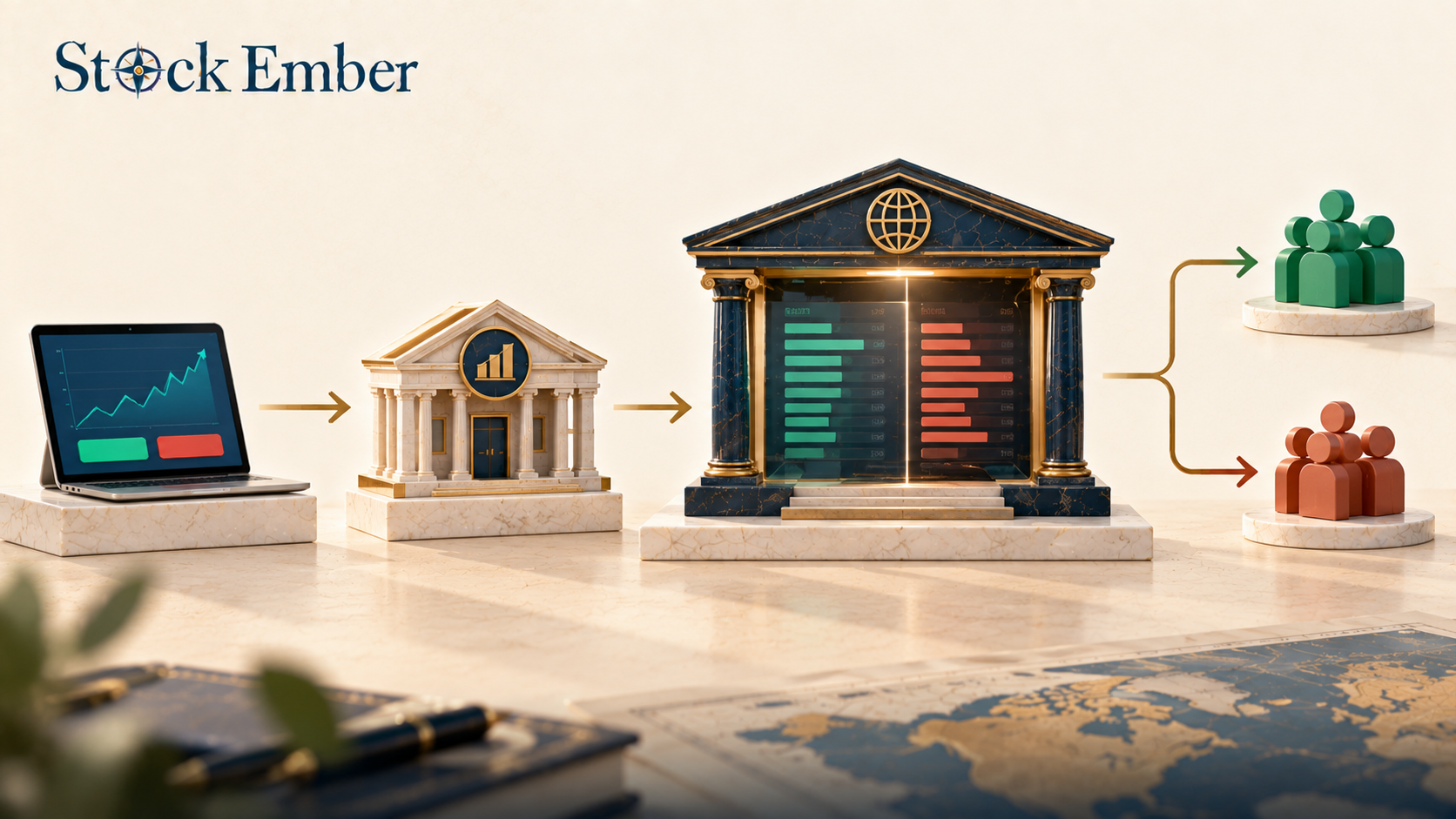
Diagram showing the path of a stock trade from broker to stock exchange order book
How a Stock Exchange Works: Orders, Matching, and Settlement
Trading on a modern stock exchange follows a swift, electronic sequence. Understanding this process clarifies what happens after you submit a trade order through your account.
First, an investor submits an order through a licensed brokerage. The broker checks account funds and routes the order directly to a stock exchange order book.
Second, the exchange matching engine compares incoming bids (buy prices) with current asks (sell prices).
A limit order sits in the order book until a matching price becomes available in the market.
A market order executes immediately against the best available price currently listed on the order book.
When a buy price matches a sell price, the exchange executes the transaction. The gap between the highest price a buyer is willing to pay and the lowest price a seller is willing to accept is known as the bid-ask spread (a narrow spread indicates high market liquidity).
Finally, post-trade settlement takes place. Although order execution happens in milliseconds, the formal transfer of cash and share ownership typically settles on a trade-date-plus-one-day ($T+1$) schedule through a central clearinghouse.
In practice, many long-term investors find that placing market orders during the first 15 minutes after market open leads to wider bid-ask spreads. Waiting until mid-morning often delivers smoother order execution and cleaner prices.
Stock Exchange vs. Stock Market: The Essential Difference
Although people often use the terms interchangeably in everyday conversation, the stock market and a stock exchange represent distinct levels of market infrastructure.
The stock market is the broad umbrella concept encompassing all public stock trading across an entire economy. It includes all market participants, brokers, regulators, and listed asset classes.
A stock exchange, by contrast, is a specific facility, venue, or corporation where that trading actually occurs. Think of the stock market as the overall retail industry, while a stock exchange is a specific store such as the New York Stock Exchange (NYSE) or Nasdaq.
Quick Comparison: Stock Market vs. Stock Exchange
Term
Description
Stock Market
A broad, economy-wide trading network encompassing all public trading, participants, and regulators.
Stock Exchange
A specific facility, venue, or corporation where the actual buying and selling of shares takes place.
Investors building a foundation in investing in stocks should note that a single country can host multiple exchanges, each with its own listing rules and company focus. For instance, technology growth firms historically preferred listing on Nasdaq, whereas established industrial businesses often chose the NYSE.
Why Stock Exchanges Matter for Long-Term Investors
For a buy-and-hold investor, daily exchange price ticks might seem secondary to earnings growth or economic cycles. However, stock exchange infrastructure directly influences portfolio costs in three ways:
Liquidity and Spread Costs: Highly liquid exchanges keep bid-ask spreads tight, often fractions of a cent per share. On thinly traded venues, wider spreads act as a hidden friction cost every time you buy or sell.
Venue Fees and Execution: While retail brokers frequently offer zero-commission stock trades, exchange transaction fees and market data costs are quietly paid by financial institutions and market makers. Over a 10-year period, these underlying execution dynamics subtly affect how closely fund managers match their index benchmarks.
Corporate Governance Standards: Exchange listing requirements force companies to publish audited financial statements every quarter. This continuous reporting gives long-term investors verified data to evaluate corporate health.
If you examine the largest stock exchanges in the world, you will see that deep trading liquidity and strict oversight consistently attract the largest concentrations of global capital.
Common Misconceptions About Stock Exchanges
Even experienced investors sometimes misinterpret what an exchange listing implies. Avoid these common misunderstandings:
Misconception 1: Exchange listing guarantees financial health. An exchange verifies that a company meets administrative and reporting rules to list shares. However, listing approval is not an endorsement of business quality. A listed company can still go bankrupt or experience severe price drops.
Misconception 2: Stock exchanges set share prices. Exchanges do not decide what a stock is worth. They provide the order book technology that allows independent buyers and sellers to discover prices through supply and demand.
Misconception 3: You can buy shares directly from an exchange. Retail investors cannot connect directly to an exchange floor or electronic matching engine. All trades must route through a licensed financial broker holding exchange membership access.
Conclusion
A stock exchange is the fundamental infrastructure of equity markets, bringing buyers and sellers together to discover prices and trade shares efficiently. By providing liquidity, setting listing standards, and supporting primary capital raising, exchanges enable public markets to operate with speed and transparency.
While stock exchange regulation helps safeguard order routing and reporting standards, holding exchange-listed shares still involves market volatility and capital risk. Understanding how exchange mechanics work gives long-term investors greater clarity when building a low-cost, resilient portfolio over a multi-year horizon.
When you are ready to evaluate platforms for routing your market orders, our broker reviews offer a clear comparison of features, tools, and execution quality.
FAQ
5 questions
What is the main purpose of a stock exchange?
The main purpose of a stock exchange is to provide a transparent, regulated marketplace for trading financial securities. It enables companies to raise capital by issuing new shares in the primary market and gives investors a secure secondary market to trade existing shares with continuous liquidity and clear price discovery.
What is the difference between a stock market and a stock exchange?
The stock market is the broad, overarching network where public stock trading occurs across an entire economy. A stock exchange is a specific physical or electronic facility such as the New York Stock Exchange or Nasdaq, where market participants actually route, match, and execute trade orders.
How does a stock exchange make money?
Stock exchanges earn revenue primarily through listing fees paid by public companies, transaction fees charged on order executions, market data feed subscriptions sold to financial institutions, and co-location services for trading infrastructure. They do not profit directly from stock price movements.
Can an individual retail investor trade directly on a stock exchange?
No, individual retail investors cannot execute trades directly on an exchange floor or electronic matching engine. All retail buy and sell orders must be placed through a licensed broker who maintains exchange membership or direct market access to route trades on your behalf.
Does listing on a stock exchange mean a company is safe?
No, an exchange listing does not guarantee a company's financial stability or protect investors from share price losses. While stock exchanges enforce administrative listing criteria and quarterly reporting standards, listed companies can still experience falling profits, high volatility, or bankruptcy.
Disclaimer
This guide was written with AI assistance and reviewed by the StockEmber editorial team for accuracy. StockEmber provides independent education, not personal financial advice. Investing puts your capital at risk: the value of investments can go down as well as up, you may get back less than you invest, and past performance doesn’t guarantee future results. Some links may support our work at no additional cost to you.
The StockEmber Team is our in-house desk of independent research writers. We test brokerage platforms, read the fine print on fees and custody, and cover ETFs and long-horizon investing for people who plan to hold for decades — not days.