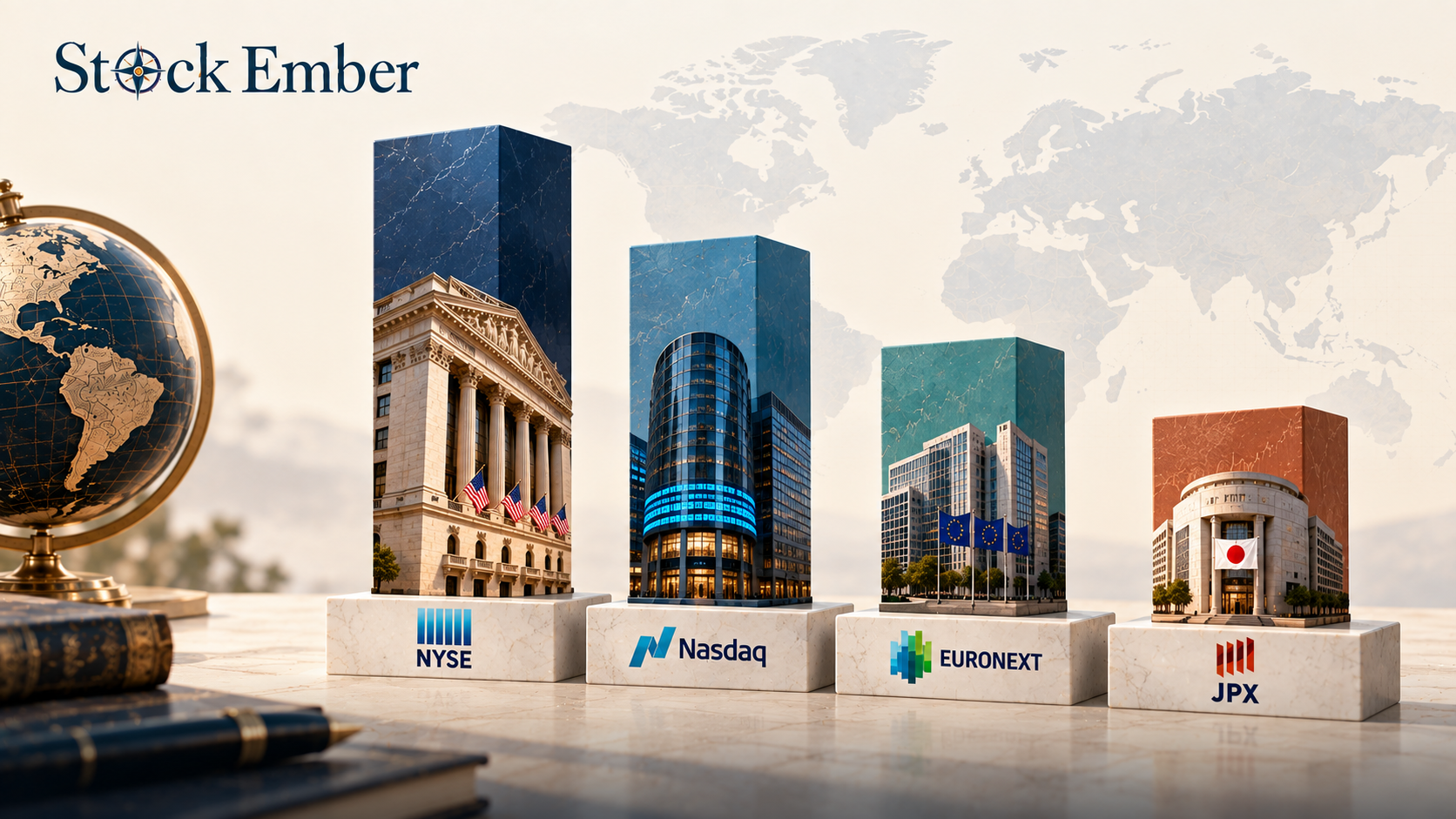
The New York Stock Exchange (NYSE) is the largest stock exchange in the world, with listed companies totaling over $28 trillion in domestic market capitalization. It is followed by Nasdaq as the second-largest global exchange, with both venues providing primary depth and trading liquidity for international investors.
NYSE tops the list of global equity venues, with listed firms representing more than $28 trillion in combined market value.
When evaluating global trading venues, long-term investors often ask what is the largest stock exchange in the world and why market scale matters for portfolio construction. Beyond sheer size, an exchange's total listed capitalization determines its depth, trading volume, and institutional participation.
This guide breaks down the world's leading stock exchanges by market capitalization, explains how venue scale influences liquidity, and outlines key considerations for buy-and-hold strategies.
Quick Takeaways
01The New York Stock Exchange (NYSE) ranks as the world's largest equity trading venue by total domestic market capitalization.
02Nasdaq holds the position as the second largest stock exchange in the world, heavily driven by major technology and growth enterprises.
03An exchange's size measures the aggregate market value of all its listed companies, not the corporate revenue of the exchange operator.
04Venue depth provides greater trading liquidity and narrower bid-ask spreads, which lowers transaction friction for long-term investors.
05Listing on a massive exchange does not eliminate share price volatility or protect individual equities from broad market downturns.
What Is a Stock Exchange and How Is Size Measured?
A stock exchange is an organized, regulated marketplace where buyers and sellers trade shares of publicly listed corporations. To understand which stock exchange is the largest in the world, investors must first clarify how exchange scale is measured.
In financial analysis, an exchange's size is defined by its domestic market capitalization, the sum of the total market value of every company listed on that venue. Market capitalization for an individual company is calculated as:
Market Capitalization = Total Outstanding Shares * Current Share Price
Summing this figure across all listed issuers yields the aggregate scale of the trading venue. Size is not based on the annual operating revenue or stock valuation of the exchange operator itself (such as Intercontinental Exchange, which owns the NYSE, or Nasdaq, Inc.).
Understanding how stock exchanges organize liquidity helps clarify why capital concentrates in specific geographic hubs. Larger venues attract more institutional order flow, creating a self-reinforcing cycle of deep liquidity and extensive capital access.
The World's Largest Stock Exchanges by Market Capitalization
Global equity capital is heavily concentrated across a few major trading centers. According to statistical benchmarks tracked by the World Federation of Exchanges, North American markets account for nearly half of global equity capitalization.
Figures reflect approximate domestic market capitalization as of 2026, based on data tracked by the World Federation of Exchanges.
The New York Stock Exchange holds the premier global position, hosting historic blue-chip enterprises and multinational conglomerates. Following close behind, Nasdaq stands as the second largest stock exchange in the world, powered by giant technology firms that experienced rapid capital expansion over recent decades.
Together, these two U.S. exchanges command a massive lead over European and Asian counterparts such as Euronext, Japan Exchange Group, and the Shanghai Stock Exchange.
Comparison chart showing market capitalization of the largest global stock exchanges.
Why Market Capitalization and Liquidity Matter for Investors
For individuals focusing on long-term wealth accumulation, an exchange's scale is more than an academic statistic. Venue size directly shapes market depth, bid-ask spreads, and order execution quality.
When a venue handles billions of dollars in daily turnover, bid-ask spreads, the difference between the highest price a buyer will offer and the lowest price a seller will accept, narrows significantly. On major markets like the NYSE or Nasdaq, spreads on highly traded funds or mega-cap shares are often just one penny.
In practice, many long-term investors find that trading on high-volume exchanges quietly preserves capital by reducing execution friction. While a 0.05% spread difference seems negligible on a single order, holding assets and rebalancing portfolios over a 10-year horizon ensures that minimal transaction slippage compounds into meaningful fee savings.
Furthermore, exchange scale affects exchange-traded products. Broad index funds tracking major benchmark indices benefit from deep underlying liquidity, ensuring that fund prices closely mirror net asset value (NAV) without severe tracking error or unexpected premiums.
Key Considerations and Common Misconceptions
While venue scale provides operational efficiency, several common misunderstandings exist regarding exchange size and investment risk.
Size Does Not Equal Safety: A company listed on the world's largest exchange is subject to the same fundamental business risks, market cycles, and earnings fluctuations as a firm listed on a smaller regional market. Large-cap equities can experience severe drawdowns during economic contractions.
Operator Scale vs. Listed Market Scale: Investors must distinguish between investing in the equity of an exchange operator (a listed company itself) and investing in the issuers listed on its market. An exchange corporate stock carries specific business risks related to trading volumes, regulatory shifts, and technology infrastructure costs.
Global Diversification Needs: Relying exclusively on companies listed on the largest U.S. exchanges creates geographic concentration risk. A well-constructed long-term portfolio balances domestic equity exposure with international assets across multiple sovereign jurisdictions.
Before building a portfolio, mastering the core principles of investing in stocks helps ensure that venue liquidity is used alongside sound asset allocation and risk management.
Conclusion
The New York Stock Exchange remains the largest stock exchange in the world by market capitalization, with Nasdaq holding the second spot globally. Together, these trading hubs offer market liquidity, tight execution spreads, and access to leading global corporations. However, market scale is an execution benefit rather than a guarantee against asset price volatility or corporate default. Long-term investors should evaluate exchanges through the lens of cost efficiency, transparency, and portfolio diversification.
When you're ready to evaluate platforms and trading access for these global markets, our broker reviews provide detailed comparisons of account features and execution fees. Investing always carries risk of capital loss, so treat venue research as one component of a broader, well-diversified financial strategy.
FAQ
5 questions
What is the largest stock exchange in the world?
The New York Stock Exchange (NYSE) is the world's largest stock exchange based on the total domestic market capitalization of listed companies, representing over $28 trillion in aggregate equity value.
What is the second largest stock exchange in the world?
Nasdaq is the second largest stock exchange in the world, largely driven by major technology, growth, and internet enterprises headquartered globally.
How is the size of a stock exchange measured?
Stock exchange size is measured by total domestic market capitalization—the aggregate market value of all outstanding shares across every public company listed on that venue.
Does listing on a larger exchange make a stock safer?
No. While larger stock exchanges offer higher trading volume and narrower bid-ask spreads, listing on a major venue does not shield a company from share price volatility, earnings downturns, or financial loss.
Which European stock exchange is the largest?
Euronext is the largest stock exchange in Europe, operating as a pan-European equity trading venue spanning major financial centers including Paris, Amsterdam, and Brussels.
Disclaimer
This guide was written with AI assistance and reviewed by the StockEmber editorial team for accuracy. StockEmber provides independent education, not personal financial advice. Investing puts your capital at risk: the value of investments can go down as well as up, you may get back less than you invest, and past performance doesn’t guarantee future results. Some links may support our work at no additional cost to you.
The StockEmber Team is our in-house desk of independent research writers. We test brokerage platforms, read the fine print on fees and custody, and cover ETFs and long-horizon investing for people who plan to hold for decades — not days.