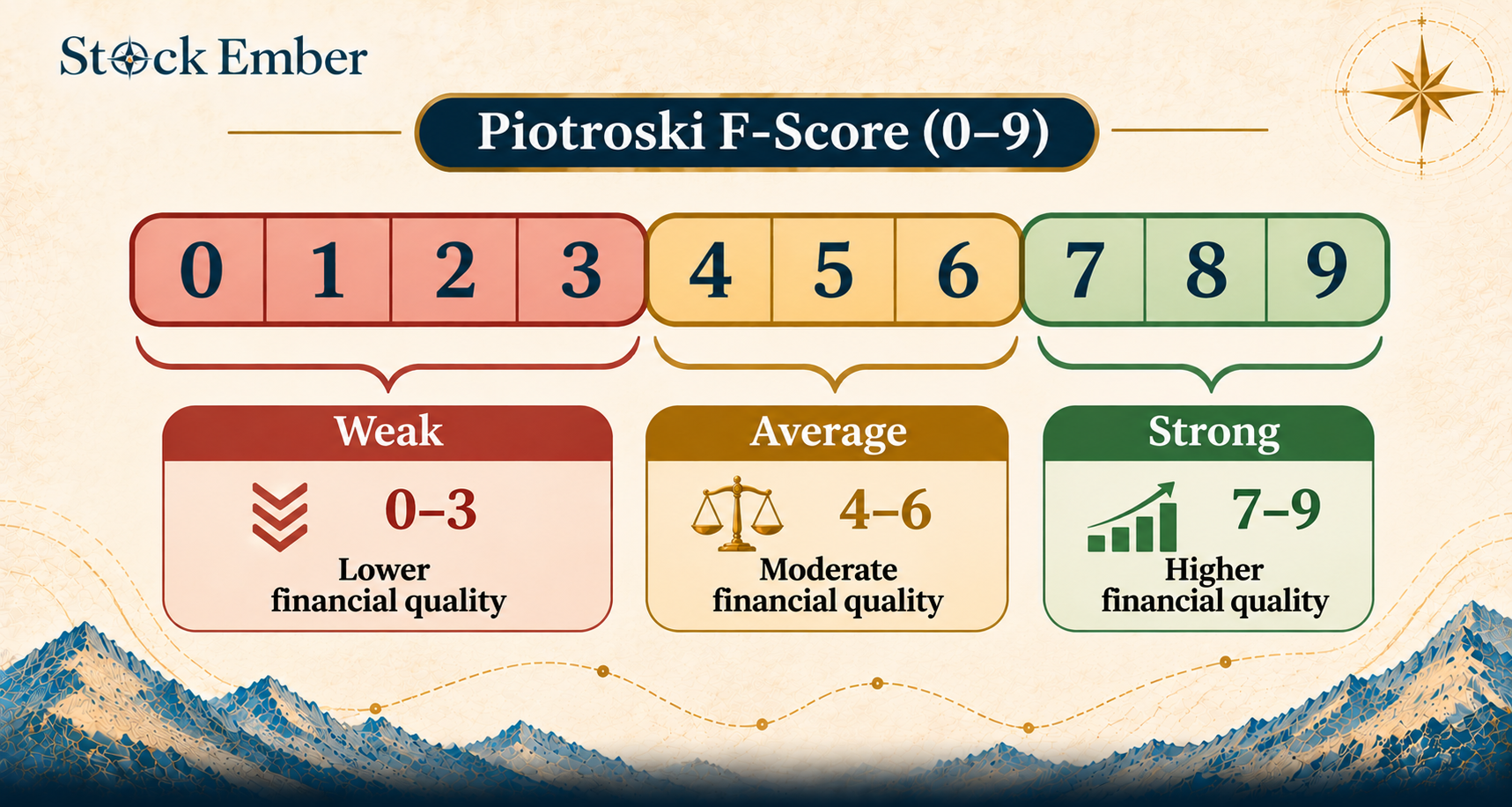
The Piotroski F-Score is a 9-point financial rating that grades a company from 0 to 9 based on recent changes in its financial statements. Each test awards one point for positive performance or year-over-year progress across profitability, debt and cash cushion, and operating efficiency.
The Piotroski F-Score is a zero-to-9 checklist that measures whether a company's financial health is improving or weakening. It awards one point for each of 9 simple accounting tests covering profit, debt, and operating efficiency.
A stock trading at a low price compared with its accounting assets can look like a bargain, or a business in slow decline. Checking financial trends helps long-term investors tell those two stories apart. This guide explains what the Piotroski F-Score means, how the 9 tests work, and where the score can mislead.
Quick Takeaways
01A high score shows improving accounting trends over the past year, not a promise of future stock gains.
02Seven of the 9 tests reward year-over-year progress rather than comparing a business against rivals.
03The score ignores share price and breaks down on banks, insurers, and fast-growing companies that reinvest heavily.
04Long-term index fund investors do not need to score individual stocks, because broad diversification spreads single-company risk.
What Is the Piotroski F-Score?
This metric is a 9-point scoring system that grades a company's recent financial momentum using numbers from its annual financial statements.
Accounting professor Joseph Piotroski introduced the framework in a 2000 Journal of Accounting Research paper. He noticed that stocks with low price-to-book ratios (a measure comparing a company's share price to its accounting net worth) often sat in the bargain bin for good reason. Many were value traps, cheap-looking stocks whose underlying businesses kept weakening.
For everyday people investing in stocks, the Piotroski F-Score meaning comes down to direction. Each test gives 1 point if the company passes and 0 points if it fails, adding up to a final score between 0 and 9.
How the Piotroski F-Score Works: The 9 Financial Tests
You calculate the score by checking 9 yes-or-no rules grouped into three areas of a business: profitability, debt and cash cushion, and operating efficiency.
Each passing test adds 1 point, while each failing test adds 0 points.
Diagram dividing the 9-point Piotroski F-Score into three scoring groups
To see the Piotroski F-Score explained step by step, review the 9 tests below:
Profitability (up to 4 points)
Positive return on assets (ROA):return on assets (ROA) (net income divided by total assets) is above zero.
Positive operating cash flow:operating cash flow (cash generated by core daily business operations) is above zero.
Higher ROA than last year: ROA improved compared with the prior year.
Cash flow beats accounting profit: operating cash flow exceeds net income (accounting profit after all expenses and taxes), which checks for accruals (non-cash accounting adjustments that can inflate reported profit).
Debt, cash cushion, and share count (up to 3 points) 5. Lower long-term debt ratio: the long-term debt-to-assets ratio (long-term borrowing compared with total company assets) fell from the prior year. 6. Higher current ratio: the current ratio (short-term assets divided by short-term bills) rose from the prior year. 7. No new shares issued: the company avoided share dilution (issuing new common shares that shrink each existing owner's slice).
Operating efficiency (up to 2 points) 8. Higher gross margin:gross margin (revenue left after direct production costs, shown as a percentage) improved from the prior year. 9. Higher asset turnover:asset turnover (how much revenue a company generates per dollar of assets) increased from the prior year.
Suppose a hypothetical manufacturer, Harborline Goods, posts positive ROA and cash flow (2 points) and improves ROA while beating net income with cash flow (2 points). It also trims its debt ratio and raises its current ratio while issuing new stock (2 points), then lifts both gross margin and asset turnover (2 points). Harborline earns an F-Score of 8 out of 9.
What a High or Low Piotroski F-Score Means
A score of 8 or 9 signals broad financial improvement over the past year, whereas a score of 0 to 2 signals weakening fundamentals across multiple fronts.
F-Score Band
Financial Signal
What It Tells an Investor
8 to 9 points
Strong momentum
Profit, cash flow, debt, and efficiency all moved in a healthy direction.
4 to 7 points
Mixed performance
Some ratios improved while others stalled or slipped.
0 to 2 points
Weakening trends
Earnings, cash cushion, or efficiency deteriorated across several checks.
Earnings, cash cushion, or efficiency deteriorated across several checks.
A high score does not mean a business is immune to trouble, and a low score does not always mean a company is failing. Seven of the 9 tests compare this year against last year, so a firm recovering from a terrible slump can score well even while its overall finances remain fragile.
Why the Piotroski F-Score Matters for Long-Term Investors
For patient, buy-and-hold investors, the score serves as a structured way to verify whether reported profits are backed by real cash and steady operations.
Many beginners look only at earnings per share, missing warning signs like rising debt or falling cash flow. Requiring operating cash flow to exceed net income helps filter out accounting illusions. It also complements other balance-sheet checks: while the Altman Z-Score gauges whether a company faces bankruptcy distress, the F-Score tracks whether day-to-day business momentum is getting stronger or weaker.
In practice, many long-term investors find that checking which specific tests a company failed matters more than the headline number alone, since a temporary drop in gross margin tells a very different story from rising debt and negative cash flow.
Common Mistakes When Using the Piotroski F-Score
Relying on this metric as a standalone stock-picking rule leads to three common mistakes.
First, ignoring the share price. None of the 9 tests checks whether a stock is cheap or expensive. A company can score 9 out of 9 and still drop sharply if its share price already bakes in years of optimism.
Second, using it on banks and financial firms. Lenders, insurers, and real estate companies operate with different balance sheets where metrics like gross margin and current ratio do not apply cleanly.
Third, penalizing healthy growth investments. Expanding businesses often issue stock to fund new projects or accept lower short-term margins while building scale. Those choices lower an F-Score even when the long-term business is thriving, and no accounting score can protect shareholders from market downturns or industry shifts.
Conclusion
The scoring system turns 9 financial-statement checks into a clear zero-to-9 snapshot of whether a company's fundamentals are strengthening or slipping. Used alongside valuation and business research, it helps investors spot cash-backed progress and avoid weak balance sheets, as long as you remember its blind spots around share price and financial companies.
If you invest through broad index funds for the long run, you do not need to score individual businesses one by one, because holding hundreds of companies spreads single-stock risk automatically.
When you are ready to compare accounts for building a diversified portfolio, our broker reviews are a practical next step. Investing always puts your money at risk and past results never promise the future, so treat this guide as education rather than financial advice.
FAQ
5 questions
What is the difference between the Piotroski F-Score and the Altman Z-Score?
This score tracks whether a company's financial momentum is improving or weakening over the past year on a scale of 0 to 9. By contrast, the Altman Z-Score estimates how close a business is to financial distress or bankruptcy using balance-sheet and earnings ratios. Investors use the F-Score to spot improving fundamentals and the Z-Score to screen out severe default risk.
Should you avoid stocks with a low Piotroski F-Score?
Not automatically, because a low score only reflects accounting changes over the last twelve months. A strong business going through a temporary industry slowdown, heavy factory upgrades, or deliberate debt-funded expansion can briefly score two or three points. Long-term investors look at multi-year business health and cash generation rather than rejecting a company over one weak scorecard.
Can a company's Piotroski F-Score change every quarter?
Yes, the score updates whenever a company releases new quarterly or annual financial statements. Because seven of the 9 tests compare current figures against the prior year, shifting profit margins, new borrowing, or share buybacks can move the score up or down each reporting period. Reviewing annual trends usually gives a steadier picture than reacting to single-quarter swings.
Why does the Piotroski F-Score reward companies that issue no new shares?
Issuing new common shares dilutes existing stockholders by dividing future profits across a larger pool of shares. In Piotroski's framework, avoiding new share issuance signals that a business can fund its operations and growth from internal cash flow rather than raising outside equity. Companies that continually sell new stock often face cash shortfalls or weaker financial discipline.
Q5: Where can investors find a company's Piotroski F-Score?
Many financial data websites and brokerage research pages display the Piotroski F-Score automatically on a company's fundamental summary tab. You can also calculate all 9 points yourself using numbers from a company's income statement, balance sheet, and cash flow statement in its annual report. Checking the underlying financial statements helps confirm why the company earned or lost specific points.
Disclaimer
This guide was written with AI assistance and reviewed by the StockEmber editorial team for accuracy. StockEmber provides independent education, not personal financial advice. Investing puts your capital at risk: the value of investments can go down as well as up, you may get back less than you invest, and past performance doesn’t guarantee future results. Some links may support our work at no additional cost to you.
The StockEmber Team is our in-house desk of independent research writers. We test brokerage platforms, read the fine print on fees and custody, and cover ETFs and long-horizon investing for people who plan to hold for decades — not days.