Mid-cap stocks represent ownership shares in medium-sized public companies, generally defined by a market capitalization between $2 billion and $10 billion. They sit between smaller, early-stage businesses and massive global corporations, offering established operations with room to expand. Because market-cap cutoffs vary by index provider and shift with share prices, mid-cap is an industry benchmark rather than a fixed legal label.
Mid-cap stocks are shares of medium-sized public companies whose total market value typically sits between $2 billion and $10 billion.
When most beginners think of the stock market, giant household brands come to mind first, yet hundreds of established businesses operate one tier below those giants. Understanding the mid-cap stocks meaning helps you see how company size shapes both growth potential and risk.
Below, you'll find mid-cap stocks explained in plain terms, including how size is measured, how mid-caps compare with smaller and larger rivals, and how they fit a long-term plan.
Quick Takeaways
01Mid-cap companies sit between early-stage small companies and slow-moving corporate giants in both size and business maturity.
02A company's size tier depends on its total market value, share price multiplied by share count, not the price of a single share.
03Mid-cap shares offer room to expand, but they can drop harder than large-cap stocks during recessions and carry higher price swings.
04Broad market index funds already hold mid-cap companies automatically, saving long-term investors from guessing which size tier will lead next.
What Are Mid-Cap Stocks?
Mid-cap stocks are shares in established, mid-sized businesses that have outgrown their early startup phase without yet reaching mega-cap scale.
The "cap" in mid-cap stands for market capitalization, which is the total dollar value the stock market places on a company's shares. When you begin investing in stocks, grouping companies by market value gives you a quick snapshot of where a business sits in its life cycle. Many mid-cap firms already have proven products, steady revenue, and national customers, while still having room to win new market share.
At the same time, "mid-cap" is a market convention rather than a strict legal label. Index providers use slightly different dollar cutoffs, and a company's category shifts naturally as its share price rises or falls over time.
How Market Capitalization Works
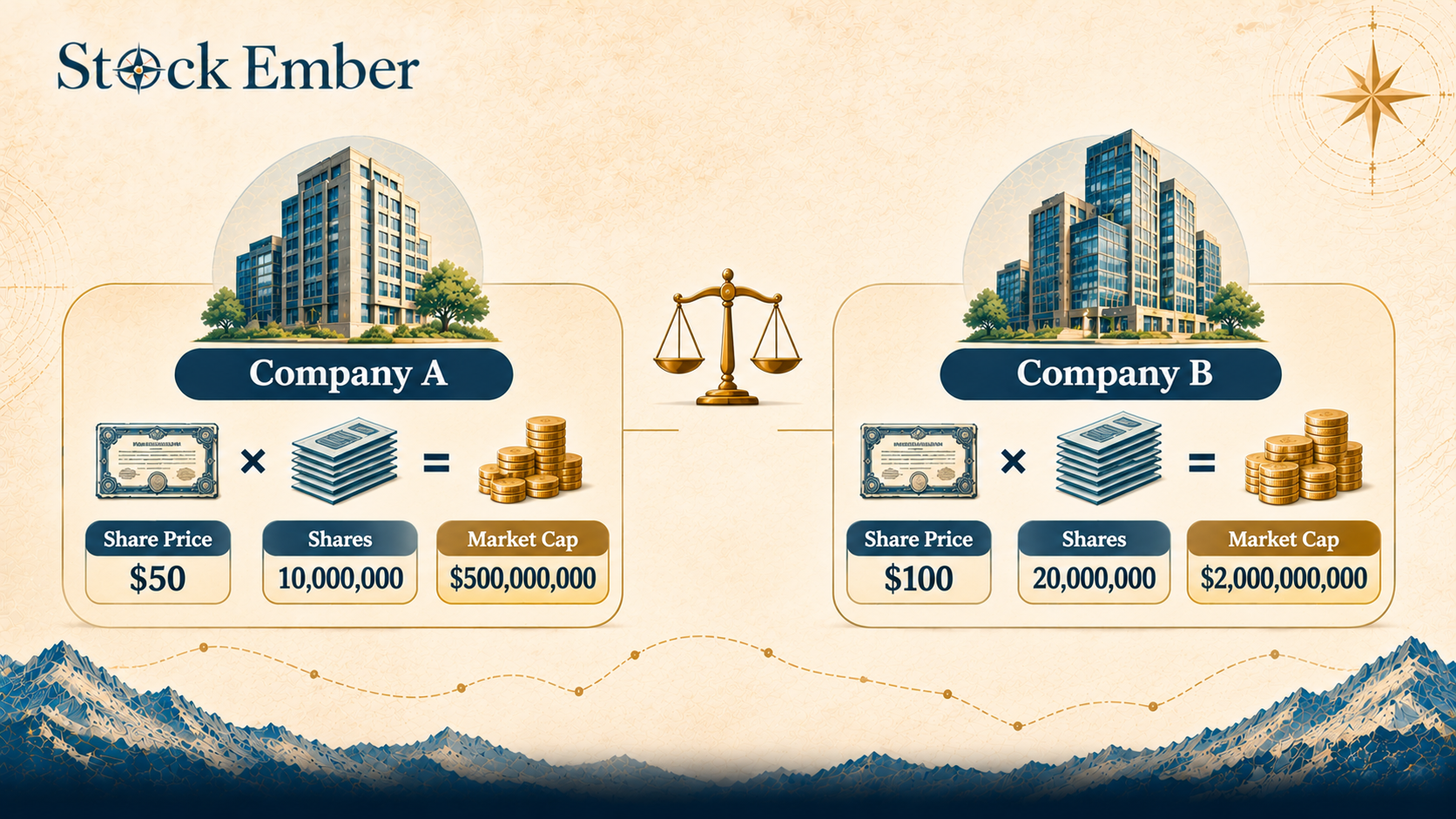
You calculate a company's market capitalization by multiplying its current share price by its total number of shares outstanding, all the shares currently held by investors.
Market Capitalization = Share Price × Total Shares Outstanding
In plain terms, the formula shows what it would cost at today's market price to buy every existing share of the business.
Beginners often assume a $200 stock belongs to a huge company and a $15 stock belongs to a small one, but share price alone tells you nothing about company size. A business with 400 million shares trading at $15 has a market value of $6 billion, placing it squarely in the mid-cap tier. Meanwhile, a business with 10 million shares trading at $150 has a market value of $1.5 billion, making it smaller overall.
According to FINRA’s 2022 investor guidance, the mid-cap tier generally covers companies valued between $2 billion and $10 billion, sitting above small-cap firms ($250 million to $2 billion) and below large-cap firms ($10 billion to $200 billion). Because share prices move every trading day, a fast-growing mid-cap company can graduate into large-cap territory, while a struggling large-cap company can shrink into the mid-cap
Diagram showing how share price times share count determines market capitalization
Mid-Cap vs. Small-Cap and Large-Cap Stocks
These companies balance proven business operations with room to expand, placing them between higher-risk small companies and steadier corporate giants.
Compared with small-cap stocks, mid-cap businesses usually have longer track records, wider customer bases, and easier access to bank loans or bond markets. Small-cap firms often rely on a single product line and face higher failure rates when the economy slows down.
Compared with large-cap companies, mid-sized firms tend to have fewer global divisions and smaller cash reserves. That smaller scale leaves more room for revenue growth, yet it also brings higher volatility, meaning share prices can swing more sharply from month to month. Large-cap firms are also more likely to pay regular dividends, whereas many mid-cap companies reinvest most of their profits back into expansion.
Feature
Small-Cap Stocks
Mid-Cap Stocks
Large-Cap Stocks
Typical market value
$250 million to $2 billion
$2 billion to $10 billion
$10 billion to $200 billion
Business stage
Early growth, narrower focus
Established, expanding
Mature, global or dominant
Price volatility
Highest
Moderate to high
Lowest of the three
Dividend payouts
Rare
Occasional
Common
Mid-cap companies carry real downside alongside their growth potential. During economic downturns, mid-cap shares often fall further than large-cap stocks because investors seek safety in the biggest, most cash-rich businesses, and mid-cap shares can have lower liquidity, meaning fewer shares trade each day, which can widen price swings during market stress.
Why Mid-Cap Stocks Matter for a Long-Term Investor
Adding mid-cap exposure to a portfolio prevents your long-term returns from relying solely on the biggest companies in the market.
Different company sizes lead the market in different decades, and no size tier outperforms in every economic cycle. If you hold a total stock market index fund, you already own hundreds of mid-cap businesses alongside large-cap and small-cap companies in proportion to their market value. If you hold only a large-cap index fund, you miss that middle tier unless you add it separately.
Over a 10-year holding period, keeping your costs low matters just as much as choosing which company sizes to own. Suppose you invest $10,000 for 10 years and earn a hypothetical 7% a year before fees; actual returns vary from year to year, can be negative, and are never guaranteed. A fund charging a 0.10% expense ratio, the yearly fee a fund deducts as a percentage of your investment, costs roughly $200 over the decade, whereas a fund charging 1.00% quietly removes roughly $1,900 of your ending balance.
In practice, many long-term investors find that owning a broad, low-cost mix of company sizes removes the pressure to guess when mid-caps will beat large-cap stocks in any given year.
Common Mistakes When Investing in Mid-Cap Stocks
The most common mistake is treating mid-caps as a surefire "sweet spot" that captures small-cap growth without small-cap losses.
No size category protects your money when stock markets drop, and past stretches of mid-cap outperformance never promise the same result ahead. Watch out for 3 practical traps:
Judging size by share price: Always check total market capitalization rather than assuming a low share price means a small, cheap company.
Ignoring downturn swings: Mid-cap shares can drop sharply during recessions, so hold only the stock allocation you can comfortably keep through a multi-year slump.
Chasing recent winners: Buying a mid-cap fund only after it has topped recent performance tables often leads to buying high and selling low when market leadership rotates.
Conclusion
Mid-cap companies bridge the gap between young, fast-changing small businesses and mature corporate giants, offering established operations alongside room to grow. Because they still carry sharper price swings and steeper recession drops than large-cap stocks, they work best as part of a diversified, low-cost portfolio held for the long run.
When you're ready to compare platforms for holding your long-term investments, our broker reviews are a sensible next step. Investing always puts your money at risk and past returns never promise the future, so treat this guide as education rather than personal financial advice.
FAQ
5 questions
Do mid-cap stocks pay dividends?
Some mid-cap companies pay dividends, though payouts are less common than among large-cap corporations. Because many mid-sized businesses are still expanding into new markets or building facilities, management often reinvests profits back into the company rather than sending cash to shareholders. Mature mid-cap firms in steadier industries, such as regional utilities or industrial suppliers, are more likely to offer regular dividends.
What indexes track mid-cap stocks?
Two of the best-known benchmarks for mid-cap stocks are the S&P MidCap 400 Index and the Russell Midcap Index. Each index provider uses its own rules and market-value cutoffs to decide which companies qualify, so their lists of holdings do not match completely. Many index funds and exchange-traded funds track these benchmarks to give investors broad exposure to medium-sized businesses.
Can a mid-cap stock become a large-cap stock?
Yes, companies move between market-capitalization tiers regularly as their share prices rise or fall. If a mid-cap business grows its earnings and attracts more investors, its total market value can climb above $10 billion, moving it into the large-cap category. Conversely, a large-cap company that loses market value during a business slump can drop down into the mid-cap tier.
Are mid-cap stocks harder to buy and sell than large-cap stocks?
Mid-cap stocks generally trade with lower daily volume than major large-cap companies, though most are still easy to buy and sell on major stock exchanges. Because fewer shares change hands each day, the gap between buying and selling prices can widen slightly during volatile markets. Using limit orders helps everyday investors control the exact price they pay or receive.
How do total stock market index funds treat mid-cap stocks?
Broad total stock market index funds hold large-cap, mid-cap, and small-cap stocks together in a single fund. They weight each company according to its market capitalization, meaning bigger businesses make up a larger share of the fund while mid-cap companies occupy the middle slice. Owning a total market fund gives you automatic exposure to mid-cap stocks without buying a separate fund.
Disclaimer
This guide was written with AI assistance and reviewed by the StockEmber editorial team for accuracy. StockEmber provides independent education, not personal financial advice. Investing puts your capital at risk: the value of investments can go down as well as up, you may get back less than you invest, and past performance doesn’t guarantee future results. Some links may support our work at no additional cost to you.
The StockEmber Team is our in-house desk of independent research writers. We test brokerage platforms, read the fine print on fees and custody, and cover ETFs and long-horizon investing for people who plan to hold for decades — not days.