Small-cap stocks represent publicly traded companies with a total market capitalization generally between $250 million and $2 billion. These smaller businesses typically offer higher growth potential than mature corporate giants, but carry greater price volatility and higher bankruptcy risk. Most long-term investors access this equity tier through low-cost, diversified index funds.
Small-cap stocks are publicly traded companies that typically have a total market value between $250 million and $2 billion, though exact ranges vary by index provider and fund company.
While massive blue-chip corporations dominate financial headlines, smaller public firms offer a very different investing profile. These businesses can expand rapidly over multi-year periods, but they also experience sharper price swings and higher bankruptcy rates. This guide covers how small-cap stocks work, their balance of growth and risk, and how patient long-term investors approach them.
Quick Takeaways
01Small-cap stocks generally represent public firms valued between $250 million and $2 billion, offering long expansion runways.
02Smaller companies face higher failure rates, wider price swings, and greater debt sensitivity than large-cap leaders.
03Over ten-year holding periods, higher fund expense ratios and trading spreads can create a noticeable performance drag.
04Everyday investors can capture small-cap growth through broad index funds without taking on single-stock insolvency risk.
What Are Small-Cap Stocks? (Meaning and Market Cap)
Small-cap stocks represent publicly traded businesses in the lower tier of market capitalization, usually valued between $250 million and $2 billion.
To understand the practical small cap stocks meaning, look at corporate life cycles. A giant corporation with hundreds of billions in market value struggles to double its revenue because it is already massive. By contrast, a smaller company in an expanding industry has room to grow. When asking what are small cap stocks, you are looking at businesses that trade publicly yet remain far smaller than industry leaders.
To see small cap stocks explained simply, think of a regional retail chain or a medical device maker. These businesses operate with real customer demand, but lack the cash reserves and global reach of market leaders. That smaller scale makes them nimble, but leaves them more vulnerable to economic shifts.
How Small-Cap Stocks Differ Across Market Tiers
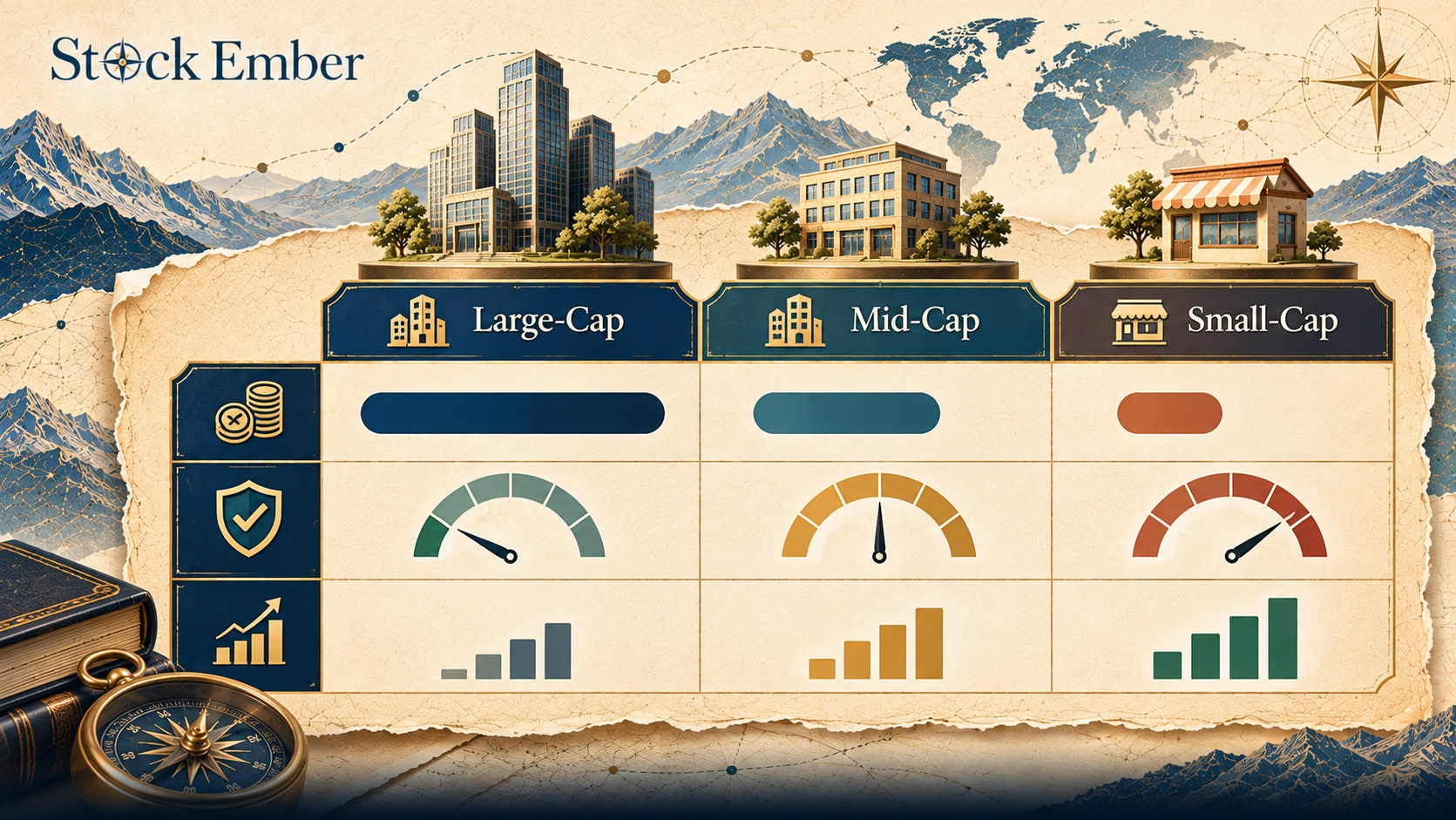
The stock market groups companies by market capitalization, creating tiers that reflect business size, stability, and trading activity.
Market capitalization is calculated by multiplying total outstanding shares by the current stock price. While large-cap companies form the stable core of the market, mid-cap stocks bridge the gap between early expansion and established maturity. Small-cap firms occupy the tier below, where companies actively compete to build market share.
Market Tier
Typical Market Value
Business Stage
Analyst Coverage
Price Volatility
Large-Cap
$10 billion and above
Established global leaders
Heavy
Lower
Mid-Cap
$2 billion–$10 billion
Proven, scaling businesses
Moderate
Moderate
Small-Cap
$250 million–$2 billion
Early-stage or regional firms
Light
Higher
Because Wall Street analysts focus mainly on giant companies, small-cap stocks receive far less institutional research. This thinner coverage can lead to mispriced shares, but also means lower trading volume, making buying and selling larger positions more difficult.
Bar chart showing market capitalization tiers from small-cap to large-cap
Growth Potential vs. Downside: The Reality of Small Companies
Smaller public companies offer meaningful long-term expansion potential, but that growth comes alongside elevated operational and financial risks.
The primary appeal of smaller companies is their runway for business reinvestment. A firm generating $50 million in annual sales can double far faster than a titan generating $50 billion. Over a ten-year holding period, growing businesses can compound earnings and reward patient shareholders who can endure market swings.
However, the downside risks are equally clear. According to educational guidance from the U.S. SEC, smaller companies can carry higher risks, such as shorter operating histories and greater sensitivity to economic slumps.
Financing is another key vulnerability. Unlike large corporations that secure cheap, fixed-rate bond debt, smaller firms often rely on floating-rate bank loans. When central banks lift interest rates, borrowing costs jump immediately. In addition, a notable portion of Russell 2000 companies may be unprofitable at any given time, meaning many must continually raise cash or dilute shareholders to fund operations.
How to Invest in Small-Cap Stocks: Index Funds vs. Picking Winners
For individual buy-and-hold investors, owning a diversified small-cap index fund is far safer than trying to pick single corporate winners.
Speculative investors often treat small companies like lottery tickets, hoping to discover an early startup that turns into an industry giant. In reality, picking individual small caps exposes capital to severe downside. Many small firms run out of cash, lose ground to larger competitors, or fail entirely during recessions.
A more disciplined approach is owning a broad index fund or exchange-traded fund (ETF). If you already practice broad investing in stocks through total stock market index funds, you already own a proportionate slice of small-cap companies.
When selecting dedicated small-cap index funds, always apply a ten-year cost lens. Small-cap funds typically carry slightly higher expense ratios and wider trading spreads than large-cap funds. On a hypothetical $10,000 investment held over ten years, a fund charging an extra 0.25% annually quietly drains hundreds of dollars that would otherwise compound. Choosing low-cost funds protects your long-term returns from fee drag.
Common Mistakes When Looking at Small-Cap Stocks
Investors often make predictable mistakes with small-cap stocks by confusing them with penny stocks, ignoring cycles, or panic selling during drawdowns.
First, established small caps are not penny stocks. Regulated small-cap stocks trade on major national exchanges like the NYSE or Nasdaq and meet strict financial reporting standards. Unregulated over-the-counter (OTC) penny stocks, by contrast, feature minimal reporting and high fraud risks.
Second, many investors expect small caps to beat large caps every year. In practice, market leadership moves in multi-year cycles. Large-cap stocks can dominate for a decade or more, leading impatient investors to abandon small caps right before a historical rebound begins.
In practice, many experienced portfolio builders suggest that small-cap volatility can test an investor's discipline far more than large caps, and rebalancing annually on a fixed calendar may help manage gains without emotional second-guessing.
Conclusion
Small-cap stocks offer patient investors exposure to early corporate expansion, balanced by sharper price swings and higher operational risks. By providing a longer growth runway, smaller businesses can play a valuable role in a diversified equity portfolio. Rather than trying to pick individual winners and risking insolvency, holding broad index funds allows you to capture market-wide growth efficiently over a ten-year horizon.
When you are ready to compare platforms for building and maintaining your portfolio, our broker reviews offer an independent place to start. Keep in mind that all stock investing involves the risk of losing money, past performance never guarantees future returns, and this guide is intended purely for educational purposes.
FAQ
5 questions
Do small-cap stocks pay dividends?
Yes, some small-cap companies pay dividends, but payouts are generally lower and far less common than among large-cap corporations. Most smaller businesses prioritize reinvesting their available cash flows directly back into expansion, product development, or debt repayment. When a small company does offer a dividend, it is usually modest and may be reduced quickly if business conditions soften.
What is the difference between the Russell 2000 and the S&P SmallCap 600?
The Russell 2000 includes roughly the 2,000 smallest companies in the broad Russell 3000 Index without requiring them to be profitable, which leaves a notable share of members losing money. By contrast, the S&P SmallCap 600 requires companies to demonstrate positive earnings history before inclusion, resulting in a benchmark with higher overall financial quality.
How much of an investment portfolio should go to small-cap stocks?
There is no single correct percentage because allocation depends on your personal risk tolerance and time horizon. Broad total stock market index funds typically allocate somewhere in the range of 5% to 10% of their holdings to small-cap companies, though the exact weight varies by provider and over time. Investors seeking extra exposure often hold a modest dedicated allocation, recognizing that sharp downturns can last several years.
Can a small-cap stock grow into a large-cap stock?
Yes, when a small-cap company consistently expands its revenue and market capitalization, it naturally moves into the mid-cap tier and eventually into large-cap status. Prominent global corporations began as smaller public companies before decades of growth expanded their valuation. Broad index funds capture this progression automatically as growing companies make up a larger share of the market.
Why are small-cap stocks more volatile than large-cap stocks?
Small-cap stocks experience significantly higher price volatility than large-cap stocks. Because smaller firms have fewer shares trading and lighter analyst coverage, market news and economic shifts produce larger percentage swings in their share prices. During market sell-offs, smaller companies often drop further than established blue-chip firms with deep balance sheets.
Disclaimer
This guide was written with AI assistance and reviewed by the StockEmber editorial team for accuracy. StockEmber provides independent education, not personal financial advice. Investing puts your capital at risk: the value of investments can go down as well as up, you may get back less than you invest, and past performance doesn’t guarantee future results. Some links may support our work at no additional cost to you.
The StockEmber Team is our in-house desk of independent research writers. We test brokerage platforms, read the fine print on fees and custody, and cover ETFs and long-horizon investing for people who plan to hold for decades — not days.