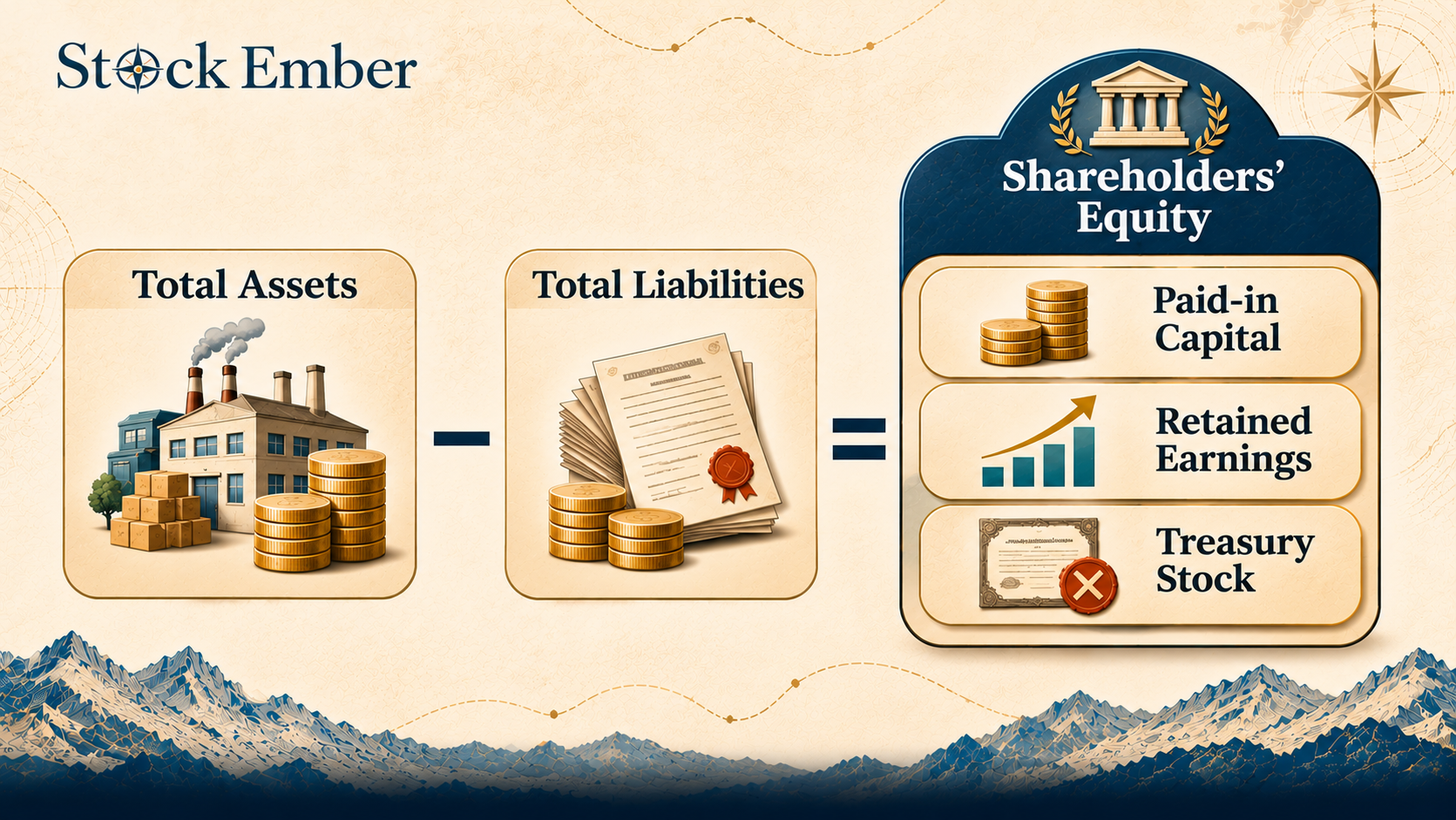
Shareholders' equity equals a company's total assets minus its total liabilities on a given date. Appearing at the bottom of the balance sheet, it represents the net accounting value that would belong to stockholders if every asset were sold at recorded value and all debts were repaid.
What is shareholders' equity? It is the accounting value left for a company's owners after all debts and obligations are subtracted from its total assets.
You might notice a company with billions in accounting equity trading at a markedly different price on the stock exchange. Knowing why accounting value and market price separate helps you judge a business without getting fooled by paper numbers.
This guide breaks down the equity formula, its core parts, and the common mistakes long-term investors should watch out for.
Quick Takeaways
01Equity shows a company's accounting net worth on a specific date, not cash sitting in its bank account.
02Book value often differs sharply from stock market value because accounting rules understate brands, software, and future growth.
03Negative equity does not always signal trouble; profitable companies often create it through share buybacks.
04Long-term index fund investors do not need to analyze individual balance sheets, since diversification spreads single-company risk.
What Is Shareholders' Equity?
Equity is the owners' residual claim on a company's assets after every debt is paid off.
Think of it like home equity. If you own a $400,000 house and owe $300,000 on your mortgage, your equity is $100,000. Businesses track the same math on a balance sheet, a financial snapshot showing what a company owns and owes on a set date.
Everything the business owns counts as assets (cash, equipment, and inventory), while everything it owes outsiders counts as liabilities (loans, unpaid bills, and bonds). Those 3 pieces always balance:
Assets = Liabilities + Shareholders' Equity.
For everyday stock investors, the real shareholders' equity meaning comes down to ownership priority. If a company sold every asset at recorded value and paid all debts, that leftover amount is what would remain for stockholders.
How Equity Works: Formula and Main Parts
You calculate equity by subtracting a company's total liabilities from its total assets.
Shareholders' Equity = Total Assets − Total Liabilities
Total assets cover everything of value the business owns, and total liabilities cover every obligation owed to creditors.
Diagram showing total assets minus total liabilities equaling shareholders' equity
To see shareholders' equity explained in practice, look at its 4 main balance-sheet parts:
Paid-in capital: money the company raised directly from investors by issuing shares, both in its first sale of stock and in any later offerings.
Retained earnings: cumulative profits the company kept and reinvested rather than paying out as dividends.
Treasury stock: shares the company bought back from the open market, recorded as a negative deduction from equity.
Accumulated other comprehensive income (AOCI): gains or losses from items like foreign-currency swings that have not passed through regular net income.
Suppose a hypothetical firm, Northstar Tools, holds $500 million in total assets and $320 million in total liabilities. Its equity equals $180 million, made up of $70 million in paid-in capital, $135 million in retained earnings, minus $25 million in treasury stock.
Book Value vs. Market Value: What the Number Leaves Out
Book value reflects a company's accounting past, whereas market value reflects what investors will pay for its future.
Investors often call equity book value, the net worth recorded in accounting books. By contrast, market capitalization is the total stock market value of all a company's shares.
Feature
Shareholders' Equity (Book Value)
Market Capitalization (Market Value)
How it is set
Past balance-sheet entries
Live share price times total shares
What it captures
Recorded assets minus recorded debts
Expectations for future profits
Main blind spot
Understates brands, software, and patents
Swings daily with investor mood
The two figures rarely match because accounting rules record many assets at historical cost, what a firm paid years ago, rather than today's value. Valuable intangible assets built in-house, such as brand loyalty or software, also go largely unrecorded. Just as important, positive book value is an accounting leftover, not idle cash sitting in a vault.
Why Equity Matters for Long-Term Investors
Tracking equity over several years shows whether a business is steadily compounding net worth or weakening its financial cushion.
When retained earnings grow year after year, it signals that a company earns real profits and reinvests them productively. A healthy equity buffer also helps a business weather downturns without issuing new shares at low prices. At the same time, book value only shows what capital sits inside the business, not the cost of equity, which measures the return investors expect for taking ownership risk.
In practice, many long-term investors find that checking a 5- or 10-year trend is far more useful than judging a single quarter, since multi-year numbers reveal whether management grows net worth steadily or leans heavily on debt.
Common Mistakes When Reading Equity
Treating this figure as a standalone buy signal leads to 3 common misreads.
First, assuming negative equity always means trouble. Years of losses can push equity below zero, yet profitable, cash-rich companies can also show negative equity after buying back large amounts of their own shares, since treasury stock subtracts directly from equity.
Second, confusing book value with cash for dividends. Most assets sit in equipment, inventory, or goodwill (the extra amount paid above asset value when buying another business), not spendable cash.
Third, forgetting write-downs and liquidation orders. Strong accounting equity will not stop a share price from falling. If an acquisition disappoints, an impairment write-down (an accounting cut when an asset is worth less than recorded) can reduce equity substantially in a single reporting period. And in liquidation (selling off assets to pay debts when shutting down), creditors get paid before common shareholders, who can still lose everything.
Conclusion
Equity offers a clear view of a company's accounting net worth, showing what remains of its assets after every debt is settled. Read across several years, it helps you spot whether a business builds lasting value or carries balance-sheet strain, provided you remember that book value is neither cash on hand nor stock market price.
If you invest through broad index funds for the long run, you do not need to analyze individual balance sheets company by company, because holding hundreds of businesses spreads single-company risk automatically.
When you are ready to compare accounts for building a diversified portfolio, our broker reviews are a practical next step. Investing always puts your money at risk and past results never promise the future, so treat this guide as education rather than financial advice.
FAQ
5 questions
What is the difference between shareholders' equity and return on equity (ROE)?
Equity is a dollar figure from the balance sheet showing a company's net accounting worth on one specific date. Return on equity, or ROE, is a profitability ratio calculated by dividing annual net income by that equity figure. While equity measures the size of the owners' accounting stake, ROE shows how efficiently management turns that stake into yearly profit.
Is higher shareholders' equity always better for investors?
No, a larger equity figure does not automatically make a business stronger or a better stock to own. Capital-heavy companies like banks or manufacturers naturally hold much more accounting equity than asset-light software or service firms. Investors generally look at whether equity grows steadily alongside profits rather than judging the raw dollar size on its own.
Where can you find a company's shareholders' equity?
You can find a company's equity in the bottom section of its balance sheet, right beneath total liabilities. Public companies publish their balance sheets inside quarterly and annual financial reports, such as Form 10-Q and Form 10-K filings in the United States. Most financial websites and brokerage platforms also list total stockholders' equity on their company summary pages.
How do share buybacks affect shareholders' equity?
When a company repurchases its own shares on the open market, it uses cash to buy back stock and records the purchase as treasury stock. Because treasury stock is a negative line item in the equity section, share buybacks directly reduce total equity. Over many years, aggressive buybacks can even push a profitable company's accounting equity below zero.
What is the difference between shareholders' equity and owners' equity?
Shareholders' equity and owners' equity describe the exact same accounting concept: total assets minus total liabilities. Businesses use the term owners' equity for sole proprietorships, partnerships, or private limited liability companies where ownership is not divided into stock. Once a business incorporates and issues shares to stockholders, the balance sheet labels that residual stake stockholders' equity.
Disclaimer
This guide was written with AI assistance and reviewed by the StockEmber editorial team for accuracy. StockEmber provides independent education, not personal financial advice. Investing puts your capital at risk: the value of investments can go down as well as up, you may get back less than you invest, and past performance doesn’t guarantee future results. Some links may support our work at no additional cost to you.
The StockEmber Team is our in-house desk of independent research writers. We test brokerage platforms, read the fine print on fees and custody, and cover ETFs and long-horizon investing for people who plan to hold for decades — not days.