Return on capital employed (ROCE) shows how effectively a company turns its total long-term funding, both shareholders' equity and long-term debt, into operating profit. Investors calculate it by dividing earnings before interest and taxes (EBIT) by capital employed, which equals total assets minus current liabilities. A higher percentage indicates that the business generates more operating profit per dollar of capital tied up in operations.
Return on capital employed (ROCE) is a profitability ratio that measures how much operating profit a company generates for each dollar of long-term capital used in its business.
Two companies can report the exact same profit while one needs twice as much cash and equipment to earn it. When you are investing in stocks for the long haul, that gap in efficiency shapes how fast a business can grow. This guide covers how the ratio is calculated, how it compares to similar metrics, and where it can mislead.
Quick Takeaways
01A company earning strong operating profit from a modest capital base has more cash left to reinvest and compound over time.
02ROCE works best when comparing direct rivals in capital-heavy industries like utilities, manufacturing, and telecoms.
03Aging, written-down equipment can make ROCE look artificially strong right before costly upgrades hit.
04A high ROCE shows business efficiency, not a bargain share price; overpaying for a great business can still hurt returns.
What Is Return on Capital Employed?
ROCE is a measure of how efficiently a business turns its long-term funding into operating profit. Understanding the return on capital employed meaning starts with looking at both sides of a company's balance sheet: money put in by shareholders and long-term debt borrowed from lenders.
Unlike profit figures viewed in isolation, ROCE asks what it took to produce those earnings. Running an airline, an electric grid, or a factory requires billions of dollars in planes, power lines, and machinery, so ROCE shows whether management earns a worthwhile return on that entire capital pool.
How to Calculate Return on Capital Employed
You calculate ROCE by dividing a company's operating profit by the total capital employed in the business.
ROCE = EBIT / Capital Employed
Here, EBIT stands for earnings before interest and taxes, the operating profit a business makes before paying lenders or taxes. Capital employed is the total long-term money tied up in operations, calculated in 2 standard ways:
Capital Employed = Total Assets - Current Liabilities
Total assets cover everything the company owns, while current liabilities are bills and debts due within 1 year. You reach the same figure by adding shareholders' equity (the net value belonging to owners) and non-current liabilities (long-term debts due after 1 year):
Capital Employed = Shareholders' Equity + Non-Current Liabilities
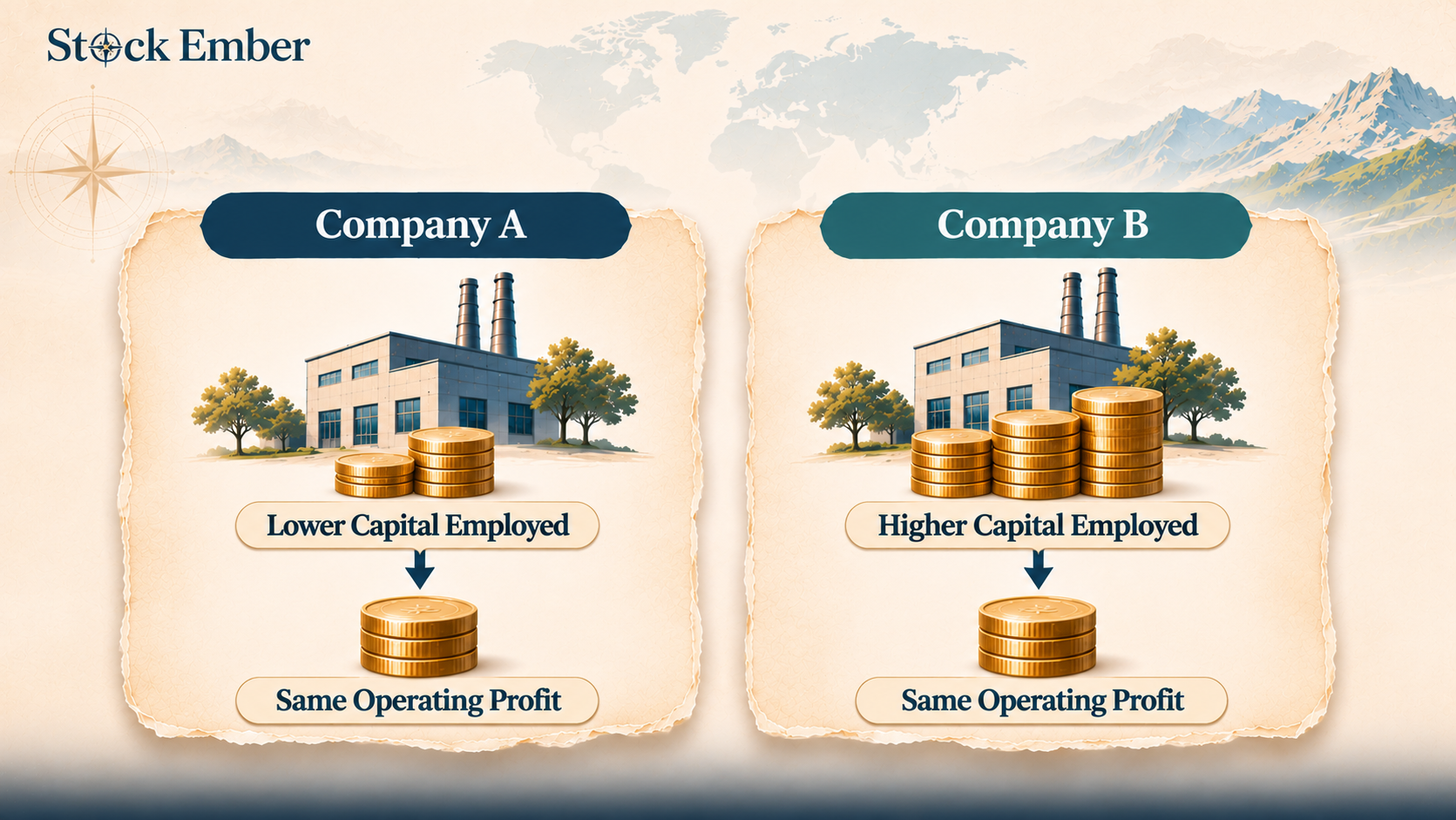
Visual comparison of two companies earning equal operating profit with different capital employed
With return on capital employed explained through a side-by-side example, the gap between two peers stands out right away. Suppose Company A and Company B both report $20 million in EBIT. Company A runs on $100 million in capital employed for a 20% ROCE ($20 million / $100 million), while Company B needs $250 million in plants and debt for an 8% ROCE ($20 million / $250 million). Both earned the same dollar profit, yet Company A used less than half the capital.
Why Return on Capital Employed Matters for Long-Term Investors
A consistently high ROCE signals that a company can reinvest profits at attractive rates rather than needing constant outside cash to stay standing. Over 10 or 20 years, a business earning 18% on reinvested cash compounds value far faster than a rival stuck at 6%.
There is no single magic number that defines a "good" ROCE across every sector. Instead, investors check whether ROCE stays comfortably above a company's cost of capital, the minimum return needed to pay lenders and shareholders, since falling below that funding cost erodes value.
In practice, many long-term investors find that one year's ROCE tells only part of the story. Tracking the ratio over 5–10 years, including through a slow economy, shows whether a business's efficiency holds up under pressure.
ROCE vs. ROIC and ROE: How They Differ
ROCE, return on invested capital (ROIC), and return on equity (ROE), a ratio comparing net profit to shareholders' equity alone, all measure profitability, but each looks at a different slice of funding.
Metric
Capital Base Measured
Best Used For
ROCE
Total assets minus current liabilities (pre-tax EBIT)
Comparing capital-heavy peers with different debt levels
ROIC
Operating capital after tax (excludes excess cash)
Measuring core operating efficiency after taxes
ROE
Shareholders' equity only (net income after tax)
Evaluating banks and asset-light businesses
Because ROE ignores long-term debt, a company can boost ROE simply by borrowing heavily, adding risk. ROCE closes that gap by counting both debt and equity. Meanwhile, ROIC adjusts for taxes and strips out idle cash, focusing tightly on core operations.
Common Mistakes and Limitations to Watch
ROCE relies on historical accounting figures, so 3 practical traps can distort what the number tells you.
Aging assets inflate the ratio: Accounting rules gradually write down the book value of old equipment through depreciation (the steady reduction of an asset's value over its useful life). As equipment ages, capital employed shrinks on paper, pushing ROCE higher even when costly replacements loom.
Cross-industry comparisons mislead: A software firm needs little physical gear, so its ROCE naturally towers over an electric utility or railway. Compare ROCE only against direct rivals in the same sector.
High ROCE does not mean a cheap stock: ROCE says nothing about share price. Overpaying for a high-ROCE business can still leave you with poor returns, and past efficiency never shields a stock from market drops.
Conclusion
ROCE shows how hard a company's long-term money works to generate operating profit, making it a useful check on business quality in capital-heavy industries. Weighed alongside debt levels, multi-year trends, and share price, rather than used as a standalone shortcut, it helps separate efficient operators from cash-hungry businesses.
If you hold broad index funds rather than picking individual stocks, you do not need to track single-company ratios like ROCE to build long-term wealth.
When you are ready to compare accounts for holding your investments, our broker reviews are a sensible place to start. Stock investing always puts your money at risk and past performance never promises future results, so treat this guide as a starting point for your own research rather than personal investment advice.
FAQ
5 questions
What is a good return on capital employed?
There is no single benchmark that works for every industry because capital needs vary widely across sectors. Instead of looking for one fixed percentage, investors usually compare a company's ROCE against direct competitors in the same industry and check whether it stays comfortably above the company's cost of capital over a full business cycle.
Can a company have a negative return on capital employed?
Yes, a company reports a negative ROCE whenever its earnings before interest and taxes (EBIT) fall below zero, meaning its core operations lost money during that period. A negative figure can also appear in rare cases where current liabilities exceed total assets, leaving negative capital employed, which signals potential short-term liquidity pressure that warrants closer review.
Why does ROCE use EBIT instead of net income?
ROCE uses earnings before interest and taxes (EBIT) because capital employed includes both shareholders' equity and long-term debt. Using pre-interest, pre-tax operating profit allows investors to measure how well the underlying business assets perform before financing choices or local tax rates change the final bottom-line profit figure.
How often should long-term investors check ROCE?
Long-term investors typically review ROCE annually rather than reacting to a single quarter's results. Looking at a 5–10-year track record helps smooth out temporary economic slowdowns or one-off spending spikes, showing whether a company consistently earns strong returns on its capital or relies on short-term accounting boosts.
Is return on capital employed useful for bank or financial stocks?
ROCE is generally not useful for banks, insurers, or other financial companies. Because customer deposits and short-term funding are the core raw materials of banking rather than operating overhead, separating current liabilities from long-term capital distorts the ratio, making return on equity (ROE) a more standard measure for financial firms.
Disclaimer
This guide was written with AI assistance and reviewed by the StockEmber editorial team for accuracy. StockEmber provides independent education, not personal financial advice. Investing puts your capital at risk: the value of investments can go down as well as up, you may get back less than you invest, and past performance doesn’t guarantee future results. Some links may support our work at no additional cost to you.
The StockEmber Team is our in-house desk of independent research writers. We test brokerage platforms, read the fine print on fees and custody, and cover ETFs and long-horizon investing for people who plan to hold for decades — not days.