Cost of equity is the minimum yearly return a business needs to generate to compensate shareholders for the risk of owning its stock. Analysts usually estimate it using models like the Capital Asset Pricing Model (CAPM) or a dividend growth formula, rather than a fixed contract.
Cost of equity is the annual return a company must offer to attract shareholders, and the minimum return an investor expects in exchange for taking on stock risk.
When you buy shares in a business, you don't get a promised interest rate like a bondholder does; instead, you accept uncertainty in hopes of a higher payoff. Understanding the cost of equity meaning helps you judge whether a stock's potential reward matches its risk.
Below, you'll see cost of equity explained in plain terms, how the math works, and how long-term investors use it.
Quick Takeaways
01A company’s equity cost is a two-sided number: an expense for the business raising money and a required return for you as a shareholder.
02Companies and analysts estimate it using models like the Capital Asset Pricing Model (CAPM) or dividend growth formulas, not a fixed contract.
03Equity financing costs more than debt because shareholders take on higher risk and sit behind lenders if a business fails.
04Treat any such figure as a rough guide built on assumptions, not a promise of future stock performance.
What Is Cost of Equity?
Cost of equity is the rate of return a business needs to deliver to keep its owners satisfied and willing to hold its shares.
Think of it as two sides of the same coin. From the company's side, raising money by selling shares isn't free, even though there are no monthly loan bills. When you start investing in stocks, you hand over your cash with the expectation that the business will grow your money over time. That expected payoff is the company's required return.
On a balance sheet, the capital contributed by owners plus retained profits is recorded as shareholders' equity. Unlike a bank loan, this money has no maturity date and no fixed interest rate. Because dividends and share price gains are never guaranteed, investors demand a higher potential return than they would accept from a safer loan. If a company fails to meet that bar over time, shareholders may sell, which can push the share price lower.
How Cost of Equity Is Calculated (With Examples)
Analysts estimate this rate using 2 main formulas: the Capital Asset Pricing Model (CAPM) for most stocks, and the dividend capitalization model (also called the dividend growth model) for steady dividend payers.
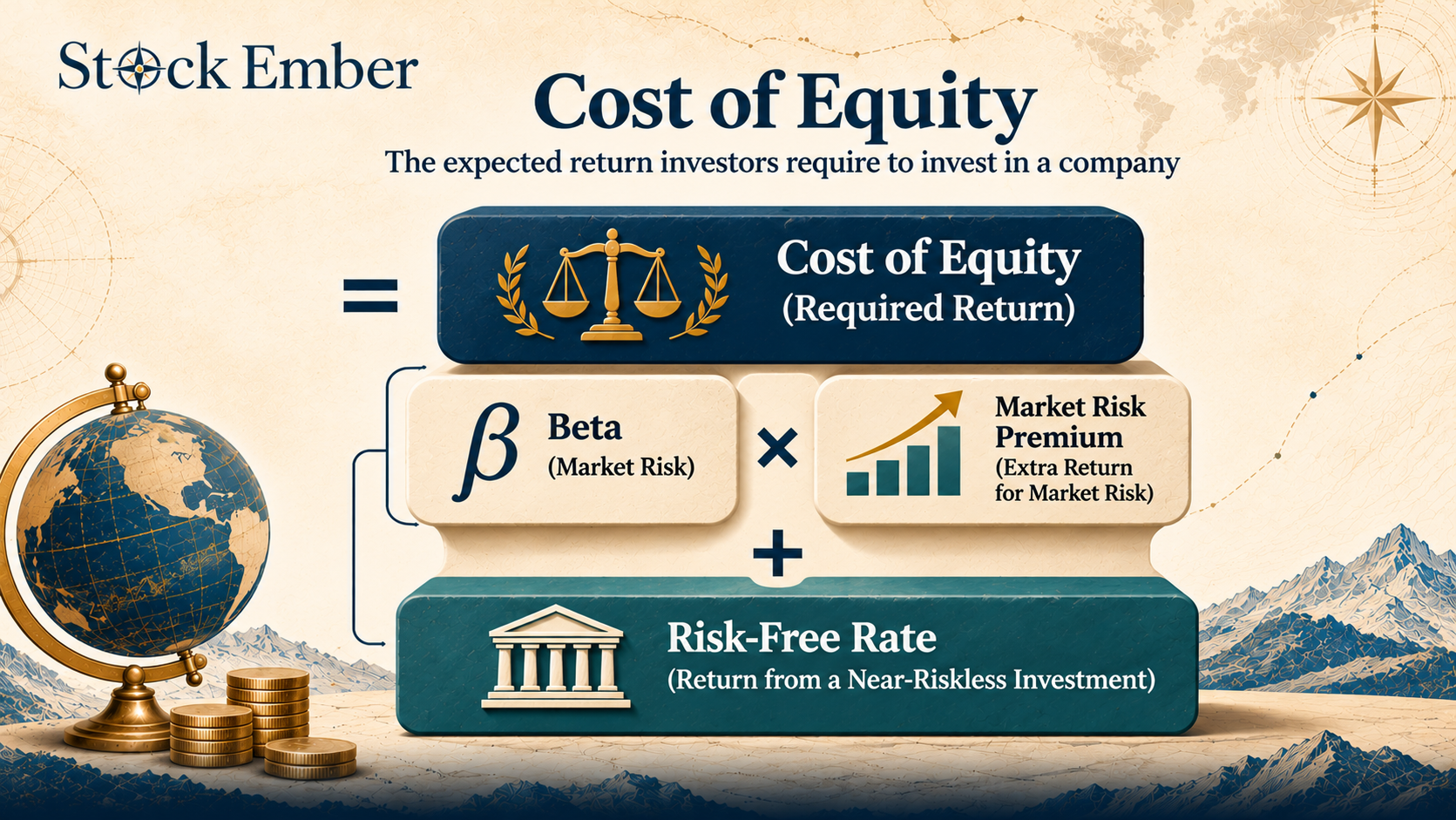
The Capital Asset Pricing Model (CAPM) estimates your required return based on how risky a stock is compared with the broader market:
Here, the risk-free rate is the yield on a government bond with very low default risk, though no investment is truly risk-free. Beta measures how sharply a stock's price swings compared with the overall market, while the gap between expected market return and the risk-free rate is the extra reward investors demand for owning stocks.
Suppose a hypothetical government bond yields 4% and the broad stock market is expected to return 9% a year. In the same example, a stock has a beta of 1.2, meaning it tends to move 20% more than the market. Plugging in those numbers gives: 4% + 1.2 * (9% - 4%) = 10%. That 10% is the estimated required return.
For mature companies that pay regular dividends, you can also use the dividend capitalization model:
Cost of Equity = (Next Year's Expected Dividend per Share / Current Share Price) + Expected Dividend Growth Rate
This adds next year's expected dividend yield to the annual rate at which payouts are expected to grow. If a $50 stock is expected to pay a $2 dividend next year (a 4% yield) and grow that payout by 5% a year, its estimated required return is 9%.
Stacked diagram showing how risk-free rate, beta, and market premium form cost of equity
Cost of Equity vs. Cost of Debt
Equity funding is almost always more expensive than debt because shareholders accept more risk than lenders, and a company cannot deduct dividends from its taxes the way it can deduct interest.
When a business borrows money through bonds or bank loans, lenders get paid interest first, and the company can usually deduct that interest on its taxes. Shareholders sit last in line if a company goes bankrupt, so they require a higher expected return to make the risk worthwhile.
Companies blend both figures into their Weighted Average Cost of Capital (WACC), the combined minimum return a business must earn across all its funding sources to justify a new project.
Feature
Equity
Debt
Payment obligation
Dividends and price gains are optional
Interest payments are legally required
Risk to investor
Higher (last in line in bankruptcy)
Lower (paid before shareholders)
Tax benefit for company
None
Interest is usually tax-deductible
Why the Required Return Matters for a Long-Term Investor
Knowing a stock's required return gives you a realistic benchmark for whether the company's growth plans justify the risk of owning its shares.
Businesses use this figure as a hurdle rate, the minimum profit threshold a new factory, product, or acquisition must clear before management approves it. If a company consistently earns less than its required return, it is quietly destroying shareholder value even while reporting accounting profits. Over a 10-year holding period, that gap between what a business earns and what shareholders require compounds into major differences in wealth.
In practice, many long-term investors find that checking whether a company earns above its cost of capital is far more useful than trying to pin down an exact decimal point. And if you prefer owning a broad market index fund rather than picking individual stocks, you don't need to calculate single-stock required returns at all, because diversification spreads company-specific risk across hundreds of businesses.
Common Mistakes When Using Cost of Equity
A common mistake investors make is treating this figure as a guaranteed annual return rather than a rough estimate.
Both CAPM and dividend models rely on inputs that nobody knows for certain in advance. Here are 3 common traps to watch for:
Confusing estimates with promises: Changing your market return assumption by just 1 or 2 percentage points shifts the answer noticeably.
Relying blindly on past numbers: Historical beta and past market averages show what happened before, not what will happen next.
Using the dividend formula on non-payers: Many growing companies reinvest every dollar instead of paying dividends, which makes the dividend capitalization model unusable for them.
Conclusion
This rate bridges the gap between a company's funding choices and your expectations as a shareholder. While formulas like CAPM and the dividend capitalization model offer a structured way to weigh risk against potential reward, every output rests on assumptions that can miss the mark in real markets. Keep your focus on long-term business quality and broad diversification rather than chasing exact model numbers.
When you're ready to compare platforms for holding your long-term investments, our broker reviews are a sensible next step. Investing always puts your money at risk and past returns never promise the future, so treat this guide as education rather than personal financial advice.
FAQ
5 questions
What is a good cost of equity?
There is no single number that counts as a good figure for every company. A stable utility company with steady cash flows typically has a lower required return than a young tech business whose earnings swing widely. In general, a lower figure signals that investors view the business as less risky, while a higher figure means shareholders demand extra return for taking on greater uncertainty.
Can a company's cost of equity be negative?
In theory, a negative result can appear in the CAPM formula if a stock's beta is negative enough to outweigh the risk-free rate, meaning the stock tends to rise when the overall market falls. In practice, investors do not buy shares expecting to lose money over the long run. When a model produces a negative number, analysts usually treat it as a quirk of historical price data rather than a realistic return expectation.
Does a company's required return change over time?
Yes, this rate shifts constantly as interest rates, market sentiment, and business risks change. When government bond yields rise, the baseline yield climbs, pushing up the minimum return investors expect from stocks. Changes in a company's debt load, earnings stability, or industry competition can also alter how risky the shares appear and raise or lower the required return.
Do companies actually pay their required return in cash?
No, it is not a bill a company pays out in cash each year. Unlike loan interest, which must be paid on a strict schedule, shareholders receive their return through a mix of optional dividends and long-term share price growth. If a business reinvests all its profits instead of paying dividends, investors expect that growth to show up in a higher stock price over time.
What is the difference between cost of equity and cost of capital?
This measure looks only at the return expected by shareholders who own a piece of the business. Cost of capital, often measured as Weighted Average Cost of Capital (WACC), is broader because it blends both the equity return and the cost of debt. Companies use total cost of capital as their overall benchmark when deciding whether a new investment project makes financial sense.
Disclaimer
This guide was written with AI assistance and reviewed by the StockEmber editorial team for accuracy. StockEmber provides independent education, not personal financial advice. Investing puts your capital at risk: the value of investments can go down as well as up, you may get back less than you invest, and past performance doesn’t guarantee future results. Some links may support our work at no additional cost to you.
The StockEmber Team is our in-house desk of independent research writers. We test brokerage platforms, read the fine print on fees and custody, and cover ETFs and long-horizon investing for people who plan to hold for decades — not days.