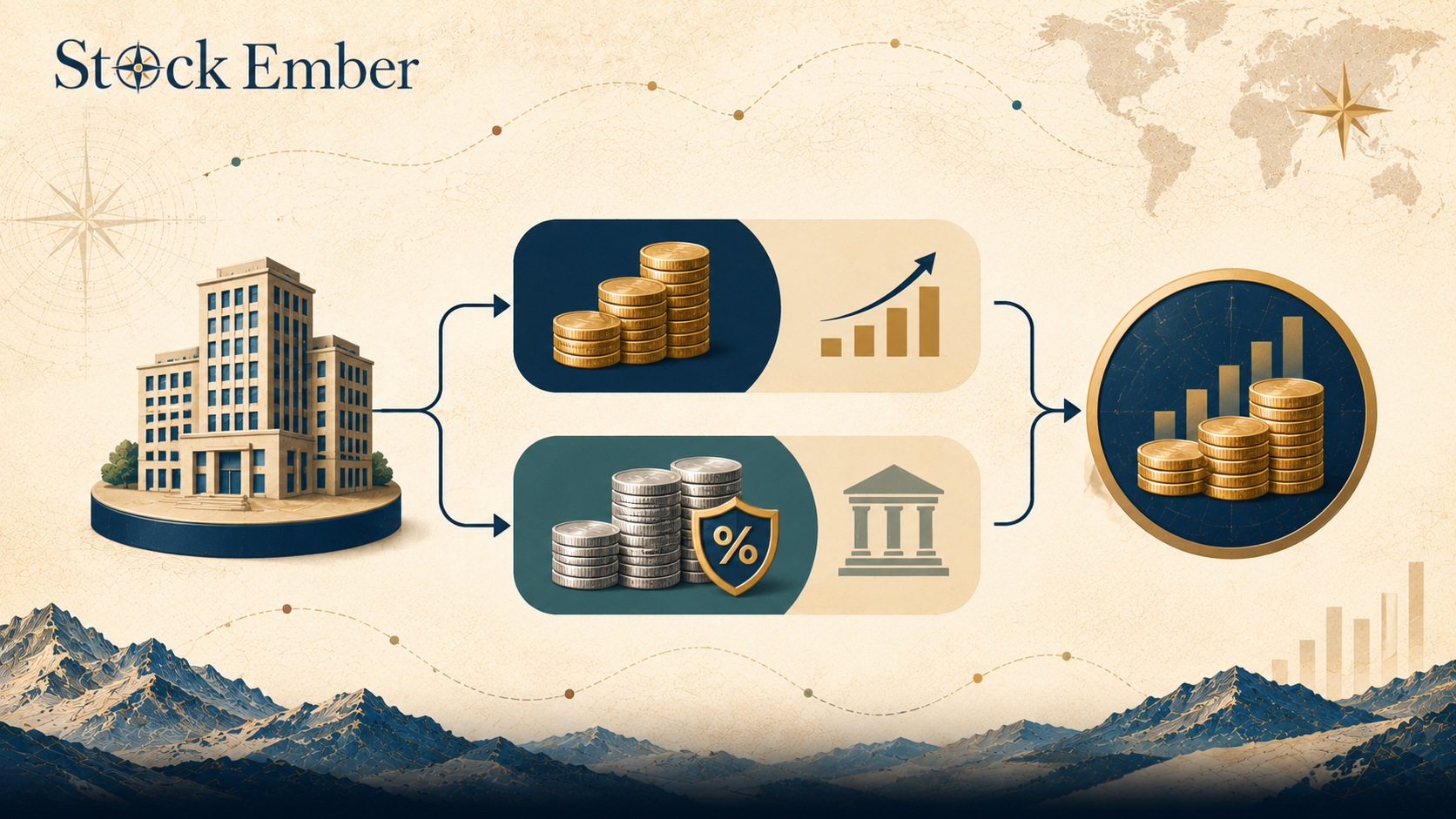
The weighted average cost of capital (WACC) represents a firm's total financing cost across all debt and equity sources. It functions as an internal hurdle rate, meaning a business must earn a return higher than this percentage to generate real economic value for its owners. Because interest payments are tax-deductible, corporate debt is generally cheaper than equity financing.
The weighted average cost of capital (WACC) is the blended interest and expected return rate a company pays across all its sources of funding.
When a business plans to build a factory or launch software, funding is never free. Management must choose between borrowing from lenders or issuing stock, and each option carries a distinct cost. This guide covers how this blended rate is calculated, why excess debt backfires, and what the metric means for patient investors.
Quick Takeaways
01WACC serves as a corporate hurdle rate; projects earning below this blended cost destroy shareholder capital over time.
02Debt is typically cheaper than equity because interest payments carry a tax shield, while shareholders demand a higher return for taking on risk.
03Borrowing heavily lowers paper WACC initially, but sharpens financial distress risk if earnings fall.
04Long-term index investors may participate in corporate value creation through broad diversification without needing to calculate discount rates, though index investing still carries market risk.
What Is WACC? (The Meaning in Plain English)
The weighted average cost of capital represents the minimum percentage return a company must earn on its funding base to satisfy both lenders and shareholders.
At its core, the practical WACC meaning is simple: corporate funding is never free. When asking what WACC is, think of a home purchase. Financing a house with a bank loan and personal savings combines mortgage interest with the return your cash could have earned elsewhere. A corporation operates under the same logic, funding assets through debt (loans and bonds) or equity (shares sold to investors).
To see WACC explained clearly, treat it as the corporate break-even rate. If a company borrows at 4% after taxes and shareholders expect an 8% return, its blended funding cost sits in between. Failing to clear that combined hurdle destroys economic value on every dollar deployed.
How WACC Works: Debt, Equity, and the Blended Rate
WACC calculates a company's blended capital cost by weighting debt and equity according to their share of the company's total capital.
The cost of debt is the interest rate paid on corporate borrowings. Because interest payments are tax-deductible in most jurisdictions, debt benefits from an interest tax shield. If a firm borrows at 6% interest and faces an assumed 25% tax rate (the U.S. federal corporate rate is 21%, according to IRS Publication 542, revised January 2024), its after-tax borrowing cost falls to 4.5%.
The cost of equity represents the return common shareholders require for taking on business risk. Because shareholders stand last in line during liquidation, they demand a higher expected return. This makes equity more expensive than debt.
The formula weights both sources into a single blended rate:
WACC = (Equity / Total Capital × Cost of Equity) + (Debt / Total Capital × Cost of Debt × (1 − Tax Rate))
Capital Source
Amount
Share
Cost
After-Tax Cost
Weighted Cost
Debt
$40,000,000
40%
6%
4.5%
1.80%
Equity
$60,000,000
60%
9%
9%
5.40%
Total / WACC
$100,000,000
100%
—
—
7.20%
In this example, the 7.20% WACC balances both pools: tax-advantaged debt pulls the overall hurdle rate below the equity return target.
Diagram breaking down equity and debt proportions in weighted average cost of capital
WACC as a Corporate Hurdle Rate (ROIC vs. WACC)
Corporate executives use WACC as an internal hurdle rate to decide which capital investments and acquisitions to approve.
Every new project must earn an annual return higher than the company's WACC to generate real wealth. If a firm's WACC is 7.2%, an initiative earning a 10% return on invested capital produces genuine economic profit. But if a project earns only 5%, it destroys value even if accounting books record net income. According to educational guidance from the CFA Institute, a company creates economic value only when its return on invested capital exceeds its weighted average cost of capital.
Over a 10-year holding period, this spread between return and funding cost drives compounding. Businesses that consistently beat their WACC may build stronger balance sheets. Companies that trail their WACC may tie up cash in weak projects, which can eventually strain liquidity measures like the quick ratio.
The Leverage Trap: Why a Lower WACC Isn't Always Better
A lower WACC is not always a sign of a stronger business, because heavy borrowing lowers capital costs on paper while sharply increasing financial fragility.
In theory, management could push WACC down simply by replacing equity with cheaper debt. Repurchasing shares with borrowed money reduces the blended funding cost in the short run.
However, this dynamic creates a dangerous leverage trap. Debt requires fixed interest payments regardless of sales. If revenue drops during an economic slump, unpaid debt leads quickly to default. Credit agencies downgrade the company, borrowing costs spike, and equity holders risk total wipeout in bankruptcy.
In practice, experienced equity analysts look past an artificially low WACC and evaluate interest coverage ratios (how many times operating profit covers interest payments), recognizing that a company funded conservatively with equity often survives severe downturns far better than an indebted peer.
What WACC Means for Everyday Stock Investors
For individual buy-and-hold investors, WACC serves as a conceptual yardstick for business quality rather than a metric needing personal spreadsheet tracking.
Valuation analysts use WACC as the discount rate to calculate the present value of future cash flows. But if your strategy centers on long-term investing in stocks through broad index funds or ETFs, you do not need to calculate cost-of-capital formulas.
Diversified index funds hold hundreds of businesses at once. Over long periods, markets tend to reward companies that clear their capital costs, which can expand their weight in a market-cap-weighted index (an index where larger companies carry bigger weights). Companies that consistently fail to earn their WACC often see their index weight shrink over time. Broad-market index investors may participate in this value creation through diversification without needing to forecast interest rates or corporate debt spreads.
Common Mistakes When Looking at WACC
Investors frequently misinterpret WACC by confusing corporate financing costs with portfolio returns or treating the metric as permanent.
First, WACC is not an investor's personal return. A company with a 7% WACC will not necessarily deliver a 7% portfolio return. WACC measures what the firm pays for capital, while your return depends on share price changes and dividend payouts.
Second, WACC changes constantly. It shifts alongside central bank interest rates, revised tax codes, and corporate credit rating adjustments. Relying on an outdated figure leads to flawed valuation assumptions.
Third, refinancing risk alters capital costs quickly. When low-rate bonds mature during higher-rate periods, refinancing debt at higher interest rates increases WACC and compresses project profit margins.
Conclusion
The weighted average cost of capital defines the blended price a company pays for its debt and equity financing. By serving as an internal hurdle rate, WACC determines whether corporate projects generate true economic value or quietly erode shareholder capital. While understanding funding costs clarifies business fundamentals, patient index investors may benefit from corporate value creation over time through broad diversification, although returns are never guaranteed.
When you are ready to compare platforms for managing your portfolio, our broker reviews offer a practical place to start. Keep in mind that all stock investing carries the risk of losing money, past performance never guarantees future results, and this guide is intended purely for educational purposes.
FAQ
5 questions
What is considered a good or normal WACC for a company?
Many established public companies may have a WACC somewhere in the mid-to-high single digits, though the figure can vary significantly by industry. Stable utility and consumer staple businesses often enjoy lower capital costs because their cash flows are predictable. High-growth technology firms or cyclical industrial businesses usually face higher capital costs because investors require larger risk premiums to compensate for volatile earnings.
Can a company's WACC ever be negative?
In practice, no: WACC stays positive. Lenders generally demand a positive interest rate to compensate for inflation, opportunity cost, and default risk, although a few highly rated issuers have borrowed at negative yields in certain markets. Equity investors, however, always expect a positive rate of return to absorb the risk of owning common shares. Because the cost of equity stays positive, the blended WACC remains positive even when borrowing costs are unusually low.
How does rising inflation affect a company's WACC?
Rising inflation can push WACC higher across both debt and equity. When inflation increases, central banks typically raise interest rates, which directly increases the cost of issuing new corporate bonds and loans. At the same time, equity investors demand higher returns to prevent their purchasing power from eroding. As both borrowing costs and required equity returns climb, the blended hurdle rate increases.
How does preferred stock factor into WACC?
Preferred stock is treated as a distinct third financing bucket alongside common equity and debt. In the expanded WACC formula, preferred shares receive their own weight and specific cost of capital based on their stated dividend yield. Unlike corporate bond interest, preferred dividends are generally not tax-deductible, meaning they do not provide an interest tax shield to the business.
What is the main difference between WACC and a discount rate?
WACC is a specific calculation representing a company's blended cost of capital, whereas a discount rate is any interest rate used to convert future cash flows into present value. In financial modeling, analysts frequently use WACC as the discount rate when valuing an entire company. However, investors can choose other discount rates, such as an arbitrary personal hurdle rate.
Disclaimer
This guide was written with AI assistance and reviewed by the StockEmber editorial team for accuracy. StockEmber provides independent education, not personal financial advice. Investing puts your capital at risk: the value of investments can go down as well as up, you may get back less than you invest, and past performance doesn’t guarantee future results. Some links may support our work at no additional cost to you.
The StockEmber Team is our in-house desk of independent research writers. We test brokerage platforms, read the fine print on fees and custody, and cover ETFs and long-horizon investing for people who plan to hold for decades — not days.