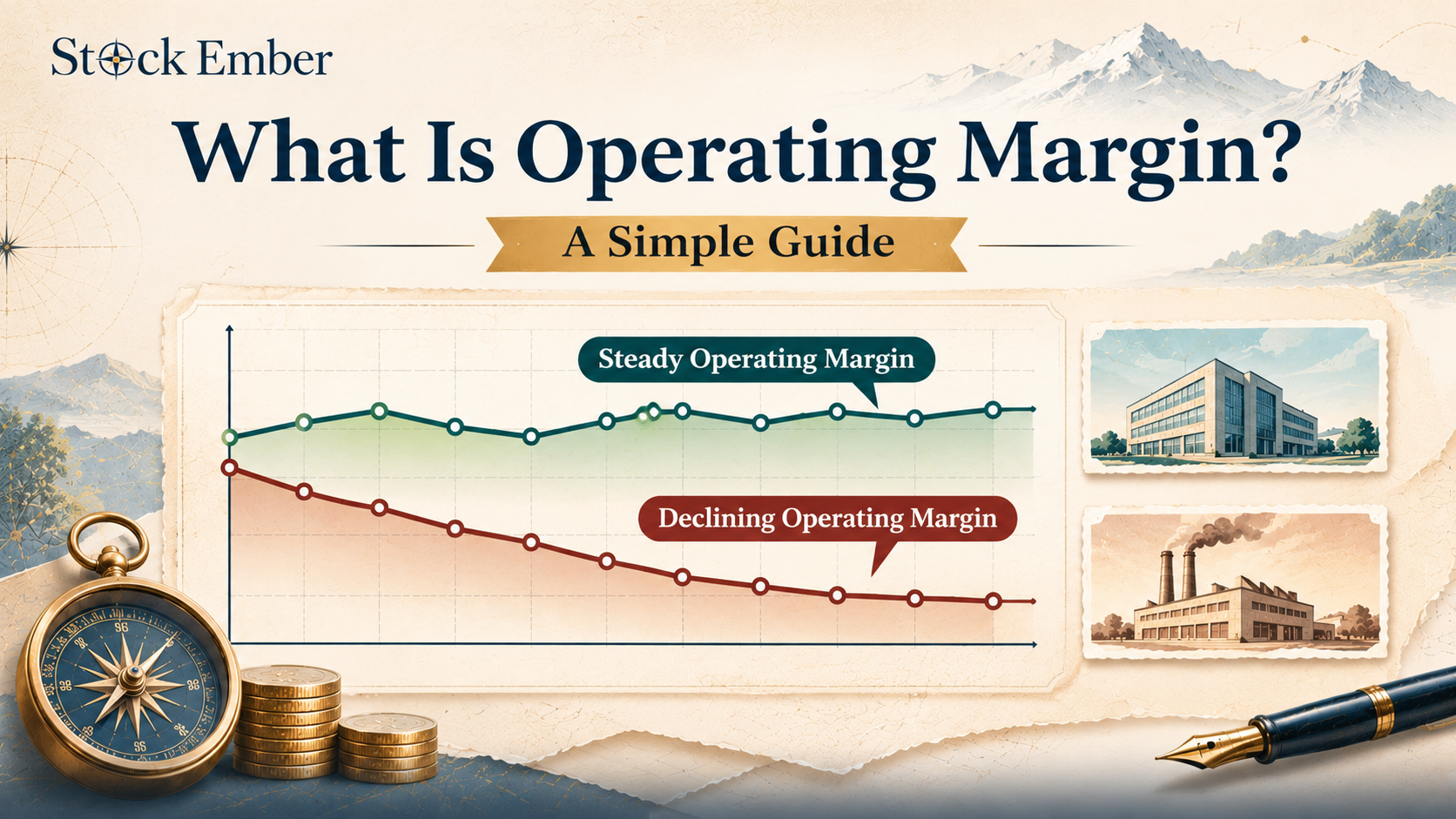
An operating margin is the share of revenue a business retains after covering its production costs and day-to-day administrative overhead. Because it leaves out interest expenses and corporate income taxes, this metric provides a clean gauge of everyday operating efficiency. Investors use it to evaluate how profitably a company generates core income from each dollar of revenue.
This metric measures how much profit a company makes on each dollar of sales after paying production and daily operating costs, before interest or taxes. It shows how cleanly a business runs its core operations.
When evaluating a company with rapid sales growth, it is easy to assume the business is thriving. Yet without healthy margins, rising revenue creates little lasting wealth for shareholders. A business can sell billions of dollars in goods and still struggle if overhead absorbs every incoming dollar.
This guide explains how the metric works, how it differs from gross and net profit, and why cost discipline matters for long-term investors.
Quick Takeaways
01This metric isolates core business performance by removing the distorting effects of debt financing and income taxes.
02High fixed overhead creates operating leverage, which expands profits during booms but deepens losses in downturns.
03Margin comparisons are only useful between companies that share the same industry and business model.
04Broad-market index investors automatically own a balanced mix of high- and low-margin businesses without needing to forecast individual margins.
What Is Operating Margin?
Put simply, it is the percentage of revenue left after paying production costs and everyday operating overhead. In company financial reports, operating profit is often called Earnings Before Interest and Taxes (EBIT). Comparing this profit figure directly to total sales shows how much profit core operations generate from each dollar of revenue.
The calculation is straightforward:
Operating Margin = (Operating Income / Revenue) * 100
Operating income is the profit remaining after subtracting direct production costs and routine administrative overhead from total sales. If a company generates $100 million in revenue and keeps $20 million in operating profit, its margin is 20%. That leaves 20 cents of every sales dollar to pay debt interest, cover taxes, and fund future growth.
If you want to know what operating margin is in practical terms, think of it as a test of operational efficiency. The true operating margin meaning is that it shows whether a business makes money from its core products before financing choices come into play. Two companies might make identical products, but one carrying heavy debt will show lower net profit. This ratio removes those debt differences so you can judge the underlying business engine.
Listed U.S. companies file quarterly and annual financial statements with the U.S. SEC. Investors can calculate the ratio from the operating income and revenue figures in those filings to evaluate operational efficiency separately from capital structure.
How Operating Margin Works: The 3-Step Margin Ladder
To see how operating profit fits into financial reporting, picture the income statement as a ladder where costs step down total sales:
Gross Profit: Revenue minus Cost of Goods Sold (COGS), which includes raw materials and factory labor. Gross margin reflects basic product markup.
Operating Profit: Gross profit minus Selling, General, and Administrative (SG&A) expenses, such as office rent, marketing, and corporate salaries, as well as Research and Development (R&D). The resulting margin reflects management efficiency.
Net Income: The final profit after subtracting debt interest, one-off charges, and income taxes. Net margin reflects final take-home earnings.
Margin Level
What It Measures
Key Costs Deducted
Gross Margin
Product markup
Cost of Goods Sold (materials and direct factory labor)
Operating Margin
Operational efficiency
Production costs plus sales, marketing, and office overhead
Net Margin
Bottom-line profit
All corporate costs, including debt interest and income taxes
With operating margin explained through this ladder, you can see how it bridges raw markup and bottom-line profit. The metric includes non-cash expenses like depreciation (writing down physical equipment over its useful life) and amortization (spreading intangible asset costs over time).
To evaluate operating cash generation before those non-cash charges are deducted, analysts often review the EBITDA margin, which adds back depreciation and amortization to operating profit.
Why Operating Margin Matters for Long-Term Investors
For buy-and-hold investors, stable margins are often the clearest sign of a competitive edge. When a company preserves its margins across full economic cycles, it usually means customers cannot easily switch to cheaper rivals. That pricing power protects profits when inflation raises wages or material costs.
Cost discipline also compounds over time. Consider 2 competing firms that each start with $100 million in sales. Firm A controls its corporate overhead, maintaining a 15% margin ($15 million in operating income). Firm B lets administrative payroll creep upward until it absorbs an extra 5% of sales, cutting its margin to 10% ($10 million in operating income).
Over a 10-year holding period, that 5-percentage-point difference in operating discipline quietly diverts tens of millions of dollars away from productive growth or dividends. This compounding cost drag shows why operational discipline is a central concept when learning about investing in stocks.
Chart comparing the 10-year profit gap between 2 companies with different margins
In practice, long-term investors often find that rapid margin gains from sudden corporate layoffs or slashed maintenance budgets are temporary. Durable margins stem from structural advantages like proprietary software or supplier scale, not from starving core operations.
Operating Leverage: Why Margins Expand and Collapse
Margins change over time because businesses carry different mixes of fixed and variable costs. This relationship is known as operating leverage.
Fixed costs are expenses that do not shift with sales volume, such as building leases, factory machinery, and head-office salaries. Variable costs, such as packaging and raw inputs, rise and fall with every unit sold.
When a firm with high fixed overhead grows its sales, each new dollar of revenue flows quickly to operating profit because the leases and salaries are already paid. This dynamic helps margins widen rapidly during good economic times. However, operating leverage cuts both ways. When revenue drops during a downturn, fixed overhead remains due, causing operating profits to fall far faster than sales.
Because cost structures vary widely by sector, you should only compare these margins between companies in the same industry:
Retail and Supermarkets: Tend to carry thin margins, often in the low single digits, because goods are commodities, making high inventory turnover essential.
Enterprise Software: Can post comparatively high margins, in some cases above 25%, because delivering code to additional customers requires minimal extra cost.
Heavy Manufacturing: Holds large fixed plant costs, leading to cyclical margins that swing with factory use.
Common Pitfalls in Operating Margin Analysis
Relying on a single financial ratio can lead to flawed conclusions. When evaluating these margins, watch for 3 common traps:
First, do not confuse a high margin with high capital efficiency. A company might earn a 25% margin, but if it required $500 million in heavy machinery to produce $20 million in operating profit, its Return on Invested Capital (ROIC), the percentage return generated on all capital used, is poor.
Second, beware of one-time adjustments and stock-based compensation (paying staff with company shares instead of cash). Management teams often exclude these items to report flattering "adjusted" operating numbers that mask real overhead costs.
Finally, do not treat peak-cycle margins as permanent. Commodity producers and industrial businesses often report record margins at the height of an economic boom. Anchoring on those temporary figures can lead investors to overpay for shares right before earnings drop.
Conclusion
Operating margin offers a clear view of core business performance by isolating everyday operations from financing choices and income taxes. Over multi-year holding periods, companies that protect their margins through pricing power and cost discipline tend to build durable value for their owners.
However, individual margins always face business risks, including unexpected wage inflation, technological shifts, and heavy fixed overhead during recessions. Long-term investors who hold broad-market index funds automatically own a diversified mix of high-margin leaders and volume-driven businesses without needing to forecast individual margins.
When you are ready to evaluate platforms for building and managing your portfolio, our broker reviews are a helpful next step.
Every investment carries the risk of capital loss, and past financial performance never guarantees future returns, so treat operational metrics as educational research rather than a promise of profit.
FAQ
5 questions
What is considered a good operating margin for a company?
Capital-light businesses like enterprise software can sustain margins above 25% in some cases, while high-turnover retailers like supermarkets often operate on margins in the low single digits. Rather than looking for a universal benchmark, evaluate whether a company maintains a higher margin than its direct competitors and whether that margin is stable or expanding over time.
Can a company have a negative operating margin?
Yes, the margin turns negative when a company's production and daily operating expenses exceed its total revenue. This indicates that core business operations are losing money before paying debt interest or taxes. Early-stage growth companies often report negative margins while investing heavily to expand, but mature firms with persistent negative margins face serious risks of cash depletion.
What causes a company's operating margin to decline?
Margins decline when everyday business costs grow faster than total revenue. Common causes include rising employee wages, increased marketing spending, office rent increases, or higher raw material costs that the business cannot pass along to customers. Price wars with competitors can also compress margins by forcing the company to discount products without lowering its fixed overhead.
Are non-operating expenses included in the operating margin?
No, non-operating expenses are excluded from operating income and the resulting margin. Costs like corporate debt interest, legal settlements, and income taxes occur outside routine day-to-day business operations. Similarly, one-time investment gains or restructuring charges are typically separated on the income statement to give investors an uncluttered look at how cleanly the underlying core business performs.
How often do public companies report their operating margin?
Publicly traded U.S. companies file financial statements with the SEC every quarter and every year, but the margin itself is not a required line item in those filings. Investors can calculate the metric directly from the operating income and net revenue figures reported on the quarterly Form 10-Q and the annual Form 10-K statements filed with regulatory authorities.
Disclaimer
This guide was written with AI assistance and reviewed by the StockEmber editorial team for accuracy. StockEmber provides independent education, not personal financial advice. Investing puts your capital at risk: the value of investments can go down as well as up, you may get back less than you invest, and past performance doesn’t guarantee future results. Some links may support our work at no additional cost to you.
The StockEmber Team is our in-house desk of independent research writers. We test brokerage platforms, read the fine print on fees and custody, and cover ETFs and long-horizon investing for people who plan to hold for decades — not days.