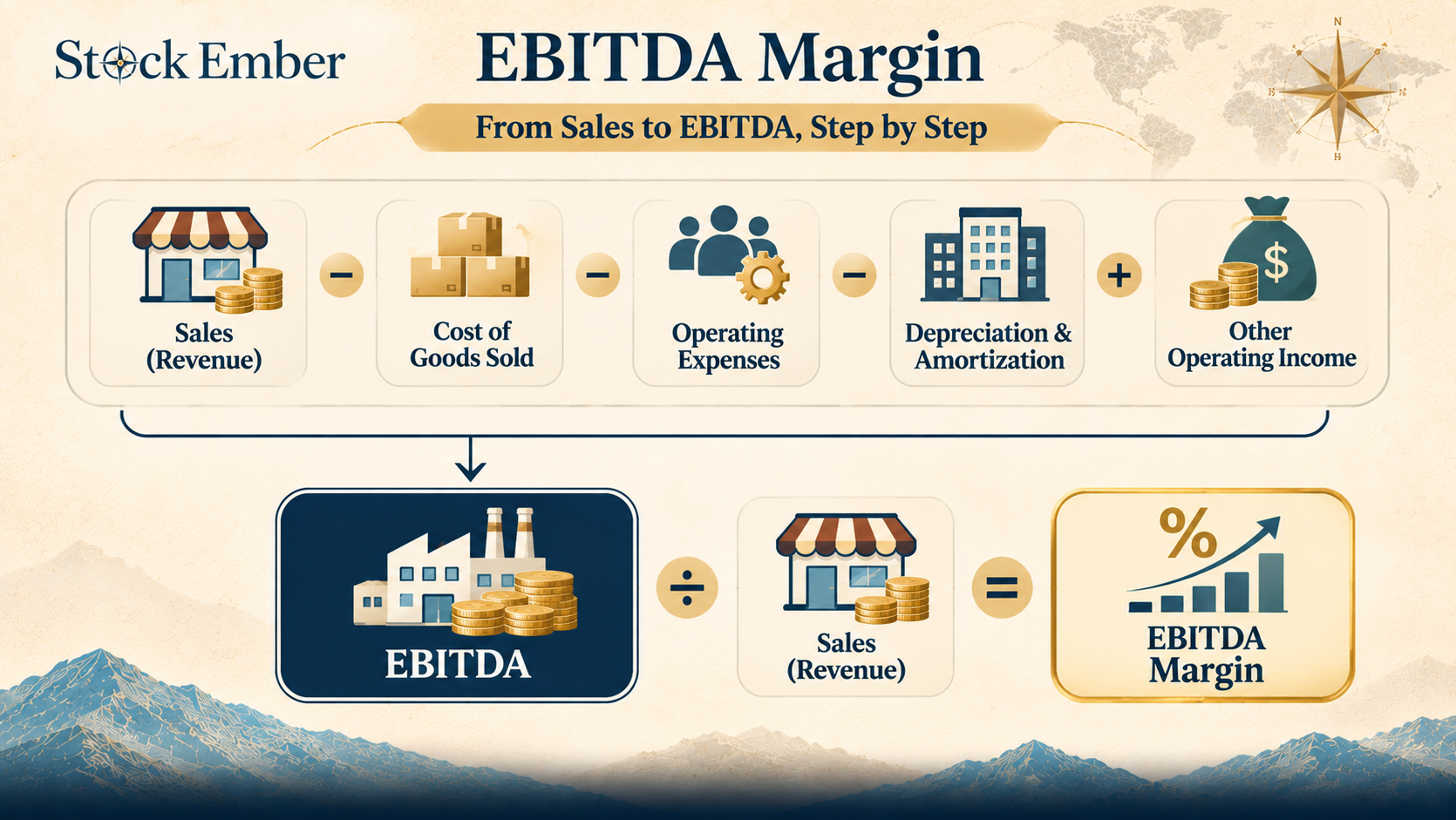
EBITDA margin measures a company's core operating profitability by comparing its earnings before interest, taxes, depreciation, and amortization against total revenue. Expressed as a percentage, it shows how efficiently a business converts top-line sales into operating income before capital structure and tax obligations are applied. Because it leaves out interest and tax payments, along with non-cash depreciation charges that stand in for the real cost of replacing equipment, it reflects operational performance rather than overall financial health.
An EBITDA margin is a financial ratio that measures a company's operating profit as a percentage of its total revenue, before subtracting interest, taxes, depreciation, and amortization.
Imagine 2 companies in the same industry that each bring in $100 million in sales, yet one shows twice the bottom-line profit of the other. The difference often comes down to financing choices, local tax rates, or accounting write-downs rather than how well their day-to-day operations run.
This guide explains how the ratio works, where it can mislead, and how to view it as a long-term investor.
Quick Takeaways
01The metric highlights core operational profitability by stripping away financing costs, taxes, and accounting write-downs.
02The ratio does not equal cash flow, because interest payments, tax bills, and equipment replacement costs still require real money.
03Long-term index investors generally do not need to screen individual company margins, because a broad index fund holds many companies across different sectors, both stronger and weaker ones, although its value still moves with the overall market.
What Is EBITDA Margin?
To answer the question "What is EBITDA margin?" you first need to look at how a business generates earnings from its core activities. The acronym stands for Earnings Before Interest, Taxes, Depreciation, and Amortization. Depreciation refers to spreading the cost of physical assets like machinery over their useful life, while amortization does the same for intangible assets like patents and software licenses.
At its heart, the EBITDA margin meaning comes down to operational efficiency. By setting aside financing decisions, government taxes, and accounting write-downs, the metric shows how many cents of operating profit a company keeps from every dollar of sales. With EBITDA margin explained in plain terms, the ratio simply reveals whether a company's basic product or service makes money before outside financial obligations enter the picture.
It is worth noting what sits outside this calculation. A company with a healthy operational spread can still struggle if it owes millions in annual debt interest or faces large tax liabilities. The ratio isolates operating performance, but it does not tell you if a business is solvent.
How to Calculate EBITDA Margin
Calculating the margin takes only 2 numbers from a company's financial statements: total revenue from the top of the income statement and EBITDA.
EBITDA Margin = (EBITDA / Total Revenue) * 100
In plain terms, you divide the company's operating profit before interest, taxes, and write-downs by its total sales, then multiply by 100 to turn it into a percentage.
Diagram showing how to calculate EBITDA margin from total revenue and operating profit
To see how this works in practice, consider a hypothetical manufacturing firm with the following annual results:
Income Statement Line
Amount
Total Revenue
$100,000,000
Cost of Goods Sold (COGS)
-$55,000,000
Operating Expenses (SG&A)
-$25,000,000
EBITDA
$20,000,000
Depreciation & Amortization
-$5,000,000
Operating Profit (EBIT)
$15,000,000
Interest Expense
-$4,000,000
Income Taxes
-$2,500,000
Net Income
$8,500,000
To find the margin, take the $20 million in EBITDA and divide it by the $100 million in total revenue:
($20,000,000 / $100,000,000) * 100 = 20%
In this example, the business keeps 20 cents of operating earnings from every dollar of revenue. By contrast, its net profit margin, which includes interest, taxes, and depreciation, is only 8.5%.
Why EBITDA Margin Matters and Where It Misleads
Analysts and managers track this ratio because it allows for cleaner comparisons between peer companies. This metric builds directly on the broader concept of EBITDA, which measures operating earnings before non-cash and financing expenses.
If 2 retail chains operate identical stores, one might rent its retail space while the other buys properties with borrowed money. The borrowing company carries heavy interest expenses, while the other does not. Looking at net profit makes the indebted business appear far less efficient, even if its store operations run just as smoothly. The metric strips out those capital structure choices so you can compare operational results side by side.
Because standard accounting rules do not define it, the U.S. SEC treats EBITDA as a non-GAAP financial measure. This means companies must reconcile it against net income in their public filings.
The primary danger is confusing this margin with cash generation. Some investors treat EBITDA as an alternative to free cash flow, but that assumption falls apart quickly. Real businesses must pay their lenders, write checks to tax authorities, and buy replacement equipment.
The table below shows how this ratio differs from standard operating margin, which also deducts depreciation and amortization:
Metric
Includes Depreciation & Amortization?
What It Measures
EBITDA Margin
No
Profitability before capital wear and financing
Operating Margin
Yes
Profitability after accounting for equipment wear
Operating margin accounts for the wear and tear on physical assets. If an industrial business ignores depreciation, its margins will look artificially attractive.
The 10-Year Drag: Debt, Taxes, and Capital Replacement
The biggest blind spot of this ratio appears when you view a business across a full 10-year holding period. Over a single quarter, ignoring equipment costs and interest bills might seem harmless. Over a decade, those expenses determine whether an investment survives.
Take a company that produces $20 million in annual EBITDA on $100 million of revenue, maintaining a steady 20% margin. Over 10 years, it would generate $200 million in cumulative EBITDA.
However, if the business holds heavy debt, annual interest payments of $8 million consume $80 million over that decade. At the same time, factory machines, delivery fleets, and data servers wear down. Keeping the business competitive requires ongoing capital expenditures (money spent to buy or repair physical equipment) of $7 million per year, or $70 million over 10 years.
Together, interest and capital replacement drain $150 million of that $200 million operating total. What looked like a wide 20% profit cushion leaves only a fraction of cash for business expansion or shareholder returns. Over a long horizon, physical assets decay and debts come due.
In practice, some companies with attractive operating margins also carry heavy debt, because lenders may be more willing to extend credit to businesses that appear profitable on paper.
Common Pitfalls When Reading EBITDA Margins
When you are learning the fundamentals of investing in stocks, it is easy to assume that higher margins always mean a safer investment. Relying on this ratio without context leads to several common traps:
Comparing across different sectors. A software company might post an EBITDA margin of 40% because it needs little physical equipment to deliver its product. A trucking company might post a 12% margin while running an exceptionally tight, well-managed fleet. Comparing margins across industries tells you nothing about relative management skill.
Ignoring balance sheet leverage. A company can show expanding margins while sliding toward financial distress if its debt load grows faster than its operating cash.
Overlooking working capital needs. A business can report strong operating margins while struggling to collect unpaid customer invoices or burning cash on unsold inventory.
A good margin in one industry can represent failure in another. Context and balance sheet health matter far more than an isolated percentage.
Conclusion
Evaluating a company's EBITDA margin gives you a helpful snapshot of core operational efficiency, but it never tells the whole financial story. The ratio strips out interest, taxes, and asset depreciation to make peer comparisons easier, yet those excluded expenses represent real cash that every operating business must pay over time.
If you invest through broad market index funds, you generally do not need to screen single stocks for margin differences, although the fund itself still carries market risk. An index fund naturally captures thousands of companies across diverse sectors, balancing capital-heavy manufacturers with asset-light service providers in a single holding.
When you are ready to put your portfolio into action, our broker reviews help you compare platforms by fee structure and reliability. Investing always involves risk and past performance never guarantees future returns, so use this metric as an educational starting point rather than an absolute rule.
FAQ
5 questions
What is considered a good EBITDA margin?
A good margin depends heavily on the industry. Capital-light software companies often achieve much higher margins than low-margin, high-volume sectors like grocery retail or transportation. Investors evaluate a company's margin relative to its direct industry peers and historical track record rather than using a universal benchmark across different sectors.
What is the key difference between EBITDA margin and operating margin?
Operating margin includes depreciation and amortization expenses, reflecting the ongoing wear and tear of physical and intangible assets. In contrast, EBITDA margin removes these non-cash write-downs entirely. As a result, it is almost always higher than operating margin and provides a view of operational performance before accounting for the replacement of capital assets.
Can a business have a positive EBITDA margin but a negative net profit margin?
Yes. A company can generate solid operating profits and maintain a positive margin while losing money on the bottom line. This situation frequently occurs when a business carries heavy debt that incurs substantial interest expenses, operates in a jurisdiction with punitive taxes, or has significant depreciation write-downs from past capital investments.
Why do analysts use EBITDA margin instead of net profit margin?
Analysts rely on this ratio to compare operational performance between companies with different debt financing, ownership structures, and local tax rates. By removing capital structure and tax jurisdiction effects, the ratio isolates how effectively management generates operating earnings from core sales, making cross-border and cross-company peer benchmarking much cleaner.
Does a high EBITDA margin mean a company is safe from bankruptcy?
No. A high margin only shows operational efficiency on sales. A business with impressive margins can still become insolvent if it cannot service its outstanding debt, satisfy working capital requirements, or fund mandatory capital expenditures. Solvency depends on total cash generation and balance sheet strength, neither of which is captured by EBITDA alone.
Disclaimer
This guide was written with AI assistance and reviewed by the StockEmber editorial team for accuracy. StockEmber provides independent education, not personal financial advice. Investing puts your capital at risk: the value of investments can go down as well as up, you may get back less than you invest, and past performance doesn’t guarantee future results. Some links may support our work at no additional cost to you.
The StockEmber Team is our in-house desk of independent research writers. We test brokerage platforms, read the fine print on fees and custody, and cover ETFs and long-horizon investing for people who plan to hold for decades — not days.