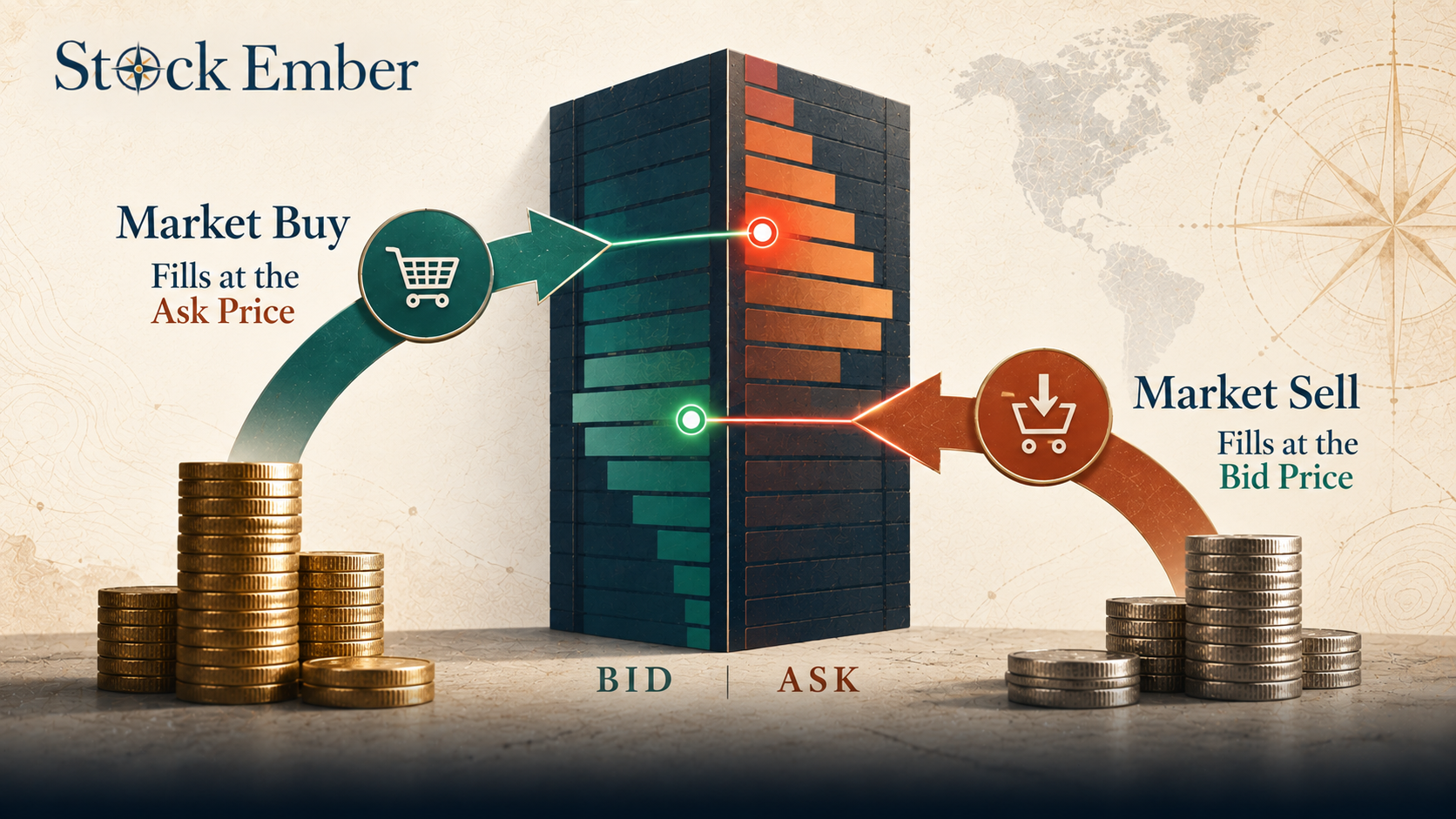
A market order is an instruction sent to a broker to execute a buy or sell transaction immediately at the best available current price. It prioritizes speed and guaranteed execution over price precision, leaving the fill price subject to active bid and ask quotes. Consequently, market orders are best suited for liquid securities where bid-ask spreads are narrow.
A market order is an instruction given to a broker to buy or sell a security immediately at the best current available price. It prioritizes speed of execution over price precision, guaranteeing that a trade completes right away.
When you decide to buy shares in a company or an index fund, choosing how to send that buy instruction to the market is your first tactical decision. For long-term investors, market orders offer simplicity and rapid entry, but they also introduce price uncertainty if executed during high volatility or thin trading hours.
This guide explains how these executions function, where execution slippage occurs, and how to use them effectively within a long-horizon portfolio.
Quick Takeaways
01A market order guarantees immediate trade execution, but it does not guarantee a specific execution price.
02Trades fill against existing bids and asks on the order book, leaving transactions exposed to bid-ask spread friction.
03Placing market orders while exchanges are closed creates severe overnight gap risk when trading opens.
04Investors using regular dollar-cost averaging in broad liquid ETFs face minimal drag from market orders over a 10-year horizon.
What Is a Market Order?
A market order definition describes a trade instruction sent to a brokerage firm to execute a buy or sell transaction immediately at whatever price the market currently offers. When you click the buy or sell button to execute instantly, you tell your broker to complete the trade right now, regardless of small price shifts between your order placement and execution.
The primary feature of a market order is execution certainty. The trade will fill as long as there are active buyers or sellers on the other side of the market. According to execution guidelines outlined by the U.S. SEC, market orders prioritize immediate order filling over price limits. This makes them the default choice for mainstream investors buying popular, highly traded assets.
However, execution certainty does not mean price protection. The quote you see on your screen represents the last traded price or the current best bid and ask. By the time your order reaches the exchange, the market price may have moved up or down by several cents or even dollars in fast-moving markets.
How Market Orders Work
When you place one, your broker routes the request directly to an exchange or market maker, where it matches against existing orders listed on the order book. The order book acts as a digital ledger matching buyers and sellers in real time.
Market orders clear against the current bid-ask spread. The bid represents the highest price a buyer is willing to pay, while the ask (or offer) represents the lowest price a seller is willing to accept.
If you are buying: Your market order fills at the current lowest ask price.
If you are selling: Your market order fills at the current highest bid price.
The distance between these two prices is the bid-ask spread:
For major assets like large-cap stocks or broad index funds, market liquidity how easily an asset trades without moving its price is deep. Thousands of shares sit at the top bid and ask prices, keeping the spread down to a single penny. In these assets, your fill price matches the quoted price almost perfectly.
Diagram showing market order routing through bid and ask prices on an exchange order book.
In practice, many long-term investors notice that this order type on major exchange-traded funds executes in a fraction of a second, with the fill price matching the online quote down to the penny.
Speed vs. Price Control: The Core Trade-Off
The decision to use a market order comes down to a fundamental trade-off between execution speed and price control. Choosing this order type means you want the trade filled immediately and do not mind minor price variances.
If controlling the exact price matters more than immediate execution, investors use conditional order types. A limit order sets a maximum price you are willing to pay when buying, or a minimum price when selling. If the market does not reach your specified price, the trade simply does not happen. Other advanced conditional tools, such as a market-if-touched order, wait for a target price trigger before submitting a market order to the exchange.
Order Type
Execution Guarantee
Price Control
Primary Risk
Common Use Case
Market Order
Guaranteed immediately
None (fills at market price)
Price slippage in fast markets
Instant buys in high-volume ETFs/stocks
Limit Order
Not guaranteed
Strict limit set by investor
Order may never fill
Buying at specific target valuation
Conditional Order
Triggered on price event
Variable once triggered
Execution lag after trigger
Automated entry on price movements
Market Orders for Long-Term Investors: The 10-Year Friction View
For buy-and-hold investors, small execution variances rarely impact long-term portfolio growth. When building a plan for investing in stocks, consistency and low management effort usually matter far more than shaving half a cent off an execution price.
Consider an investor adding $500 every month into a major S&P 500 index ETF over a 10-year period. Over 120 monthly purchases, the investor deploys $60,000 in total capital.
If the broad ETF has a tight bid-ask spread of $0.01 on a $500 share price (a spread of 0.002%), the total execution drag over the entire decade amounts to less than $5. Attempting to use limit orders to save that $5 introduces a different cost: missing out on market gains if a limit order sits unfilled while the stock price trends upward.
For regular dollar-cost averaging in broad liquid index funds, market orders remain the simplest, most effective execution method.
Common Pitfalls: Overnight Gaps and Illiquid Slippage
While this order type works smoothly for liquid stocks during standard trading hours, it carries significant financial risk under two specific conditions:
1. Queueing Market Orders Outside Market Hours
Standard trading hours for major U.S. stock exchanges run from 9:30 AM to 4:00 PM Eastern Time. If you submit a market order at 10:00 PM on a Sunday, your order sits in a queue waiting for Monday morning’s opening bell.
Overnight news, earnings releases, or global events can cause the stock price to gap up or down significantly before opening. When the market opens, your queued market order fills immediately at the new market price, which could be 5% or 10% higher than Friday's closing quote.
2. Trading Thinly Traded Assets
In small-cap stocks, foreign equities, or niche sector funds, daily trading volume is low. The bid-ask spread in these illiquid securities can stretch to several dollars.
If you place a market order to buy 500 shares of a low-volume stock, your order might sweep through multiple levels of the order book. The first 100 shares might fill at $20.00, the next 200 at $20.50, and the final 200 at $21.50. This unexpected cost surge is known as price slippage.
Conclusion
This order type remains the most straightforward tool for executing stock and ETF purchases when immediate trade completion is your priority. By guaranteeing execution rather than fill price, they allow investors to deploy capital quickly without managing unexecuted order queues. For long-horizon investors buying liquid, high-volume funds, instant market transactions offer efficiency and minimal friction.
When evaluating execution features across trading platforms, reviewing our broker reviews can help you select a service that handles order routing transparently. Investing always puts your money at risk and past returns never promise future performance, so treat this guide as educational context for your own financial decisions.
FAQ
5 questions
What is a market order definition?
A market order definition refers to a trading request that instructs a broker to buy or sell a security instantly at the prevailing market price. Unlike limit orders, market orders do not set price boundaries, ensuring immediate execution as long as trading volume exists on the exchange.
What is an example of a market order?
If a stock is currently quoted with a bid price of $50.00 and an ask price of $50.05, placing a market buy order for 10 shares will execute immediately at $50.05 per share. The total transaction cost will be $500.50 plus any relevant market or brokerage fees.
Is a market order better than a limit order?
Neither order type is universally better; they serve different strategic purposes. Market orders guarantee instant execution at the cost of price certainty, making them practical for liquid ETFs and large-cap stocks. Limit orders guarantee price control but risk remaining unfilled if the market moves away from your specified target.
What happens if you place a market order when the market is closed?
If you place a market order after hours, it enters a queue and executes at the opening bell on the next trading day. Because market prices can gap up or down overnight due to news or earnings, your order may fill at a drastically different price than the previous day's close.
Why did my market order execute at a different price than quoted?
Stock quotes show the last traded price or the top of the order book, which can change in milliseconds. In fast-moving or low-volume markets, price slippage occurs when your order fills against higher ask or lower bid prices required to complete your requested share quantity.
Disclaimer
This guide was written with AI assistance and reviewed by the StockEmber editorial team for accuracy. StockEmber provides independent education, not personal financial advice. Investing puts your capital at risk: the value of investments can go down as well as up, you may get back less than you invest, and past performance doesn’t guarantee future results. Some links may support our work at no additional cost to you.
The StockEmber Team is our in-house desk of independent research writers. We test brokerage platforms, read the fine print on fees and custody, and cover ETFs and long-horizon investing for people who plan to hold for decades — not days.