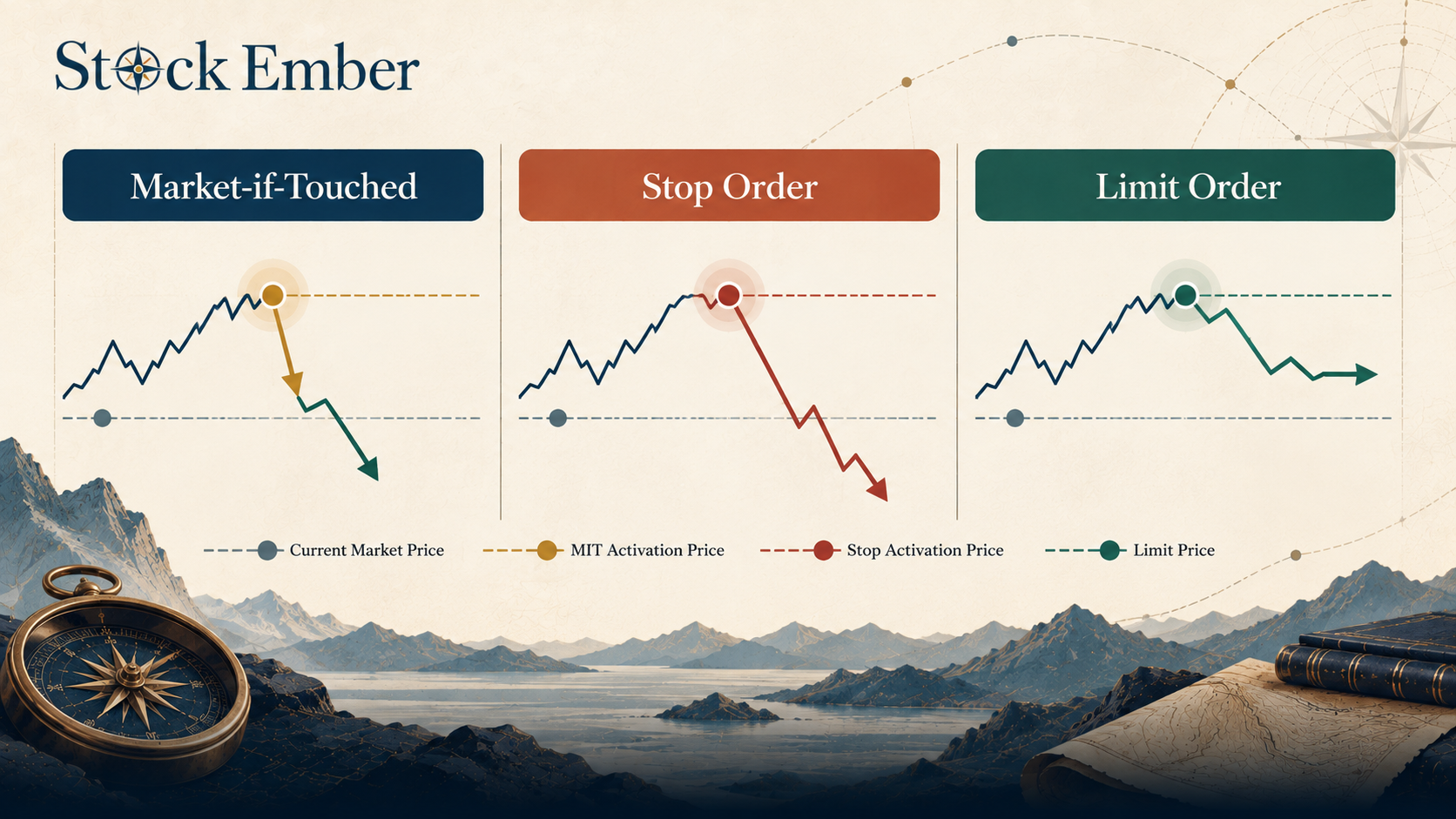
A market-if-touched order is a conditional instruction held on a broker server that converts into a standard market order once a preset trigger price is touched. While Buy orders are placed below current market prices and Sell orders above, the order does not guarantee a specific execution price upon conversion.
A market-if-touched (MIT) order is a conditional order held on a brokerage server that converts into a standard market order once a specified trigger price is reached.
While active traders use conditional triggers to enter positions on pullbacks or capture profit targets automatically, long-horizon investors must handle them with care. Because an MIT order converts into an un-priced market order upon activation, rapid market swings or sudden overnight gaps can lead to unexpected execution prices.
Understanding how trigger prices transition into live exchange orders helps you prevent execution slippage and manage transaction costs when investing in stocks.
Quick Takeaways
01A market-if-touched (MIT) order remains inactive off the exchange until a preset trigger price is touched, at which point it converts into a market order.
02Buy MIT orders are placed below the current market price to capture dips, whereas Sell MIT orders are placed above to lock in profits.
03An MIT order guarantees execution upon reaching its trigger price, but it does not guarantee the final execution price.
04Fast-moving markets and overnight price gaps can cause execution slippage, filling orders far from the original trigger level.
05Long-term investors often prefer limit orders or limit-if-touched orders to maintain strict price boundaries and avoid un-priced market risk.
What Is a Market-if-Touched Order?
A market-if-touched (MIT) order is a conditional instruction held on a brokerage system rather than the public exchange order book. It remains completely resting and invisible to the market until the underlying asset trades at or through the specified trigger price.
The moment a trade occurs at the trigger price, the brokerage system automatically converts the MIT instruction into a standard market order. This new market order is sent directly to the exchange to execute immediately at the best available bid or ask price.
Because the conversion yields a market order, execution priority takes precedent over price boundaries. The system prioritizes filling the order as quickly as possible, regardless of whether the prevailing market price has moved away from your trigger point.
According to investor education resources from the U.S. SEC, conditional market orders prioritize immediate execution over price control once their activation threshold is satisfied.
How Market-if-Touched Orders Work (Buy vs. Sell Logic)
Market-if-touched orders operate on inverted placement logic compared to standard stop orders. While traditional stop orders are designed to catch breaking momentum or limit downside losses, MIT orders are structured to capture mean-reversion movements.
Buy MIT Orders: You place a Buy MIT order below the current market price. For instance, if a stock trades at $100 and you wish to purchase it if it dips, you might set a Buy MIT trigger at $92. If trading activity touches $92, the order instantly converts into a market buy order to fill the position.
Sell MIT Orders: You place a Sell MIT order above the current market price. If you hold shares trading at $100 and want to take profits during a rally, you might set a Sell MIT trigger at $115. Once a trade occurs at $115, the order becomes a market sell order to exit the position.
The table below contrasts this placement logic with standard protective orders.
Order Condition
Placement vs. Current Price
Trigger Conversion
Primary Strategic Objective
Buy MIT
Below current price
Market Buy
Capture price dips ("buy low")
Sell MIT
Above current price
Market Sell
Lock in profit targets ("sell high")
Buy Stop
Above current price
Market Buy
Ride upside momentum breakouts
Sell Stop (Stop-Loss)
Below current price
Market Sell
Limit downside portfolio losses
Visual chart comparing market-if-touched, stop, and limit order trigger levels
Market-if-Touched vs. Stop Orders vs. Limit Orders
Choosing the right order type requires balancing execution certainty against price protection. While MIT orders share similarities with stop and limit orders, their execution paths differ significantly once triggered.
A standard limit order sets an absolute price ceiling for buys or a price floor for sells. A limit buy order at $92 will only fill at $92 or lower. If the market bounces rapidly, your order might not execute, but you avoid overpaying.
An MIT order handles activation differently. Reaching $92 activates the order, but because it transforms into a market order, your final fill price depends entirely on immediate market liquidity. In volatile conditions, your fill price could end up higher or lower than $92.
Similarly, investors managing time-sensitive trades might consider market-on-close orders to execute near the end of the trading session, prioritizing execution timing rather than specific intraday price triggers.
Feature
Market-if-Touched (MIT)
Stop Order
Limit Order
Trigger Location
Below market (Buy) / Above market (Sell)
Above market (Buy) / Below market (Sell)
No trigger (rests on exchange book)
Converted Order Type
Market Order
Market Order
Limit Order
Execution Guarantee
Yes (once touched)
Yes (once touched)
No (depends on price matching)
Price Guarantee
No
No
Yes (at limit price or better)
Why Order Execution Risk Matters for Long-Term Investors
For buy-and-hold investors, unpredictable execution prices create hidden financial drag. The core risk associated with market-if-touched orders is execution slippage, the difference between your intended trigger price and the actual fill price reported by your broker.
Slippage usually occurs during two distinct market environments:
Overnight Price Gaps: If a company releases major news after exchange hours, the stock may open the next morning far past your trigger price. A Buy MIT set at $95 might trigger at market open when the stock gaps down to $88, executing your buy order at $88 or higher if prices rebound swiftly.
Fast-Moving Intraday Volatility: During sudden price swings, available market liquidity at your exact trigger price can vanish in milliseconds. Your converted market order sweeps up available shares at progressively worse prices.
In practice, many long-term investors find that relying on un-priced conditional orders during volatile earnings seasons often results in unexpected transaction friction. Using conditional order types without price bounds can accidentally convert a planned long-term investment into a costly execution mistake.
Over a 10-year portfolio accumulation phase, repeatedly paying un-priced fills or absorbing execution slippage can meaningfully erode capital from your portfolio over time. Unnecessary transaction friction compounds over time, reducing overall total returns.
Limit-if-Touched (LIT) vs. Market-if-Touched (MIT)
To manage execution risk, exchanges offer a hybrid alternative known as a Limit-if-Touched (LIT) order.
An LIT order uses the same trigger conditions as an MIT order, but converts into a limit order instead of a market order upon activation.
For example, you can set a Buy LIT order with a trigger price of $92 and a limit price of $92.50. When the stock touches $92, the order converts into a Limit Buy order capped at $92.50. If the stock gaps violently down or spikes upward beyond $92.50, the order will not execute above your cap.
The trade-off between MIT and LIT comes down to priorities:
Choose MIT if completing the trade is your top priority, regardless of minor price movements.
Choose LIT if capping your purchase price or setting a floor on your sale price matters more than guaranteed execution.
Common Execution Pitfalls to Avoid
Using market-if-touched orders without clear guidelines can lead to structural trading errors:
Using MIT as a Stop-Loss: Placing a Sell MIT order below your purchase price to limit losses will fail. Because Sell MIT orders are placed above market price, placing one below market price causes it to trigger immediately as a market order.
Placing MIT Orders Before Major News: Setting MIT triggers right before corporate earnings announcements exposes your order to extreme opening gap risk and severe execution slippage.
Trading Low-Float Stocks: Thinly traded equities feature wide gaps between bid and ask prices. Converting an MIT order in a low-liquidity asset can sweep the order book and yield bad fills.
Conclusion
Market-if-touched orders offer a practical way to automate buy-low or sell-high entry points without monitoring screens continuously. However, because an MIT order converts directly into an un-priced market order upon touching its trigger, it exposes your capital to execution slippage and market gap risk. For long-horizon investors, incorporating price limits through limit orders or limit-if-touched structures provides greater control over portfolio transaction costs.
When selecting a trading platform to manage these conditional executions, our Broker reviews offer clear comparisons to help you evaluate broker order-handling capabilities.
Trading and investing involve financial risk, including potential execution slippage and loss of principal. Past market order behavior does not guarantee future performance, so treat this educational material as a foundation for your own research.
FAQ
5 questions
What is a market-if-touched order?
It's a conditional order that rests on a broker's server until a stock reaches a designated trigger price. Once that price is touched by market trading, the instruction automatically converts into a standard market order to execute immediately at available prices.
How does a market-if-touched order differ from a stop order?
This order type uses inverted placement logic compared to a stop order. Buy orders of this type are placed below the current market price to buy dips, whereas buy stop orders are placed above market price to catch momentum breakouts.
Does a market-if-touched order guarantee execution price?
No, it guarantees that an order will be submitted once activated, but it does not guarantee the final execution price. Because it converts into an un-priced market order, fast-moving markets or overnight price gaps can cause severe execution slippage.
What is the difference between a market-if-touched and a limit-if-touched order?
The former converts into an un-priced market order upon reaching its trigger, prioritizing complete execution over price boundaries. A limit-if-touched order converts into a limit order instead, establishing a strict maximum buy price or minimum sell price.
Can you use a market-if-touched order as a stop-loss?
No, placing a sell order of this type below the current market price as a stop-loss will fail. Because these sell orders are designed to be placed above market prices, placing one below the current price causes it to trigger instantly as an active market order.
Disclaimer
This guide was written with AI assistance and reviewed by the StockEmber editorial team for accuracy. StockEmber provides independent education, not personal financial advice. Investing puts your capital at risk: the value of investments can go down as well as up, you may get back less than you invest, and past performance doesn’t guarantee future results. Some links may support our work at no additional cost to you.
The StockEmber Team is our in-house desk of independent research writers. We test brokerage platforms, read the fine print on fees and custody, and cover ETFs and long-horizon investing for people who plan to hold for decades — not days.