

To invest in stocks, open a regulated brokerage account, select between individual shares or broad-market index funds, and establish a disciplined buy-and-hold strategy. For most long-horizon beginners, focusing on broad-market index funds allows you to capture equity market growth while keeping fees and concentration risk low over a multi-decade horizon.
When you ask what is a stock or simply what is stock, you are looking at a fundamental claim on a business's net assets and future earnings. Rather than attempting to trade short-term price fluctuations, patient investors accumulate ownership in resilient businesses or broad market indices, letting long-term compounding perform the heavy lifting. This guide covers everything beginners need to know about how to invest in stocks for long-term wealth. This hub provides a clear overview of market mechanics, core valuation tools, and practical account setup to guide your journey.
Quick Takeaways
- Knowing how to invest in stocks means understanding that stock ownership grants you a direct proportional stake in a publicly traded corporation's profit and growth.
- Broad-market index funds reduce single-stock concentration risk by holding a diversified portfolio instead of relying on individual company selection.
- The level of market exposure depends on the index you choose. For example, an S&P 500 fund tracks large U.S. companies, while global exposure requires an all-world or international index fund.
- Valuation tools like price-to-earnings (P/E) ratios and earnings per share (EPS) help assess business health, but long-term holders focus primarily on market coverage and fee control.
- Quiet investment fees, spread drag, and foreign exchange (FX) charges can quietly consume a substantial portion of your total portfolio wealth over a decade.
What Is Stock Ownership and How Markets Operate
Stock ownership grants you a proportionate claim on a company's profits and net assets, while stock markets serve as regulated exchanges where these equity shares are bought and sold. Understanding how public equities function is the foundation of long-term wealth accumulation.
To navigate equity ownership effectively, explore these core market mechanisms:
- Public Exchanges: To understand where share trading takes place, review what is the stock market to see how centralized exchanges match buyers and sellers while establishing fair market pricing.
- Established Industry Leaders: Large, financially sound companies with long records of stable earnings are detailed in what is a blue-chip stock, representing foundational holdings for conservative portfolios.
- Corporate Share Adjustments: When companies change their outstanding share count without altering market value, understanding what is a stock split explains why share prices adjust and how liquidity is maintained.
When you hold shares in a company, your returns come from two primary sources: capital appreciation (the stock price rising over time as the business grows) and cash dividends (direct payouts of corporate profits). While individual share prices fluctuate daily based on market sentiment, long-term equity value is ultimately anchored to corporate earning power.
Business Evaluation and Core Valuation Metrics
Evaluating a stock requires analyzing a company's underlying financial metrics to determine whether its market price reflects its actual earning power and asset value. Financial metrics provide a framework for assessing corporate profitability and efficiency.
Key evaluation metrics used by analysts include:
- Total Business Size: Assessing corporate magnitude begins with what is market cap, which measures total market equity value to classify companies by risk profile.
- Valuation Expectations: Comparing stock price to corporate profit requires
- examining what is the price-to-earnings (P/E) ratio. In plain terms, a P/E of 20 means investors are currently paying $20 for every $1 of annual earnings the company generates — a quick way to judge whether a share looks expensive or affordable relative to what the business actually earns.
- Profitability Per Share: Measuring net income allocated to each share of common stock is covered in what is earnings per share (EPS), a primary driver of stock performance.
- Management Efficiency: Evaluating how effectively a management team generates profits from shareholder capital relies on what is return on equity (ROE)
- .
- Net Asset Value: Measuring the underlying balance-sheet worth of each share
- you own is explained in what is book value per share, which shows you whether a stock is trading
- above or below the net asset value the business actually holds on its books.
In practice, many long-term investors find that dissecting individual balance sheets takes significant time and introduces single-company failure risk. While metric analysis is valuable for evaluating business quality, passive investors holding broad index funds capture aggregate market earnings growth naturally without needing to pick individual winners.
If you choose to hold individual equity shares, valuation metrics serve as safeguards against overpaying for market hype. However, if your strategy centers on broad-market index funds, these metric calculations occur automatically across the index components, allowing you to focus on asset allocation rather than quarterly earnings calls.

Practical Execution and Account Infrastructure
Knowing how to invest in stocks starts with setting up a regulated brokerage account and placing trade orders through an intermediary that executes purchases on public exchanges. Having a secure investment infrastructure ensures low execution costs and reliable custody of your assets.
Essential steps to establish your equity position:
- Account Setup: Before placing a trade, you need to understand what a brokerage account is to choose the appropriate custody structure for holding shares.
- Order Execution: Learning the practical mechanics of placing your first buy order is
- detailed in how to buy stocks, including
- how to choose between order types that can affect the final price you pay.
- Broad-Market Indexing: Rather than picking single stocks, exploring what is the s&p 500 demonstrates how a single index holding can deliver exposure to hundreds of leading U.S. corporations.
To begin investing, you deposit funds into your brokerage account, select your target investment whether individual shares or a broad-market exchange-traded fund (ETF) and execute an order. For most long-horizon investors, setting up recurring, automated contributions into broad index funds minimizes behavioral mistakes and removes the stress of timing the market.
The 10-Year Cost Lens in Equity Investing
Long-term equity returns are heavily shaped by investment friction, as small recurring fees and transaction costs compound over a decade to significantly erode final net returns. Managing investment costs is one of the few variables completely under an investor's control.
Consider a hypothetical portfolio of $10,000 invested in equities achieving an assumed 7% average annual gross nominal return. This assumption is broadly consistent with long-term historical U.S. equity returns and is used solely to illustrate the impact of investment costs, not to forecast future performance. Over a 10-year holding period, that portfolio would grow to approximately $19,671 in a zero-fee environment. However, if that same portfolio is subject to a total annual friction drag of 1.0% combining fund expense ratios, platform maintenance fees, and currency conversion markups, the final balance drops to roughly $17,908.
10-Year Compounding Comparison ($10,000 Initial Investment at 7% Gross Return)
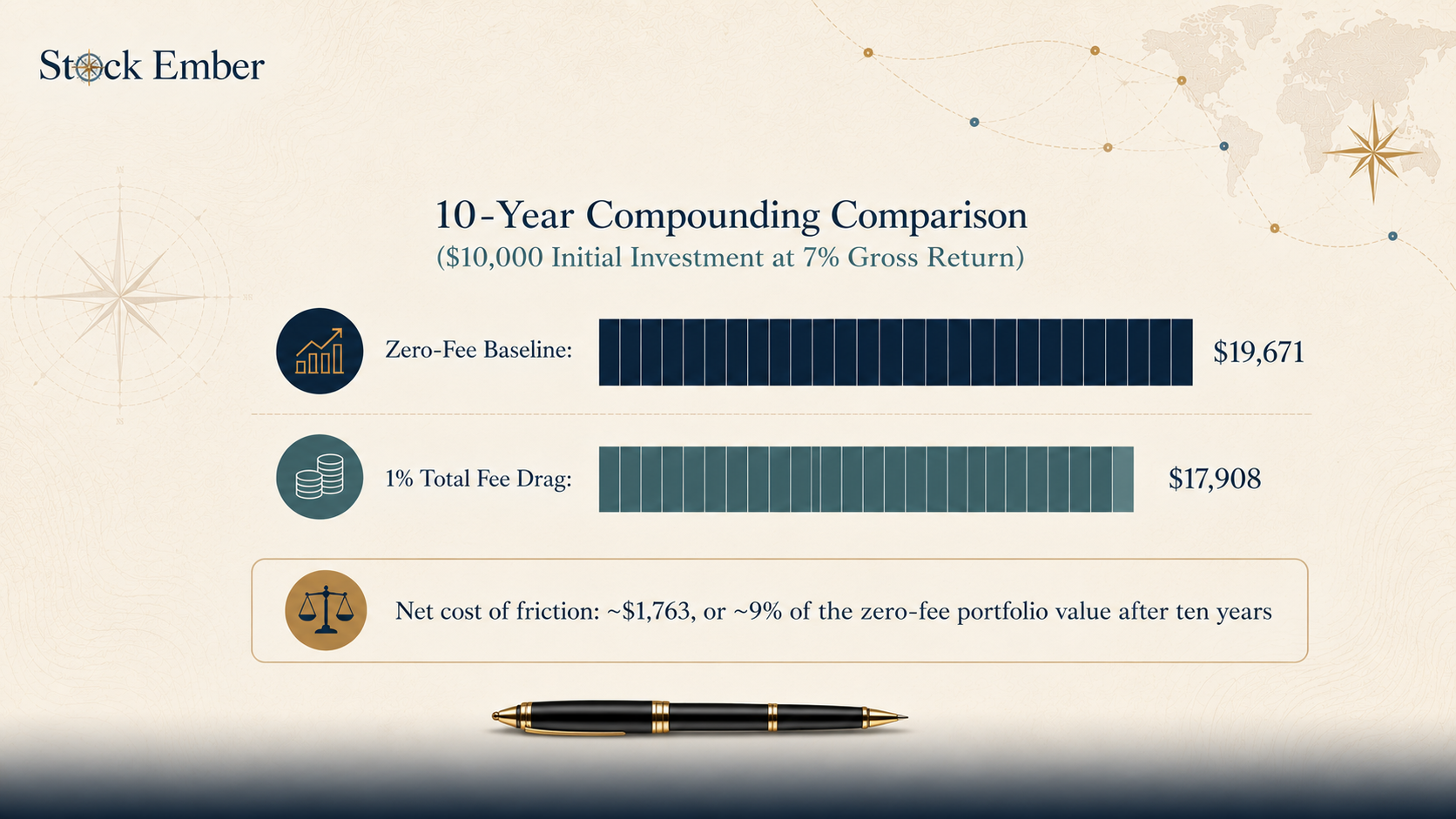
That single 1.0% annual drag quietly claims nearly 9% of your total potential wealth over a decade.
For balance, the same arithmetic works in the opposite direction. At a 0% average annual gross return, a $10,000 portfolio remains worth $10,000 before fees after ten years but falls to about $9,044 after a 1.0% annual cost drag. If average returns are negative over the decade, the ending balance will be lower still. Controlling investment costs improves whatever return the market delivers, but it cannot create positive returns when markets do not provide them.
In practice, many long-term investors find that foreign exchange (FX) conversion spreads and account administration charges can reduce returns more than fund expense ratios. Reading a platform's full fee schedule rather than focusing only on the headline expense ratio is one of the few reliable ways to protect compound growth over a decade or longer.
Minimizing friction requires selecting low-cost brokerage platforms, prioritizing low-expense index funds, where expense ratios for large broad-market funds have commonly fallen below 0.10% annually (data as of July 2026, per Vanguard; always confirm the current figure in the fund's own prospectus), and avoiding unnecessary trading activity that triggers execution spreads and tax events.
Mapping Your Long-Term Investment Journey
Understanding how to invest in stocks means transitioning from foundational definitions to disciplined, broad-market portfolio construction. Building lasting wealth requires aligning your account structure, investment choices, and risk tolerance into a cohesive, low-maintenance strategy.
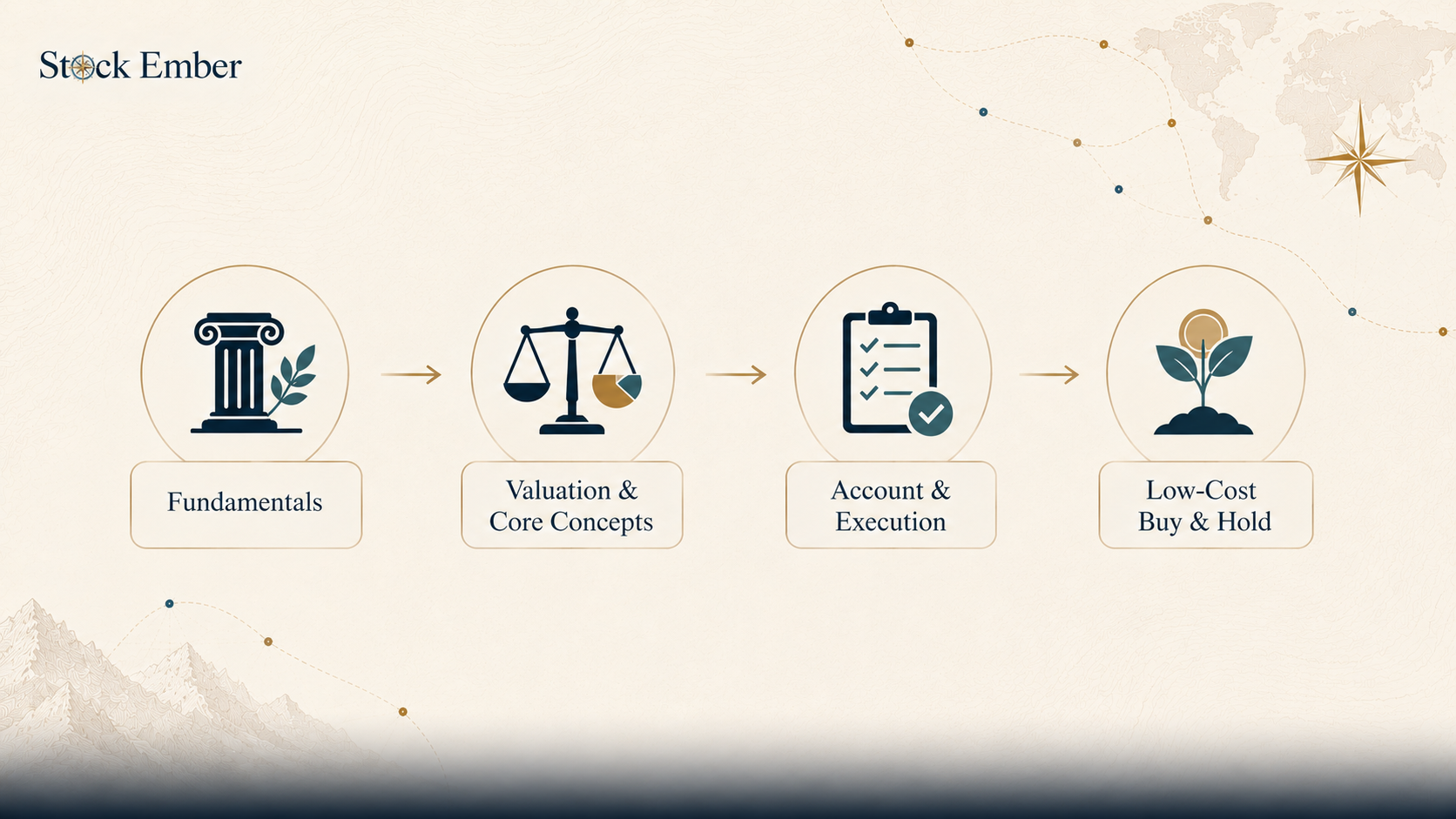
- Master the Fundamentals: Understand what stocks represent and how public exchanges execute transactions.
- Grasp Valuation Basics: Recognize how businesses are priced using metrics like market cap and P/E ratios, while keeping single-stock risks in perspective.
- Establish Custody: Open a low-cost brokerage account and learn how to execute trade orders cleanly.
- Commit to Long-Term Compounding: Focus on broad diversification, automated contributions, and strict fee control to capture global economic growth over decades.
What Can Go Wrong: The Risks of Equity Investing
Equity investing carries a real and permanent possibility of loss, and a long horizon reduces but never removes that possibility. Broad-market indices have historically experienced 30% to 50% drawdowns during major market downturns, and some ten-year holding periods have delivered flat or negative real returns after inflation.
Diversification across an index removes single-company failure risk, but it does not protect you from a market-wide decline, from currency movements if you invest outside your home market, or from the risk of selling at a loss because you needed the money earlier than planned.
Money you may need within five years generally does not belong in equities at all, and only capital you can leave invested through a full market cycle should be committed to this asset class.
Conclusion
Learning how to invest in stocks successfully over decades relies on patience, fee discipline, and broad diversification rather than predicting short-term market fluctuations. By keeping execution costs low and maintaining a long-term perspective, you improve the conditions under which compounding can work, while accepting that market outcomes over any given period remain outside your control.
When you are ready to compare brokers and trading costs, our broker reviews provide a transparent overview of fees, account features, supported markets, and other key considerations.