Buying stocks involves opening and funding a regulated brokerage account, selecting an account type (taxable or tax-advantaged), searching for a company or fund ticker symbol, and placing a purchase order. Investors choose between market orders for immediate execution or limit orders for price control, while fractional share functionality allows buying precise dollar amounts regardless of nominal stock prices.
Buying stocks involves opening a regulated brokerage account, funding it with cash, selecting a public company or index fund ticker symbol, and placing a market or limit order to execute the purchase.
While purchasing shares online has become fast and accessible, navigating order types, settlement periods, and account structures can feel intimidating for beginners. Understanding these operational mechanics ensures you execute trades smoothly without paying unnecessary fees or making emotional timing mistakes. This step-by-step guide walks you through account setup, trade execution, and long-term portfolio holding.
Quick Takeaways
01Buying stocks requires opening and funding a regulated brokerage account with cash.
02A market order executes immediately at the current market price, whereas a limit order specifies a maximum purchase price.
03Fractional shares allow you to invest fixed dollar amounts regardless of an individual share's nominal price.
04Placing a stock order is an administrative action; long-term compounding drives true wealth creation.
Step 1: Select the Right Account Type
Choosing the right account type determines how your investment earnings are taxed and when you can access your money. Brokerage platforms typically offer two primary account categories:
Taxable Brokerage Accounts: These accounts offer total flexibility, allowing you to deposit and withdraw capital at any time without penalty. However, any realized capital gains and dividend distributions are subject to annual income taxes.
Tax-Advantaged Accounts: Accounts such as IRAs or pension wrappers provide tax-sheltered growth designed for retirement. While they offer substantial tax savings over decades, they carry annual contribution limits and early withdrawal penalties.
Selecting the appropriate account structure upfront aligns your trading activity with your broader financial timeline.
Step 2: Open and Fund Your Brokerage Account
Opening a brokerage account requires completing identity verification and linking a bank account to transfer investment cash.
Under standard financial regulations, custodians require personal identification, proof of address, and tax identification details to satisfy Know Your Customer (KYC) compliance rules. Once verified, you can transfer capital electronically from your bank account via standard transfer methods.
After purchasing stocks, trades are generally settled on a T+1 basis under SEC and FINRA regulations, meaning ownership and cash are exchanged one business day after the trade date. Keeping settled cash in your account helps ensure orders execute smoothly without margin restrictions or settlement violations.
Step 3: Choose Your Order Type (Market vs. Limit Orders)
An order type instructs your broker how and at what price to execute your share purchase in the open market. Selecting the correct order type gives you control over execution speed and price certainty.
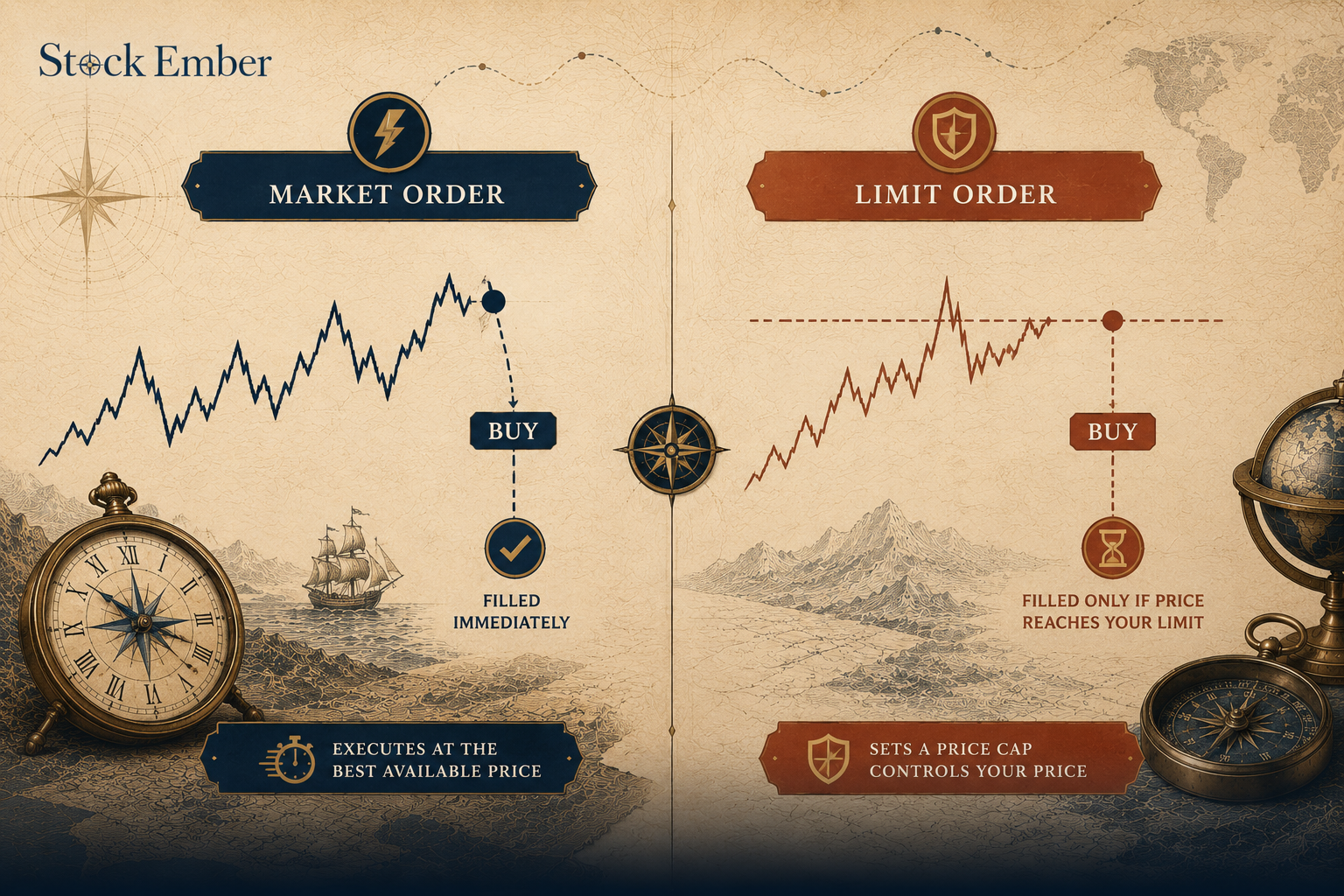
Diagram comparing market orders versus limit orders in stock trading.
Market Orders
A market order instructs the broker to buy shares immediately at the best available current market price. Market orders prioritize immediate execution over price control.
While market orders are ideal for highly liquid, large-cap stocks during standard market hours, they carry execution slippage risk during periods of extreme price volatility or around the market open, when prices can change rapidly before an order is executed, according to the U.S. Securities and Exchange Commission (SEC).
Limit Orders
A limit order specifies the maximum price you are willing to pay per share. If the stock trades at or below your specified limit price, your order executes; if the market price remains higher, the order stays unfilled.
Limit orders provide exact price protection, making them valuable when trading volatile securities, lower-volume shares, or placing orders outside peak trading hours.
Step 4: Execute the Trade and Utilize Fractional Shares
Executing a trade requires entering the ticker symbol, choosing your share quantity or dollar amount, and submitting your order to the brokerage.
Modern brokerage platforms allow you to place orders based on whole share counts or fixed dollar amounts. Through dollar-based investing, you can buy fractional shares of high-priced market leaders. For instance, if a stock trades at $500 per share, you can allocate $50 to acquire exactly 0.10 shares, receiving proportional ownership and dividend rights.
If a company later adjusts its total share count to alter individual share prices, explore what is a stock split to understand how corporate adjustments impact your holdings.
In practice, many long-term investors find that setting up automated recurring transfers to buy fractional shares eliminates the impulse to time the market. Removing the manual step of placing individual trades reduces friction and keeps your compounding on schedule.
Post-Purchase: The Buy-and-Hold Investor's Mindset
Successful stock investing requires maintaining a disciplined buy-and-hold perspective after your purchase order executes.
Clicking the "Buy" button is merely the administrative beginning of your investment journey. Checking portfolio charts daily often triggers emotional reactions, leading investors to sell during temporary market downturns or chase short-term price momentum.
Rather than managing individual orders in isolation, integrate your share purchases into a structured wealth-building strategy. To build a resilient portfolio across market cycles, read our foundational guide on how to invest in stocks.
Conclusion
Purchasing stocks online is a straightforward administrative process once you understand account funding, market versus limit orders, and fractional share execution. By selecting the proper account structure and focusing on long-term discipline rather than short-term price movements, you set a solid foundation for patient wealth accumulation.
When you are ready to evaluate trading features and select an account provider, our curated broker reviews offer a clear look at platform capabilities and fee structures.
FAQ
5 questions
How much money do you need to start buying stocks?
Thanks to modern brokerage platforms supporting fractional shares, many brokers now let you start buying stocks with as little as $1, though minimum amounts vary by platform, so check your broker's specific requirements before you begin. Rather than requiring enough cash to purchase a full share of a company, fractional investing lets you allocate whatever dollar amount suits your budget.
What is the difference between a market order and a limit order?
A market order instructs your broker to buy shares immediately at the best available current market price, prioritizing speed over price guarantee. A limit order sets a maximum price you are willing to pay per share, ensuring price protection but risking non-execution if the stock stays above your limit target.
What happens after you place a stock order online?
After your stock order executes, your brokerage processes the transaction through a clearing cycle (typically settling within one business day, known as T+1). Once settled, you officially own the shares, and any dividends or voting rights automatically attach to your account.
Can you buy fractional shares of any stock?
Most major online brokerages now support fractional share trading for major US equities and exchange-traded funds (ETFs). However, availability varies depending on your platform and whether the specific security meets your broker’s trading liquidity and volume requirements.
Is it better to buy individual stocks or broad index funds?
For most long-term investors, buying broad-market index funds is safer and more effective than picking individual stocks. Index funds automatically pool hundreds of leading companies into a single purchase, delivering broad market growth while eliminating the single-company bankruptcy risk of holding individual stocks.
Disclaimer
This guide was written with AI assistance and reviewed by the StockEmber editorial team for accuracy. StockEmber provides independent education, not personal financial advice. Some links may support our work at no additional cost to you.
The StockEmber Team is our in-house desk of independent research writers. We test brokerage platforms, read the fine print on fees and custody, and cover ETFs and long-horizon investing for people who plan to hold for decades — not days.