Common stock represents fractional ownership in a business with voting rights and uncapped growth potential, while sitting last in liquidation priority. Preferred stock is a hybrid security that offers fixed dividend payouts and priority over common shares during bankruptcy, but typically lacks voting power and price appreciation.
Common stock represents residual corporate ownership with voting rights and variable growth potential, whereas preferred stock is a hybrid security offering priority dividend payouts and liquidation preference without voting privileges.
When building a long-term portfolio, deciding between fixed-income priority and uncapped capital growth shapes your overall strategy. Companies issue both share classes to balance capital raising with ownership control. Choosing the right equity class requires understanding how dividend security, bankruptcy protection, and price appreciation align with your wealth goals.
Quick Takeaways
01Common shares offer voting rights and uncapped capital growth, but sit last in line during corporate bankruptcy.
02Preferred shares provide fixed dividend payouts and higher liquidation priority, but usually lack voting rights and growth upside.
03Preferred dividends are paid before common dividends, though board directors can still suspend them if cash flow drops.
04Preferred share prices react directly to interest rate movements, behaving similarly to long-term bonds.
05Buy-and-hold investors often hold common shares for compounding equity growth and preferred shares for predictable yield.
Core Definitions: Ownership vs. Hybrid Income
Common stock gives investors direct fractional ownership of a company with voting rights, while preferred stock operates as a hybrid instrument combining equity structure with bond-like fixed payments.
When you purchase common stock, you become a residual owner of the business. You benefit directly when company profits rise through share price growth and variable payout increases. Common shareholders absorb both the full risk of business downturns and the full benefit of corporate expansion.
Conversely, preferred stockfunctions more like a fixed-income asset wrapped in an equity shell. Preferred shares trade around a fixed par value (typically $25 per share) and pay a set payout rate based on that par value. While preferred shareholders own equity in the firm, they do not participate in expanding corporate profits. If a company doubles its annual revenue, preferred payouts remain capped at their predetermined percentage rate.
Priority in Capital Structure: Who Gets Paid First?
Preferred shareholders hold priority over common shareholders for both regular dividend distributions and capital distribution during corporate liquidation.
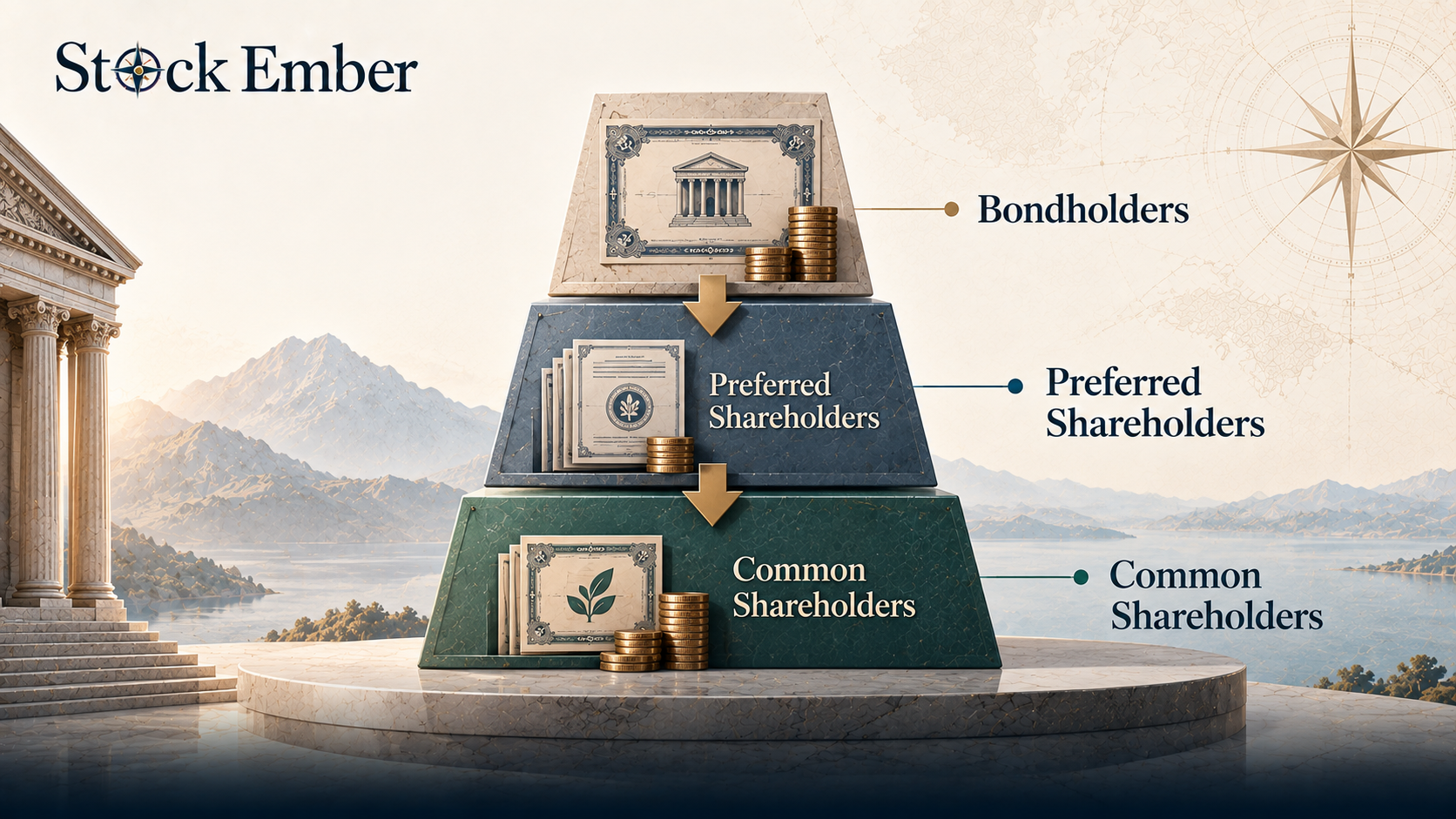
Corporate finance follows a strict legal order when allocating earnings or distributing assets in bankruptcy. The SEC defines this payout hierarchy, placing debt holders at the top, followed by preferred owners, with common owners at the bottom.
Before a company distributes dividendsto common owners, it must satisfy all obligations to preferred investors. If earnings drop, common distributions are reduced or eliminated first to protect preferred payouts.
In the event of insolvency or liquidation, secured and unsecured creditors holding corporate bonds are paid in full first. If any asset value remains, preferred shareholders receive their liquidation preference, typically returning the original par value per share, before common equity receives anything.
Feature
Common Stock
Preferred Stock
Voting Rights
Yes (1 vote per share standard)
Usually No
Dividend Structure
Variable, discretionary growth
Fixed rate or set percentage of par
Payout Priority
Junior (after preferred shares)
Senior to common, junior to bonds
Capital Growth
Uncapped potential
Capped near par value
Liquidation Priority
Last claim on assets
Ahead of common, behind debt holders
Interest Rate Sensitivity
Low to moderate
High (acts like a fixed-income bond)
Diagram of corporate capital structure showing priority of bondholders, preferred stock, and common stock.
Voting Rights and Governance: Control vs. Passive Income
Common shares carry voting rights that allow investors to influence corporate governance, whereas preferred shares rarely grant voting power.
Holding common equity grants voting rights on key corporate decisions, including electing the board of directors, approving corporate mergers, and authorizing auditor changes. Annual shareholder meetings give common owners a voice in oversight proportioned to their share count.
Preferred shareholders forfeit governance influence in exchange for payout priority. They cannot vote for board members or influence operational policies under normal conditions. Some preferred issues include contingent voting rights, which activate only if the issuing firm skips dividend payments for multiple consecutive quarters.
Long-Term Returns: Capped Yields vs. Compounding Growth
Over a multi-year horizon, common stock returns stem from compounding share appreciation and growing distributions, while preferred stock returns rely almost entirely on fixed income yields.
Consider how these two assets behave over a ten-year holding period. If a corporation grows its underlying profits by 10% annually, common share prices and payout distributions tend to rise alongside that growth. Over ten years, reinvesting growing payouts can compound total wealth significantly.
Preferred shares, by contrast, offer a steady income stream but virtually no price growth. If you buy a preferred share at a $25 par value with a 6% yield ($1.50 annually), your annual cash return stays $1.50 regardless of corporate expansion.
In practice, long-term investors evaluating total portfolio performance recognize that fixed-yield assets carry an opportunity cost during strong economic expansions, as capped payments cannot keep pace with business growth.
In addition, factoring in the cost of investing, including fund expense ratios or trading spreads, demonstrates that fixed preferred yields must be evaluated against long-term inflation. Over ten years, inflation erodes the purchasing power of a fixed $1.50 payout, whereas growing common distributions help preserve real purchasing power.
Structural Risks: Call Risk, Interest Rates, and Dividend Cuts
Preferred stock carries distinct structural risks including call risk, inverse interest rate sensitivity, and potential payout suspension.
Although preferred equity sits ahead of common shares in liquidation safety, it remains subordinate to corporate debt and carries unique vulnerabilities:
Call Risk: Most preferred shares are callable after a set period (often five years from issuance). If market interest rates decline, the issuing company can redeem preferred shares at par value (typically $25 per share) and issue new preferred stock at a lower payout rate. This limits capital gain potential if share prices rise above par value.
Interest Rate Sensitivity: Because preferred shares pay fixed income, their market price moves inversely to interest rates. When benchmark rates rise, existing preferred share prices fall so their effective yield matches new market offerings.
Cumulative Dividends vs. Non-Cumulative: Preferred shares are issued as either cumulative or non-cumulative. With cumulative dividends, any skipped payouts accumulate as arrears and must be paid in full before common shareholders receive any distribution. Non-cumulative preferred shares forfeit skipped payouts permanently.
Payout Suspension Risk: Preferred payouts are not legal debt obligations. Unlike bond interest payments, which trigger immediate default if missed, a company board of directors can suspend preferred distributions during severe financial stress without entering bankruptcy.
Strategy Selection: Aligning Equity Classes with Your Goals
Choosing between preferred and common stock depends on whether your priority is long-term capital compounding or immediate cash flow stability.
Neither asset class is universally superior; each serves distinct portfolio objectives:
Choose Common Stock if: You have a long time horizon (ten years or longer), seek capital appreciation to beat inflation, and want to participate in growing corporate profits over time.
Choose Preferred Stock if: You require predictable cash flow, prefer lower price volatility relative to common shares, and are willing to forgo capital upside for distribution priority.
For most buy-and-hold portfolios, common equity forms the core engine for growth, while preferred equity or bonds serve specialized cash-flow roles.
Conclusion
Understanding the structural trade-offs between preferred stock and common stock allows you to structure a balanced investment portfolio. Common shares offer voting rights and growth upside through profit compounding, while preferred shares provide fixed yield stability and payment priority at the expense of capital appreciation. Evaluating your time horizon, income needs, and risk tolerance determines how each asset fits into your overall asset allocation.
When you are ready to evaluate funds holding these assets, our ETF reviews provide a clear next step. Investing always involves risk of capital loss and past performance does not guarantee future results, so use this guide as an educational foundation for your own research.
FAQ
5 questions
Do preferred stocks appreciate in value like common stocks?
No, preferred stocks generally do not experience substantial capital appreciation. Because they trade around a fixed par value (typically $25 per share) and pay a set dividend rate, their market price behaves similarly to a fixed-income bond. While common shares benefit from growing corporate profits, preferred shares remain capped near their original par value regardless of company earnings growth.
Can preferred stock dividends be cut or suspended?
Yes, a company's board of directors can suspend or defer preferred stock dividends during severe financial hardship without entering default or bankruptcy. However, preferred dividends take priority over common stock dividends. If the preferred shares are cumulative, any skipped payments accumulate as arrears and must be paid in full before common shareholders can receive any future distributions.
Why would an investor choose preferred stock over common stock?
Investors typically choose preferred stock when they seek reliable, predictable income distributions and reduced price volatility compared to common equity. Preferred shares yield higher dividend payouts than standard common stock or high-grade corporate bonds. This steady income structure appeals to income-focused investors who prioritize steady cash flow over long-term capital compounding and corporate voting rights.
What happens to preferred stock if a company goes bankrupt?
In a corporate liquidation or bankruptcy, preferred shareholders hold priority claim on remaining company assets over common shareholders. However, preferred equity remains subordinate to all bondholders, banks, and corporate creditors. After secured and unsecured creditors are fully repaid, preferred owners receive up to their share liquidation preference, usually returning the $25 par value, before common owners receive any assets.
Is preferred stock safer than common stock?
Preferred stock is generally considered less volatile and higher in payment priority than common stock, making its income stream safer during downturns. However, preferred stock carries distinct risks, including call risk (where the company redeems shares at par) and high sensitivity to rising market interest rates. Additionally, preferred shareholders do not participate in long-term earnings expansion.
Disclaimer
This guide was written with AI assistance and reviewed by the StockEmber editorial team for accuracy. StockEmber provides independent education, not personal financial advice. Some links may support our work at no additional cost to you.
The StockEmber Team is our in-house desk of independent research writers. We test brokerage platforms, read the fine print on fees and custody, and cover ETFs and long-horizon investing for people who plan to hold for decades — not days.