The stock market is a regulated network of public exchanges and electronic venues where companies issue shares and investors buy and sell them. It provides growing businesses with essential capital for expansion while allowing investors to participate directly in corporate growth through long-term capital appreciation and dividend payouts.
The stock market is a public network of exchanges and electronic venues where investors buy, sell, and issue ownership shares in publicly traded companies.
For individual investors, navigating financial headlines and fluctuating daily charts can make public exchanges feel like a complex speculative casino. In reality, the equity market is a regulated marketplace designed to supply companies with growth capital while giving everyday people a direct share in business profits. This guide explains how stock exchanges operate, how share prices move, how investors build wealth, and how passive strategies remove short-term market stress.
In short, what is the stock market? It is the public system that lets companies raise capital and investors build long-term wealth.
Quick Takeaways
01The stock market is the regulated global network where ownership shares in public corporations are bought and sold.
02Understanding what stock market trading is requires distinguishing between primary markets (where companies issue new shares) and secondary markets (where investors trade existing shares).
03Stock exchanges such as the New York Stock Exchange (NYSE) and Nasdaq match eligible buy and sell orders routed through regulated broker-dealers and other authorized market participants.
04Investors generate equity returns through long-term capital appreciation and corporate dividend payouts.
05Passive index investors capture overall stock market expansion automatically without needing to predict daily market movements.
What Is the Stock Market?
The stock market is a network of regulated exchanges and electronic trading venues where shares of publicly traded companies are issued, bought, sold, and settled.
To understand what is stock market ownership, imagine a public marketplace where fractional units of businesses change hands. When a private company reaches a certain size, it can choose to issue stock to the public. A share of stock represents a fractional ownership interest in a company and may provide rights such as voting and receiving dividends when the company declares them; shareholders generally have only a residual claim on assets if the company is liquidated.
Unlike private companies, where ownership is held by founders or private venture capital firms, publicly traded companies list their shares on public exchanges. A public listing generally allows eligible retail and institutional investors to buy shares through brokerage accounts and participate in the company’s potential gains and losses.
How the Stock Market Works: Primary vs. Secondary Markets
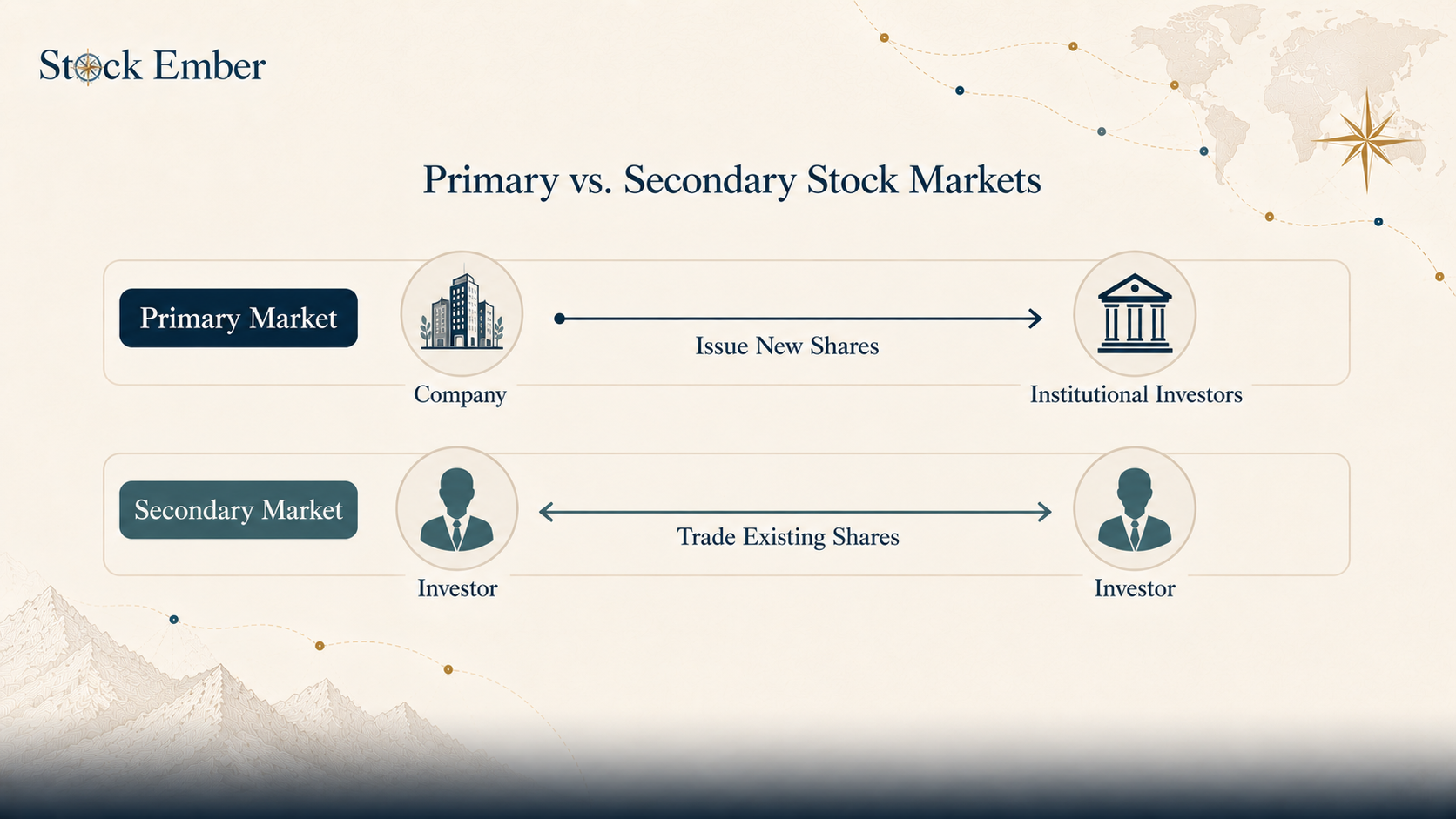
The stock market operates across two distinct stages: the primary market, where companies issue new shares, and the secondary market, where investors buy and sell shares among themselves.
Diagram comparing the primary stock market, where companies issue new shares, with the secondary market, where investors trade existing shares.
The Primary Market (Initial Public Offerings)
In the primary market, a company offers newly issued shares to investors through an Initial Public Offering (IPO), typically with investment banks acting as underwriters and distributing shares to institutional and, in some offerings, retail investors. The primary market allows companies to raise capital that may be used for research, business expansion, acquisitions, or debt repayment. The company receives the capital raised from these primary sales to fund research, expand physical operations, or pay down existing corporate debt.
The Secondary Market
Once an IPO completes, the newly created shares begin trading on the secondary market. The secondary market is what people typically refer to as "the stock market." Here, individual retail investors and institutional funds buy and sell existing shares with one another. Crucially, when you purchase a share on the secondary market, your money goes to another shareholder who sold their position, not to the company itself.
The secondary market provides liquidity, ensuring that investors can convert their ownership shares back into cash whenever they choose.
Stock Exchanges, Brokers, and Market Infrastructure
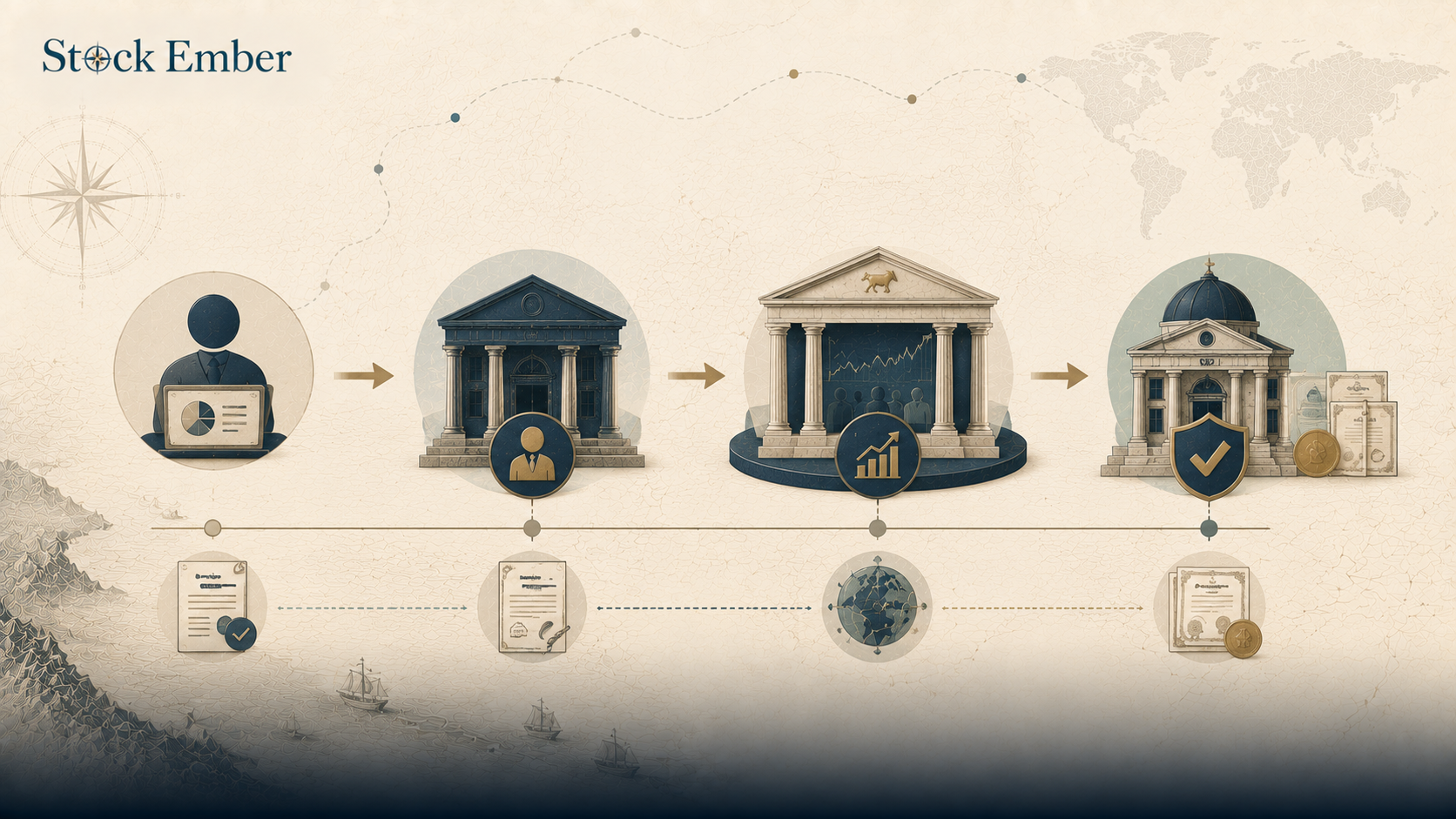
Stock exchanges are regulated physical or electronic marketplaces that receive and execute eligible buy and sell orders routed by broker-dealers and other authorized market participants.
Diagram illustrating stock market infrastructure from investor to broker, exchange, and clearinghouse.
Many investors confuse stock exchanges with the stock market as a whole. The stock market is the overarching system, while exchanges are specific regulated venues within that system:
Stock Exchanges: Exchanges such as the New York Stock Exchange and Nasdaq maintain electronic order books containing buy and sell orders; trades may execute when compatible prices and other order conditions are met.
Brokerages: Retail investors cannot walk onto an exchange floor directly. Instead, you place trade orders through a licensed brokerage account, which routes your request electronically to an exchange for execution.
Clearinghouses: Once a buy and sell order match, clearinghouses step in behind the scenes to verify trade details, transfer stock ownership records, and move cash securely.
How Investors Generate Returns in the Stock Market
Investors earn returns from stock market investments through capital appreciation as company share prices rise, and cash dividends paid out of corporate net profits.
Over multi-decade periods, public equity markets have historically generated robust long-term returns for disciplined buy-and-hold investors, for example, U.S. large-cap stocks have averaged roughly 10% in annual nominal returns since 1928, according to data compiled by NYU Stern's Aswath Damodaran. However, yearly results vary widely and past performance never guarantees future results.
Capital Appreciation: Revenue and earnings growth may support investor demand, but a stock’s price also depends on expectations, valuation, interest rates, competitive conditions, and broader market sentiment. A share purchased for $50 that eventually reaches $150 provides $100 of unrealized capital growth; conversely, if that same share fell to $30, the investor would hold an unrealized loss instead, since share prices can move in either direction.
Dividend Income: Mature, cash-generative corporations often distribute a portion of their net profits directly to shareholders as regular cash payouts called dividends.
Reinvesting dividends can increase the number of shares held and may enhance long-term compounding, although the result depends on dividend payments, market returns, fees, and taxes. For example, if a portfolio maintained a hypothetical 2% annual dividend yield and all distributions were reinvested, those reinvested payments could contribute to total return; actual yields and returns can rise, fall, or stop entirely.
What Drives Stock Market Prices and Short-Term Volatility?
Stock prices move up and down continuously based on real-time supply and demand, which is shaped by business earnings, interest rates, and investor expectations.
At any given moment during trading hours, a stock's market price reflects the exact point where buyer demand balances seller supply. Several key factors shift this equilibrium:
Corporate Earnings Disclosures: Quarterly reports showing rising sales or higher net profit draw buyers, pushing prices higher. Earnings misses often trigger selling.
Interest Rates and Economic Policy: Central bank interest rate hikes increase borrowing costs for businesses, which can reduce stock valuations across the economy.
Investor Sentiment and News Cycles: Geopolitical tensions, industry disruptions, or macroeconomic releases alter market confidence, causing short-term price swings.
Short-term volatility is a normal feature of equity markets, but some price declines can become permanent losses if a company fails or an investment never recovers. Investors who remain focused on multi-year business growth look past daily price fluctuations.
Types of Securities Traded: From Growth Shares to Blue-Chip Stocks
Public equity markets contain a wide variety of public companies, ranging from young high-growth firms to mature market leaders.
To navigate market choices effectively, investors categorize stocks by company scale and operational maturity. Emerging growth companies often reinvest all earnings into rapid business expansion, delivering higher price volatility alongside potential capital growth.
Conversely, large-cap market leaders, often called blue-chip stocks, provide essential stability, proven business models, and steady dividend payouts across economic cycles.
In practice, many long-term investors find that trying to identify the next breakout small-cap stock consumes endless research time while delivering volatile results. Diversifying across established companies may reduce reliance on any one business, but it does not eliminate company-specific or market-wide risk.
The Passive Investor's Mindset: Owning the Market Without Speculation
Passive investors can use broad-market index funds to seek returns that approximate a selected market index before fees and tracking differences, without choosing individual constituent stocks.
Attempting to time market cycles or trade individual shares introduces emotional pressure and single-stock risk. A single company can suffer management failures or technological obsolescence, leading to permanent capital losses.
Broad-market index funds and exchange-traded funds (ETFs) may reduce single-company concentration by holding a diversified basket of securities, although the number and type of holdings vary by fund. When you hold a broad-market index fund, your returns reflect the market segment it tracks, while diversification may reduce, but cannot eliminate, single-company and market-wide risks.
To see how broad-market indexing fits into a complete wealth-building plan, read our comprehensive guide on how to invest in stocks.
Conclusion
The stock market is a regulated global system that connects businesses seeking expansion capital with investors seeking long-term compounding. Understanding how primary and secondary markets function, how exchanges match orders, and how dividends accumulate helps you view price volatility with calm discipline. Rather than relying on short-term market predictions, broad-market investing can provide exposure to a diversified group of companies while remaining subject to market losses and periods of weak performance.
When you are ready to evaluate platforms and open an investment account, our curated broker reviews provide a transparent look at features, account types, and cost structures.
FAQ
5 questions
What is the main purpose of the stock market?
The stock market serves two core functions: it enables companies to raise investment capital from the public to expand their business operations, and it provides investors with a regulated platform to acquire equity ownership and grow wealth over time.
What is the difference between a stock market and a stock exchange?
The stock market refers to the entire global system and infrastructure of public trading. A stock exchange (such as the NYSE or Nasdaq) is a specific, regulated venue within that system where buy and sell orders for specific shares are matched and executed.
What is the difference between the primary market and the secondary market?
In the primary market, companies issue new shares to investors through offerings such as an Initial Public Offering (IPO), often with underwriters helping distribute the shares. In the secondary market, investors trade existing shares among themselves on exchanges, with transactions moving money between investors rather than to the company itself.
How do investors generate money from the stock market?
Investors may earn money from stocks through capital appreciation selling shares for more than they paid and through dividends that companies choose to distribute to shareholders.
What causes daily stock market price fluctuations?
Daily stock prices move continuously based on real-time supply and demand on exchanges. Buyer and seller sentiment is influenced by corporate quarterly earnings disclosures, macroeconomic trends, central bank interest rate changes, and geopolitical events.
Disclaimer
This guide was written with AI assistance and reviewed by the StockEmber editorial team for accuracy. StockEmber provides independent education, not personal financial advice. Some links may support our work at no additional cost to you.
The StockEmber Team is our in-house desk of independent research writers. We test brokerage platforms, read the fine print on fees and custody, and cover ETFs and long-horizon investing for people who plan to hold for decades — not days.