A blue-chip stock is equity ownership in a large, well-established, and financially sound corporation with a history of stable earnings and reliable dividend payments. These market leaders typically command market capitalizations above $10 billion and form the foundation of major stock indices. While blue chips offer lower volatility and balance-sheet resilience, long-term investors hold them through broad-market index funds to manage individual corporate risk.
A blue-chip stock is equity ownership in a large, well-established, and financially sound public corporation with a proven history of stable earnings, reliable dividend payments, and strong brand recognition.
When market volatility picks up, individual investors frequently look for businesses with proven resilience and fortress balance sheets. However, understanding what truly defines a blue-chip stock and recognizing the trade-offs between stability and rapid growth is essential before adding individual shares to your portfolio. This guide breaks down core blue-chip characteristics, common misconceptions, and how broad-market index funds fit into a long-term strategy.
Quick Takeaways
01Blue-chip stocks represent industry-leading companies with large market capitalizations, typically exceeding $10 billion.
02These corporations are characterized by balance-sheet stability, consistent profit generation, and dependable dividend distributions through economic cycles.
03While blue-chip equities are generally less volatile than small-cap stocks, they remain subject to broader market risks and technological disruption.
04Passive index investors automatically own broad baskets of blue-chip market leaders without taking on single-stock concentration risk.
Core Characteristics of a Blue-Chip Stock
Understanding what is a blue-chip stock starts with recognizing the scale, stability, and dividend history that separate these companies from the broader market. A stock qualifies as a blue-chip equity when the underlying company demonstrates massive market scale, financial resilience, and a multi-decade record of steady profitability. While there is no official regulatory body that designates companies as "blue chips," financial markets generally recognize corporations that meet specific operational benchmarks:
Financial Scale and Large Market Capitalization: Blue-chip companies typically command market capitalizations in the tens or hundreds of billions of dollars, with the large-cap classification generally beginning around $10 billion according to S&P Dow Jones Indices's market classification methodology. Their balance sheets feature manageable debt obligations, high credit ratings (a score reflecting how likely a company is to repay its debts), and substantial cash reserves.
Earnings and Dividend Consistency: These businesses generate recurring net profits across varying economic environments. Many blue chips maintain multi-decade records of paying and steadily increasing cash dividends to shareholders, reflecting operational stability.
Market Benchmark Inclusion: Blue-chip equities form the core components of major global stock indices, such as the Dow Jones Industrial Average and the S&P 500 (Standard & Poor's 500).
Because of these attributes, investors often view blue-chip equities as foundational assets during periods of economic uncertainty.
The Origin and the "Invincibility" Fallacy
The term "blue chip" originates from the game of poker, where blue chips historically represented the highest monetary value on the betting table. Oliver Gingold, an early employee at Dow Jones, is widely credited, according to Dow Jones's own company history, with coining the financial term in the 1920s when describing high-priced stocks trading at $200 or more per share. Over time, the definition shifted from nominal stock price to corporate balance-sheet quality and business dominance.
Despite their reputation for stability, treating blue-chip stocks as "uncrashable" or immune to business failure is a dangerous fallacy. No corporation is permanently protected from technological disruption, poor executive management, or shifting consumer preferences.
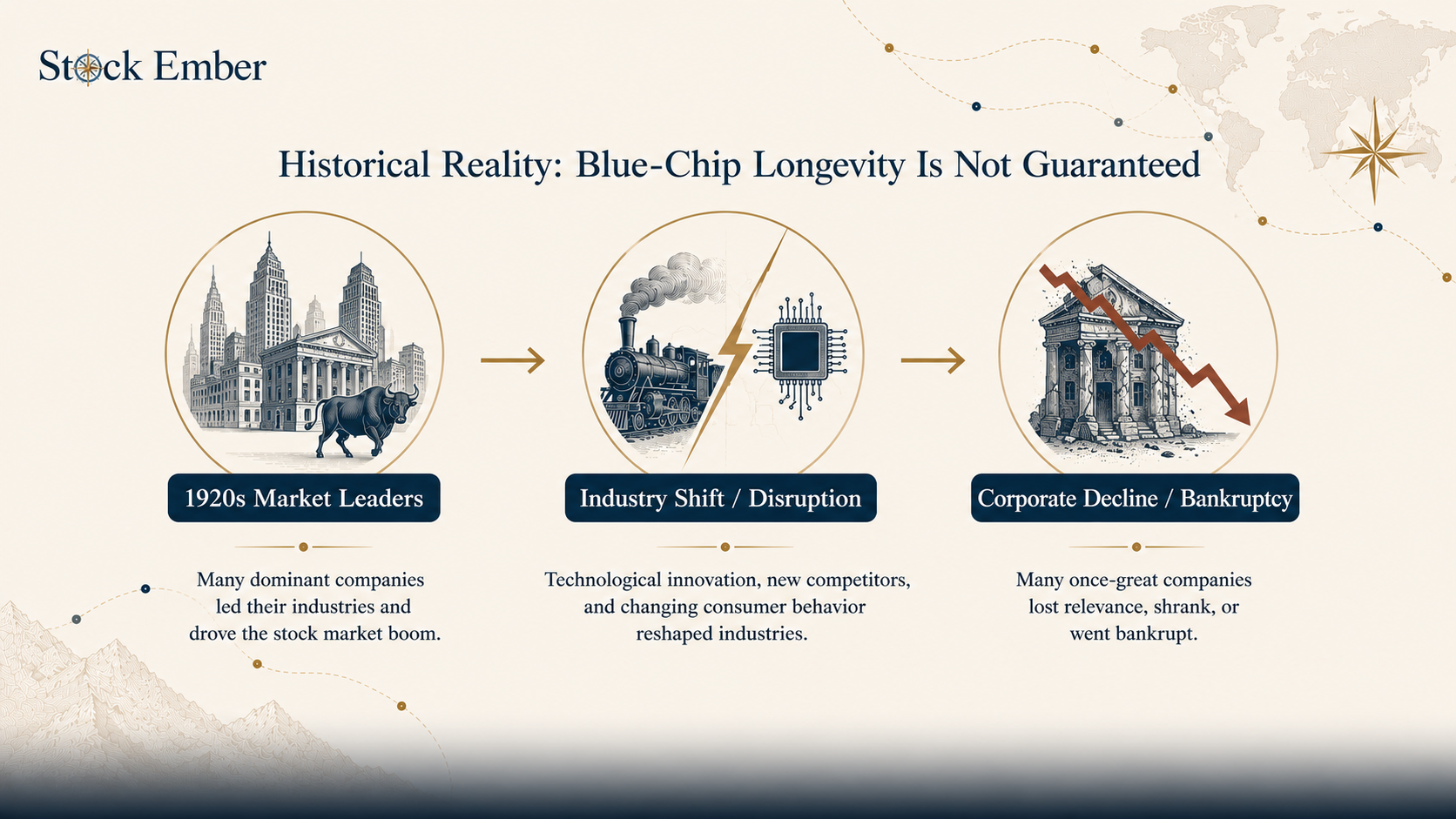
Historical Reality: Blue-Chip Longevity Is Not Guaranteed
Timeline illustrating how blue-chip companies can lose market leadership through industry disruption and corporate decline over time.
History shows that many former blue-chip market leaders such as Eastman Kodak, Sears, and Pan American World Airways eventually suffered severe operational declines or bankruptcy after failing to adapt, as documented in S&P Dow Jones Indices' historical records of Dow Jones Industrial Average component changes. Holding a single blue-chip stock still exposes your capital to individual business risk.
Blue-Chip Stocks vs. Growth and Small-Cap Equities
Blue-chip stocks prioritize capital preservation, modest earnings expansion, and dividend income over the rapid growth offered by smaller equities. Because blue-chip corporations operate at massive scale, doubling their revenue or market valuation requires immense capital compared to an emerging startup.
Characteristic
Blue-Chip Equities
Small-Cap & Growth Stocks
Market Capitalization
Large ($10B+)
Small to Mid ($300M – $10B)
Growth Potential
Moderate, mature pace
High, volatile potential
Dividend Yield
Steady, recurring payouts
Rare (profits reinvested)
Price Volatility
Generally lower
Higher price swings
Business Moat
Established market share
Unproven or emerging
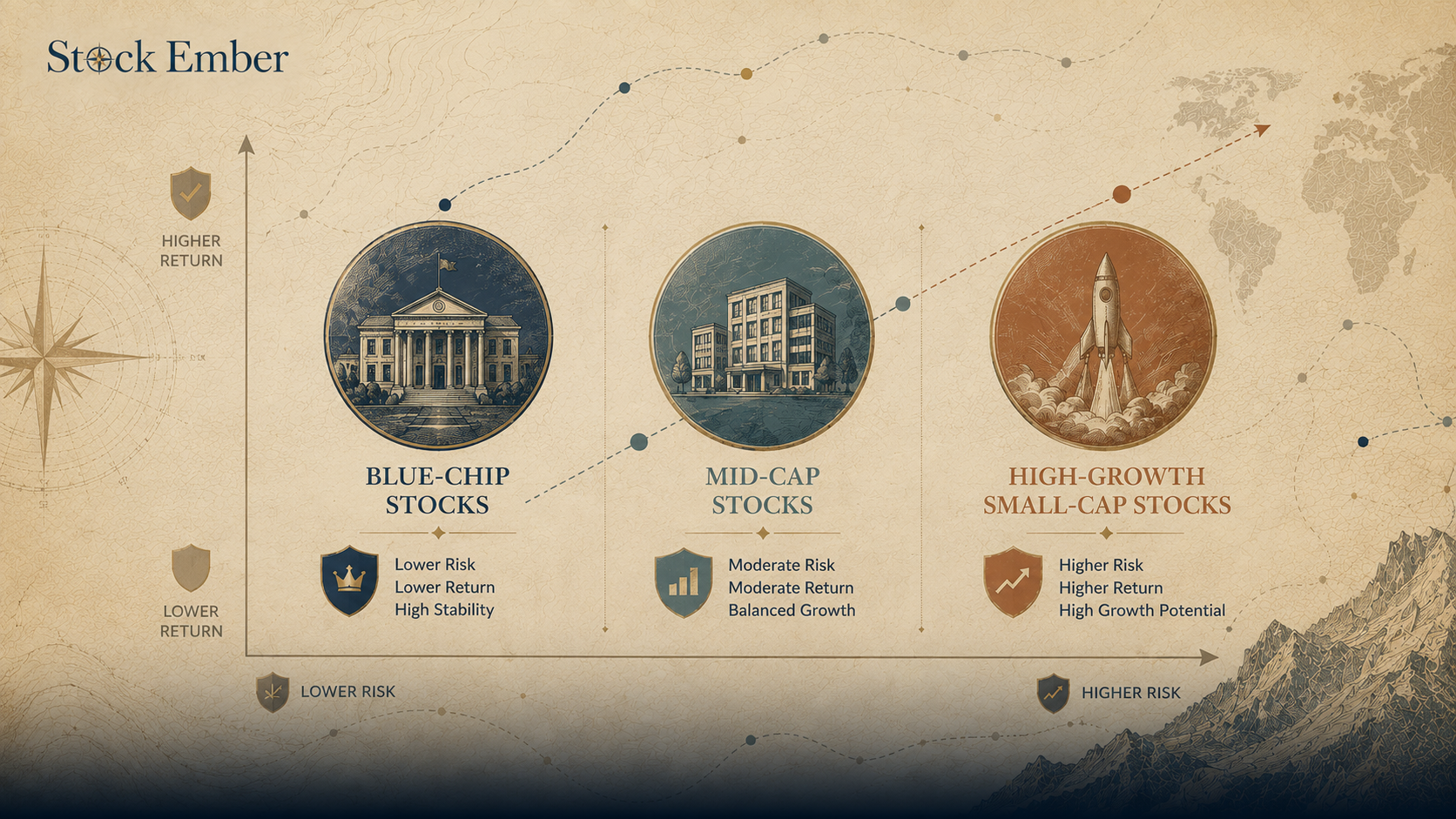
Investors holding blue chips accept a trade-off: they gain lower price volatility and reliable dividend distributions, but sacrifice the explosive capital growth potential found in younger, high-risk growth stocks.
Comparison diagram showing blue-chip stocks versus growth stocks.
Practical Execution: How Investors Access Blue-Chip Shares
Investors can access blue-chip stocks either by purchasing individual company shares or by holding diversified market funds. Purchasing individual equity positions requires opening a regulated custody account and executing trade orders through an intermediary. To learn about account setup and trade mechanics, review our guide on how to buy stocks.
However, buying individual blue-chip shares introduces single-stock concentration risk, meaning too much of an investor's portfolio depends on the fate of one company. If an investor places a large portion of their savings into just two or three industry leaders, an unexpected accounting issue or product failure can damage their total portfolio value.
In practice, building a portfolio by selecting individual blue-chip stocks often requires ongoing monitoring of financial statements and competitive developments. A company that dominates its sector today may see its competitive advantage erode over time, making individual stock ownership generally more demanding than holding a broadly diversified index fund.
The Passive Investor's Perspective: Broad Market Coverage
Passive investors capture the earning power and stability of blue-chip corporations automatically by owning broad-market index funds rather than picking individual winners.
Because major stock benchmarks like the S&P 500 are market-cap weighted, a single index fund automatically allocates the largest percentage of your capital to leading blue-chip corporations. As industry dynamics shift and new market leaders emerge, the index rebalances automatically, removing declining firms and adding rising businesses.
To see how large-cap equities fit into a comprehensive buy-and-hold strategy, read our core overview on how to invest in stocks. Broad-market indexing allows you to participate in global economic expansion without needing to forecast which blue-chip companies will retain their dominance over the next decade.
Conclusion
Blue-chip stocks represent mature, financially resilient companies that provide balance-sheet stability and recurring dividend income. However, holding individual shares still carries single-company failure risks. By utilizing broad-market index funds, long-term investors capture the growth of world-class corporate leaders while maintaining the safety of broad diversification.
To sum up what is a blue-chip stock: it is a large, financially resilient company whose shares offer stability rather than explosive growth.
When you are ready to evaluate platform fees and select an account structure for your portfolio, explore our curated broker reviews to compare features and custody options.
FAQ
5 questions
What qualifies a company as a blue-chip stock?
A company qualifies as a blue-chip stock by demonstrating large market capitalization (typically $10 billion or more), a long history of stable profitability, a solid balance sheet, and a consistent track record of paying dividend distributions through varying economic cycles.
Are blue-chip stocks completely safe from market crashes?
No, blue-chip stocks are not immune to market downturns or business failures. While large-cap market leaders generally exhibit lower price volatility than smaller companies, their stock prices still drop during broader market declines, and individual blue chips can face long-term disruption.
Do all blue-chip stocks pay dividends to shareholders?
While the vast majority of traditional blue-chip companies have long histories of paying cash dividends, paying a dividend is not a strict requirement. Certain modern technology market leaders reinvest all earnings into business expansion rather than distributing quarterly cash payouts.
What is the difference between a blue-chip stock and a growth stock?
Blue-chip stocks represent mature, financially stable companies that offer modest earnings growth and steady dividend income. In contrast, growth stocks represent younger or expanding businesses that reinvest profits to maximize revenue growth, offering higher capital appreciation potential along with higher volatility.
Is it better to buy individual blue-chip stocks or an index fund?
For most long-term investors, buying broad-market index funds is preferable to selecting individual blue-chip stocks. Index funds automatically hold a broad basket of large-cap market leaders, providing exposure to blue-chip earnings while eliminating single-company concentration risk.
Disclaimer
This guide was written with AI assistance and reviewed by the StockEmber editorial team for accuracy. StockEmber provides independent education, not personal financial advice. Some links may support our work at no additional cost to you.
The StockEmber Team is our in-house desk of independent research writers. We test brokerage platforms, read the fine print on fees and custody, and cover ETFs and long-horizon investing for people who plan to hold for decades — not days.