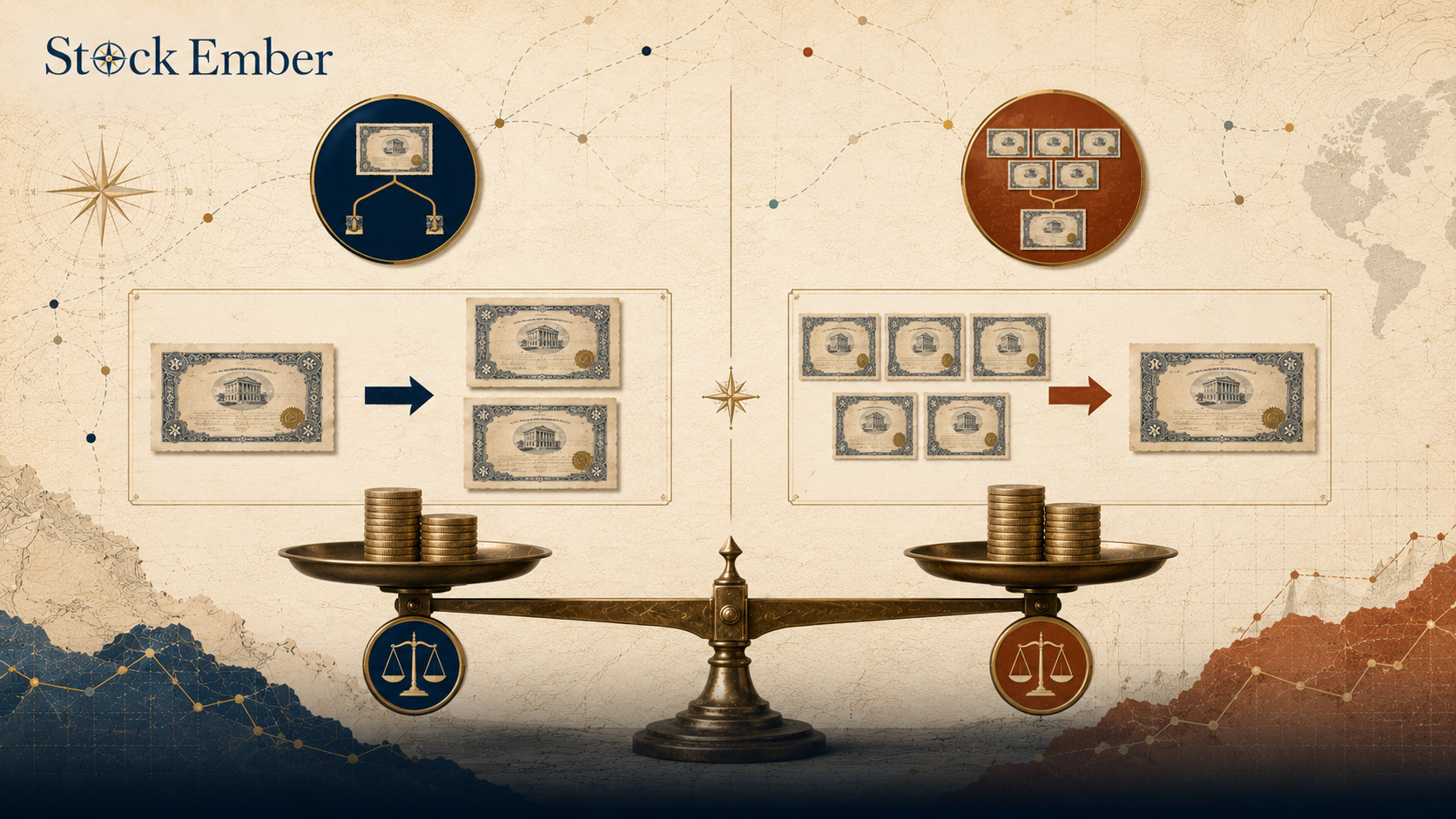
A stock split is a corporate action in which a company increases its total number of outstanding shares while reducing the price per share proportionally. Because the total market value of the business remains unchanged, a stock split does not alter an investor's ownership stake or fundamental portfolio value. Companies primarily execute stock splits to lower per-share prices, improve trading liquidity, and make individual shares more accessible to retail investors.
A stock split is a corporate action in which a company multiplies its existing share count while proportionally reducing the per-share price, leaving the company's total market capitalization unchanged.
When news breaks that a major company is splitting its shares, many investors search for what is a stock split before headlines even explain why it is framed as a significant financial milestone. In reality, a stock split is primarily an administrative accounting adjustment. Understanding how split ratios work helps long-term investors look past market hype and maintain a disciplined buy-and-hold strategy.
Quick Takeaways
01A stock split alters the total number of outstanding shares and the per-share price by the exact same proportion.
02The overall market capitalization of the company and the total value of your investment remain identical post-split.
03Forward splits lower per-share prices to improve trading liquidity, whereas reverse splits consolidate shares to meet exchange listing standards.
04Modern fractional share trading allows you to invest fixed dollar amounts regardless of nominal share prices.
05Passive index investors treat stock splits as routine accounting events requiring no portfolio adjustments.
How a Stock Split Works: The Accounting Mechanics
A stock split alters the quantity of outstanding shares issued by a company while adjusting the per-share market price in exact inverse proportion. Because both sides of the equation adjust equally, the fundamental economic value of the business does not change.
To visualize the mechanics, consider a pizza. Slicing a large pizza into eight pieces instead of four gives you twice as many slices, but the total amount of food remains identical. Similarly, splitting a company's shares creates more individual share certificates without changing the size of the corporate entity.
The Mathematics of a Forward Split
In a standard forward stock split, shareholders receive additional shares for every share they already hold. Common forward split ratios include 2-for-1, 3-for-1, or 10-for-1.
Consider the following hypothetical example:
Pre-Split Position: You own 10 shares of a company trading at $200 per share. Your total investment value is $2,000 (10$200).
Corporate Action: The company declares a 2-for-1 forward stock split.
Post-Split Position: Your share count doubles to 20 shares, while the stock price is cut in half to $100 per share. Your total investment value remains $2,000 (20$100).
Market Capitalization Remains Neutral
A company's total valuation on the public exchange is its market capitalization, calculated by multiplying total outstanding shares by the current share price. To learn more about company size classifications, explore what is market cap.
Because a forward split multiplies share count by the exact factor used to divide the share price, total market capitalization stays exact. Neither existing shareholders nor new buyers gain or lose equity value purely from the split itself.
Forward Stock Splits vs. Reverse Stock Splits
Forward stock splits increase the total share count to lower individual share prices, whereas reverse stock splits decrease the share count to raise per-share prices. Companies utilize these two corporate actions for entirely different operational reasons.
Forward Stock Splits
Companies whose share prices have appreciated significantly over many years often execute forward stock splits. Key motivations include:
Options Market Liquidity: Standard equity option contracts represent 100 shares of underlying stock. Lowering the per-share price makes options trading more accessible for institutional and retail traders.
Employee Stock Compensation: Issuing equity bonuses or stock options to employees is functionally easier when per-share values are lower, allowing for precise compensation adjustments.
Retail Accessibility: While institutional investors trade millions of dollars at a time, lower nominal share prices make whole shares appear more approachable to individual investors.
Reverse Stock Splits
A reverse stock split consolidates existing shares into a smaller number of higher-priced shares. For example, in a hypothetical 1-for-5 reverse stock split, an investor holding 50 shares trading at $2.00 per share ($100 total) ends up holding 10 shares trading at $10.00 per share ($100 total).
Unlike forward splits, reverse splits are frequently a signal of financial distress. Major exchanges such as the NASDAQ and the New York Stock Exchange enforce minimum bid price requirements, typically requiring stocks to maintain a price above $1.00 per share under continued listing standards such as NASDAQ Listing Rule 5550(a)(2). Companies whose stock prices have plummeted execute reverse splits to artificially boost their per-share price and avoid being delisted.
Diagram comparing forward and reverse stock split mechanics.
Debunking the "Cheap Stock" Fallacy
A lower post-split share price makes a stock nominally lower in price, but it does not make the underlying company fundamentally cheaper or a better value. A company's valuation depends on its earnings, revenue, and cash flows relative to its market capitalization, not its per-share price tag.
For example, a single share trading at $20 with a high price-to-earnings ratio (a common measure of how expensive a stock is relative to its profits) can be far more expensive in valuation terms than a $500 share in a highly profitable, low-valuation business. Confusing nominal share price with underlying business valuation is a common trap for beginner investors.
In practice, many long-term investors find that the psychological urge to buy "cheaper" post-split stocks distracts from assessing business quality. With modern brokerages offering fractional share investing, you can allocate $50 into any market leader regardless of whether its single-share price is $100 or $3,000.
Thanks to fractional share trading, you no longer need a company to split its stock to purchase a piece of its business. If a share trades at $1,000 and your budget is $100, your brokerage can execute a purchase for 0.10 shares, delivering proportional economic ownership instantly.
Practical Implications: Dividends, Taxes, and Cost Basis
Stock splits do not create taxable income, nor do they increase the total dividend income paid to shareholders. Because splits are non-taxable accounting adjustments, tax authorities treat them as balance-neutral events.
Dividend Adjustments: If a company pays a dividend, its board adjusts the per-share payout by the exact split ratio. Owning 10 shares paying a $1.00 quarterly dividend ($10 total) becomes 20 shares paying a $0.50 quarterly dividend ($10 total). Your income remains unchanged.
Tax Cost Basis: Under IRS Section 305, receiving additional shares from a split does not trigger capital gains taxes. Your original purchase cost basis (the price you originally paid for your shares, used to calculate taxes when you eventually sell) automatically reallocates across your expanded share count.
The Long-Term Investor's Perspective on Stock Splits
Passive buy-and-hold investors view stock splits as administrative accounting updates rather than trading signals or portfolio events. Attempting to buy shares ahead of a split announcement to chase short-term price momentum introduces speculative trading risks.
Building long-term wealth depends on corporate earning power, patient compounding, and broad diversification over decades. To understand how single stock events fit into a comprehensive wealth-building strategy, read our foundational guide on how to invest in stocks. Broad-market index funds process stock splits across underlying holdings automatically, allowing passive investors to stay focused on long-term compound growth.
Conclusion
Now that you know what a stock split is, remember that it only alters the presentation of a company's share count without changing its economic foundation or total market value. By looking past headlines and nominal share prices, you keep your investment strategy anchored on corporate earning power and long-term compounding.
When you are ready to establish your account and build a disciplined portfolio, our curated broker reviews offer a clear look at platform features and fractional trading support.
FAQ
5 questions
Does a stock split increase the total value of your investment?
No, a stock split does not change the total dollar value of your investment. While you receive a greater number of shares, each individual share is worth proportionally less. For example, in a 2-for-1 split, holding 10 shares at $100 ($1,000 total) becomes 20 shares at $50 ($1,000 total). The fundamental market value of your holding remains identical.
What is the difference between a forward stock split and a reverse stock split?
A forward stock split increases total share count while lowering the price per share (e.g., a 2-for-1 split). Conversely, a reverse stock split decreases total share count while raising the per-share price (e.g., a 1-for-10 split). Forward splits are used by growing companies to lower share prices, while reverse splits are often used by distressed companies to meet exchange listing requirements.
Do you get higher dividend payments after a stock split?
No, a stock split does not increase your total dividend payout. When a stock splits, the company adjusts its dividend per share downward by the exact same ratio. If you owned 10 shares paying a $1.00 dividend ($10 total), a 2-for-1 split gives you 20 shares paying a $0.50 dividend ($10 total). Your total income remains unchanged.
Why would a company declare a reverse stock split?
Companies usually execute reverse stock splits to boost their per-share price above major stock exchange listing minimums (such as $1.00 per share on the NYSE or NASDAQ) to avoid being delisted. A reverse split consolidates shares for example, converting 10 shares worth $0.50 into 1 share worth $5.00 without changing the company's overall market capitalization.
How do stock splits affect investors who buy fractional shares?
Stock splits apply proportionally to fractional shares in modern brokerage accounts. If you own 0.5 shares of a stock undergoing a 4-for-1 forward split, your account will automatically hold 2.0 shares post-split. Your total dollar equity value stays exact, meaning fractional investors experience the split mechanics seamlessly without losing equity value or receiving cash in lieu of shares.
Disclaimer
This guide was written with AI assistance and reviewed by the StockEmber editorial team for accuracy. StockEmber provides independent education, not personal financial advice. Some links may support our work at no additional cost to you.
The StockEmber Team is our in-house desk of independent research writers. We test brokerage platforms, read the fine print on fees and custody, and cover ETFs and long-horizon investing for people who plan to hold for decades — not days.