Market cap (market capitalization) is the total dollar value of a public company's outstanding common shares. It is calculated by multiplying a company's current stock price by its total shares outstanding. Market cap allows investors to categorize businesses into scale tiers from small-cap to mega-cap to evaluate corporate size, stability, and growth potential.
Market cap (short for market capitalization) is the total dollar value of a public company's outstanding common shares, calculated by multiplying its current stock price by its total number of shares.
A common beginner mistake is assuming a $500 stock represents a larger company than a $10 stock, but price per share alone tells you very little about a business's true size. Understanding market cap meaning helps you assess corporate scale, risk levels, and portfolio diversification. This guide breaks down the calculation, market cap tiers, common price illusions, and how passive investors handle company sizing.
Quick Takeaways
01Market cap measures a public company's total equity value by multiplying its live stock price by its total shares outstanding.
02Understanding market capitalization provides a standardized metric for categorizing companies into size tiers like small-cap, mid-cap, and large-cap.
03A high share price does not mean a stock is expensive or large; total share count determines total business valuation.
04Corporate stock splits adjust share price and share count in opposite directions without changing total market capitalization.
05Passive index investors hold companies across all market cap tiers automatically without needing to manually rebalance size segments.
What Does Market Cap Mean in Simple Terms?
Market cap is the total equity value assigned to a publicly traded corporation by the open stock market.
When investors evaluate a public business, looking at the stock price in isolation creates a false impression of company size. A company with a $10 stock price might have 1 billion shares outstanding, making it worth $10 billion. Meanwhile, another company with a $500 stock price might only have 1 million shares outstanding, making it worth $500 million.
The market cap meaning clarifies this valuation scale. It converts nominal share prices into a single, concrete dollar figure representing what the market thinks the company's total equity is worth right now.
How to Calculate Market Capitalization
To calculate market capitalization, multiply a company's current stock price by its total number of outstanding shares.
The calculation formula is expressed as:
Market Cap = Current Share Price × Total Shares Outstanding
Component Breakdown
Current Share Price: The live market price required to purchase one share of common stock on an exchange.
Total Shares Outstanding: The total quantity of common shares issued by the company and currently held by all shareholders, including retail investors and institutional funds.
Step-by-Step Valuation Example
Consider two hypothetical companies trading on public exchanges:
Company A: Share price of $20 × 500 million shares outstanding = $10 Billion Market Cap.
Company B: Share price of $200 × 10 million shares outstanding = $2 Billion Market Cap.
Even though Company B's individual share price is ten times higher than Company A's, Company A is actually five times larger in total equity value.
Do Stock Splits Change Market Cap?
A corporate stock split increases or decreases the number of shares outstanding while adjusting the share price by the exact same proportion. For example, in a 2-for-1 stock split, a $100 stock splits into two $50 shares. Because price and share count move in opposite directions by the same factor, a company's overall market capitalization remains unchanged.
The Main Market Cap Tiers: From Small-Cap to Mega-Cap
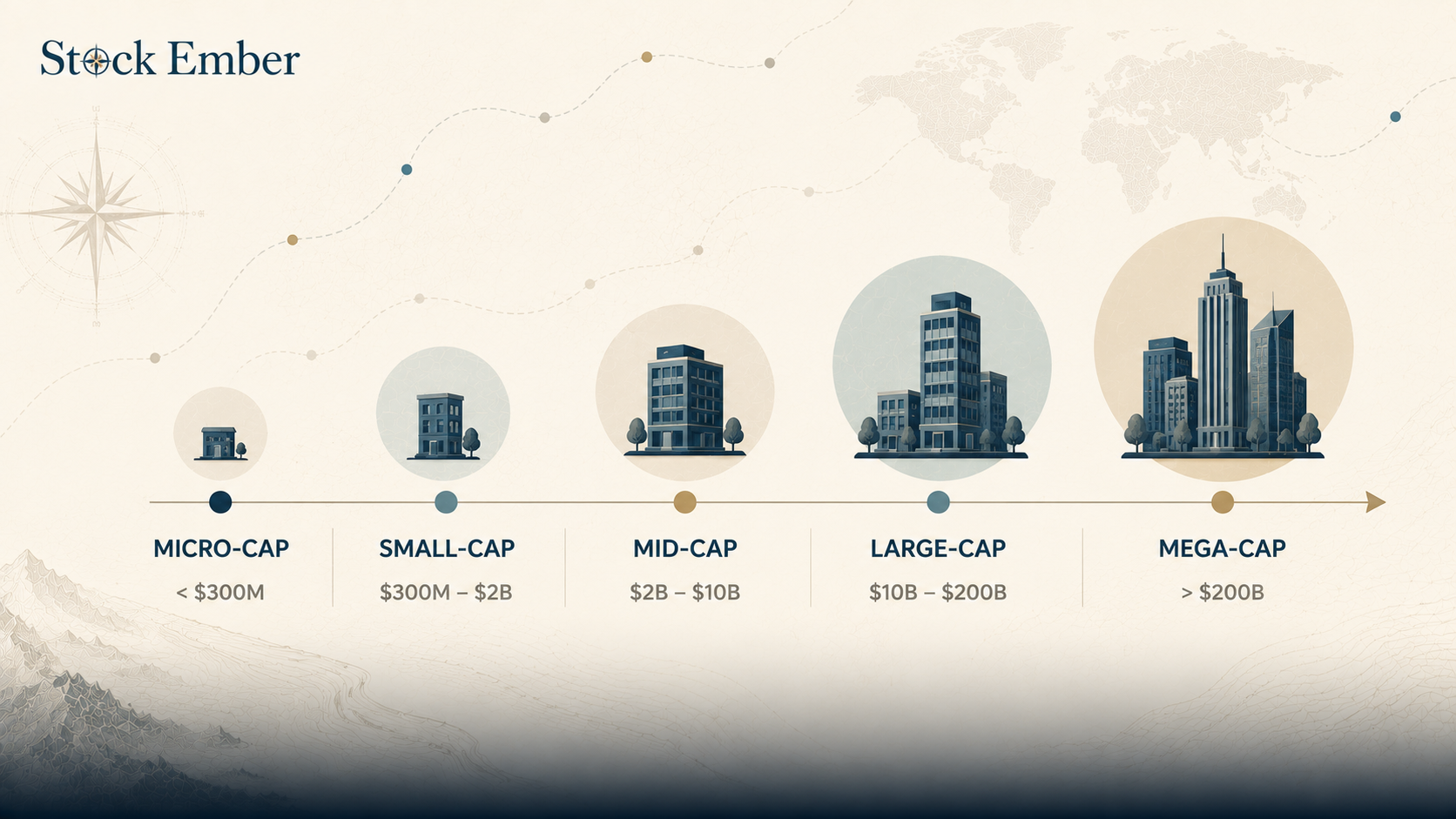
Financial markets categorize public companies into five primary market cap tiers to help investors measure size, growth potential, and volatility risk.
Diagram comparing market capitalization tiers from micro-cap to mega-cap.
Market-cap thresholds are not universal and may vary by data provider. The ranges below follow FINRA's general classifications:
Market Cap Tier
Valuation Range
Characteristics & Risk Profile
Mega-Cap
> $200 Billion
Global industry leaders, highly liquid, steady earnings.
Large-Cap
$10 Billion – $200 Billion
Established businesses, lower volatility, often pay dividends.
Mid-Cap
$2 Billion – $10 Billion
Expanding market share, balance of growth and stability.
Small-Cap
$250 Million – $2 Billion
High growth potential, greater price volatility and operational risk.
Micro-Cap
< $250 Million
Early-stage public firms, lower trading liquidity, higher risk.
sSmaller companies may have greater room to expand, but a smaller market capitalization does not guarantee higher returns. Their shares can also be more volatile and less liquid, particularly during periods of market stress. Large-cap and mega-cap companies may have more diversified operations and greater access to capital than smaller businesses, but company size alone does not guarantee financial stability or make a stock suitable for a conservative portfolio.
Market Cap vs. Enterprise Value: Understanding the Distinction
Market capitalization measures only a company's total equity value, whereas enterprise value accounts for balance sheet debt and cash reserves to calculate total business acquisition cost.
A common point of confusion for beginners is assuming market cap equals the total cost to buy an entire company. Market cap reflects only the value of common stock equity. If a company has a $50 billion market cap but also carries $20 billion in corporate debt and $5 billion in cash, an acquirer would need to pay off that debt while absorbing the cash.
Enterprise Value (EV) adjusts for this balance sheet structure:
Enterprise Value = Market Cap + Total Debt - Cash and Equivaler
While market cap provides a quick snapshot of public equity size, institutional analysts use enterprise value to evaluate a business's complete capital structure.
Role in Index Weighting: The S&P 500 Connection
The S&P 500 is weighted by float-adjusted market capitalization, meaning that each constituent's weight is based on the market value of shares considered available to public investors.
In a market-cap-weighted index, companies with greater eligible market value receive larger weights. Because the S&P 500 uses float-adjusted market capitalization, larger constituents generally have a greater effect on the index's daily movement than smaller constituents.
To see how size weighting shapes benchmark returns, read our full guide on what is the s&p 500.
In practice, many long-term investors find that trying to manually overweight small-cap stocks for higher returns leads to unnecessary portfolio volatility. Holding a broad, market-cap-weighted index fund captures corporate growth across all size tiers without requiring constant rebalancing.
The Passive Investor's Mindset: Automatic Sizing Across Portfolio Tiers
Investors using a total-market index fund may gain exposure to multiple market-cap segments without selecting each segment individually, although coverage varies by fund and should be confirmed in the fund's index methodology and prospectus.
Attempting to time market cap shifts such as switching from small-cap to large-cap stocks during economic changes requires constant research and introduces execution costs. Small caps can underperform for long stretches, while mega-caps can lead market rallies unpredictably.
A total-market index fund generally adjusts its holdings and weights according to the rules of its underlying index, but the securities included, rebalancing schedule, fees, and market-cap coverage vary among funds, when an index constituent's eligible market value increases, its weight in a market-cap-weighted index may also rise. This approach reduces the need to select individual stocks manually, but investors remain exposed to market risk, concentration risk, fees, and possible losses.
To see how broad diversification fits into a complete wealth-building plan, read our core guide on how to invest in stocks.
Conclusion
Market capitalization is an essential metric that strips away the illusion of share price, giving you a clear view of a company's real size and risk profile. By evaluating public firms through market cap tiers rather than nominal stock prices, you avoid overpaying for hype or confusing low stock prices with cheap valuations. A total-market index fund may provide exposure to several market-cap tiers, but investors should review the fund's benchmark and holdings because some broad index funds exclude certain small-cap or micro-cap companies.
When you are ready to open an account and build your index portfolio, our curated broker reviews provide a transparent comparison of account options and platform fees.
FAQ
5 questions
What does market cap mean in simple terms?
Market cap, short for market capitalization, represents the total dollar value assigned to a company's common stock by the market. Calculated by multiplying share price by total shares outstanding, it provides a standardized measurement of a company's total equity value rather than relying on individual share price.
Is a higher market cap better for investors?
Not necessarily. Large-cap and mega-cap companies generally offer greater business stability, balance sheet strength, and lower price volatility during market downturns. However, small-cap companies often offer higher long-term growth potential because they have more room to expand, albeit with greater price volatility.
What is the difference between share price and market cap?
Share price measures the cost to purchase a single share of stock, while market cap measures the total value of all shares combined. A company with a $10 share price can be significantly larger than a company with a $100 share price if it has a far greater number of total shares outstanding.
Does a stock split change a company's market cap?
No, a corporate stock split does not change a company's market capitalization. Stock splits increase the number of shares outstanding while reducing the share price proportionally. Because the price and share count adjust by the exact same ratio, total market capitalization remains identical.
What is the difference between market cap and enterprise value?
Market cap measures only the equity value of a company's common stock. Enterprise value (EV) provides a broader picture of total corporate acquisition cost by taking market cap, adding total balance sheet debt, and subtracting cash reserves.
Disclaimer
This guide was written with AI assistance and reviewed by the StockEmber editorial team for accuracy. StockEmber provides independent education, not personal financial advice. Some links may support our work at no additional cost to you.
The StockEmber Team is our in-house desk of independent research writers. We test brokerage platforms, read the fine print on fees and custody, and cover ETFs and long-horizon investing for people who plan to hold for decades — not days.