The S&P 500 (Standard & Poor's 500) is a float-adjusted market-capitalization-weighted stock index that measures the performance of 500 leading large-cap US companies. Representing roughly 80% of total US equity market capitalization, it serves as the primary benchmark for American corporate health and is accessed by investors through low-cost index funds and ETFs.
The S&P 500 (Standard & Poor's 500) is a market-capitalization-weighted stock index that tracks 500 of the largest publicly traded companies in the United States.
When financial news outlets report on "how the market is doing," they are usually referring to the S&P 500. Because the index covers approximately 80% of available US market capitalization, understanding how it works can help investors evaluate broad US large-cap exposure. This guide breaks down index weighting mechanics, how to invest through funds, concentration risks, and the S&P 500's role in a long-term strategy.
Quick Takeaways
01The S&P 500 measures the collective stock performance of 500 leading large-cap US public corporations.
02It uses float-adjusted market-capitalization weighting, meaning larger companies exert a larger influence on daily index moves.
03You cannot purchase the S&P 500 index directly; instead, investors buy low-cost index funds or ETFs that track it.
04While highly diversified, top mega-cap technology firms represent a significant portion of the total index weighting.
05Broad S&P 500 index funds allow long-term investors to capture US corporate earnings growth with minimal management fees.
What Is the S&P 500 Index?
The S&P 500 is a financial benchmark created by Standard & Poor's that measures the stock performance of 500 leading public American corporations.
Launched in its modern 500-company format in March 1957, the index is maintained by S&P Dow Jones Indices, with constituent changes determined by its U.S. Index Committee. Rather than simply picking the 500 largest companies by market value, the committee enforces strict eligibility criteria to ensure index constituents represent the broader American economy.
To be considered for inclusion, a company must satisfy the eligibility criteria in the current S&P U.S. Indices Methodology, including requirements relating to US status, market capitalization, liquidity, public float, and financial viability.
Maintain a primary corporate domicile in the United States.
Meet minimum market capitalization thresholds.
Demonstrate high liquidity and public share float.
Report positive cumulative net income over the most recent four quarters.
Because it covers approximately 80% of available US market capitalization, the S&P 500 is widely used as a benchmark for the performance of US large-cap equities, although it does not represent every segment of the US economy.
How the S&P 500 Works: Market-Cap Weighting Mechanics
Market-capitalization weighting means a company's representation in the S&P 500 is directly proportional to the total market value of its outstanding shares.
In a float-adjusted market-cap weighted index, larger companies carry a higher percentage weight than smaller ones. If a mega-cap corporation has a market value of $2 trillion and a smaller constituent has a market value of $20 billion, a 1% price change in the mega-cap firm will have a 100-times greater impact on the S&P 500 index price than the same percentage move in the smaller company.
Company Market Cap = Shares Outstanding × Current Share Price
Index Weight (%) = Company Market Cap ÷ Total Market Cap of All 500 Companies
Automatic Rebalancing and Survival of the Fittest
The S&P 500 automatically updates its composition through periodic rebalancing. As growing companies expand their revenues and market cap, their weighting inside the index increases. Conversely, if a business suffers long-term operational decline, its weighting shrinks, and it may eventually be removed from the index entirely to make room for a healthier entrant.
This self-cleansing structure helps that an S&P 500 portfolio naturally retains thriving businesses while pruning failing ones over time.
How to Invest in the S&P 500: Index vs. Funds
Investors cannot purchase the S&P 500 index directly because it is a mathematical statistical metric rather than a tradeable financial security.
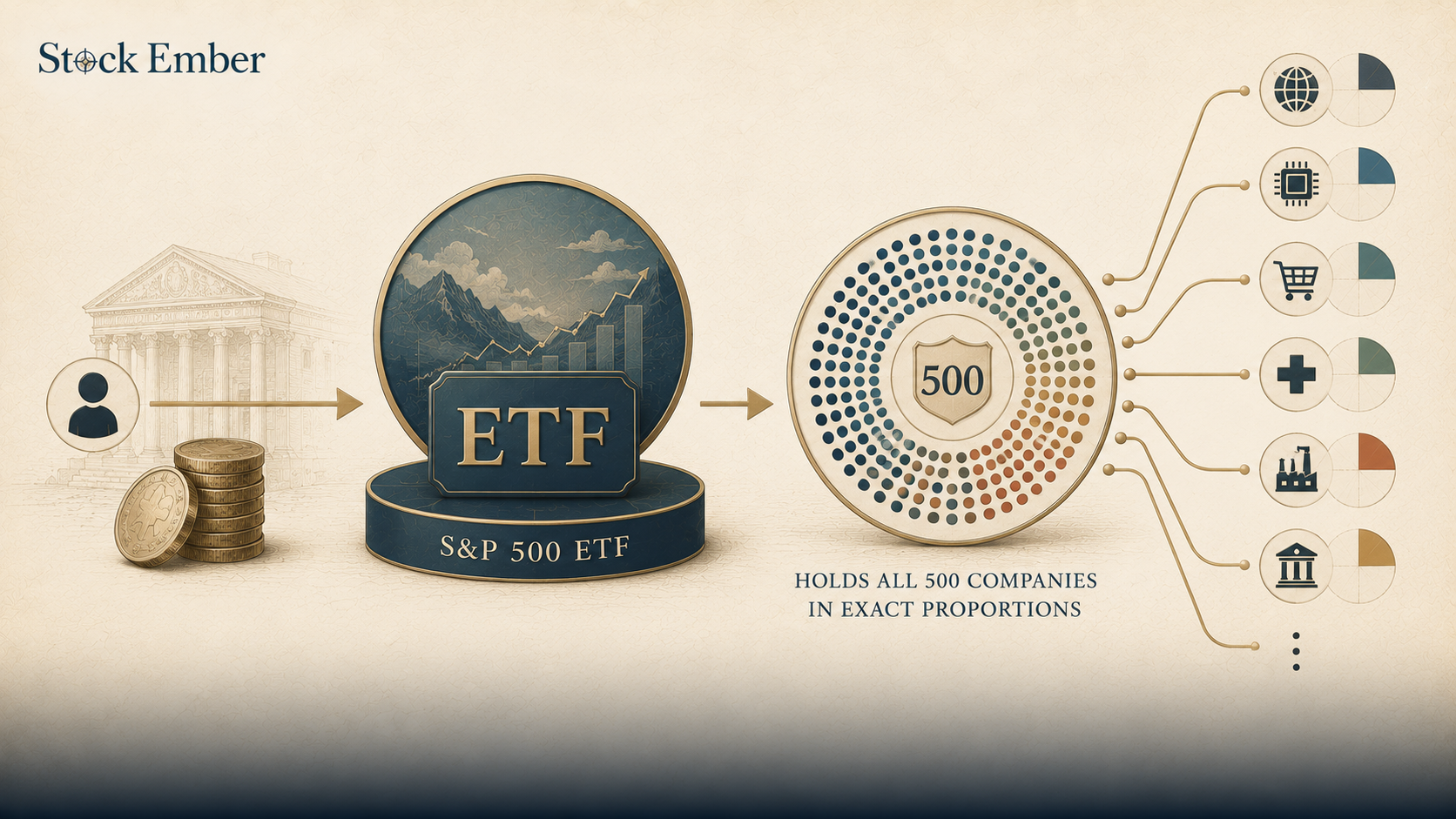
Diagram showing how index funds pool investor money to purchase all S&P 500 constituent stocks.
To gain exposure to the S&P 500, investors purchase shares in index mutual funds or Exchange-Traded Funds (ETFs) designed to replicate the index.
Asset management firms build these funds by purchasing shares in all 500 constituent companies in exact proportion to their index weightings. When you buy one share of an S&P 500 ETF, your money is distributed across all 500 companies simultaneously.
Dividends and Expense Ratios
Dividend Pass-Through: As underlying companies pay cash dividends, the index fund collects these payouts and distributes them to fund shareholders quarterly or automatically reinvests them.
Low Expense Ratios: Because index funds follow a passive tracking strategy rather than paying active managers to pick stocks, many passively managed S&P 500 funds charge relatively low expense ratios, although costs vary by fund. For example, an expense ratio of 0.05% would equal approximately $5 per year for every $10,000 invested, excluding trading and account-related costs (based on the Vanguard S&P 500 ETF (VOO) expense ratio, as of July 2026).
S&P 500 vs. Other Major Market Indices
The S&P 500 differs from other major stock market indices primarily through its broader diversification and market-cap weighting methodology.
S&P 500 vs. Dow Jones Industrial Average (DJIA): The Dow Jones tracks only 30 large-cap US companies and uses a price-weighted system, meaning higher-priced stocks exert greater influence regardless of total market cap. The S&P 500 covers 500 companies using market-cap weighting, offering a far broader economic reflection.
S&P 500 vs. Nasdaq Composite: The Nasdaq tracks over 3,000 stocks listed on the Nasdaq exchange, heavily concentrated in technology and growth sectors. The S&P 500 includes companies across all major sectors, including financial services, healthcare, industrial manufacturing, and consumer goods.
Concentration Risks and Valuation Metrics
Although the S&P 500 holds 500 individual companies, its market-cap weighting creates concentration risk when a small group of mega-cap firms grows unusually dominant.
In recent years, the top 10 holdings have represented approximately 35% to 40% of the S&P 500's total weight (based on Vanguard VOO fund holdings, as of July 2026). If these dominant firms experience sharp price declines, the overall S&P 500 index can fall even if many of the remaining constituents perform well.
Evaluating whether the overall market is fully valued requires tracking fundamental metrics like what is the price-to-earnings (P/E) ratio. Monitoring valuation multiples helps investors maintain reasonable expectations during market expansions.
In practice, many long-term investors find that worrying about mega-cap tech concentration in the S&P 500 leads to unnecessary overthinking. The market-cap weighting mechanism has historically adjusted as sector leaders shift over multi-decade cycles.
The Passive Investor's Perspective: The S&P 500 as a Portfolio Core
For passive investors, an S&P 500 index fund serves as a reliable core portfolio building block that captures long-term American corporate growth at minimal cost.
Over multi-decade periods, the S&P 500 has historically delivered average annual nominal returns of approximately 10% and real (inflation-adjusted) returns of around 7%, based on long-run market data from S&P Dow Jones Indices and the Yale Robert Shiller U.S. Stock Market Data. While the index experiences temporary market downturns, its self-rebalancing structure has historically enabled it to recover and reach new highs over full market cycles.
By holding an S&P 500 fund within a long-term strategy, you reduce the need to analyze individual financial statements or predict market cycles. To see how broad US market exposure connects with global diversification, read our complete guide on how to invest in stocks.
Conclusion
The S&P 500 is a transparent, self-cleansing benchmark that provides low-cost exposure to 500 of America's leading corporations. By understanding market-cap weighting, dividend distributions, and fund mechanics, you can view market drawdowns as normal volatility rather than a reason to abandon your plan. Holding a low-cost S&P 500 index fund lets you participate in long-term corporate profits without taking on single-stock picking risks.
When you are ready to choose an account to hold your index investments, our curated broker reviews offer a clear look at platform options and fee structures.
FAQ
5 questions
Can you buy the S&P 500 index directly?
No, you cannot buy the S&P 500 index directly because it is a mathematical tracking metric rather than a tradeable security. Instead, investors purchase shares of index mutual funds or Exchange-Traded Funds (ETFs) that hold all 500 constituent companies in exact proportion to replicate the index's performance.
What is the average historical annual return of the S&P 500?
Historically, the S&P 500 has delivered a long-term average nominal return of approximately 10% per year, which equals roughly 7% annually after adjusting for inflation. However, annual returns fluctuate significantly from year to year due to market cycles.
What is the difference between the S&P 500, Dow Jones, and Nasdaq?
The S&P 500 tracks 500 large US companies across all sectors using market-cap weighting. The Dow Jones Industrial Average (DJIA) tracks only 30 blue-chip companies using price weighting. The Nasdaq Composite tracks over 3,000 exchange-listed stocks heavily concentrated in technology and growth sectors.
How are companies selected for entry into the S&P 500?
Companies are selected by an independent committee at S&P Dow Jones Indices based on strict criteria, including US corporate domicile, large-cap market capitalization thresholds, high trading liquidity, public share availability, and positive cumulative net earnings over the previous four quarters.
Do S&P 500 index funds pay dividends to investors?
Yes, S&P 500 index funds and ETFs collect cash dividend payments made by the 500 underlying constituent companies. The fund then distributes these cash payouts to fund shareholders, usually on a quarterly basis, or allows them to be automatically reinvested.
Disclaimer
This guide was written with AI assistance and reviewed by the StockEmber editorial team for accuracy. StockEmber provides independent education, not personal financial advice. Some links may support our work at no additional cost to you.
The StockEmber Team is our in-house desk of independent research writers. We test brokerage platforms, read the fine print on fees and custody, and cover ETFs and long-horizon investing for people who plan to hold for decades — not days.