

A brokerage account (also referred to as a trading account) is a taxable investment account opened with a licensed financial institution that allows you to buy, sell, and hold securities like stocks, bonds, mutual funds, and exchange-traded funds (ETFs). It is simply the place where those investments are held, rather than being an investment product or asset class itself.
Unlike a traditional bank account designed for short-term liquidity and capital preservation, a brokerage account acts as a direct portal to global financial markets. This exposes your deposited capital to market risk in exchange for potential long-term compounding growth. So, what is a brokerage account in everyday terms? Think of it as a container that holds your investments—the account itself is not an investment product, and it does not earn returns on its own.
Quick Takeaways
- A brokerage account is an empty structural vehicle used to buy and hold assets, not an independent generator of financial returns.
- Standard brokerage accounts are fully taxable, meaning dividends, interest, and capital gains trigger tax liabilities in the year they are realized.
- Your underlying securities are structurally shielded from broker insolvency through strict regulatory asset separation rules.
- Long-term portfolio success requires minimizing systemic investment fees, which compound heavily over a 10-year timeline.
The Fundamentals of Investment Accounts: Brokerage Meaning Explained
To grasp the true brokerage meaning, it helps to view the account as an empty bucket. The bucket itself does not generate wealth or lose value; your financial outcomes depend entirely on the specific assets you choose to place inside it. When you open a taxable trading account, you are establishing a legal contract with a financial intermediary to execute transactions and maintain custody of your investments.
A common point of confusion for beginners is distinguishing a brokerage account from a traditional bank account. While both accept cash deposits, their underlying architectures, regulatory protections, and risk profiles are fundamentally different.
| Feature | Traditional Bank Account | Taxable Brokerage Account |
|---|---|---|
| Primary Purpose | Short-term cash storage, bill payment, and capital preservation. | Long-term capital accumulation and wealth building. |
| Asset Types | Cash, savings balances, and Certificates of Deposit (CDs). | Stocks, ETFs, mutual funds, bonds, and cash equivalents. |
| Core Return Structure | Fixed or variable deposit interest. | Capital gains, dividend distributions, and bond interest. |
| Capital Risk | None (up to statutory banking insurance limits). | High; values fluctuate daily based on open market pricing. |
| Baseline Protection | Insured by the Federal Deposit Insurance Corporation (FDIC), with a standard limit of $250,000 per depositor as of 2026. | Protected by the Securities Investor Protection Corporation (SIPC) against broker insolvency, up to $500,000 in total, including a $250,000 cap on cash, as of 2026. |
Core Pillars of the Brokerage Ecosystem
The broader investment landscape is composed of several distinct operational roles and account architectures. Navigating this ecosystem requires a clear understanding of the components that facilitate your market access.
The Intermediary Framework
To trade efficiently, you must understand what is a broker. A broker is the licensed institution that provides the platform and regulatory clearing infrastructure required to access the exchanges. When analyzing what does a broker do, its responsibilities extend far beyond simply routing your order; it acts as the primary custodian responsible for record-keeping, tax reporting, and ensuring the legal transfer of asset ownership.
Human and Automated Interfaces
Within these institutions, the operational interface can vary. Historically, understanding what is a stockbroker meant looking at individual human advisors who executed orders via phone calls and charged high transactional commissions. In the modern digital landscape, the term broadens to encompass self-directed electronic platforms where the investor retains full command over trade execution, lowering baseline operational friction.
Structural Account Variations
Different goals require different legal frameworks. Reviewing the primary types of brokerage accounts reveals a split between standard cash structures—where you must fund every purchase fully with settled capital—and margin frameworks, which allow you to leverage borrowed funds against your existing portfolio holdings. Furthermore, families looking to pass assets down to the next generation can utilize a formal custodial account, which holds investments under a minor's name managed by an adult custodian under strict fiduciary standards until the minor reaches adulthood.
Friction and Capital Management: The True Cost of Trading
Many investors mistakenly believe that the performance of their chosen stocks or ETFs is the sole determinant of their financial success. In reality, systemic financial friction within a trading account can quietly erode significant portions of your wealth before it ever has a chance to compound.
Every long-term investment decision should be viewed through a rigorous 10-year total cost of ownership (TCO) lens. For example, a seemingly minor 0.75% annual administrative fee or portfolio drag doesn't sound like an immediate threat. However, on a balanced portfolio held for 10 years, that quiet fee friction will absorb roughly 7.5% of your total capital—money that is permanently removed from the compounding cycle.
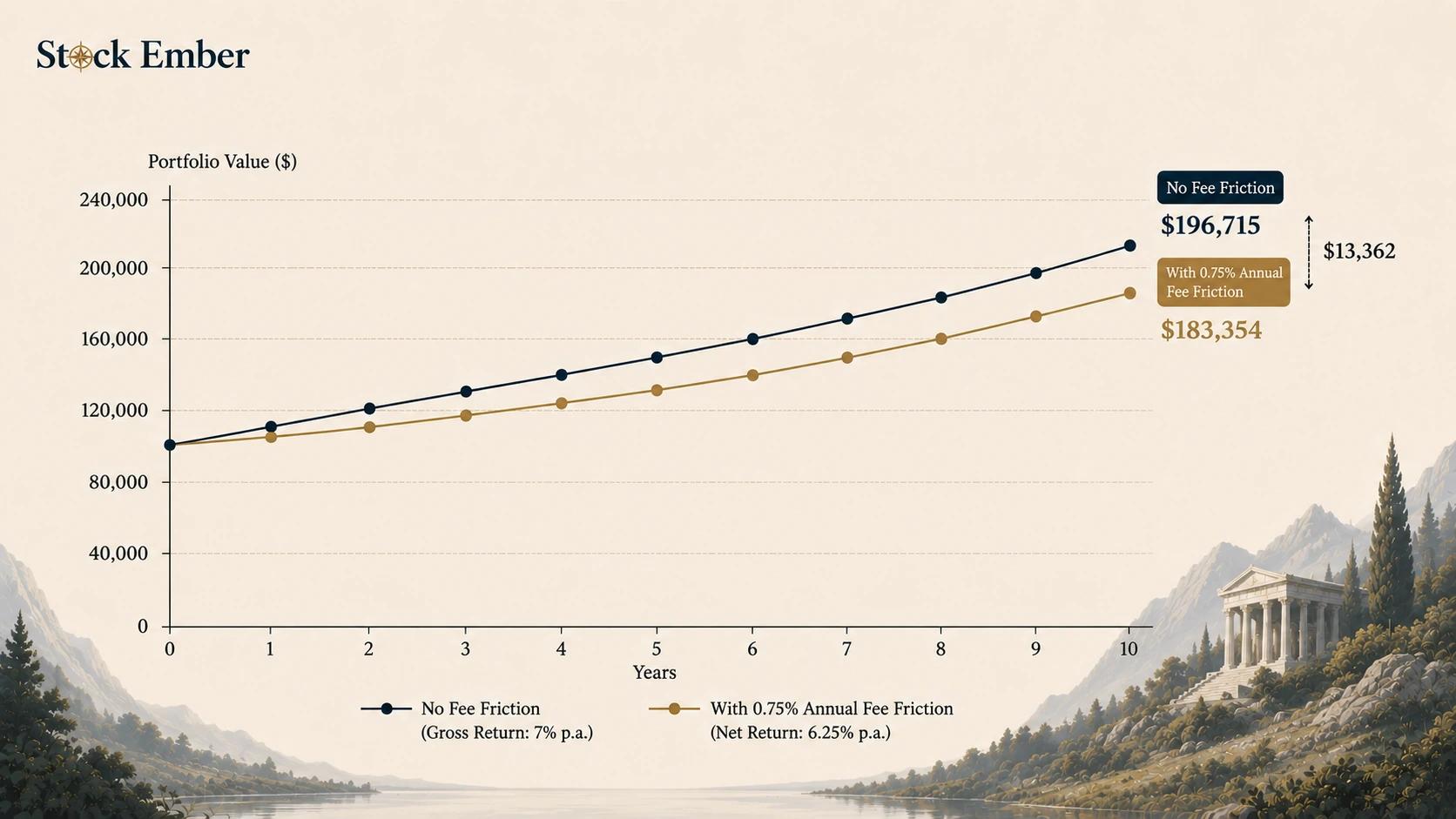
Note: Illustrative example only: $100,000 initial investment, 7% gross annual return compounded yearly over 10 years, versus a 6.25% net return after a 0.75% annual fee. Not a projection of actual results.
To protect your capital from unnecessary erosion, you must audit the primary layers of operational cost. A comprehensive understanding of the cost of investing (investment fees) requires looking past headline transaction commissions. You must explicitly watch for hidden costs such as currency conversion spreads on foreign assets, ongoing account maintenance penalties, and the internal expense ratios managed by the creators of mutual funds and ETFs. Minimizing this structural friction is one of the few variables an investor can completely control.
How the Topics Connect: The Long-Term Investor's Path
Building a resilient, multi-decade portfolio requires a structured, step-by-step approach to mastering market infrastructure.
Understand Vehicle Mechanics] ──> [Minimize Fee Friction] ──> [Select Account Framework
First, you master the core mechanics of the taxable investment vehicle, recognizing how custody and standard tax liabilities operate. Second, you review every fee you are being charged, so unnecessary costs do not quietly eat into your money. Finally, you align these fundamentals to select the specific execution framework that matches your risk profile and horizon.
Once you are comfortable utilizing a flexible, fully taxable account, you will be well-positioned to evaluate specialized tax-advantaged wrappers. These specialized shells can shelter income but often introduce rigid liquidity constraints and early withdrawal penalties.
Where to Start
If you are ready to establish your first investment position, your onboarding process should be deliberate and systematic:
- Verify Fee Transparency: Review the prospective institution's complete fee schedule, looking specifically for inactivity charges, transfer penalties, or hidden currency costs.
- Confirm Asset Alignment: Ensure the platform offers unhindered access to broad-market, low-cost ETFs and equities rather than steering you toward proprietary, high-commission products.
- Assess Regulatory Safety: Confirm the institution maintains verifiable registration with core national financial regulators and provides baseline securities insurance.
- Fund via Settled Capital: Start with a standard cash account that uses no borrowed money (no margin), and only invest funds you have set aside for long-term goals.
Conclusion
So, what is a brokerage account at its core? It is the foundational cornerstone of modern wealth accumulation—a highly scalable vehicle designed to connect your surplus capital directly to global economic growth. By treating this account as an operational utility, keeping strict control over hidden structural fees, and maintaining a disciplined buy-and-hold perspective, you can turn a simple market portal into a long-term compounding engine — while remembering that market values fluctuate and your capital remains at risk throughout the journey.
When you are ready to evaluate the specialized financial institutions that host these accounts, our comprehensive broker reviews & rankings provide the independent data needed to make an informed choice.