Compound interest works with stocks through compound returns rather than fixed interest payments. When companies reinvest their profits back into business expansion and investors reinvest cash dividends to buy more shares, their capital base compounds over time. This continuous reinvestment creates an exponential growth curve that builds long-term wealth across market cycles.
Many people open a brokerage account expecting their shares to pay a fixed yield just like a bank savings account. However, stocks do not actually pay contractual interest.
Instead, the stock market builds wealth through compound returns. When companies grow their businesses and distribute cash to shareholders, those gains can be reinvested to buy even more shares. This creates a powerful snowball effect over decades.
This guide breaks down exactly how equity compounding functions, why minimizing investment fees is critical to your long-term success, and how to avoid the behavioral traps that ruin returns.
Quick Takeaways
01Stocks do not pay guaranteed interest; they generate compound returns through rising share prices and cash payouts.
02Compounding in equities is driven by two engines: companies reinvesting their own profits, and investors reinvesting their dividends.
03High trading fees and fund costs act as permanent friction, potentially stripping tens of thousands of dollars from your portfolio over ten years.
04Market compounding is never a straight line; surviving multi-year drawdowns without selling is required to achieve long-term growth.
What Does Compounding Mean for Stocks?
When new investors ask what is how does compound interest work with stocks, they are usually trying to understand how their capital multiplies without them doing any extra work.
In a traditional savings account, a bank pays you a set percentage on your cash. The foundational math of compound interest means you earn interest on both your original deposit and the past interest you have already received.
How does compound interest work with stocks meaning ultimately comes down to the same snowball concept, but applied to variable business growth instead of fixed debt. When you buy a stock, you own a fractional piece of a real company. As that company earns money, your investment grows.
Getting how does compound interest work with stocks explained properly requires separating smooth bank math from jagged stock market reality. Equity returns fluctuate wildly from year to year. However, over long time horizons, the combination of rising business values and reinvested cash creates an exponential growth curve that mimics traditional compounding.
The Twin Engines: Retained Earnings and Dividend Reinvestment
Stock market compounding relies on two distinct engines working simultaneously: internal business growth and external share accumulation.
The first engine is internal compounding, which happens automatically inside the company. When a business generates a profit, it rarely gives all that cash back to shareholders. Instead, management retains a portion of those earnings (retained earnings) to build new factories, fund research, or acquire competitors. By reinvesting its own profits, the company becomes inherently more valuable over time, although share prices can also fall.
The second engine is external compounding, driven by dividends. A dividend is a direct cash payment a company makes to its shareholders out of its profits. If you take that cash and immediately use it to purchase more shares of the company, you have more shares paying you dividends the next time around.
Many brokerages offer a Dividend Reinvestment Plan (DRIP), which automates this process. Once you enroll, whenever a company operating under a specific stock tickerpays a dividend, the broker uses that cash to buy more shares of the same stock, often fractional shares, depending on your broker. Over the long run, this matters: from 1940 to 2025, dividend income averaged about one-third of the S&P 500’s total return, according to Hartford Funds, though its share varies widely from decade to decade.
The 10-Year Cost of Friction: Preserving Your Compounding Engine
Mathematical compounding formulas assume a perfect, frictionless environment. In reality, the financial industry charges fees that quietly erode your growth.
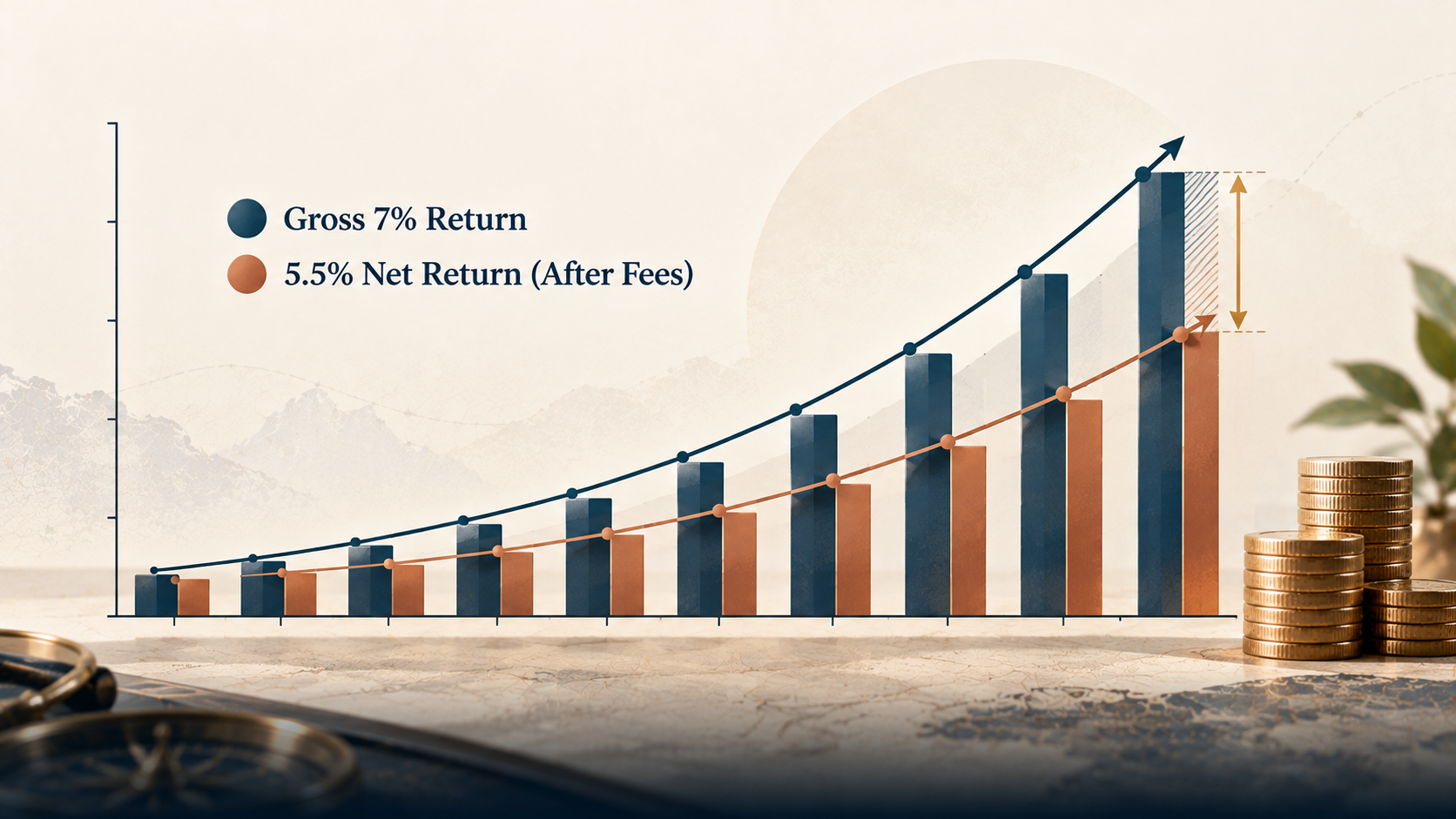
Over a ten-year holding period, these small percentage fees permanently damage your compound curve. Imagine you hold a $100,000 diversified portfolio that earns a hypothetical 7% average annual return before fees. Here is how ten years looks with and without 1.5% in annual fund fees and trading friction:
Scenario
Net annual return
Balance after 10 years
No fees
7%
$196,715
With 1.5% friction
5.5%
$170,814
Difference
−1.5 points
−$25,900 (about 13% less)
The 7% return is an assumption for illustration, not a forecast or a guarantee. The 1.5% is also illustrative; many low-cost index funds charge far less, so check your own fund’s expense ratio in its prospectus.
Chart illustrating how investment fees and trading friction reduce compound returns in the stock market over ten years
Volatility, Drawdowns, and the Market Timing Trap
The hardest part of stock compounding is not the math; it is the psychology. Bank interest moves in a straight line, but equity markets experience deep, sometimes severe drawdowns (declines from a peak).
Many investors attempt to time the market by selling their stocks before a crash and buying back in before a recovery. In practice, this disrupts the compounding process. The stock market's strongest single days historically occur during periods of extreme volatility, often directly after massive drops.
In J.P. Morgan data shows that missing just the 10 best trading days over the 20 years ending December 2025 cut the annualized return from about 11.0% to about 6.6%. This is a hypothetical example, and no one can know the best days in advance. By staying fully invested through bear markets, you allow your reinvested dividends to purchase shares at lower prices, so you can participate in the recovery when it comes, though past performance does not guarantee future results.
Common Stock Compounding Mistakes to Avoid
To let compounding work, you must avoid the unforced errors that derail long-term plans.
First, avoid the single-stock trap. It is tempting to calculate compound returns on one highly successful tech company. However, individual companies face bankruptcy, disruption, and total failure. If a stock goes to zero, your compounding stops permanently. Broad index funds offer a safer compounding vehicle because they spread risk across hundreds of businesses.
Second, avoid spending your dividends during your working years. Taking dividend cash to pay for lifestyle expenses during your wealth-accumulation phase breaks the external compounding engine. Those dollars are no longer buying new shares, which severely limits your future dividend income.
Finally, do not underestimate sequence risk (the danger of experiencing a major market crash right when you need to withdraw cash). To protect your stock compounding, you must maintain a separate cash emergency fund. If you are forced to sell stocks at the bottom of a bear market just to pay rent, you permanently lock in your losses.
Conclusion
Stock compounding relies on the powerful combination of businesses reinvesting their profits and shareholders reinvesting their dividends. While equity markets do not offer guaranteed, straight-line interest rates, adopting a long-term time horizon allows variable market growth to snowball into significant wealth.
By keeping your investment fees low and ignoring the temptation to trade during market panics, you protect your capital’s ability to multiply. Once you understand how compound interest works with stocks, the next step is simply staying invested long enough to let the snowball build.
When you are ready to find a low-cost platform to manage your portfolio, our Broker reviews are the best place to begin. All investing involves the risk of capital loss, and past performance does not guarantee future results, so use this guide as an educational tool rather than personal financial advice.
FAQ
5 questions
Do stocks pay compound interest or compound returns?
Stocks generate compound returns rather than legal compound interest. Contractual interest applies to debt instruments like bonds or bank deposits where an institution guarantees a fixed payment percentage. Equities compound through capital growth and reinvested dividends. Because stock prices fluctuate with market conditions and company earnings, the compounding process produces variable, non-linear returns rather than a guaranteed annual rate.
How do you get compound interest on stocks that don't pay dividends?
Non-dividend stocks compound internally when company management retains net profits instead of paying cash distributions to shareholders. The business reinvests this retained capital into research, operational expansion, acquisitions, or share repurchases. Over long horizons, successful reinvestment expands the company's intrinsic earnings power, driving up the stock price and compounding your investment without requiring cash dividend payouts.
How long does it take to see the effects of compounding in stocks?
The effects of compounding in stocks typically become noticeable after seven to ten years of uninterrupted investment. In the initial years, annual growth appears modest because the principal base is relatively small. As decades pass and accumulated earnings begin generating their own subsequent returns, the exponential curve steepens dramatically, producing the largest dollar gains in later years.
What is the difference between simple growth and compound growth in the stock market?
Simple growth occurs when an investor withdraws cash dividends and leaves only the original capital base in the market, resulting in linear gains. Compound growth occurs when all cash dividends and earnings remain invested to purchase additional shares. Over time, reinvesting distributions creates an expanding asset base that generates increasingly larger payouts, causing total wealth to accelerate exponentially.
Does compound interest work if you buy individual stocks instead of index funds?
Compounding functions in individual stocks only as long as the underlying company continues to grow its earnings. However, individual companies carry idiosyncratic business risks, disruption threats, and potential bankruptcy. If an individual company fails, the compounding process stops permanently. Broad index funds provide a more dependable compounding framework by diversifying across hundreds of profitable businesses simultaneously.
Disclaimer
This guide was written with AI assistance and reviewed by the StockEmber editorial team for accuracy. StockEmber provides independent education, not personal financial advice. Investing puts your capital at risk: the value of investments can go down as well as up, you may get back less than you invest, and past performance doesn’t guarantee future results. Some links may support our work at no additional cost to you.
The StockEmber Team is our in-house desk of independent research writers. We test brokerage platforms, read the fine print on fees and custody, and cover ETFs and long-horizon investing for people who plan to hold for decades — not days.