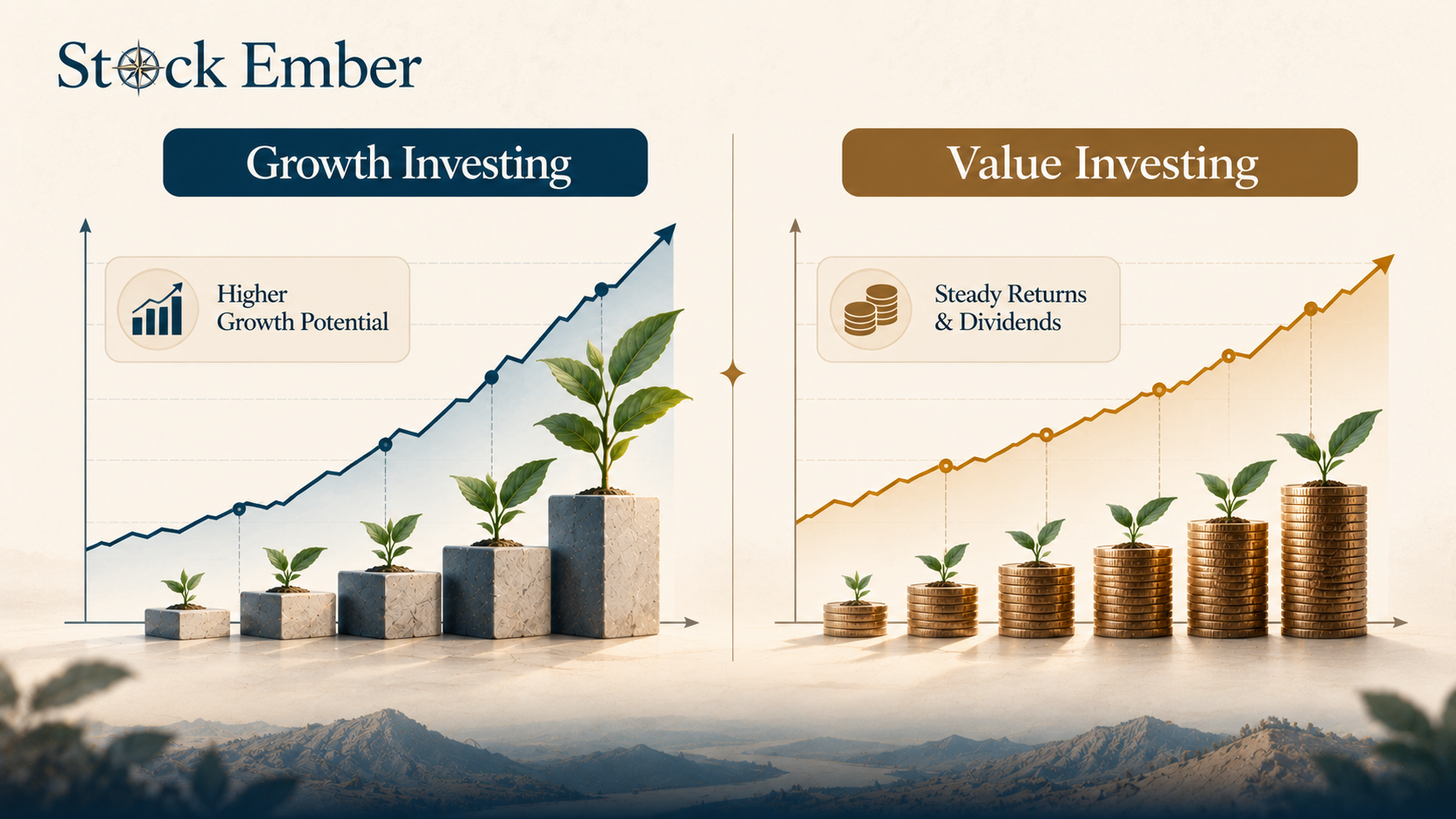
Growth investing is an equity strategy focused on buying shares in companies expanding revenues and earnings faster than the wider market average. Rather than generating cash flow through dividends, these companies reinvest profits into operations to achieve long-term capital appreciation. Investors who choose this strategy target capital growth, while accepting higher price volatility and valuation risk.
Growth investing is an investment strategy focused on building capital by purchasing shares in companies expected to grow their revenues and earnings at an above-average rate compared to the broader market. Instead of prioritizing immediate income through cash dividends, growth investors seek long-term capital appreciation driven by business expansion.
Watching an innovative business scale rapidly is compelling, but buying fast-expanding companies requires knowing what you pay for that momentum. Paying too high a valuation can lead to flat returns for years, even when the underlying enterprise succeeds operationally.
This guide explains how growth investing works, how corporate capital reinvestment fuels compounding, and how patient investors manage valuation risks.
Quick Takeaways
01Growth companies retain their earnings to reinvest in expansion rather than distributing cash dividends to shareholders.
02Elevated valuation multiples mean that even minor quarterly earnings misses can trigger steep price drops.
03Overpaying exposes investors to the 10-year valuation trap, where multiple contraction can erase business gains.
04Broad-market index funds offer exposure to growing companies while spreading out the risk of any single company's business failure, though they still carry market risk.
What Is Growth Investing? (The Core Meaning)
At its foundation, growth investing comes down to buying ownership stakes in companies expanding their sales and profits faster than the general economy. The growth investing meaning centers on identifying businesses operating in expanding industries or gaining market share through superior technology, proprietary products, or scalable business models.
Rather than distributing profits to shareholders as dividends, growth-oriented companies keep their capital to fund business development, a choice investors can trace in a company's financial statements.
Key characteristics of growth companies include:
Above-Average Revenue Expansion: Sales consistently outpace the annual growth rate of the wider economy and industry peers.
Large Addressable Markets: The business operates in an expanding sector with plenty of room for customer acquisition.
Competitive Advantages: High switching costs, brand strength, or network effects protect operating margins from competitors.
Elevated Valuation Multiples: Investors pay higher price-to-earnings (P/E) and price-to-sales (P/S) multiples based on expected future earnings rather than current profits.
How Growth Investing Works: Capital Reinvestment and Compounding
The economic engine behind growth investing explained plainly is the compounding effect of retained earnings reinvestment. When a business earns net profits, management faces a choice: return that cash to shareholders as dividends, or reinvest it into operations.
Growth businesses choose reinvestment. They direct capital into research and development (R&D), production facilities, technological infrastructure, and talent acquisition. When a company earns a high return on invested capital (ROIC), keeping that money inside the business compounds shareholder value faster than paying cash out.
Understanding corporate capital allocation is a core part of learning investing in stocks. When a management team deploys retained earnings at a 15% to 20% return, each retained dollar builds additional future earning power. However, this model depends entirely on the company finding profitable expansion projects year after year without experiencing diminishing returns.
Growth Investing vs. Value Investing: The 10-Year Trade-Off
Growth and value investing represent two distinct paths to purchasing equities, differing mainly in how much an investor pays today for future earnings. While growth investors pay premium multiples for anticipated expansion, value investors seek shares trading below their current worth, frequently calculating target prices using an intrinsic value formula.
Comparison diagram showing growth stock valuation versus value stock dividend stability
Feature / Metric
Growth Investing
Value Investing
Primary Goal
Long-term capital appreciation
Purchasing assets below intrinsic worth
Valuation Multiples
High P/E and P/S ratios
Low to moderate P/E and price-to-book (P/B) ratios
Dividend Policy
Minimal or zero cash payouts
Regular, established dividend payouts
Core Financial Focus
Revenue and profit growth rates
Free cash flow yield (cash generated relative to share price) and balance sheet stability
Primary Risk
Multiple compression and missed earnings
Value traps (cheap stocks that stay cheap for good reason) and structural business decline
The primary danger for growth investors is the 10-year valuation trap. When an investor buys a company trading at 50 times its annual earnings, the current share price already assumes years of uninterrupted operational success.
If that company successfully doubles its revenue and earnings over the next decade, the business has performed well. However, if shifting market conditions compress its valuation multiple from 50 times earnings down to 20 times earnings, the share price could fall by roughly 20% over that 10-year window, even though earnings doubled. Overpaying for growth can weaken the link between business progress and investment returns.
The Key Risks: Why Paying for Growth Demands Caution
Because growth equities derive much of their value from cash flows projected years into the future, their share prices carry specific vulnerabilities:
Multiple Compression: Even when an enterprise hits revenue targets, changes in market sentiment can shrink valuation multiples. During market downturns, high-multiple stocks have often experienced steeper price drops than asset-heavy, dividend-paying companies.
Sensitivity to Rising Interest Rates: Valuation models discount projected future profits back to the present day using current interest rates. When benchmark rates climb, profits expected 10 or 15 years from now become worth less in present terms, placing direct downward pressure on growth stock valuations.
Severe Drawdowns on Missed Guidance: Because expectations are priced high, a small quarterly revenue miss or a conservative management forecast can trigger sudden double-digit price declines in a single day.
In practice, many long-term investors find that the hardest part of this strategy is enduring steep price drawdowns during broader market pullbacks without panic selling. For illustration, a $10,000 position that falls 40% would be worth $6,000, and it would then need to gain about 67% just to get back to even. When market sentiment turns sour, even operationally sound businesses can see their share prices drop sharply.
How Long-Term Investors Access Growth Without Stock-Picking
Predicting which individual early-stage company will dominate its industry over the next two decades is difficult. Many promising businesses face competitive disruption, leadership missteps, or shifting consumer habits before reaching sustainable profitability.
To manage single-company business risk, many long-term investors rely on diversified index products rather than active stock-picking:
Broad-Market Index Funds: Holding a low-cost fund tracking a broad market index automatically includes leading growth companies alongside mature cash generators. As emerging businesses expand their market capitalization, the index naturally increases its exposure to them without requiring manual trading.
Targeted Growth ETFs: Investors seeking deliberate exposure to higher-growth sectors can use exchange-traded funds (ETFs) holding baskets of growth-oriented stocks. This approach captures sector expansion while spreading the impact of any single company's failure across many holdings, although growth ETFs still carry the valuation and interest-rate risks described above.
Using low-cost funds can reduce the emotional pressure of following daily corporate headlines and may help investors avoid buying popular individual stocks near their valuation peaks.
Conclusion
Growth investing provides a structured path toward capital accumulation by aligning an investor's portfolio with business reinvestment and economic expansion. By owning companies that deploy their earnings into research, technology, and market development, investors participate directly in corporate compounding.
Achieving sustainable results, however, requires balancing growth goals with valuation discipline. Rapid sales growth does not eliminate the risk of multiple contraction if an investor pays an excessive price relative to underlying earnings. When you are ready to evaluate platforms for your portfolio, exploring our broker reviews helps you compare account fees, platform reliability, and global market access.
Past business growth does not guarantee future investment returns. All equity investing involves the risk of capital loss, and maintaining a diversified portfolio matched to your financial timeline remains central to protecting your wealth over time.
FAQ
5 questions
What is an example of a growth investing approach?
This approach involves buying shares in an enterprise that reinvests its cash flow into research, new infrastructure, and market expansion rather than distributing income. For instance, an investor might purchase shares in an enterprise expanding cloud software services across global markets. The goal is to benefit from substantial share price appreciation as corporate earnings compound over several years, rather than receiving quarterly dividend checks.
Do growth companies ever pay dividends to shareholders?
Most growth companies pay minimal or no cash dividends because they generate higher long-term value by reinvesting profits back into operations. Retaining cash allows expanding firms to fund capital expenditures, product development, and geographic scaling. While some mature growth companies eventually initiate small dividend distributions once market saturation slows their expansion, capital appreciation remains the primary investment objective for growth portfolios.
Is growth investing better than value investing?
Neither strategy is universally superior; each performs differently across various economic cycles. Growth investing often outperforms during periods of low interest rates and steady economic expansion, while value investing typically provides better downside protection and steady cash flow during market slowdowns. Many long-term investors hold a diversified mix of both styles to balance capital appreciation with portfolio stability across multiple decades.
What time horizon is recommended for a growth investing strategy?
This strategy typically requires an investment horizon of at least five to ten years. Because growth stocks trade at elevated valuation multiples, their market prices experience sharp short-term volatility during earnings misses or macro shifts. A long-term holding period allows underlying business compounding to overcome valuation multiple compression and smooths out interim market corrections.
Can you practice growth investing through low-cost index funds?
Yes. Investors can access growth companies without picking individual stocks by purchasing broad-market index funds or dedicated growth exchange-traded funds (ETFs). Broad index funds automatically allocate higher weightings to rapidly growing firms as their market capitalization increases, while growth-specific index funds focus directly on companies demonstrating above-average revenue and earnings metrics at a low annual expense ratio.
Disclaimer
This guide was written with AI assistance and reviewed by the StockEmber editorial team for accuracy. StockEmber provides independent education, not personal financial advice. Investing puts your capital at risk: the value of investments can go down as well as up, you may get back less than you invest, and past performance doesn’t guarantee future results. Some links may support our work at no additional cost to you.
The StockEmber Team is our in-house desk of independent research writers. We test brokerage platforms, read the fine print on fees and custody, and cover ETFs and long-horizon investing for people who plan to hold for decades — not days.