The intrinsic value formula calculates the theoretical true worth of a company based on its financial fundamentals, such as projected free cash flows and earnings. Comparing this calculated value to a stock's market price helps investors determine if shares are trading at a discount or a premium.
Intrinsic value is the calculated true worth of a company based on its underlying financial fundamentals, independent of its current stock market price.
When stock market prices swing based on market sentiment, finding a company's actual business value helps you make rational decisions. Buying shares below their true value provides a margin of protection against unexpected market drops.
This guide explains how the intrinsic value formula works, breaks down common valuation models in plain language, and shows how to use valuation to build a resilient long-term stock portfolio.
Quick Takeaways
01The intrinsic value formula calculates what a business is fundamentally worth based on its earnings, cash flows, and balance sheet strength.
02Valuation models use plain financial inputs, including future cash flow projections and a chosen discount rate.
03Calculating intrinsic value helps long-term investors establish a margin of safety before buying shares.
04Small changes in growth assumptions can drastically alter calculated intrinsic value, making qualitative analysis equally important.
What Is the Intrinsic Value Formula?
An intrinsic value formula is an analytical method used to estimate the fundamental cash-generating worth of a company. Unlike market capitalization, the total dollar value of a company's outstanding shares, intrinsic value measures what the business is actually worth based on its underlying financial health.
To understand what is intrinsic value formula in simple terms, you must separate market opinion from fundamental financial reality. Market prices move daily based on short-term sentiment, economic news, and investor emotion. Intrinsic value focuses on business fundamentals, including free cash flow, tangible assets, debt levels, and competitive strength.
The intrinsic value formula meaning rests on the principle that a stock represents partial ownership of an operating business. When evaluating any business, its value comes from the net cash it generates for its owners over time. When the intrinsic value formula is explained in plain language, it serves as a reality check that prevents investors from paying inflated prices during market hype.
How the Intrinsic Value Formula Works: Plain-Text Methods
Calculating intrinsic value involves projecting future cash flows or earnings and converting them into present-day dollar terms. Investors typically use two common valuation models:
Discounted Cash Flow (DCF) Model: This model estimates all the free cash flow (the cash left over after funding operations and capital expenses) that a company will generate in the future, then discounts those future dollars back to today's value using a discount rate (the expected annual return rate used to adjust future cash flows to present value).
Intrinsic Value per Share = Expected Future Cash Flows / (1 + Discount Rate)
Benjamin Graham Formula: Developed by the pioneer of value investing, this classic formula offers a quick shorthand estimate for growing companies:
Intrinsic Value per Share = Earnings per Share × (8.5 + 2 × Annual Growth Rate)
Here, 8.5 is the price-to-earnings ratio Graham assigned to a company with zero growth, and the growth rate is the expected annual rate over the next 7 to 10 years, entered as a whole number (use 5 for 5%, not 0.05).
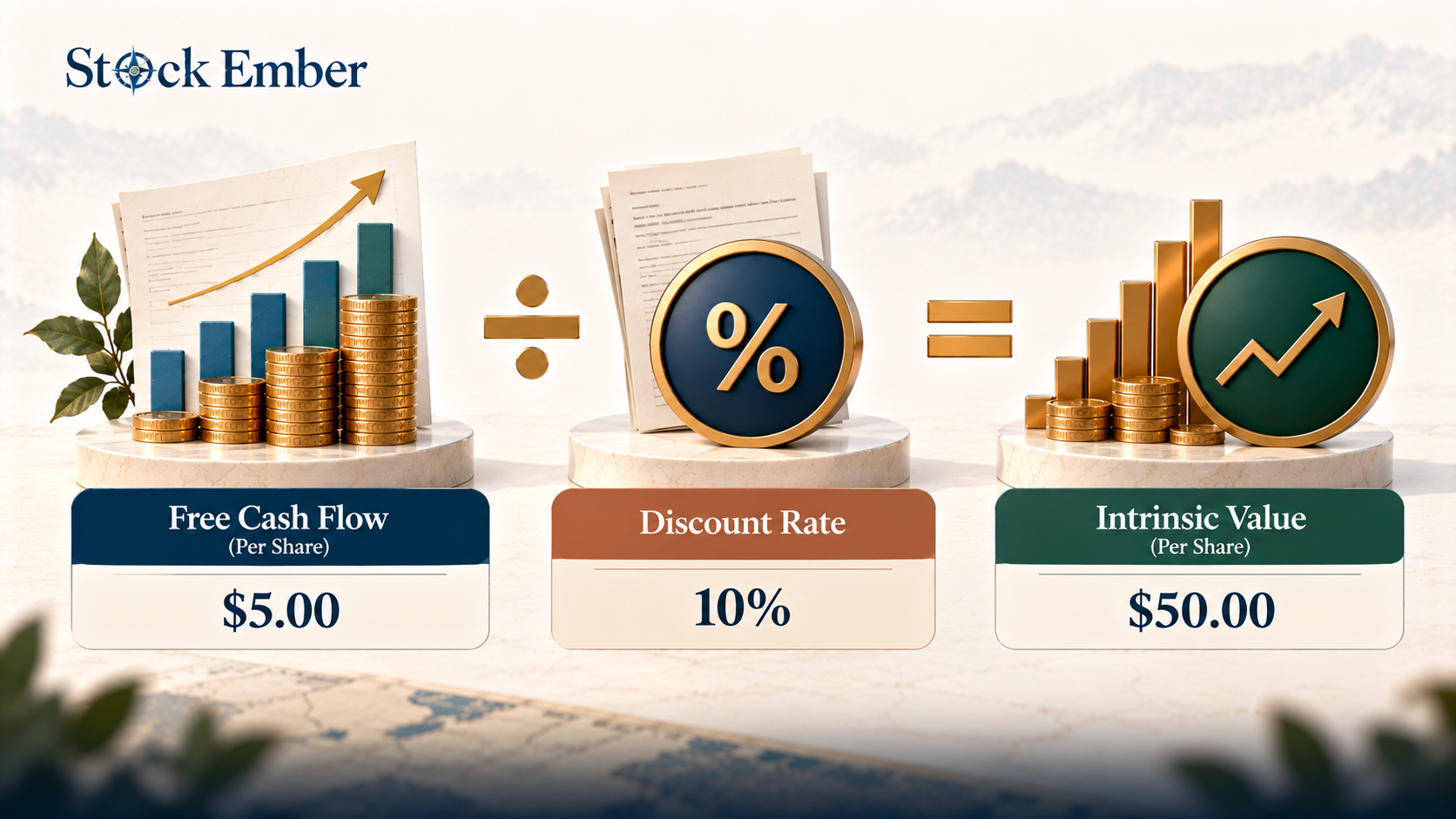
Consider a practical example. Suppose a company generates $5.00 in free cash flow per share. If you expect that cash flow to continue indefinitely with no growth and require a 10% discount rate, the DCF model collapses into a simple perpetuity formula, Cash Flow / Discount Rate:
$5.00 / 0.10 = $50.00 per share
Diagram demonstrating a simplified intrinsic value calculation using cash flow and discount rates.
Inputs like growth rates and discount rates are educated estimates rather than fixed facts. Changing your growth expectation by even a few percentage points can shift the final calculated value significantly.
In practice, many long-term investors find that using conservative growth estimates, such as matching historical GDP growth rather than aggressive expansion projections, prevents overvaluing cyclical companies.
Why Intrinsic Value Matters for Long-Term Stock Investors
Calculating an intrinsic value baseline helps you buy stocks at a discount, creating a margin of safety, a price gap between market trading price and estimated value that buffers against analytical mistakes. If a company's calculated value is $50 per share and it trades at $35, purchasing shares gives you a 30% buffer against unexpected economic downturns, making valuation analysis an essential foundation when investing in stocks.
Over multi-year holding periods, business valuation interacts directly with how compound interest with stocksbuilds wealth over time. When a company steadily expands its earnings and reinvests cash efficiently, its intrinsic value grows over time. Investors who buy discounted shares of growing companies benefit from both valuation expansion and underlying compounding gains.
Common Pitfalls and Limitations of Valuation Formulas
While valuation models provide useful benchmarks, relying entirely on mathematical formulas creates practical risks:
Garbage-In, Garbage-Out Risk: A formula is only as reliable as its inputs. Overestimating sales growth or selecting an overly optimistic discount rate produces an unrealistically high intrinsic value, leading you to overpay for shares.
Ignoring Qualitative Factors: Formulas cannot evaluate management integrity, brand strength, or competitive advantage. A company with stellar historical numbers can quickly lose market share if a new competitor disrupts its industry.
The Value Trap Fallacy: A stock trading below its calculated intrinsic value is not automatically a bargain. If a company's industry is permanently shrinking or its debt burden is unsustainable, its true value may fall faster than its stock price.
Feature
True Intrinsic Value Opportunity
Value Trap
Earnings Outlook
Stable or growing cash flows
Declining revenue and shrinking margins
Balance Sheet
Manageable debt and cash reserves
Rising debt and liquid capital drain
Market Condition
Temporary price drop due to market pessimism
Permanent structural industry decline
Conclusion
The intrinsic value formula offers a systematic method for estimating what a business is worth based on financial fundamentals. By comparing estimated value against market prices, long-term investors can identify opportunities, avoid overvalued hype, and establish a margin of safety.
Keep in mind that calculating intrinsic value relies on assumptions about the future that can prove inaccurate. Market prices can remain below estimated value for long periods, and no valuation formula removes the risk of market loss. Combining quantitative financial models with qualitative business research helps you build a balanced perspective over long holding periods.
When you are ready to choose a platform for building your long-term stock portfolio, our broker reviews offer a clear place to start.
FAQ
5 questions
What is the basic formula for intrinsic value?
The most common intrinsic value formula is the Discounted Cash Flow (DCF) model: Intrinsic Value per Share = Expected Future Cash Flows / (1 + Discount Rate). Another shorthand model is Benjamin Graham's formula: Intrinsic Value = EPS * (8.5 + 2 * Growth Rate). Both methods estimate fundamental worth based on business earning power.
What is the difference between market price and intrinsic value?
Market price is the current dollar amount at which a stock trades on an exchange, driven by daily supply, demand, and market sentiment. Intrinsic value is an estimated calculation of what the business is actually worth based on its balance sheet, cash flows, and long-term earnings potential.
Can intrinsic value be negative?
Yes, mathematically a company can have a negative intrinsic value if its liabilities heavily exceed its assets and it consistently generates negative cash flows with no path to profitability. In practice, investors usually treat such businesses as having zero intrinsic value because equity cannot be valued below zero due to limited liability.
Why does intrinsic value change over time?
Intrinsic value changes as a company's underlying financial performance shifts. If a business increases its profit margins, expands its free cash flow, or reduces debt, its calculated intrinsic value rises. Conversely, rising interest rates, declining revenue, or shrinking market share lower a stock's underlying value.
How does a margin of safety relate to intrinsic value?
A margin of safety is the discount between a stock's current market price and its calculated intrinsic value. Purchasing shares well below their estimated value provides a financial buffer that protects long-term investors against analytical errors, unexpected economic downturns, or temporary operational setbacks.
Disclaimer
This guide was written with AI assistance and reviewed by the StockEmber editorial team for accuracy. StockEmber provides independent education, not personal financial advice. Investing puts your capital at risk: the value of investments can go down as well as up, you may get back less than you invest, and past performance doesn’t guarantee future results. Some links may support our work at no additional cost to you.
The StockEmber Team is our in-house desk of independent research writers. We test brokerage platforms, read the fine print on fees and custody, and cover ETFs and long-horizon investing for people who plan to hold for decades — not days.