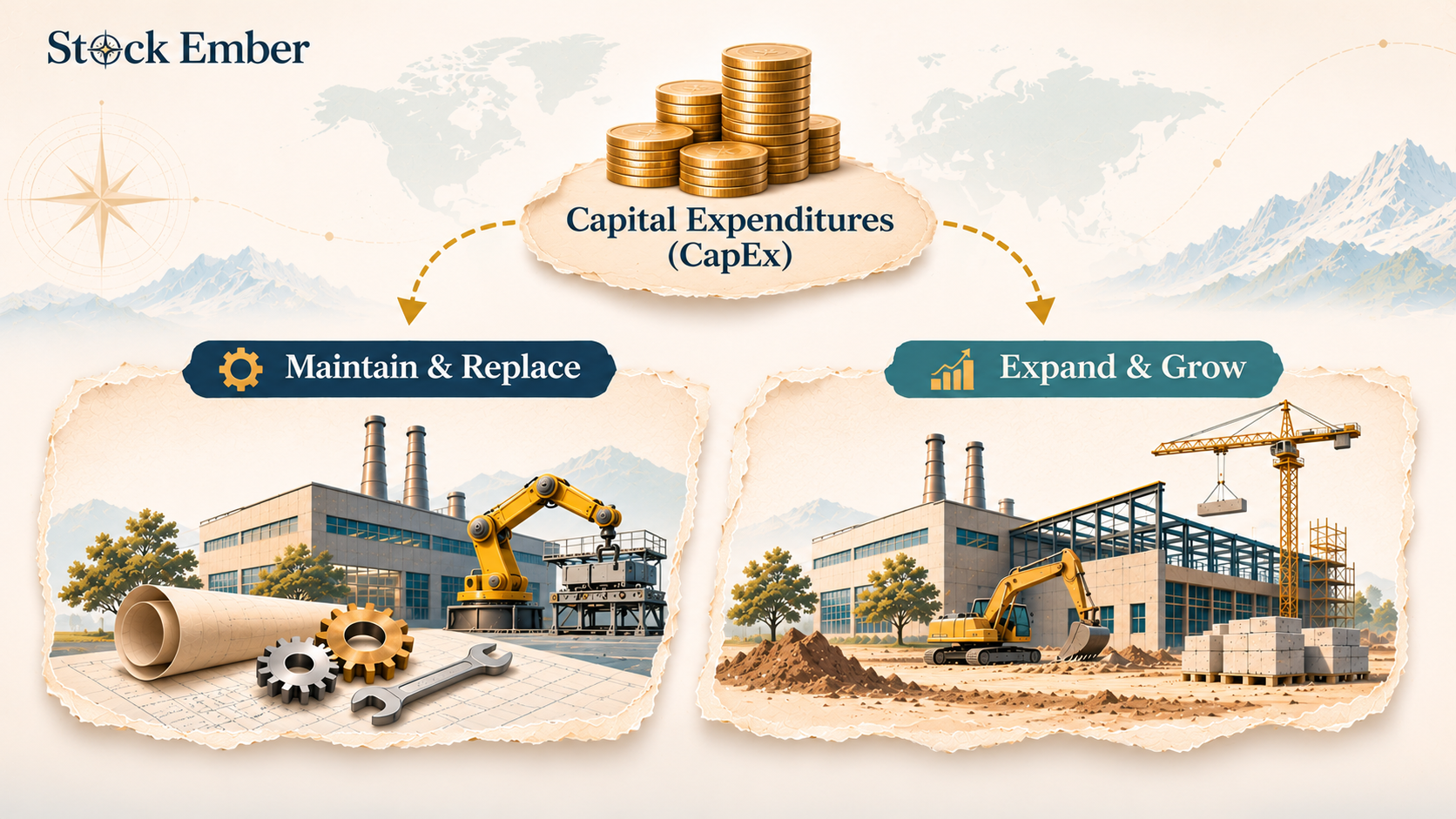
Capital expenditures, commonly called CapEx, are the money a company invests to buy, improve, or maintain long-term physical assets such as buildings, vehicles, and machinery. Instead of being expensed immediately like daily operating costs, CapEx is capitalized on the balance sheet and deducted gradually over time through depreciation. These capital outlays reveal how aggressively a company is reinvesting to sustain and expand its future earning power.
Capital expenditures are the funds a business spends to purchase, upgrade, or maintain long-term physical assets like buildings, machinery, and equipment. Often shortened to CapEx, these cash outlays help a company build and protect its core productive capacity.
When a company produces cash, leadership faces an ongoing choice: distribute that money to shareholders or plow it back into operations. Deciding how much capital to reinvest can make or break an enterprise over a decade. This guide covers how these investments work, where to find them in financial reports, and how they shape long-term investment performance.
Quick Takeaways
01Capital expenditures (CapEx) purchase long-term physical assets that provide operating value across multiple years.
02Unlike daily operating costs that reduce profit immediately, CapEx sits on the balance sheet and gets expensed over time through depreciation.
03Maintenance CapEx sustains current operations, while growth CapEx expands capacity to boost production.
04CapEx lowers near-term free cash flow today in the pursuit of generating higher cash returns over the next decade.
What Are Capital Expenditures? (CapEx vs. OpEx)
Capital expenditures are cash outlays that purchase or upgrade physical assets built to last beyond a single calendar year. In corporate finance, asking what are capital expenditures means examining long-lived resources, such as a delivery fleet, an automated warehouse, or new data servers. At its core, the capital expenditures meaning comes down to buying multi-year productive capacity rather than paying for immediate upkeep.
This multi-year benefit separates CapEx from operating expenses (OpEx). Operating expenses cover the daily running costs of doing business, including staff wages, office rent, utilities, and marketing. When a company pays its power bill or monthly payroll, that benefit is consumed immediately. Accountants expense it directly on the income statement, reducing current profit dollar for dollar.
Capital expenditures function differently. If a delivery firm buys new vans, those vehicles will transport packages for 5–10 years. Writing off that entire check against a single month’s earnings would distort underlying business performance. Instead, the company capitalizes the purchase: cash leaves the bank account, and an equivalent physical asset appears on the balance sheet.
Feature
Capital Expenditures (CapEx)
Operating Expenses (OpEx)
Time Horizon
Multi-year benefit
Consumed in current period
Financial Statement
Balance sheet asset
Income statement expense
Deduction Timing
Gradual via depreciation
Subtracted in full immediately
Common Examples
Machinery, factories, vehicles
Wages, rent, utilities
How Capital Expenditures Work on Financial Statements
To see capital expenditures explained in corporate reports, investors follow the cash across 2 distinct statements. CapEx does not sit on the income statement. Instead, you will find it on the cash flow statement under Cash Flows from Investing Activities. According to the U.S. SEC’s beginner’s guide to financial statements, cash spent to acquire long-term assets is separated from ordinary operating cash flows to show how much money feeds physical plants.
When a business spends cash on physical property, plant, and equipment (PP&E), that outlay enters the balance sheet as an asset. Then, over each year of the asset’s useful life, a portion of its original cost is expensed on the income statement through depreciation (spreading the purchase cost of a physical asset across the years it remains in use).
If a company does not list CapEx on its cash flow statement, you can calculate it using the balance sheet and income statement:
CapEx = Ending Net PP&E − Beginning Net PP&E + Depreciation
Net PP&E represents recorded asset value after subtracting accumulated depreciation. Adding back current depreciation reveals how much fresh cash management spent on physical equipment during the year.
Comparison showing maintenance capital expenditures sustaining operations versus growth capital expenditures expanding capacity
Maintenance CapEx vs. Growth CapEx: The Critical Distinction
Maintenance CapEx keeps a business running at its current pace, while growth CapEx expands capacity to generate new revenue. Corporate filings combine both numbers into one CapEx line, but separating them is key to judging true earnings power.
Maintenance CapEx is the mandatory cost of staying in business. Machines wear down and physical facilities decay.
If an airline skips engine overhauls, it cannot fly safely. Spending money to replace an engine does not add a new flight route; it simply preserves existing passenger capacity. Without steady maintenance CapEx, an enterprise slowly decays.
Growth CapEx represents optional investment in future expansion. When that airline buys 10 additional aircraft to open new routes, that cash funds future revenue. Management invests this capital expecting future cash returns to beat the upfront purchase price.
In practice, many long-term investors find that tracking capital intensity over rolling 5-year windows reveals far more about management discipline than reading single-quarter press releases.
This distinction reveals whether a company produces real surplus cash or merely treads water. A firm that consumes almost all its operating cash on maintenance has little discretionary money left for owners.
Why CapEx Matters for Long-Term Investors (and Free Cash Flow)
Capital spending matters because every dollar spent on equipment is a dollar unavailable for dividends, debt reduction, or share buybacks today. When studying investing in stocks, one of the first metrics you meet is free cash flow (FCF). Free cash flow measures the actual cash a company produces after funding operations and capital investments:
Free Cash Flow = Cash Flow from Operations − Capital Expenditures
A company can report positive accounting net income while producing negative free cash flow if it pours cash into costly equipment. For long-term investors, cash pays dividends and funds growth. If management reinvests cash wisely, the company builds an economic advantage competitors struggle to match. If management misallocates capital, that wealth is lost.
Measuring the Payoff: Capital Intensity and 10-Year Returns
Not all businesses require the same capital reinvestment to thrive. A capital-intensive company, such as a semiconductor maker or electric utility, must spend heavy sums every year on cleanrooms and equipment. In contrast, an asset-light company, such as an enterprise software firm, can scale revenue with minimal spending on physical assets.
Over a decade, these demands shape shareholder returns. Consider a hypothetical 10-year comparison between 2 companies that each generate $10 million in annual operating cash flow:
The Capital-Intensive Firm: Reinvests 70% of its cash flow ($7 million yearly) into equipment. Over 10 years, it spends $70 million on CapEx, leaving $30 million in cumulative free cash flow.
The Capital-Light Firm: Requires only 15% of its cash flow ($1.5 million yearly) for computer hardware. Over 10 years, it spends $15 million on CapEx, leaving $85 million in cumulative free cash flow.
Reinvestment only benefits shareholders when the return beats the company’s cost of financing. This is where tracking return on capital employed becomes essential. If a company earns a 15% return on every fresh dollar it pours into factories, heavy CapEx builds shareholder value. If it earns only 4% while borrowing at 6%, growth CapEx erodes wealth over time.
Common CapEx Pitfalls and What to Watch
Even profitable companies can destroy shareholder capital through poor capital allocation. Watch for these 3 pitfalls:
The Empire-Building Trap: Corporate managers sometimes expand for prestige rather than shareholder return. Building flashy headquarters or funding vanity factory expansions burns cash on low-return projects that depress earnings for years.
Deferred Maintenance: A struggling company can temporarily inflate reported free cash flow by skipping maintenance. Delaying repairs can make cash flow look strong for a year or two, but it may set up severe equipment breakdowns and expensive emergency fixes later.
The Industry Overcapacity Cycle: In cyclical sectors like shipping or chemicals, rising prices often prompt rivals to launch massive CapEx projects simultaneously. Years later, when new plants open together, the market can suffer from oversupply, which may push down prices and industry profits.
Conclusion
CapEx reflects the trade-off at the heart of physical business: investing cash today to generate productive earnings tomorrow. For buy-and-hold investors, high CapEx is neither a red flag nor a promise of success. What matters is whether management allocates cash into projects that earn returns above their financing cost, or burns money defending an inefficient business.
If you invest through broad market index funds, you already own a balanced cross-section of capital-intensive and capital-light industries without needing to evaluate individual corporate cash flow statements.
When you want to compare platforms for holding your portfolio, our broker reviews offer a clean place to start. Every investment involves financial risk and past company performance never guarantees future returns, so use this guide to sharpen your financial literacy rather than as personal investment advice.
FAQ
5 questions
Is capital expenditure considered an asset or an expense?
When cash is initially spent, a capital expenditure creates a physical asset on the balance sheet under property, plant, and equipment rather than an immediate expense. Over time, as that asset wears down through regular business use, its cost is gradually expensed on the income statement as annual depreciation across its estimated operational life.
Does CapEx directly reduce net income on the income statement?
No, CapEx does not directly reduce net income when the cash is spent. Instead, the full cash outflow is recorded on the cash flow statement under investing activities. The income statement is only affected in later periods through depreciation, which spreads the cost of the asset across multiple operating years to reflect routine wear and tear.
Where can investors find capital expenditures in a company’s financial report?
CapEx is listed on the cash flow statement in the section titled Cash Flows from Investing Activities, frequently labeled as additions to property, plant, and equipment or capital additions. You can also calculate CapEx by comparing the year-over-year change in net physical assets on the balance sheet and adding back annual depreciation.
Is high capital expenditure good or bad for stock investors?
A high level of CapEx is neither automatically good nor bad on its own. It creates shareholder value when reinvested capital earns a rate of return higher than the company’s cost of capital. However, if management pours cash into low-return vanity projects or oversupplied markets, high CapEx destroys value by wasting cash that could have been paid as dividends.
What happens if a company repeatedly underfunds its maintenance CapEx?
If a company underinvests in maintenance CapEx, its reported cash flow and net income may look temporarily boosted because cash outflows are delayed. Over several years, however, machinery may break down, operating costs can rise, and the business may lose competitive ground to rivals. Neglecting maintenance often leads to operational disruption and costly emergency capital outlays.
Disclaimer
This guide was written with AI assistance and reviewed by the StockEmber editorial team for accuracy. StockEmber provides independent education, not personal financial advice. Investing puts your capital at risk: the value of investments can go down as well as up, you may get back less than you invest, and past performance doesn’t guarantee future results. Some links may support our work at no additional cost to you.
The StockEmber Team is our in-house desk of independent research writers. We test brokerage platforms, read the fine print on fees and custody, and cover ETFs and long-horizon investing for people who plan to hold for decades — not days.