Working capital is the difference between a business's current assets and its current liabilities, measuring its ability to cover short-term operational expenses and upcoming debts. A positive balance indicates adequate operational liquidity to fund everyday bills, while an efficient cash cycle ensures capital is not needlessly tied up in inventory or unpaid receivables.
This metric covers the cash and short-term assets a business uses to fund daily operations and pay immediate bills.
A company can show healthy paper profits yet stumble if cash stays trapped in unpaid customer bills or unsold warehouse stock. Understanding short-term liquidity helps you see whether a business runs a lean operation or risks running out of money. This guide explains how net current assets work, why bigger is not always better, and how long-term investors should evaluate it.
Quick Takeaways
01This metric measures whether a company owns enough short-term resources to cover bills due within a year.
02A positive balance provides a cash cushion, but a large surplus can signal unsold inventory or delayed collections.
03Fast-moving businesses can run on a negative balance by collecting customer cash upfront and paying suppliers later.
04For long-term investors, lean management of short-term operating funds frees up operating cash for reinvestment and cuts insolvency risk.
What Is Working Capital?
Working capital is the difference between a company's current assets and its current liabilities on its balance sheet (the financial statement showing what a company owns and owes at a specific date, per the SEC).
In plain language, the working capital meaning centers on operational breathing room: it shows whether a business can clear its short-term debts over the next twelve months using resources it already holds.
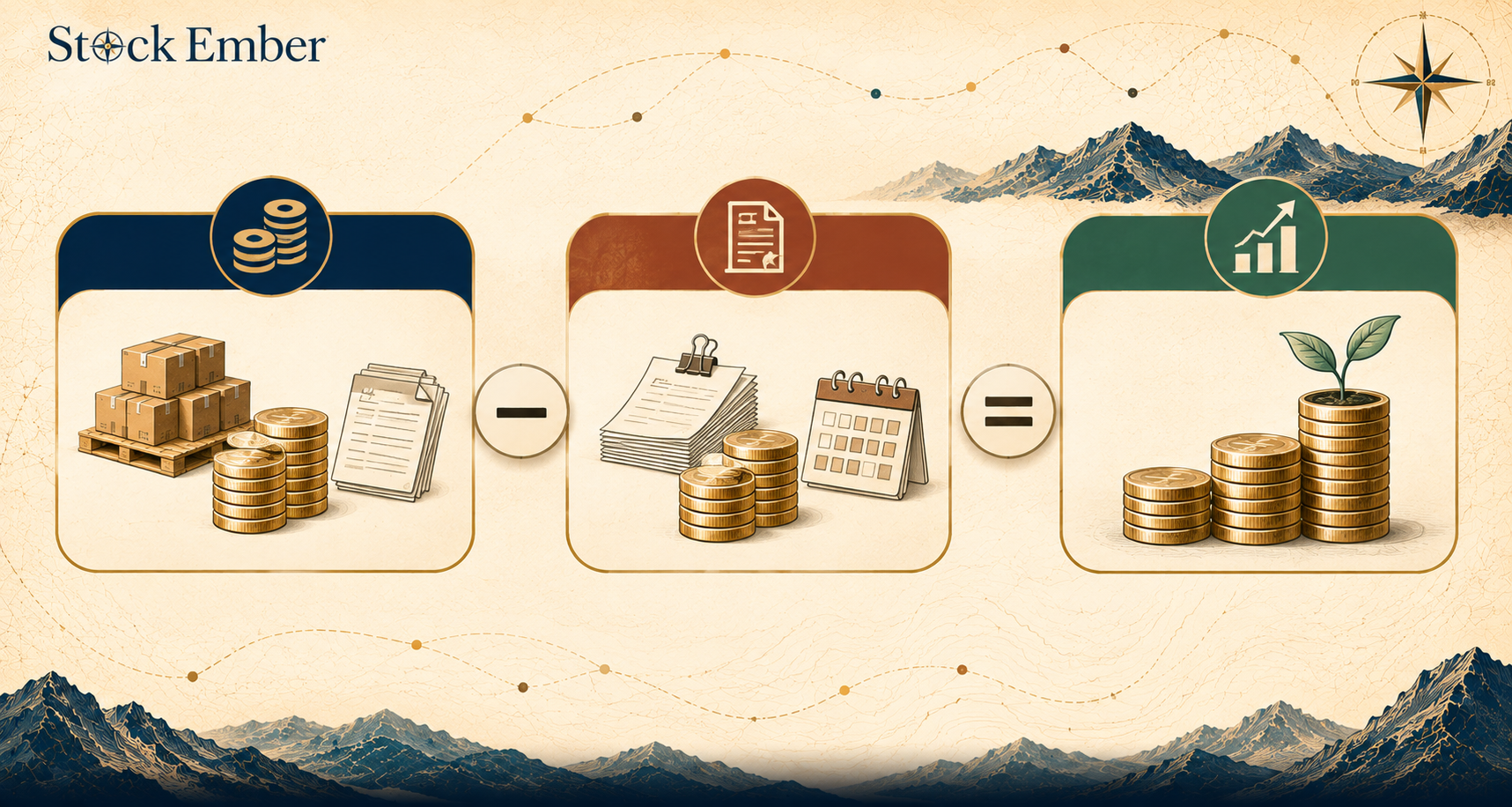
Accountants calculate the metric with a simple subtraction:
Working Capital = Current Assets − Current Liabilities
Current assets represent cash and holdings expected to convert to cash within one year, while current liabilities represent debts and bills due in that same period.
Current Assets (Due in 1 Year)
Current Liabilities (Due in 1 Year)
Cash and cash equivalents
Accounts payable to suppliers
Accounts receivable from customers
Short-term debt and notes due
Raw materials and finished inventory
Accrued wages, taxes, and expenses
Diagram showing current assets minus current liabilities to calculate working capital
Investors also gauge liquidity (how quickly an asset turns into cash without losing value) using the current ratio:
Current Ratio = Current Assets / Current Liabilities
A ratio above 1.0 means short-term assets exceed short-term debts. Many analysts treat a range between 1.2 and 2.0 as a common rule of thumb for healthy liquidity, though acceptable levels vary widely by industry.
How Working Capital Works in Daily Business
It operates as a rolling cash cycle that funds every step of making, storing, and selling a product.
To see working capital explained in practice, follow how cash moves through an ordinary company. A manufacturer starts with cash in the bank to purchase raw materials, pays staff to build products, and stores finished goods. Liquid cash has now turned into inventory.
When a buyer purchases those goods on credit, inventory turns into accounts receivable (money customers owe for goods already delivered). Only when that buyer settles the invoice does cash return to the bank.
This journey is the operating cash cycle. The wider the gap between paying suppliers and collecting cash from buyers, the more money a business must keep parked in net current assets to fund daily operations.
Positive vs. Negative Working Capital: Debunking the Myth
A positive balance is not an automatic badge of health, and a negative one is not an automatic sign of financial distress.
Many novice investors assume a larger surplus is always safer. Yet an excess liquidity cushion often conceals operational friction. A company with an unusually large surplus may hold obsolete inventory nobody wants to buy, or let customer invoices sit unpaid for months due to weak collections. That trapped cash earns nothing.
On the other hand, a negative balance occurs when current liabilities exceed current assets. In a struggling business with falling sales, this condition can trigger a severe cash crunch. But for dominant, high-turnover companies, such as grocery chains or software platforms, it reflects operational strength.
These firms collect cash from customers immediately at the register or through card payments, while negotiating sixty-day terms with suppliers. In effect, suppliers provide interest-free credit to fund daily store operations.
In practice, many long-term investors find that tracking inventory turnover (how many times a company sells and replaces its stock over a year) alongside this metric reveals whether cash is truly flowing or quietly stagnating in warehouse aisles.
Why Working Capital Matters to Long-Term Stock Investors
This metric matters to long-term stock investors because every dollar tied up on the balance sheet is a dollar that cannot generate free cash flow.
Free cash flow is the cash left over after a business pays for daily operations and funds physical investments. When the need for short-term operating funds expands faster than revenue, cash gets swallowed by the balance sheet instead of reaching the bank.
That dynamic directly limits how much cash management can set aside for capital expenditures, the funds used to buy machinery, build facilities, or upgrade technology to expand over time. If this balance drains too much operational cash, the business may need to take on expensive debt or issue new shares just to maintain equipment.
Trapped cash also carries a heavy opportunity cost over ten years. Consider a business that allows $10 million in unneeded inventory and overdue receivables to linger on its balance sheet. If that $10 million were freed up through disciplined operations and reinvested at an assumed 5% annual return, a hypothetical rate rather than a guaranteed one, it could generate more than $6 million in additional value for shareholders over a decade, though actual results may differ. When cash stays locked in net current assets, that wealth never gets created.
Common Working Capital Traps and Index Funds
Investors can avoid balance sheet surprises by watching for sudden spikes in unpaid customer bills and heavy walls of maturing debt.
The first trap is aggressive revenue recognition. When a struggling business books sales before customers pay, accounts receivable jump while real cash stays flat. If those buyers default, the company must write off those receivables, wiping out shareholder equity.
The second trap is debt refinancing risk. If a firm relies heavily on short-term bank credit lines to cover day-to-day funding needs, a sudden jump in borrowing costs or a credit freeze can trigger an immediate solvency crisis.
If you are learning toinvest in stocks through broad-market index funds or exchange-traded funds, you do not need to spend weekends auditing balance sheet ratios. An index fund spreads your money across hundreds of profitable businesses, which can help limit the damage that poor short-term cash management at any single firm may do to your overall portfolio.
Conclusion
This metric is a practical gauge of day-to-day liquidity and operational discipline, showing how smoothly a business turns goods and services back into cash. A healthy company balances short-term safety with capital efficiency, keeping enough buffer to pay suppliers on time without trapping cash in slow-moving stock or unpaid bills. Rather than treating a positive balance as a simple virtue, wise investors look at the cash cycle and customer payment terms to judge true quality.
When you are ready to put your research into practice, our broker reviews can help you find a platform that matches your goals. Every investment carries risk, and balance sheet strength alone does not shield you from market downturns or business disruption. Treat it as one diagnostic tool among many in your broader research, rather than a single reason to buy or sell a stock.
FAQ
5 questions
What is the difference between working capital and cash flow?
This metric is a balance sheet snapshot at a specific point in time, showing whether short-term assets exceed short-term liabilities. Cash flow, tracked on the cash flow statement, measures the actual movement of cash in and out of a business over a period. A company can have a positive balance while temporarily burning operational cash.
Can a profitable company fail due to poor working capital management?
Yes. A business can report accounting profits while running out of spendable money if revenue remains tied up in overdue customer invoices and unsold inventory. If suppliers and employees demand payment before customer cash arrives, the company can experience a liquidity crisis and face insolvency despite generating profitable sales on paper.
Does working capital include long-term debt or fixed assets?
No. The calculation strictly focuses on current assets and current liabilities due within twelve months. Long-term assets, such as real estate, factories, and long-term investments and long-term liabilities, like bonds maturing in ten years are excluded. However, the portion of long-term debt maturing within the current year is included under current liabilities.
How does inflation impact a business's working capital needs?
Inflation raises the cost of raw materials and wholesale inventory, forcing companies to spend more cash simply to maintain existing stock levels. If customer payment terms remain thirty to sixty days, higher nominal invoice values tie up more short-term operating funds on the balance sheet, tightening liquid reserves unless cash collections accelerate.
Do index fund investors need to track working capital metrics?
No. Broad-market index fund and ETF investors hold hundreds or thousands of companies across diverse sectors. Because broad index funds automatically diversify away individual operational and balance sheet risks, long-term passive investors do not need to track this metric or balance sheet ratios for individual corporate holdings.
Disclaimer
This guide was written with AI assistance and reviewed by the StockEmber editorial team for accuracy. StockEmber provides independent education, not personal financial advice. Investing puts your capital at risk: the value of investments can go down as well as up, you may get back less than you invest, and past performance doesn’t guarantee future results. Some links may support our work at no additional cost to you.
The StockEmber Team is our in-house desk of independent research writers. We test brokerage platforms, read the fine print on fees and custody, and cover ETFs and long-horizon investing for people who plan to hold for decades — not days.