The bid-ask spread is the difference between the highest price a buyer is willing to pay and the lowest price a seller will accept for a security. Captured by market makers as compensation for providing immediate liquidity, this gap acts as an implicit transaction cost that increases entry friction on every purchase.
The bid-ask spread is the difference between the highest price a buyer is willing to pay for a security and the lowest price a seller is willing to accept. Understanding what is bid ask spread is essential for any investor who wants to account for all entry costs in their portfolio.
When you buy an index fund or exchange-traded fund (ETF), you rarely pay the underlying assets' exact real-time value. Instead, this invisible gap acts as a quiet transaction cost captured by market liquidity providers. While a spread of a few pennies feels insignificant on a single purchase, repeating that entry cost across a decade of recurring investments quietly drags down your total portfolio wealth. Here is how bid and ask mechanics work and how you can minimize their long-term impact.
Quick Takeaways
01The bid price represents the highest offer from buyers, while the ask price is the lowest price accepted by sellers.
02The bid-ask spread functions as an implicit transaction cost captured by market makers in exchange for providing instant liquidity.
03Broad, highly liquid ETFs feature paper-thin spreads, whereas niche funds or volatile market hours cause spreads to widen significantly.
04Over a 10-year investment horizon, recurring spread friction acts as an immediate entry tax on every dollar-cost averaging contribution.
What Are Bid and Ask Prices?
What is bid and ask? In plain terms, the bid price is the maximum amount a buyer is actively offering to pay for a stock or ETF share, while the ask price (sometimes called the offer) is the minimum amount a seller is willing to accept to part with it.
Whenever you view a quote for a security, you will see both prices listed side by side rather than a single fixed tag. For example, a broad market ETF might display a bid price of $10.00 and an ask price of $10.05.
Understanding the key distinction between bid vs ask prices comes down to which side of the trade you sit on:
If you are buying: You pay the ask price ($10.05), which is always the higher number.
If you are selling: You receive the bid price ($10.00), which is always the lower number.
The Bid and Ask Price Gap: The $0.05 difference between the two quotes represents the market spread.
If you were to buy a share at the ask price of $10.05 and immediately turn around and sell it back to the market at the bid price of $10.00, you would lose $0.05 instantly. That gap is what is a bid ask spread in practice—an immediate threshold every trade must overcome just to break even
How the Bid-Ask Spread Works as an Implicit Cost
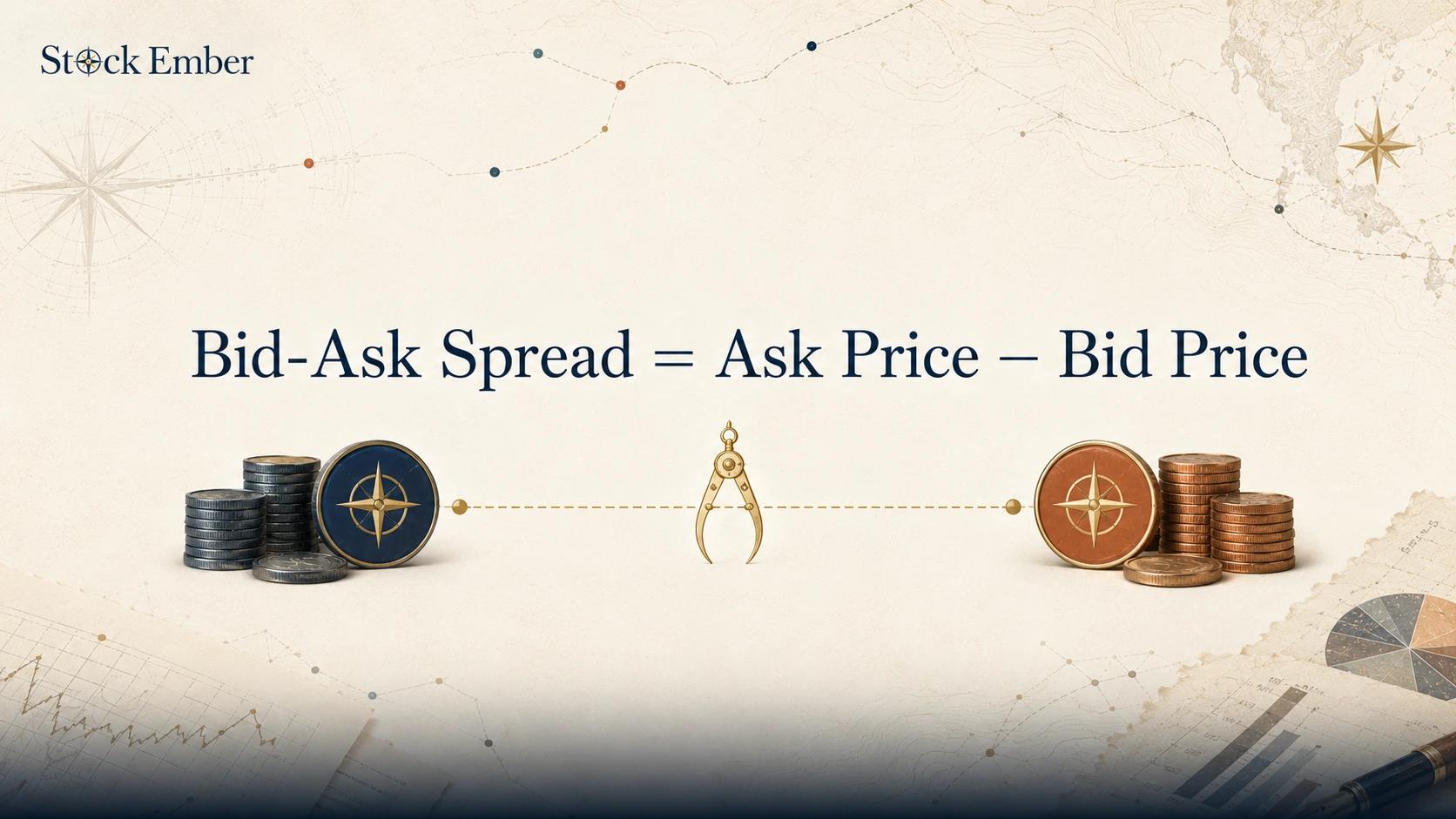
The bid-ask spread is calculated by subtracting the bid price from the ask price, representing the immediate market markup you pay whenever executing an order.
Bid-Ask spread formula
Unlike explicit broker commissions or administrative platform charges, the spread is an implicit transaction cost. You do not see a separate line item on your trade confirmation receipt for the spread. Instead, the cost is built directly into the execution price you receive.
Where does that money go? It is retained by market makers—specialized financial firms that facilitate trading by standing ready to buy or sell securities at any moment. Market makers assume inventory risk by holding shares on their balance sheets. The spread serves as their compensation for keeping the market liquid and ensuring your trade fills instantly.
Why Spread Drag Matters for a 10-Year Portfolio
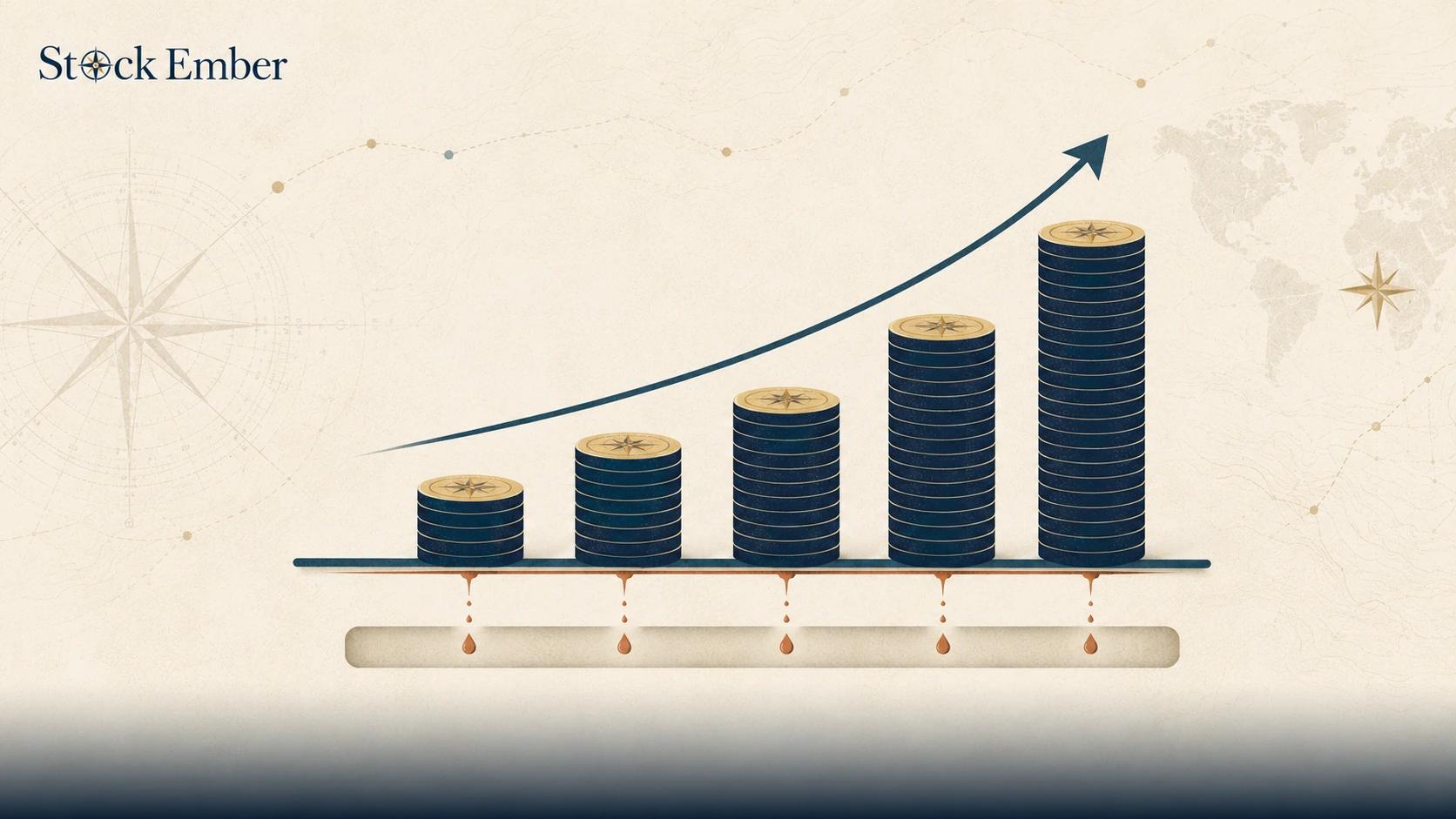
For long-horizon investors, spread drag matters because it acts as an immediate entry tax on every dollar you invest, compounding into a meaningful cost over time.
While day traders worry about spreads because they trade repeatedly throughout a single afternoon, passive buy-and-hold investors often ignore them entirely. However, if you build wealth through monthly dollar-cost averaging (DCA), you incur spread friction every single month when your new capital enters the market.
To see how this adds up, consider a 10-year investment plan where you contribute $500 per month ($60,000 total invested over a decade):
Highly Liquid Fund (0.02% Spread): On a major index ETF with a paper-thin spread, total 10-year spread friction costs roughly $12 in lost entry capital.
Illiquid Niche Fund (0.25% Spread): On a specialized or low-volume fund with a wider spread, total 10-year spread friction swallows $150 directly off the top before your money even begins earning compound interest.
While $150 might still look small alongside major management fees, it represents pure loss that yields zero benefit. When combined with management fees, custody charges, and foreign exchange friction, it forms an integral part of the cost of investing that quietly chips away at your final wealth.
What Causes Spreads to Widen or Narrow?
Market liquidity and daily trading volume are the primary factors that determine whether a bid-ask spread stays paper-thin or widens dramatically.
Several distinct market conditions dictate how wide a spread becomes:
Trading Volume and Asset Popularity: Massive, broad-market ETFs covering major global indices trade millions of shares daily. Competition among market makers keeps their spreads near zero. Conversely, niche thematic funds, foreign micro-caps, or illiquid bonds trade infrequently, forcing market makers to charge wider spreads to cover their inventory risk.
Market Hours and Volatility: Spreads fluctuate throughout the trading day. During periods of sharp market volatility or unexpected economic announcements, market makers widen spreads to protect themselves against rapid price swings.
Cross-Border and Currency Friction: When buying international assets, underlying holdings may trade in different time zones or foreign currencies. In these cases, you face both wider spread friction on the security itself and an added currency conversion fee when converting your funds to settle the purchase.
How Long-Term Investors Can Minimize Spread Friction
You can virtually eliminate spread friction by sticking to broad, highly liquid funds and using basic order discipline during normal market hours.
Because you are investing for years rather than trading for minutes, you do not need complex strategies to handle spreads. Following three practical rules will keep your execution costs near zero:
Stick to Core, High-Volume ETFs: For your core portfolio allocations, choose established funds with deep market liquidity. Highly popular index funds consistently maintain the tightest spreads in the industry.
Trade During Peak Market Hours: Avoid placing orders during the opening or closing 15 minutes of the market session, as well as during major market holidays when trading volume thins out.
Use Limit Orders for Volatile Assets: A market order executes instantly at whatever ask price is available, exposing you to unexpected spread spikes. Setting a limit order specifies the maximum ask price you are willing to accept, ensuring you never pay an inflated spread.
Conclusion
The bid-ask spread is a quiet, implicit transaction cost built into every buy and sell order you place. While a tight spread on a major index fund causes minimal harm, wide spreads on illiquid securities act as a constant drag on recurring contributions over a 10-year timeline. By choosing liquid assets, trading during normal market hours, and remaining mindful of total friction, you keep more of your capital working for your long-term future.
When evaluating your overall portfolio efficiency, using our fee calculators can help you model the true long-term impact of explicit and implicit costs combined.
FAQ
4 questions
Why is the bid-ask spread wider during pre-market and after-hours trading?
Bid-ask spreads widen outside normal exchange hours because trading volume and market liquidity drop significantly. With fewer buyers and sellers active, market makers increase the spread to compensate for higher price volatility and execution risk.
How does low liquidity affect the bid-ask spread on niche ETFs?
Low liquidity means fewer shares are actively traded daily. Market makers widen the gap between the buying price (bid) and selling price (ask) to offset the risk of holding assets they may not be able to offload quickly.
Can limit orders help investors avoid paying wide bid-ask spreads?
Yes. Using a limit order allows you to specify the maximum price you are willing to pay or the minimum price you are willing to receive, protecting you from buying at the ask or selling at the bid during market fluctuations.
Does a market order execute at the bid price or the ask price when buying?
When submitting a market order to buy shares, your trade executes immediately at the seller's current ask price. Conversely, when submitting a market sell order, your trade executes at the buyer's current bid price.
Disclaimer
This guide was written with AI assistance and reviewed by the StockEmber editorial team for accuracy. StockEmber provides independent education, not personal financial advice. Investing puts your capital at risk: the value of investments can go down as well as up, you may get back less than you invest, and past performance doesn’t guarantee future results. Some links may support our work at no additional cost to you.
The StockEmber Team is our in-house desk of independent research writers. We test brokerage platforms, read the fine print on fees and custody, and cover ETFs and long-horizon investing for people who plan to hold for decades — not days.