A total expense ratio (TER) is the total annual cost charged by an investment fund to cover its management, administrative, and legal operational expenses, expressed as a percentage of total fund assets. These internal costs are deducted directly from the fund's Net Asset Value (NAV) on a daily basis rather than billed separately to investors. Over a 10-year holding period, small TER differences compound significantly, quietly reducing total portfolio returns.
A total expense ratio (TER) is the total annual cost charged by an investment fund to cover its operational expenses, expressed as a percentage of the fund's total assets.
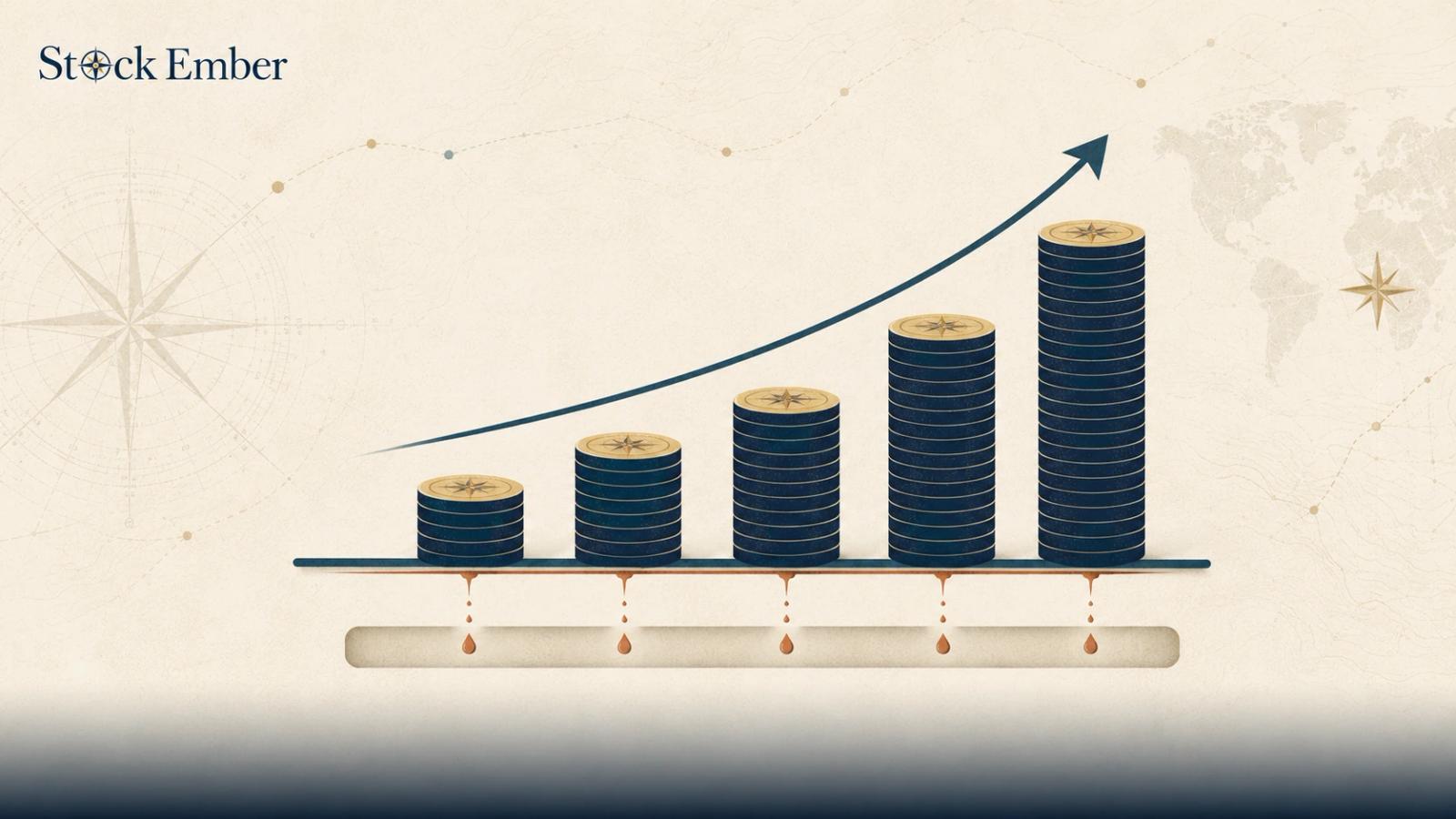
When you invest in a fund, operational costs—such as management fees, administrative charges, and custody expenses—are deducted behind the scenes. Over a long holding horizon, these ongoing fees compound, quietly reducing your overall wealth accumulation. Understanding what a total expense ratio (TER) is helps you evaluate how internal fund costs impact your long-term investment performance.
Quick Takeaways
01TER represents the annualized percentage deducted from a fund's assets to cover management, administrative, and legal operational costs.
02Fund expenses are deducted continuously from the Net Asset Value (NAV), meaning you never receive an explicit bill or invoice.
03The ter meaning covers internal operational charges, but excludes external trading friction like brokerage commissions and bid-ask spreads.
04Fees compound negatively over time, making even fractional percentage differences critical across a 10-year holding horizon.
What Is a Total Expense Ratio (TER)?
A total expense ratio (TER) measures the operational efficiency of an investment fund by calculating its total annual operating costs relative to its overall asset base.
In financial markets, the term expense ratio meaning refers to the annual fee percentage charged by mutual funds, index funds, and exchange-traded funds (ETFs) to run the portfolio. The ter meaning expands on basic management fees by grouping all primary internal operational overheads into a single, standardized percentage.
Fund managers do not bill you directly for these expenses. Instead, the TER is deducted incrementally from the fund's Net Asset Value (NAV) every single trading day. Because the fee is priced directly into the fund's share price, you only ever see performance net of operating costs. Knowing the cost of investing begins with recognizing that these quiet deductions happen regardless of whether the market goes up or down.
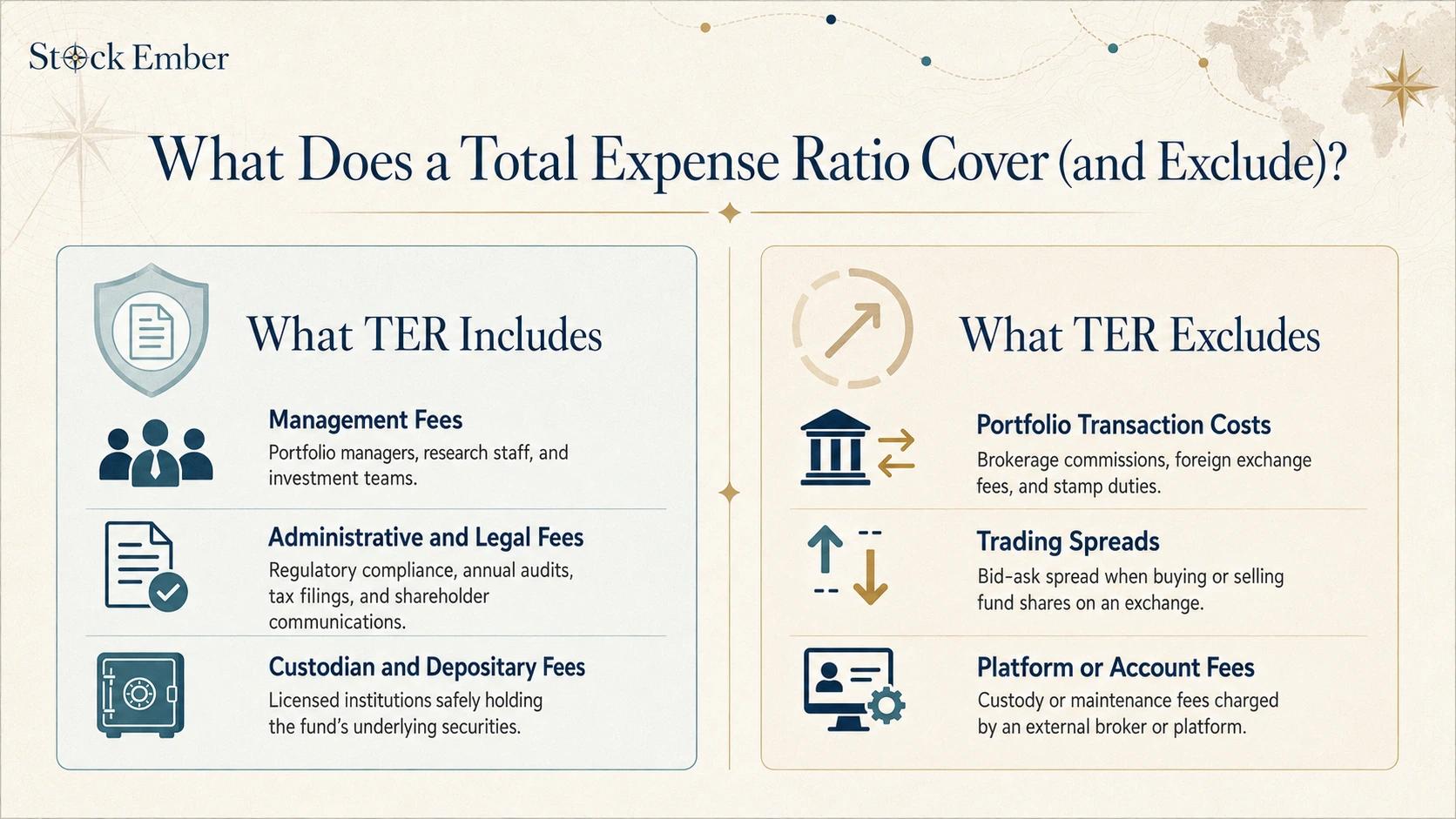
What Does a Total Expense Ratio Cover (and Exclude)?
A fund's TER consolidates several operational costs into a single metric, but it does not represent every fee involved in buying and holding an asset.
To understand what you are paying for, it helps to distinguish between internal operating charges and external market costs.
What Does a Total Expense Ratio Cover (and Exclude)?
What TER Includes
Management Fees: Compensation paid to portfolio managers, research staff, and investment teams.
Administrative and Legal Fees: Costs associated with regulatory compliance, annual audit reports, tax filings, and shareholder communications.
Custodian and Depositary Fees: Charges paid to licensed institutions for safely holding the fund's underlying securities.
What TER Excludes
Portfolio Transaction Costs: Brokerage commissions, foreign exchange fees, and stamp duties paid when the fund manager buys or sells assets inside the portfolio.
Trading Spreads: The bid-ask spread encountered when buying or selling fund shares on an open exchange.
Platform or Account Fees: Custody or maintenance fees charged directly by your external broker or trading platform.
How TER Works in ETFs and Funds
The total expense ratio varies substantially depending on the investment vehicle and management style.
When analyzing a ter etf structure, you will typically find lower costs compared to traditional actively managed mutual funds. Passive ETFs aim to track an underlying market index rather than outmaneuver it, requiring less active research and fewer portfolio adjustments.
Passive Index ETFs: typically carry low TERs, often ranging between 0.03% and 0.25%, according to Morningstar's 2024 Global Fund Fee Study.
Actively Managed Funds: frequently carry higher TERs, often between 0.50% and 1.50%+, to cover research and portfolio management costs (Morningstar, 2024 Global Fund Fee Study).
When reviewing fund prospectuses, you may also encounter a fund's gross expense ratio alongside its net expense ratio. The gross expense ratio represents the total unadjusted cost of operating the fund. The net expense ratio reflects the actual fee paid after temporary manager fee waivers or fee reimbursements are applied. If a temporary fee waiver expires, your operational cost rises from the net rate to the gross rate. Learning what is a good expense ratio requires verifying whether a low listed fee is permanent or temporary.
The 10-Year Drag: Why TER Matters for Long-Horizon Investors
Fees compound against your portfolio over time in the exact same mathematical fashion that investment returns compound for it.
To see how a seemingly minor fee difference impacts long-term wealth, consider an illustrative comparison between two funds holding identical underlying assets over a 10-year period.
Illustrative 10-Year Cost Comparison
Initial Investment: $10,000
Gross Annual Return: 7.00% (before fees)
Holding Horizon: 10 Years
Metric
Low-Cost Fund A
Higher-Cost Fund B
Total Expense Ratio (TER)
0.05%
0.75%
Net Annual Return
6.95%
6.25%
Ending Portfolio Value (10 Yrs)
~$19,580
~$18,335
Total Lost Wealth to Fee Drag
~$90
~$1,335
Over a single year, a 0.70% fee gap on $10,000 equals $70—a figure many investors dismiss. However, across a decade of compounding, that same fee gap surrenders over $1,240 in ending wealth. That difference represents capital that could have remained invested and compounding on your behalf.
Common TER Pitfalls to Watch
Even informed investors make recurring mistakes when evaluating fund costs. Avoid these three common traps:
Assuming TER Is the Total Cost of Ownership: TER covers internal management, but ignores external broker charges, account maintenance, and trading spreads.
Ignoring Expiration Dates on Fee Waivers: Always check whether a low fee is a temporary promotional rate that will revert to a higher gross expense ratio.
Selecting Funds Based Only on the Lowest Fee: A low TER is valuable, but choosing an illiquid fund with severe tracking difference or wide bid-ask spreads can cost more than you save on operational fees.
Conclusion
A fund's Total Expense Ratio (TER) is the foundational benchmark for understanding ongoing operational investment costs. Because fees are deducted directly from fund performance every day, high operational drag steadily erodes wealth over long holding periods. By reviewing the TER alongside secondary trading costs, long-horizon investors can keep operational friction low and preserve more compounding growth. When you are ready to evaluate how fee friction impacts your specific portfolio projections, exploring interactive investment calculators is a practical next step.
FAQ
4 questions
What hidden costs are excluded from a fund's Total Expense Ratio?
A fund's Total Expense Ratio (TER) includes management and administrative costs, but excludes internal portfolio trading commissions, performance fees, foreign exchange charges, and local stamp duties incurred when fund managers trade assets inside the portfolio.
How does Total Expense Ratio differ from an ongoing charges figure (OCF)?
TER and OCF are very similar metrics used to measure fund operational costs. However, OCF (standardized in Europe and the UK) uses a precise regulatory formula to reflect expected forward-looking annual operational expenses, whereas TER relies on historical annual costs.
Why can two ETFs tracking the same index have different Total Expense Ratios?
Different fund management firms have varying operational scales, administrative costs, licensing arrangements, and profit margins. Larger asset managers can spread fixed costs over a bigger asset pool, leading to lower TERs.
Does the TER include internal portfolio trading costs incurred by the fund manager?
No. Transaction costs stemming from buying and selling underlying securities within the portfolio (broker commissions, market impact costs) are excluded from the TER calculation and reported separately in annual fund statements.
Disclaimer
This guide was written with AI assistance and reviewed by the StockEmber editorial team for accuracy. StockEmber provides independent education, not personal financial advice. Some links may support our work at no additional cost to you.
The StockEmber Team is our in-house desk of independent research writers. We test brokerage platforms, read the fine print on fees and custody, and cover ETFs and long-horizon investing for people who plan to hold for decades — not days.