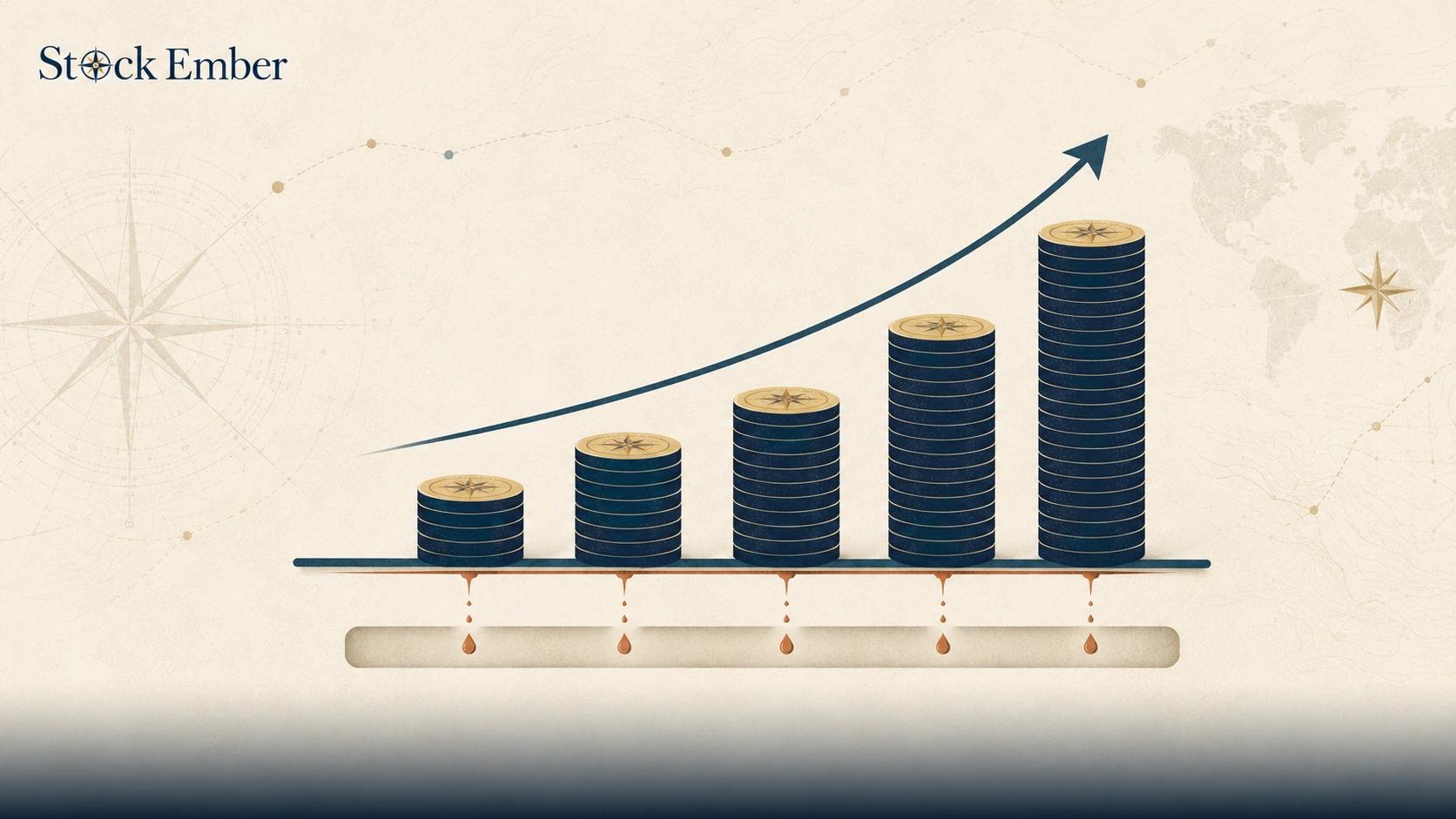
Payment for order flow (PFOF) is the compensation a brokerage firm receives from a wholesale market maker for directing client trade orders to that market maker for execution. Wholesalers pay brokers fractions of a cent per share out of the bid-ask spread to capture retail trade volume. This back-end rebate model serves as the primary revenue source enabling zero-commission trading.
Payment for order flow (PFOF) is the compensation a stockbroker receives from a wholesale market maker in exchange for directing client trade orders to that market maker for execution.
When you buy or sell shares without paying an upfront broker commission, that transaction is rarely free behind the scenes. Wholesalers pay brokers fractions of a cent per share to handle retail trade volume, creating a subtle financial engine that replaces explicit fees with back-end rebates. Understanding how this mechanism operates helps you see where hidden costs hide and how trade routing impacts your total portfolio return over time.
Quick Takeaways
01Payment for order flow (PFOF) is a rebate paid by wholesale market makers to brokerage firms for routing retail client orders to them.
02PFOF serves as the primary financial model enabling zero-commission stock and ETF trading for retail investors.
03Market makers generate profit from the bid-ask spread and share a portion of that margin back with the originating broker.
04While PFOF eliminates upfront trading fees, it creates a potential principal-agent conflict regarding order execution quality.
05For long-term index investors, recurring fund management fees impact wealth far more over 10 years than minor trade execution spreads.
What Is Payment for Order Flow?
Payment for order flow (PFOF) is an indirect compensation model where brokerage firms earn cash rebates by sending retail trade orders to wholesale market makers rather than directly to public stock exchanges.
To understand what PFOF means in practice, it helps to identify the key players involved in a typical trade:
Retail Investor: The individual placing a buy or sell order through a trading platform.
Retail Brokerage: The platform that maintains customer accounts and receives the trade order.
Wholesale Market Maker: A specialized financial institution that stands ready to buy or sell securities, providing liquidity to the market.
Public Stock Exchange: A centralized, lit market exchange where buy and sell orders are publicly matched.
Historically, stockbrokers charged explicit per-trade commissions to cover clearing and routing costs. As competitive pressures drove commissions down to zero, brokerage firms shifted their business models toward alternative revenue streams. Monetizing order flow volume allowed brokers to remove upfront customer friction while earning revenue behind the curtain.
While zero-commission trading lowers the barrier to entering the markets, it shifts trading costs from explicit fees to implicit execution dynamics. Evaluating these trade-offs is a core part of managing overall investment fees over a lifetime of investing.
How PFOF Works Behind Zero-Commission Trades
Wholesale market makers pay brokers for retail trade orders because retail order flow is relatively predictable and carries low risk for market makers.
When you place a market order to buy stock, your broker usually routes that order to a wholesale market maker rather than directly to an exchange order book. The market maker executes the order internally by filling it from its own inventory or matching it with another buyer or seller.
Market makers profit through the bid-ask spread—the difference between the highest price a buyer is willing to pay (bid) and the lowest price a seller is willing to accept (ask).
The Bid Price: $100.00
The Ask Price: $100.02
The Spread: $0.02
When a market maker handles buy and sell orders simultaneously, it captures that $0.02 spread per share. To attract continuous order volume from brokers, the market maker shares a small fraction of that spread—often a fraction of a cent per share—back with the broker.
Market makers prefer retail orders over institutional orders because individual investors trade in smaller quantities and lack information that could rapidly move market prices against the wholesaler. This "uninformed" retail volume allows market makers to manage inventory risk safely while extracting consistent micro-profits from the spread.
The Principal-Agent Conflict: Best Execution vs. Rebates
The principal-agent conflict in payment for order flow arises when a broker's financial incentive to maximize wholesaler rebates conflicts with its legal duty to secure the best possible trade price for the investor.
Brokers operate under a strict legal obligation known as the duty of best execution. This requires brokerage firms to execute client orders at the most favorable terms reasonably available under market conditions.
However, payment for order flow introduces structural friction between broker incentives and investor interests::
The Broker's Incentive: Route orders to market makers offering the highest rebate per share.
The Investor's Interest: Route orders to whichever venue provides the best execution price (the lowest purchase price or highest sale price).
Because of this inherent conflict of interest, global regulators view PFOF differently:
United States: Permitted under Securities and Exchange Commission (SEC) regulations, provided brokers disclose PFOF payments and regularly review execution quality metrics under Rule 605 and Rule 606 guidelines.
United Kingdom & European Union: Banned or heavily restricted by regulatory bodies like the FCA and under MiFIR updates, which mandate that brokers must not receive third-party remuneration for order routing.
The 10-Year Cost Lens: Does PFOF Impact Long-Term Investors?
Over a 10-year holding period, payment for order flow has a negligible impact on long-term buy-and-hold investors compared to the compounding drag of ongoing fund management fees.
To see why, consider how order execution friction affects two distinct types of market participants over a decade:
Scenario A: The Active Day Trader
An active trader placing 500 trades a year with 100 shares per trade experiences a minor execution drag of $0.01 per share due to wider fill spreads.
Per Trade Cost Drag: $1.00
Annual Impact: $500.00
10-Year Cost: $5,000.00
For high-frequency traders, order execution quality directly impacts long-term profitability.
Scenario B: The Passive Buy-and-Hold Investor
A long-term investor allocating funds monthly into index ETFs executes 12 purchases per year. On a purchase of 10 shares, a $0.01 execution drag costs $0.10 per trade.
Annual Impact: $1.20
10-Year Cost: $12.00
Investor Type
Trade Frequency
10-Year Execution Drag Impact
Primary Cost Risk
Active Day Trader
~500 trades/year
High (~$5,000)
Spread slippage & routing delay
Passive Long-Term Investor
~12 trades/year
Negligible (~$12)
High expense ratios & holding fees
While trade execution slippage adds up for day traders, passive investors face a far greater threat from ongoing holding costs. A 0.50% annual expense ratio on a $50,000 index portfolio costs thousands of dollars over a decade. Keeping ongoing mutual fund fees alow matters far more to your total 10-year wealth than fractions of a cent on a trade execution.
Common Pitfalls & Misconceptions About "Free" Trading
The most common misconception about payment for order flow is assuming that zero-commission trading guarantees zero investment cost.
Pitfall 1: Assuming "Zero Commission" Means "Zero Cost"Removing the upfront trading fee does not mean a transaction is free. If an order fills at a slightly wider spread, you pay an implicit cost through execution quality rather than an explicit line item on your confirmation slip.
Pitfall 2: Believing PFOF Always Results in Worse ExecutionWholesalers often process trades faster than exchange books and frequently offer price improvement—executing orders at a price better than the National Best Bid and Offer (NBBO). Payment for order flow represents a potential conflict of interest, not a guarantee of inferior pricing.
Pitfall 3: Sweating Execution Cents While Ignoring Fund FeesFocusing intensely on payment for order flow execution quality while holding funds with high expense ratios with high expense ratios is a classic case of major-minor confusion. Execution costs happen once per trade; expense ratios compound against your balance every day for years.
Conclusion
Payment for order flow is the financial mechanism that makes zero-commission stock and ETF trading possible by sharing bid-ask spread profits between market makers and brokers. While PFOF introduces a potential conflict of interest regarding trade routing, its practical financial impact depends on how often you trade. For active traders, trade slippage is a meaningful drag; for long-term buy-and-hold investors, execution fractions matter far less than ongoing annual holding fees.
To analyze how ongoing annual holding costs impact your portfolio over a decade compared to one-off transaction friction, try our interactive fee calculators.
FAQ
4 questions
Does Payment for Order Flow mean commission-free trading is completely free?
No. While commission-free brokers do not charge trade fees, market makers pay brokers for routing order flow, which can sometimes lead to slightly poorer trade execution prices. This execution quality gap acts as a hidden trading cost.
How does Payment for Order Flow impact trade execution quality for retail investors?
PFOF can result in trades being executed slightly away from the national best bid and offer (NBBO). Even a fraction of a cent price slip per share increases total trading friction on market orders over time.
Why do some online brokers ban or refuse Payment for Order Flow?
Brokers that reject PFOF prioritize price execution quality, routing trades to exchanges offering the best price for investors rather than maximizing market maker rebates. These brokers often charge explicit commissions instead.
Is Payment for Order Flow legal in Europe and the UK?
PFOF is banned in the UK under FCA rules and is being phased out across the European Union under MiFID II regulations due to concerns over broker conflicts of interest and lack of transparency.
Disclaimer
This guide was written with AI assistance and reviewed by the StockEmber editorial team for accuracy. StockEmber provides independent education, not personal financial advice. Some links may support our work at no additional cost to you.
The StockEmber Team is our in-house desk of independent research writers. We test brokerage platforms, read the fine print on fees and custody, and cover ETFs and long-horizon investing for people who plan to hold for decades — not days.