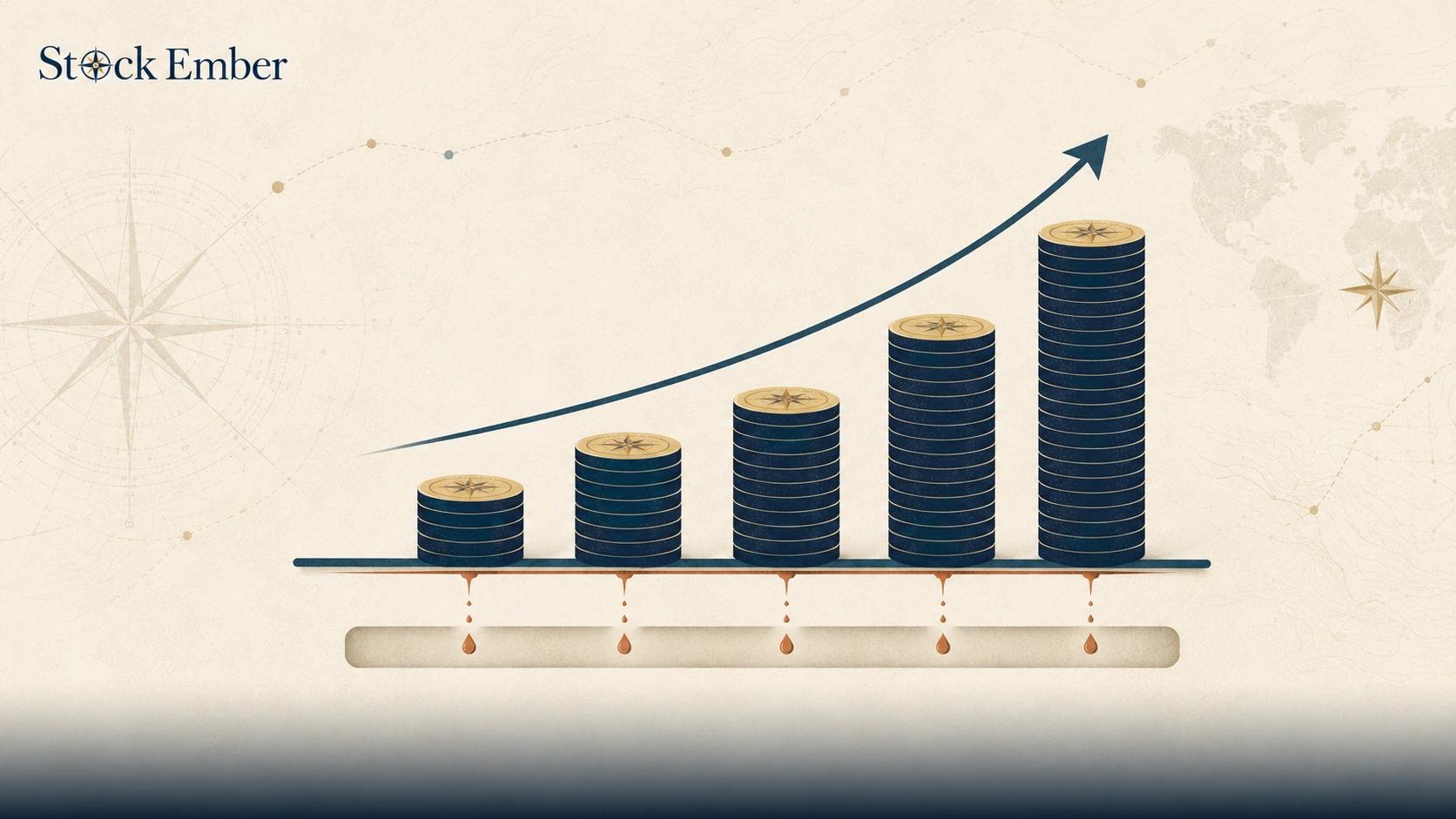
A good expense ratio for broad-market passive index funds and ETFs is generally under 0.20%, with core equity funds charging as little as 0.03% to 0.10% annually. Actively managed funds and specialized asset classes carry higher averages, typically ranging from 0.50% to over 1.00%. Minimizing these fees protects your portfolio from significant compounding drag over a 10-year holding period.
A good expense ratio for a broad-market passive fund or ETF is generally under 0.20%, with core index funds charging as little as 0.03% to 0.10% annually.
When you invest for decades, subtle percentage points determine how much wealth stays in your account versus leaking into management fees. Knowing what constitutes a fair fee helps you avoid overpaying without sacrificing quality across different asset classes. Here is how to evaluate fund costs and protect your long-term returns from silent fee drag.
Quick Takeaways
01A good expense ratio for broad passive equity ETFs is under 0.20%, while core large-cap trackers often fall below 0.10%.
02Actively managed funds carry higher average costs (0.50% to 1.00%+), requiring substantial outperformance to break even after fees.
03A seemingly small 0.70% fee gap can erase thousands of dollars from a modest portfolio over a 10-year holding period.
04Specialized asset classes like emerging markets or niche sector funds naturally command slightly higher fees due to operational complexity.
05The expense ratio is only one part of total cost; spread costs, tracking difference, and account platform fees also shape your net returns.
What Is an Expense Ratio?
An expense ratio is the annual percentage of your invested capital that a fund deducts directly from its total assets to cover management, administrative, and operational costs. Rather than sending you an explicit bill or deducting cash from your account balance, the fund manager incorporates this fee directly into the fund's daily Net Asset Value (NAV). If a fund has an expense ratio of 0.10%, you pay $10 annually for every $10,000 you have invested.
Understanding how this percentage operates is essential because it represents a recurring, baseline cost of ownership. These fund management fees sit within the broader framework of investment fees, compounding quietly every single day you hold the position. Because the deduction happens automatically inside the fund, many investors overlook its impact until they evaluate their net long-term performance.
What Is Considered a Good Expense Ratio?
A good expense ratio depends on the asset class and strategy, but for broad-market passive equity funds, any annual fee below 0.20% is generally considered attractive. Passively managed index funds that track mega-cap benchmarks (such as major US or global broad-market indexes) can often keep costs down to 0.03%–0.08% thanks to massive economies of scale.
When evaluating whether a fee is reasonable, compare the fund against peers following the exact same benchmark or strategy. Passive funds tracking specialized sectors or international regions carry slightly higher baseline operational costs, while active management incurs human research and trading overhead.
Strategy / Asset Class
Good Expense Ratio
Average Range
High Expense Ratio
Passive Broad Equity (US / Developed)
Under 0.10%
0.03% – 0.15%
Above 0.30%
Passive Emerging Markets / Niche Sectors
Under 0.25%
0.20% – 0.40%
Above 0.50%
Passive Core Bond Funds
Under 0.12%
0.05% – 0.20%
Above 0.35%
Active Equity Funds
Under 0.60%
0.60% – 1.00%
Above 1.00%
What Is a High Expense Ratio?
A high expense ratio is generally any annual fund fee exceeding 0.50% for passive index funds or 1.00% for actively managed strategies. Paying high management fees creates an immediate mathematical hurdle for your investment portfolio. For an active fund manager charging 1.00% per year to match the net performance of a 0.05% passive tracker, their stock selections must outperform the benchmark by at least 0.95% every single year just to break even.
Over long horizons, research consistently shows that very few active managers outperform their benchmark net of fees (SPIVA U.S. Scorecard, S&P Global, 2024). This persistent fee hurdle makes low-cost passive strategies the starting point for most long-term investors. While specialized strategies or international funds carry legitimate operational costs, holding broad core equity exposures with a high expense ratio quietly drains thousands of dollars from your portfolio without providing proportional value.
The 10-Year Fee Drag: Why Expense Ratios Matter
The true impact of an expense ratio only becomes visible when you measure its compounding cost across a decade or more. Because fund fees reduce the capital remaining in your account to compound, high expense ratios cost you not only the fee itself, but also all the future growth that money would have generated.
Consider a hypothetical investment of $10,000 held over a 10-year horizon, assuming a constant gross annual return of 7%
Low-Cost Fund (0.05% Expense Ratio): Your net annual growth rate is 6.95%. After 10 years, your $10,000 grows to approximately $19,580, costing you roughly $92 in cumulative fees.
Higher-Cost Fund (0.75% Expense Ratio): Your net annual growth rate drops to 6.25%. After 10 years, your $10,000 grows to approximately $18,335, costing you roughly $1,336 in fee drag and missed compound growth.
Paying an extra 0.70% per year costs you over $1,240 on a single $10,000 investment over a decade. On a larger $100,000 portfolio, that subtle fee difference quietly consumes over $12,400—more than 12% of your starting principal—eroded strictly by management overhead.
When Is a Slightly Higher Expense Ratio Justified?
A slightly higher expense ratio can be justified when a fund provides exposure to complex, niche, or illiquid markets that carry naturally higher operational and transaction costs. For instance, holding broad emerging market equities, small-cap international stocks, or specialized commodities requires navigating foreign custody fees, local currency conversions, and complex tax reclaims. Paying 0.25% or 0.35% for efficient access to these markets can be reasonable if low-cost broad alternatives do not exist.
However, you must look at the complete financial picture rather than judging a fund on its expense ratio alone. A ultra-low expense ratio of 0.03% offers little benefit if the underlying broker or account provider imposes heavy custody fees or high platform fees. Total Cost of Ownership involves balancing the fund's expense ratio against trading spreads, tracking precision, and platform administration costs.
Conclusion
Finding a good expense ratio requires matching the fee you pay to the underlying complexity and strategy of the fund. For core long-term holdings in developed equity markets, prioritizing passive index funds with expense ratios below 0.20%—and ideally under 0.10%—ensures the vast majority of market returns remain in your account. By minimizing ongoing fee drag today, you preserve maximum compounding power over the next decade.
When you are ready to evaluate how management costs impact your actual investment timeline, exploring our interactive fee calculators is a practical next step to model your personal portfolio costs.
FAQ
4 questions
Is a 0.50% expense ratio considered high for a long-term ETF investor?
For a broad market index ETF, a 0.50% expense ratio is high, as standard index funds charge under 0.10%. For specialized thematic or actively managed funds, 0.50% is average, though high ongoing fees still reduce long-term compounding.
What expense ratio threshold should buy-and-hold investors target for index funds?
For core portfolio holdings tracking major market indexes (like the S&P 500 or Total Stock Market), buy-and-hold investors should aim for expense ratios under 0.10%, with many low-cost index ETFs charging between 0.03% and 0.07%.
Why do sector ETFs usually have higher expense ratios than broad market ETFs?
Sector ETFs require focused portfolio management, rebalancing, and licensing for narrower benchmark indexes. Lower overall trading volume and asset sizes across niche funds also cause fund managers to set slightly higher fees to cover operating expenses.
Does a lower expense ratio always mean better overall portfolio performance?
Not necessarily. While a lower expense ratio preserves more capital over time, net performance depends on the underlying assets. A low-cost ETF tracking a poor-performing market sector will still underperform a high-cost fund in a strong sector.
Disclaimer
This guide was written with AI assistance and reviewed by the StockEmber editorial team for accuracy. StockEmber provides independent education, not personal financial advice. Some links may support our work at no additional cost to you.
The StockEmber Team is our in-house desk of independent research writers. We test brokerage platforms, read the fine print on fees and custody, and cover ETFs and long-horizon investing for people who plan to hold for decades — not days.