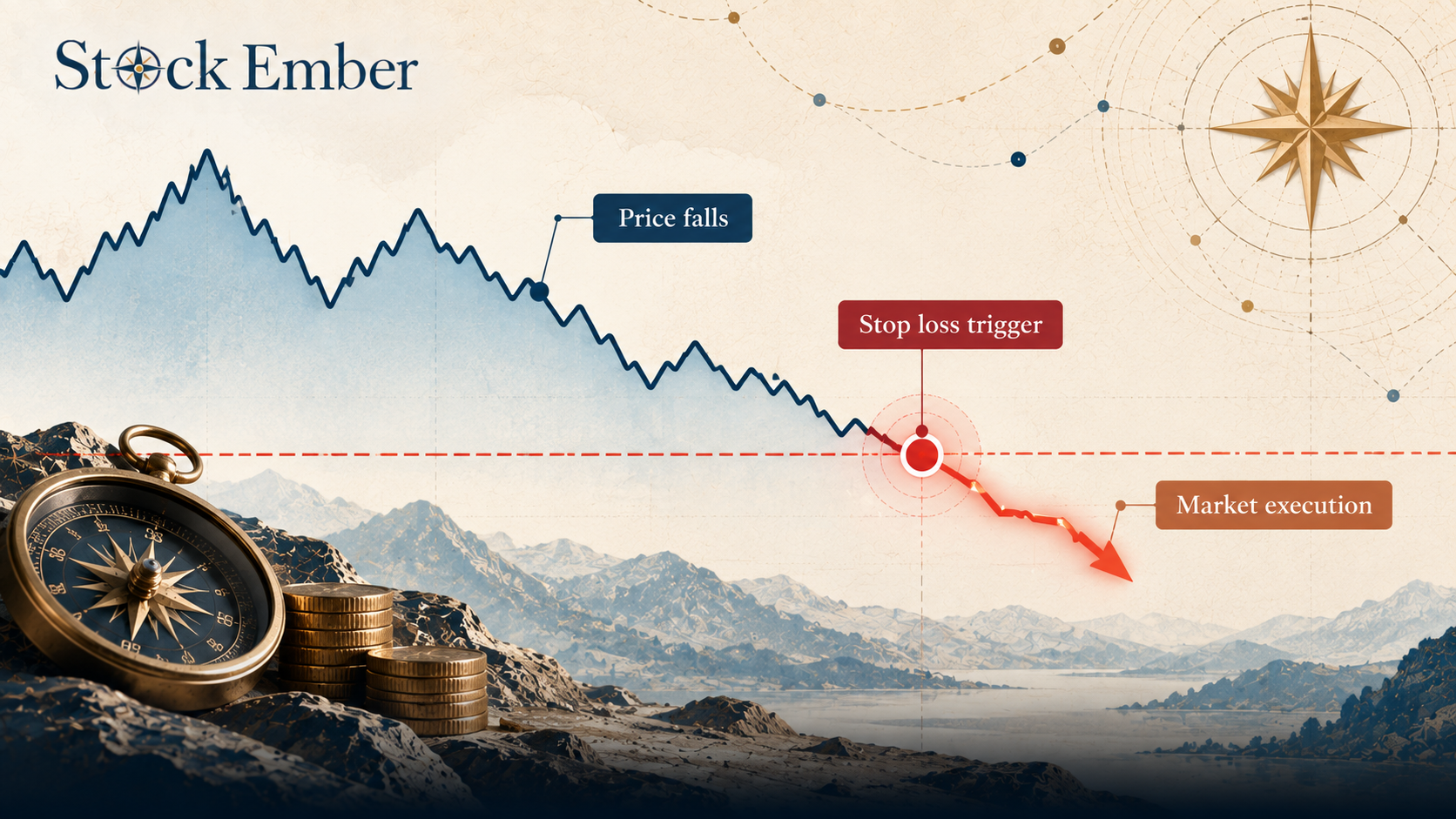
A stop loss order is a conditional instruction sent to a broker to sell a security once its price drops to a designated trigger level. Upon touching the stop price, it automatically converts into a standard market order to prevent further portfolio losses.
A stop loss order is an automated order type sent to a broker to sell a stock once its market price drops to a specified trigger price. It converts into a standard market order to prevent further portfolio losses.
When stock prices fall quickly, deciding when to cut losses can feel overwhelming. Many investors turn to automated conditional orders so they do not have to watch stock price movements every minute of the trading day.
If you've ever wondered what is a stop loss order and how it protects a position, this guide breaks down the mechanics step by step.
Quick Takeaways
01A stop loss order triggers an automatic sell order when a stock drops to your chosen price.
02Once activated, a stop order transforms into a regular market order, which sells at the next available market price.
03Execution prices are not fixed and can fall below your stop price if the market gaps downward overnight.
04Long-term buy-and-hold investors rarely need short-term stop loss orders for broad market index positions.
What Is a Stop Loss Order? (Core Definition)
A stop loss order is an automated order type designed to limit investor losses on an existing stock position. You place the order with your broker in advance, setting a specific price level known as the stop price below the current market value of the stock.
If the stock price falls to or below your designated stop price, the order activates automatically. For long positions, a sell-stop order helps limit potential downside losses if a company's price drops unexpectedly. For short traders, a buy-stop order serves a similar protective role by covering a short position if the share price rises above a set point.
Unlike standard limit orders that set an exact floor on your sale price, a stop loss order acts primarily as a trigger mechanism. It stays inactive until the market reaches your chosen price threshold, after which your broker immediately executes the trade to exit the position.
Diagram showing a stop loss trigger price converting into an active sell order.
How a Stop Loss Order Works: Trigger Price to Market Order
Understanding order execution requires looking at the two distinct stages of a stop order: the trigger phase and the execution phase.
During the trigger phase, your broker monitors continuous price quotes from the stock exchanges. When a transaction occurs at or below your stop price, your conditional instruction is formally triggered.
Once triggered, the order immediately converts into a standard market order. A market order instructs the exchange to sell your shares at the best price available in the market right now.
Because the order converts into a market order, final execution depends on current market liquidity and price activity:
Normal Market Conditions: In a stable market with high trading volume, your stock usually sells at or very close to your trigger price.
Volatile Market Conditions: If market prices are falling rapidly, the price you receive may be lower than your trigger price.
The key distinction is that setting a stop price establishes when the order becomes active, not the exact price at which your shares will trade hands.
Stop Loss vs. Stop Limit: Knowing the Difference
When reviewing different stock order types, investors often compare stop loss orders with stop-limit orders. While both orders use a stop price trigger, they handle execution differently once activated.
A stop loss order converts into a market order when triggered, prioritizing execution speed over price control. Your order will execute, but the final price depends on available buyers.
A stop-limit order converts into a limit order instead of a market order when triggered. It requires two separate prices: a stop price (the trigger) and a limit price (the minimum acceptable sale price).
Stop Loss Order: Guarantees execution (assuming market liquidity), but does not guarantee the sale price.
Stop Limit Order: Controls the exact sale price floor, but carries the risk that your trade will not execute if the stock price plummets below your limit price before your shares can sell.
Feature
Stop Loss Order
Stop Limit Order
Execution Guarantee
Guarantees execution (assuming market liquidity)
Not guaranteed
Price Control
Does not guarantee the sale price
Controls the exact sale price floor
Risk
Final price depends on available buyers
Risk that the trade will not execute if the price plummets below the limit price
According to regulatory investor bulletins from the U.S. SEC, a stop order becomes a market order once the stop price is reached, meaning the final execution price is never guaranteed.
Execution Risks: Market Gaps, Slippage, and Whipsaws
While stop orders help automate risk management, they introduce specific execution risks that every stock investor should understand:
Market Gap Risk
Stock markets close every afternoon and reopen the following morning. If negative news comes out overnight, a stock trading at $50 at closing time might open the next morning at $40. If you had a stop loss set at $45, your order triggers at the market open and executes near $40 far below your intended stop price.
Execution Slippage
Slippage describes the difference between your trigger price and your actual execution price. During market drops, buyers pull back, causing sell orders to execute several steps below the trigger level.
Market Whipsaws
Stock prices frequently fluctuate throughout the trading day. A short-term drop might trigger your stop loss order, selling your shares at a loss right before the price rebounds back to new highs. This risk, known as a whipsaw, can cause you to sell quality businesses during brief, temporary panics.
Common Stop Loss Mistakes: What to Watch Out For
To avoid execution traps when managing trade orders, watch out for these frequent mistakes:
Setting stops too close to normal volatility: Placing a stop trigger only a percent or two below the current market price can often cause the order to trigger during ordinary daily price swings, so it helps to account for a stock's typical volatility when choosing the distance.
Assuming stop prices are guaranteed sale prices: Remembering that a stop loss turns into a market order keeps expectations realistic regarding gap-down risk.
Using short-term stops on long-term investments: Relying on short-term price triggers can interrupt long-term compound growth by forcing premature exits.
In practice, many long-term investors find that relying on broad portfolio diversification and scheduled rebalancing works better than placing short-term stop orders on individual holdings.
Conclusion
Understanding what is a stop loss order is essential for risk management, as it serves as a practical execution tool that converts into a market order once a stock hits a pre-selected trigger price. While it helps automate risk controls and prevents unmanaged downward losses, it carries execution risks like slippage and market gaps during volatile trading periods.
However, execution mechanics matter far more to short-term traders than to long-horizon investors. If your primary goal is investing in stocks through broad index funds over ten years or more, short-term stop orders are generally unnecessary. Long-term buy-and-hold strategies rely on asset allocation and periodic rebalancing rather than trying to time daily price movements.
Investing involves risk, including the possible loss of principal, and past order performance does not guarantee future market safety. Use conditional order types as educational tools within a broader portfolio framework. When you are ready to compare trading platforms and execution tools for your accounts, our broker reviews offer an objective place to start.
FAQ
5 questions
What is an example of a stop loss order?
If you buy a stock at $50 and place a sell-stop loss order at $45, your broker will automatically place a market order to sell your shares if the market price drops to $45.
What is the difference between a stop loss and a stop limit order?
A stop loss order converts into a standard market order when triggered, prioritizing trade execution over price. A stop-limit order converts into a limit order, specifying a minimum sale price floor but risking non-execution if the price falls too fast.
Does a stop loss order guarantee price execution?
No. A stop loss order guarantees that an order will be placed when the trigger price is touched, but it does not guarantee the final sale price if the market gaps downward overnight or experiences rapid slippage.
Can you lose money with a stop loss order?
Yes. A stop loss order is designed to cap downside losses, but execution slippage or overnight price gaps can cause shares to sell below your set stop price. Additionally, temporary market dips (whipsaws) can lock in losses right before prices recover.
Should long-term investors use stop loss orders?
Long-term buy-and-hold investors using broad market index funds generally do not need short-term stop loss orders. Long-horizon strategies rely on broad asset allocation and periodic rebalancing rather than trying to protect against short-term price swings.
Disclaimer
This guide was written with AI assistance and reviewed by the StockEmber editorial team for accuracy. StockEmber provides independent education, not personal financial advice. Investing puts your capital at risk: the value of investments can go down as well as up, you may get back less than you invest, and past performance doesn’t guarantee future results. Some links may support our work at no additional cost to you.
The StockEmber Team is our in-house desk of independent research writers. We test brokerage platforms, read the fine print on fees and custody, and cover ETFs and long-horizon investing for people who plan to hold for decades — not days.